Development and Governance

Tag: Sustainable Livelihoods

  • Working with Poor Communities

    In February 2021, President Xi Jinping of China proudly declared the eradication of extreme poverty in his country – and this is indeed a historic achievement for the world’s most populous nation, with centuries of endemic poverty, inequalities and feudal injustices to deal with – but how far the rest of the world will be able to emulate China in this regard, is a moot point.

    The very first two goals of the UN’s Sustainable Development Goals are in fact:

    1. End poverty in all its forms everywhere
    2. End hunger, achieve food security and improved nutrition, and promote sustainable agriculture

    However, with the fallout from a year of pandemics and disasters still being measured, it is extremely unlikely that the governments in vulnerable areas like South Asia will be able to achieve these goals on schedule. And with some of the most populous nations on the planet, the figures from South Asia (India, Pakistan, Bangladesh et al) can affect global targets drastically.

    Meantime, civil society around the world has been moved by the plight of the suffering millions on an unprecedented scale, and every country, city, community is looking for ways in which the better-off (especially the young) can do something to ‘give back to society’.

    Unfortunately, many of these well-intentioned efforts remain unorganized, making them prone to opportunistic politicization, or else individual inspiration drips away as a trickle into the empty desert sand – making no lasting impact on the lives of their intended beneficiaries.

    I have noticed that one of the most bookmarked posts on this website is Dimensions of Urban Poverty, and always believed that it was something students googled most often, perhaps for a class assignment or as an introduction to their own writings on urban poverty. Then I got a request from somebody in India who felt inspired by my various posts on poverty and wanted my help in designing certain voluntary actions because they ‘wanted to give back something to society’ by working with deprived communities in their areas. As the viewership of this blog has now hit 155 countries, I realized that people across the world may be looking for some framework to hang their good intentions on, so why don’t I attempt a simple generic template for voluntary action among poor communities, which could be customized to local needs and used across the world?

    This framework draws largely on the well-known Sustainable Livelihoods Framework, where sustainability is achieved by building up 5 types of ASSETS or CAPITAL: Human, Financial, Physical, Social and Natural.

    The underlying assumption is that as we build up each of these capitals, the LIVELIHOOD POLYGON of an individual or community becomes progressively enlarged, so that the individual or community gradually gets lifted out of ABSOLUTE and eventually, RELATIVE poverty.

    The SL Framework defines five types of Capital Assets. These are:

    Unfortunately, most government programmes tend to focus on just one type of capital/asset, thereby greatly shrinking the options available to the poor. For example, slum upgradation programmes in India concentrate on providing only physical infrastructure like internal roads, storm drains, public water and sanitation, and neglect the growth of human capital through better health and education services. This results in a skewed livelihood polygon with a much smaller area of opportunity for the individual and community.

    This is where Voluntary Action can fill the interstices, as it were, and help in building up all 5 types of ‘capital’ in a poor community so that the overall livelihood polygon can be expanded.

    Thus, FINANCIAL CAPITAL can be greatly augmented through:

    • Providing a place for a cooperative store / fair price shop to be run by the community
    • Starting kitchen gardens
    • Installing metered electricity connections in each household
    • Forming women’s Self-Help Groups and Thrift Societies
    • Setting up labour cooperatives
    • Providing vocational training geared to local handicrafts / industry
    • Helping artisans to adopt modern design, manufacture, and management practices to make their traditional goods attractive to the modern consumer
    • Facilitating the listing of local businesses on e-retail sites like Amazon

    NATURAL CAPITAL can be enhanced by easy ‘doables’ like:

    • Providing a playground for children near their homes
    • Initiating participatory activities for improving community environment and sanitation
    • Providing the means for rainwater harvesting, localized garbage treatment and recycling
    • Developing sources of renewable energy like wind or solar power, depending on the geography and feasibility
    • Ensuring a clean and safe drinking water supply in every home

    The growth of HUMAN CAPITAL in a community is a combination of sound health, education, skill development and capacity to work. All countries have numerous human development programmes either initiated by donor agencies, through NGOs, or undertaken by Governments themselves. Voluntary agencies can run their own micro-programmes within communities to enhance their Human Capital, such as:

    • Holding camps for regular antenatal and post-natal check-ups including counselling and testing for HIV/AIDS and STD
    • Conducting nutrition checks on under-5 children on a monthly basis
    • Mass testing for communicable diseases
    • Organising immunization camps
    • Running training camps in various sports for children
    • Running a mobile clinic scheme for a cluster of poor communities with help from local corporates under their Corporate Social Responsibility Programmes
    • Improving housing and sanitation
    • Running ‘pavement’ schools and night classes for school dropouts / child labourers
    • Mobilising Women’s Self Help Groups for running awareness campaigns against drug addiction, alcoholism, domestic violence, underage marriages, teen pregnancies etc, and monitoring school attendance to prevent drop outs

    PHYSICAL CAPITAL because of the high capital outlay is best left to the local authority, though voluntary agencies and self-help groups can play a role in ensuring that this expensive asset is well taken care of, not misused or allowed to fall into disrepair.

    Where there is a government funded Housing Scheme for the poor, volunteers can play a major role in arranging proper legal advice to the beneficiaries especially in the matter of land ownership, title, mortgage and taxation which are most nebulous in most developing countries and prevent the assets of the poor from becoming fungible and tradeable – so that the poor remain poor in perpetuity.

    It is often said that SOCIAL CAPITAL is the only wealth of the poor, given the vast array of caste, clan, ethnic, linguistic, tribal and kinship networks in rural and tribal areas around the world. These ties, however, are the first casualty, when the rural poor migrate to cities. However, it is possible through development interventions to build new networks and support systems – the most obvious examples being Self Help Groups, Thrift Societies, and Workers’ Cooperatives. Group activities like literacy drives, religious festivals, carnivals, mass immunization campaigns, and nutritional assessment camps are also instrumental in cementing community bonds, besides helping with human capital growth.

    Working with the urban poor needs an understanding of the underlying social and political reality and the Sustainable Livelihoods Framework is the most practical template to apply.

  • Multidimensional and Societal Poverty

    The World Bank’s Report on Poverty and Shared Prosperity 2018 is titled: Piecing together the Poverty Puzzle.

    In his Foreword, the outgoing WB President Jim Yong Kim points out that the world had impressively got its act together in implementing the Millennium Development Goals to bring down extreme poverty from 33% in 1990 to 10% in 2015. He is sure that global efforts will continue under the new Sustainable Development Goals, to reduce extreme poverty to less than 3% percent by 2030.

    He goes on to point out that most of the world’s poor now live in middle-income countries, and research indicates that those countries tend to have a more demanding view of poverty. Drawing on national poverty lines, the World Bank now also report poverty rates at two higher thresholds—$3.20 per day and $5.50 per day—which are typical of standards in lower-middle-income countries, like India, and upper-middle-income countries, like China.  

    These higher-valued poverty lines reflect social assessments of what defines minimum basic needs in countries at these income levels. As may be expected, these two standards for measuring poverty portray a less encouraging picture of the level of well-being in the world relative to the measure of extreme poverty, which is forecast now to be in single digits. Nearly half the world (46 percent) lives on less than US$5.50 per day, a standard that defines poverty in a typical upper-middle income country, while a quarter of the world lives on less than US$3.20 per day.

    The Societal Poverty Line (SPL) to measure poverty relative to the standard of that society is a combination of the absolute income-based poverty line (IPL), and a poverty line that is relative to the median consumption (or income) level of each country. Specifically, it is equal in value to either the IPL or US$1.00, plus half of daily median consumption in the country, whichever is greater. This means that, for the poorest of countries, the value of the SPL will never be less than the IPL, although after a certain point, as countries get richer, the value of the SPL will increase as the consumption level of the median individual in that country increases.

    This increasing value of the SPL corresponds with the fact that the value of national poverty lines typically increases as countries grow richer. In fact, the SPL is constructed in such a way that it directly corresponds to the average value of national poverty lines at different levels of (median) consumption for each country of the world. In this sense, societal poverty provides a global measure of poverty that corresponds on average with how all countries of the world define being poor.

    When poverty is defined this way, the number of people who are poor stood at 2.1 billion as of 2015, almost three times more than those living under the US$1.90 level.

    This Report also presents the World Bank’s first exercise in multidimensional global poverty measurement to account for multiple and overlapping components of poverty. The multidimensional approach highlights how the ways deprivations interact vary widely from country to country, and can be extended to include, in addition to education and access to basic infrastructure services, two other dimensions: health and nutrition, and security from crime and natural disaster. (See: Dimensions of Urban Poverty).

    Including additional dimensions of deprivation in measures of poverty can provide valuable insight into how policies can be directed to have the most effect on poverty. The profile of the poor can change as we take a multidimensional view of poverty – as becomes starkly evident in the South Asian Region.

    In this regard, the World Bank was anticipated by pioneers of the Sustainable Livelihoods approach, which looks at 5 types of capital available to an individual or a community, and it is the sufficiency or insufficiency of these ‘capitals’ which determine the extent and expanse of one’s livelihood polygon. This can be a great tool to decide the relative focus on various aspects of a poverty alleviation programme. In slum rehabilitation for instance, emphasis seems to be on providing basic physical infrastructure (water, roads, drains) while totally neglecting human development aspects of health and education. As a result, the livelihood polygon of the slum-dweller remains narrowly restricted, and the poverty becomes endemic as it passes from generation to generation (See Sustainable Livelihoods).

  • Urbanization Trends in India

    India is one of the many countries which has never got around to formulating a National Urban Policy, even seventy years after Independence, and successive governments have just thrown money at the myriad problems of unplanned and undirected urban growth, with scant results and a perpetually deteriorating quality of life. India has the dubious distinction of hosting 9 of the 10 most polluted cities in the world. Therefore, it is incumbent on any incoming Indian Government that its policy makers take a step back and look at the urbanization trends in the country, before more of its precious resources (including scarce urban land) are handed over to the private sector, in the name of smart cities, or housing for the poor, or some other gimmick.


    The report of Census 2001 surprised urban experts by showing a downward trend in urbanization, first noticed in the 1991 Census, which had not been reversed, despite India’s notable successes on the economic front. Scholars of such phenomena had pinpointed four main reasons for this downturn :

    • As a result of the economic reforms of 1991, there had been a noticeable reduction in rural poverty, improvement in infrastructure and services, and a steady tertiarization of rural economies, reducing the flow of distress migration to cities
    • Secondly, with increasing global connectivity, the economic migration of people from small towns in search of education, skill building, and white-collar jobs, had reduced
    • Thirdly, villages on the periphery of big towns and/or with sizeable populations had resisted municipalization, chiefly because the local, landed power elite did not wish to relinquish control. The fear of higher taxation in an urban regime may also have dissuaded the rural citizenry, or perhaps, the host city (in a proposed merger) may have baulked at having its services and resources stretched over a wider area
    • Finally, it was believed that globalization itself was a cause for this downturn. As India transformed itself into a knowledge society, those on the wrong side of the digital and technological divide were put at a disadvantage. The knowledge sector tended to be capital intensive rather than labour intensive, and this discouraged unskilled labour from migrating.

    In the following decade of 2001-2010, the changes wrought by globalization on Indian society were well entrenched and urbanization picked up once again because:

    Liberalization brought foreign direct investment and MNCs demanded the dilution of India’s stringent, albeit humanitarian labour laws. Rightsizing and downsizing became the goal and social security (like pension schemes and medical aid) went out the door. This pushed more and more people into the informal sector, where they didn’t need to pay either direct or indirect taxes, and this in turn led to the further impoverishment of local bodies who had traditionally relied heavily on local business taxes like octroi.

    In the long term, informalization has a very insidious and deleterious effect on local economies. Anybody and everybody can aspire to ‘learn on the job’ and work as a plumber or electrician on a construction project without any qualifications, using shoddy materials from any fly by night ‘factory’ with no safety standards, and get paid for it in cash with no tax paid at any stage. Is it any wonder then, that buildings and bridges collapsing in Indian cities are a regular occurrence? And nobody is held accountable. Informalization also leads to extremely exploitative trade and labour practices, encourages forced labour and child labour, higher school dropout rates, and generally weakens a country’s human capital, so that one generation down the line, we have clearly lost our demographic dividend.

    Privatisation has led to a whole culture of unprecedented corruption and crony capitalism, especially in urban infrastructure. Even Government Schemes are now outsourced to private consultants, who have little or no local knowledge to make them effective and sustainable in the long run. The corporatization of basic municipal services, such as water supply and transport, further eats into the earnings of the local body and diminishes, rather than builds the capacity of municipal personnel. Further, unlike elected representatives, the bosses of these private and public corporates are not accountable to the people.

    The boost given to construction once again made cities attractive and pull migration brought in both semi-skilled and unskilled labour, who stayed on to boost the urban population, eking out a living in the informal sector and living in increasingly squalid settlements.

    It is noteworthy that although globalization and all its concomitants have dramatically raised the standards of living of the Indian urban middle class, and greatly reduced absolute poverty in the countryside, it has unfortunately skewed our priorities in favour of prestige projects like bullet trains instead of grassroots rail infrastructure; airports instead of bus stations; medical tourism instead of primary health care; business schools instead of primary schools; and so on.

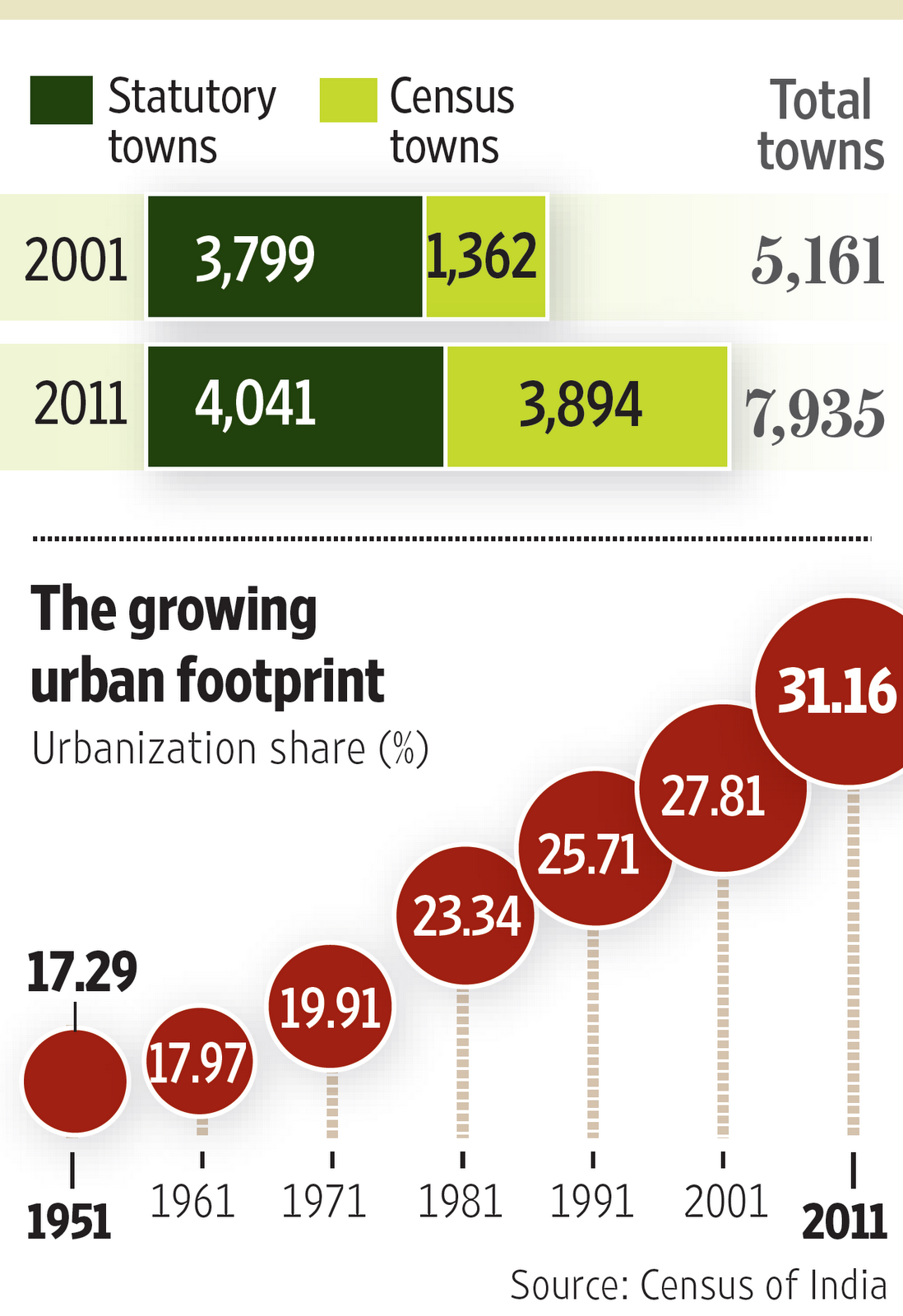
    The increased urbanization of India becomes quite clear in the Census 2011 report.

    Urbanization in India

    We see that by the time of the 2011 Census:

    • It was suddenly desirable to be urban’. The old landed elites had given way to the new rich, who had become wealthy beyond their wildest dreams by selling farmland on the peripheries of expanding metros, and now aspired for political power to match their financial clout – which could only happen in a new municipal/urban setting. This explains why although there were 7,935 towns in the country, only 468 or 6% had a population exceeding 100,000 (one lakh), that were home to around 265 million persons, constituting 70% of the total urban population! Which begs the question: what sort of towns (!) were the remaining 94%?
    • The 53 million-plus cities, where 42.6% of the urban population live, continued as the real ‘urban’ India. They were the hub of the old industrial sector and the new services sector. They continue to grow far beyond their carrying capacity and the impact on their environment has been devastating – whether through air pollution, toxicity in the food chain, dwindling groundwater, or recurring monsoon floods. These are the ‘generators of economic momentum’ for their regions and the country – pathetically inadequate, as their municipal governments are permanently impoverished, their tax bases are stagnant and non-viable, and informalization of both housing and the local economy is well over 40%.
    • The decline of the great urban symbols of British India, like Mumbai and Kolkata, foreshadowed in Census 2011, tell a sadder story: the abdication of power and responsibility by both, State and local governments, have given speculators a field day in these megacities, making real estate unaffordable to all but the super-rich. As the middle class gets pushed to the peripheries of these cities, the transport system reaches breaking point, and it makes more sense to opt for a relatively stress-free life in a smaller city. The archaic Rent Control Laws coupled with the absence of a clear title system prevents the growth of rental housing, further making these megacities unaffordable. With the exodus of formal sector economic activity to smaller metros/ towns, the vacuum is filled by the informal sector – reaching 68% in Mumbai, 62% in New Delhi, and 60% in Chennai.

    The United Nations estimates that 40% of India’s population will be urban by 2030, but if our cities continue into the next decade on their present trajectory, life would be a living hell in some dystopian concrete jungle. So, before that scenario unfolds, let us urge the next government to seriously formulate a National Urban Policy to revitalize India’s cities through a four-pronged approach:

    • Firstly, the decentralization of local Government to manageable ward level, which will ensure greater stakeholder participation in governance and will be a check on the arbitrary decisions of huge Municipal Corporations and parastatals, some of which have budgets larger than that of several smaller State governments
    • Secondly, a neighbourhood approach to city planning which is more organic and more Indian
    • Thirdly, a commitment to heavy investment in education and health to provide sustainable livelihoods beginning in our million-plus cities
    • Finally, hand-holding support to poor communities to enable them to formalize large informal sub-economies, so that they are gradually integrated into the city’s formal economy and eventually into the national economy.

  • Sustainable Livelihoods

    It is estimated that to break out of the present poverty-pollution-population trap, India needs to create some one hundred million sustainable livelihoods in the next ten years, to cover the backlog, plus a similar number for the new entrants into the job market. With this many jobs created, each family in the country can hope to have at least one member with a reasonably paid job.

    Given the present direction in both the public and corporate sectors, it is expected that not even 10% of this target will be met. With the new Government’s Make in India emphasis on further industrialisation, any jobs created will be in the formal sector and for non-poor households. True, there will be some trickle down through outsourcing, but as this sub-contracting will only be in India’s urban informal sector, it is not likely to provide long-term, sustainable livelihoods, nor build up the coping mechanisms of the poor.

    What do we mean by Sustainable Livelihoods?

    As we have seen in an earlier post, urban poverty is a complex multi-dimensional phenomenon, and therefore the approaches to poverty reduction must also be multi-dimensional. Current thinking in development studies has seen a paradigm shift from top-down planning to participatory micro planning, with the focus on local people and their livelihood strategies. There is also a concerted effort to make people aware of their rights and entitlements, so that priorities are fixed by the people rather than by a faceless bureaucracy.

    One such approach, developed initially for rural areas and now successfully adapted to urban areas is the Sustainable Livelihoods Framework (SLF).

    The SL framework revolves around three assessment criteria:

    Foremost of them is the ASSETS or CAPITAL of the individual or community. Assets may be financial, natural, human, social or physical as detailed later.

    The second criterion is the RIGHTS and ENTITLEMENTS available to the community or individual. These may be traditional, social, moral, legal, or political. Entitlements are things that people may rely upon because of legal or customary rights – like access to common-property resources, employment benefits, right of usufruct on land etc. Entitlements could also include the mutual support structures that are often present in localized communities.

    And the final criterion is how far ACTIVITIES dovetail with assets and entitlements. Activities are things that people do to gain a living, and these will usually be based on available assets. A personal asset, such as artistic ability, may form the basis of activities that generate income. Land may be used to earn income. Activities may be based on acquired knowledge and skills; thus education and training has a prominent position in a sustainable livelihoods framework. Knowledge and skills may also be acquired through traditional, cultural processes.

    Sometimes, a fourth criterion is added to assess how successfully the individual or group can deal with the vulnerabilities and risks of their situation, and how well they can come up with a COPING STRATEGY.

    The SL Framework defines five types of Capital Assets. These are:

    Financial Capital which denotes financial resources like: wages, salaries, pension, savings, access to credit, rent, remittances and so on.

    Physical Capital or basic infrastructure facilities like roads, transport, electricity, water supply, energy, communication, tools and technology for production

    Natural Capital like food security, adequate water supply, minimum air and noise pollution

    Human Capital through skills, knowledge, good health, ability to work

    Social Capital which includes the formal and informal social relationships such as kinship ties, client-patron relationships, networks and organisations that exist in a community

    Under the sustainable livelihood framework it is possible to draw a livelihood polygon for an individual, a group or a community, as illustrated below:

    SL POLYGON

    The relative length of each of the arrows connecting to the corners of the polygon, is an indicator of the adequacy/ inadequacy of a particular type of capital in a particular community. In the above case, if all assets or capitals are adequately developed, we see a larger polygon, thereby providing greater livelihood opportunities, and stronger coping abilities to individuals/communities.

    However, most government programmes tend to focus on just one type of capital/asset, thereby greatly shrinking the options available to the poor. For example, slum upgradation programmes in India concentrate on providing only physical infrastructure like internal roads, storm drains, public water and sanitation, and neglect the growth of human capital through better health and education services. This results in a skewed livelihood polygon with a much smaller area of opportunity  for the individual and community, as shown below:

    SKEWED SL POLYGON

    The SL Framework in Urban Areas

    The Sustainable Livelihoods Framework (SLF) can be used in the urban context to assess the current state of assets/capital in a community, and then plan new poverty reduction strategies based on this assessment. In fact, it is the ideal framework for undertaking a City Poverty Profile. Practical solutions can then be worked out within the available resources to maximise each of the five ASSETS or CAPITALS in the community, so that the livelihood polygon of the community can be suitably expanded. It must be remembered that every decision may affect more than one type of capital, sometimes adversely. The emphasis is therefore on thinking holistically and getting the balance right.

    Thus, FINANCIAL CAPITAL can be greatly augmented through: Providing a place for a cooperative store / fair price shop to be run by the community; starting kitchen gardens; installing metered electricity connections in each household; forming women’s Self Help Groups; setting up labour cooperatives; and providing vocational training geared to local handicrafts / industry.

    NATURAL CAPITAL can be enhanced by easy ‘doables’ like providing a playground for children near their homes, initiating participatory activities for improving community environment and sanitation, and providing the means for rainwater harvesting.

    The growth of HUMAN CAPITAL in a community is a combination of sound health, education, skill development and capacity to work. All countries have numerous human development programmes either initiated by donor agencies, through NGOs, or undertaken by Governments themselves. Some of these which have impacted positively on HD across the world include: regular antenatal and post natal check-ups by community health workers; regular check-ups for HIV/AIDS, STD; Gender budgeting; immunization camps; mobile clinic schemes; improved housing and sanitation; night classes for school dropouts / child labourers; women’s Self Help Groups; nutrition checks on under-5 children on a monthly basis, awareness campaigns against drug addiction, alcoholism, domestic violence; increasing the number of group connections for water supply, adult literacy classes; school attendance / drop outs to be monitored by the community itself; constructing / upgrading community toilets for washing, bathing facilities for women… and many more

    PHYSICAL CAPITAL is already the only focus of slum improvement programmes in India, but remains very narrow in its ambit. It should also look to augment infrastructure that will help enhance other assets like income, health and education by, for example, transforming muddy approach roads to all-weather roads, building / upgrading community health and family planning centres, improving the housing facilities, removing encroachments, providing covered drains and sanitary facilities, etc.

    It is often said that SOCIAL CAPITAL is the only wealth of the poor Indian, given the vast array of caste, clan, ethnic, linguistic, tribal and kinship networks in rural India. These ties, however, are the first casualty, when the rural poor migrate to the cities. However, it is possible through development interventions to build new networks and support systems – the most obvious examples being Self Help Groups, Thrift Societies, and Workers’ Cooperatives. Group activities like literacy drives, mass immunization campaigns, and nutritional assessment camps are also instrumental in cementing community bonds, besides helping with human capital growth.


    So where do we go from here? Experts believe that the answer lies in small scale, decentralised industries of a new kind. The key factor is the application of new technologies to the traditional skill and resource base of the community. For instance, the traditional knowledge of certain tribal communities can be successfully utilised in wildlife tourism, and its conservation and preservation. Similarly, with urban heritage suddenly becoming a priority in India, there is a lot of scope for traditional artisans in restoration and preservation of heritage buildings.

    If the traditional knowledge handed down from generation to generation is not correctly utilised, it will be lost forever, and will have to be rediscovered and relearnt in Universities (as in Europe), thereby becoming an asset not of the poor – its original owners – but the better off.

    Should we sleepwalk through yet another cycle of deprivation, or hear the wake-up call?

    Perhaps, the Kudumbashree Programme of the Kerala Government could point the way to sustainable livelihoods for the entire country. They deserve an entire post to themselves, which I shall hope to put up soon. Meanwhile, time for a diversion don’t you think?