Development and Governance

Tag: Quality of Life

  • Quality of Life in a Global and Indian Context

    (Published in 2018, and still relevant.)

    Quality of Life is being increasingly discussed in India – the older generation laments its passing and TV Gurus propose that we use it to measure the Government’s performance before the next election. Then again, there are sporadic reports from foreign agencies ranking Indian cities globally at 116, or 126, or whatever. And we shake our heads in sorrow. But have you ever wondered how ‘quality’ of life can be measured with such accuracy in ‘quantities’? And who exactly is measuring it and why?

    The whole QOL craze is a product of our increasingly interconnected global economy. Multinationals needed an easy base number to calculate the salaries of expatriate workers and an index was needed to work out the costs of children’s education, medical care, and ‘hardship’ allowances for conveniences unavailable in a foreign posting.

    The best known of these indices is the Mercer Index for Quality of Life. It evaluates local living conditions in more than 450 cities according to 39 factors, grouped in 10 categories: political and social environment, economic environment, cultural environment, medical and health considerations, schools and education, public services and transportation, recreation, consumer goods availability, rental housing including household appliances, furniture and maintenance services, and lastly, natural environment/climate and record of natural disasters.

    QOL Determinants

    As expected, the prime cities of over-resourced and underpopulated Western Europe, Australia or Canada take the top spots. Interestingly, if we list the best 20 cities on the Mercer Index and compare them with the 20 most populous cities, we will find that not one city from the second list figures in the first. So, one can safely conclude that as a city grows in size, beyond its carrying capacity, the first casualty will always be the quality of life of its citizens.

    Does this mean that the world’s largest urban agglomerations are doomed to linger in the nether regions of such scales year after year – with their citizens forever deprived of a decent quality of life? I don’t think so.

    Instead of constantly validating our happiness by western criteria, why can’t Indian (and Asian) cities set their own standards for judging Quality of Life? These would be firmly anchored in each country’s social, cultural and political realities and would resonate well with the people, besides comparing one city with another on the true quality of life; not just the level of services available.


    To work out an Indian QOL Index, the following questions need to be asked. These can be answered using our own urban experience and data locally available with various government agencies, parastatals, professional bodies and NGOs. (Note: These can readily be adapted for other countries too, taking local socio-political factors into account.)

    Political and Social Environment

    • Do women feel safe living by themselves and traveling at all hours across the city?
    • What is the city’s performance in Centrally-sponsored programmes for the poor – in terms of livelihoods, self-help groups and subsidized housing?
    • What is the Police record in tackling crime and maintaining Law and Order in the city?
    • Are there mohalla (community) committees to defuse a potential conflict before violence breaks out?
    • How active is the voluntary sector in the city?
    • How successful are public awareness and sensitization campaigns on various social issues?

    Economic Environment

    • What is the city’s contribution to the Central and State exchequer in terms of various direct and indirect taxes?
    • What is the access and availability of banking and financial services in the city?
    • Are there Special Economic Zones, IT Parks and other facilities, earmarked for industries and services?
    • Does the city have a domestic/international airport, a railway junction/station?
    • How well is the city connected to national and international e-retail networks?
    • What are the rents per square foot for commercial premises in the city’s CBD?
    • How many businesses in the city are registered under the Shop and Establishments Act?
    • How efficient are the public utilities like power and broadband connectivity?
    • What is the standard of municipal services in the areas of public transport, water supply, sanitation, solid waste management, etc?

    Housing and related issues

    • What percentage of the city’s economy and housing are in the informal sector?
    • How many notified slums does the city have?
    • What is the average monthly rent for a 1000 sq ft apartment?
    • What are the average monthly maintenance charges in a cooperative society?
    • What percentage of the city’s housing is owner-occupied?

    Schools and Education

    • Is the number of schools adequate for 100% coverage of the school going population?
    • What is the average student to teacher ratio in the city schools?
    • Do municipal and ZP schools offer children the same learning opportunities as private schools?
    • What is the availability and affordability of institutions of higher learning? Are they equally accessible to locals as to outsiders?

    Health and Sanitation

    • How does the Public Health machinery respond to a crisis, epidemic or disaster?
    • Is Primary Health Care (PHC) available and accessible in every corner of the city?
    • What is the city’s doctor to patient ratio?
    • What is the city’s hospital bed to patient ratio?
    • How many specialist medical and diagnostic services are available in the city’s hospitals?
    • How many 24-hour pharmacies does the city have?
    • What is the city’s record in mass immunization campaigns?
    • What percentage of the city’s housing is connected to the main sewage line?
    • How many public toilets does the city have per 1000 users?

    Natural Environment

    • Is there a city policy on monitoring and limiting air, noise and water pollution?
    • What are the average annual pollution levels for the city as a whole?
    • Are the public spaces and green cover available in the city adequate for its population?
    • Is the water supply in the city adequate per WHO norms? How much is actually supplied per day per capita?

    Cultural Environment

    • Does the city government finance, subsidize and encourage cultural activities?
    • Does the city organize annual festivals of Literature, Art, Music, Drama?
    • How many Libraries, Art Galleries, Drama theatres, Cinema theatres and multiplexes does the city have?
    • Are there local handicrafts and artisan groups? Does the city provide them subsidized business support?

    And so on…

    Such an Index will not only be meaningful to Indians, but will also facilitate policy formulation at the city level, and allow cities to compete with one another to offer a better quality of life to all their citizens.
  • Quality of Life in Cities

    When the urban population of the planet crossed 50% in 2007, our world was forever changed. Those who believed in cities as the hallmark of human civilization let off a silent cheer. Others were filled with fear, as they contemplated yet more crowding of already crowded cities; a greater concentration of the world’s poor in these cities; deteriorating urban infrastructure; and a growing threat to the global environment.

    Two sets of figures clearly encapsulate this dichotomy.

    Top 10 Megacities (Population > 10 million) in 2014: Tokyo, Delhi, Seoul, Shanghai, Mumbai, Mexico City, Sao Paulo, Beijing, Lagos, Osaka

    Top 10 on Mercer Quality of Life (QOL) Index 2014: Vienna, Zurich, Auckland, Munich, Vancouver, Düsseldorf, Frankfurt, Geneva, Copenhagen, Sydney

    Comparing the two lists we find that:

    • Not ONE city in the first list is represented in the second.
    • EVERY city in the Mercer list is in the ‘developed’ world and are beneficiaries of the colonial era – either through trade (North and Western Europe); or as settlers where the native population was too weak to defend their land and resources (Canada and Australasia). Furthermore, the developed countries are free from population pressure on their facilities and infrastructure, because fertility rates have been steadily declining, and immigration is strictly regulated.
    • NEARLY 70% of megacities are in the so-called ‘developing world’, with a history of being the victims of colonial rule. Moreover the countries with the most megacities are also the most populous in the world, putting tremendous pressure on services and infrastructure.

    Therefore one may safely conclude that as a city or town grows in size the first casualty is always the Quality of Life enjoyed by its citizens.

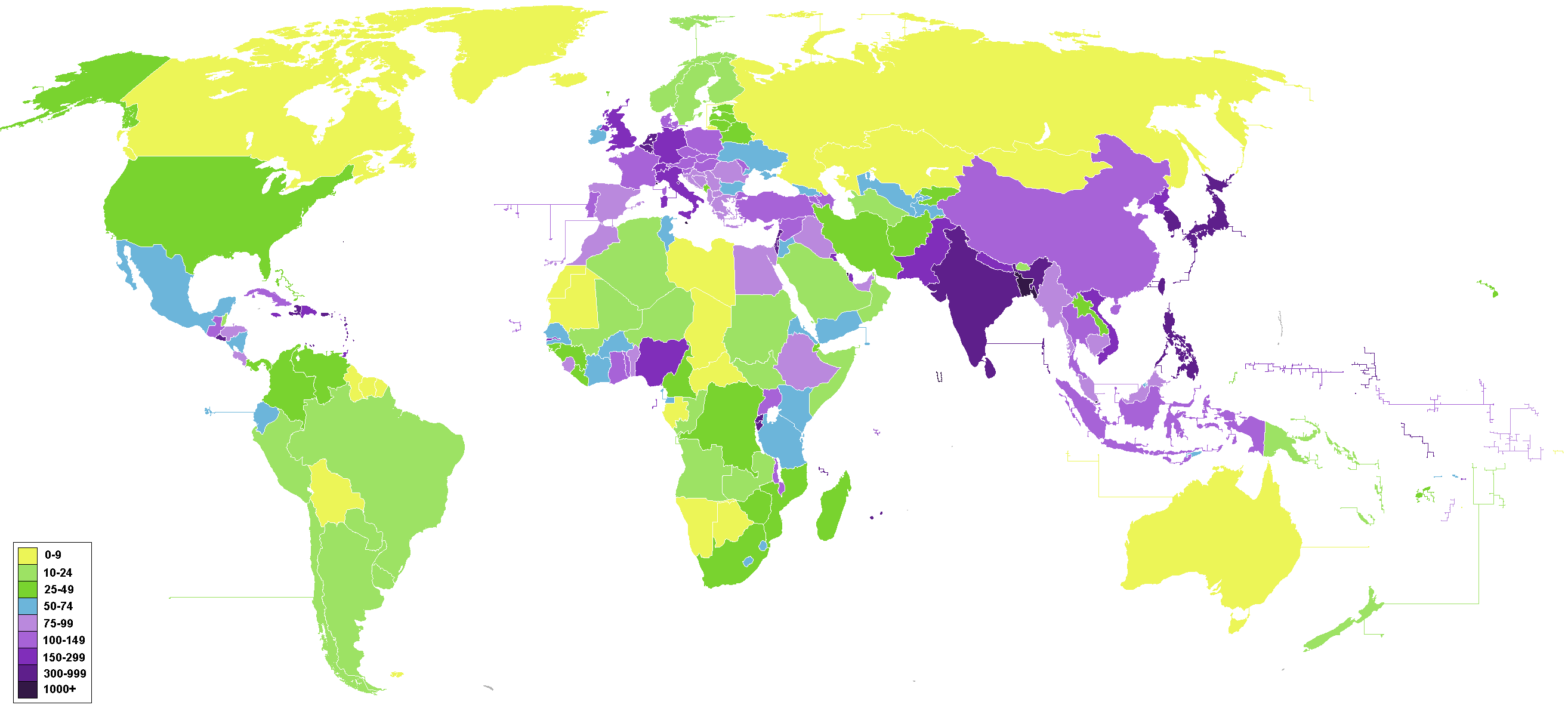
    The map of population density brings this point vividly to life:

    World_population_density_map

    The second largest land mass, Canada, has a total population of 35 million, less than the total population of just one urban agglomeration – Tokyo-Yokohama. Similarly, the population of Australia (which has a much bigger area than India) is almost exactly equal to just one Indian city- the National Capital Region Delhi.

    So with such immense resources at the disposal of such few, is it any wonder that Canadian and Australian cities figure so high in any QOL Index?!

    The inexorable growth of megacities is often due to the migration of the rural poor to towns and cities, leading to the urbanisation of poverty. The increasing heterogeneity of urban populations, brings its own pressures in terms of ethnic and class schisms and has a negative effect on the quality of life and makes the city difficult to govern.

    By inference from the indicators of quality of life, one may go a step further to conclude that as a city grows beyond its natural carrying capacity, it suffers from deteriorating infrastructure and services, leading to disease and deprivation.

    The urbanisation of poverty and the informalisation of the local economy often lead to a spurt in encroachments; slums; and squatter settlements. The political aftermath of this informalisation is a subsidy culture, impractically low user charges, and further impoverishment of local governments.

    … and so are the best planned cities, unplanned.

    As things now stand, it is highly unlikely that any of the 10-million plus population cities will see things improve. The drought-risk map below, issued by the World Resources Institute is a further reminder of the tough times ahead:

    drought-risk World Resources Inst

    What quality of life can we offer to the unborn millions of these parched cities?

    Quality of Life is essentially a subjective measure about how cost effective, convenient, healthy, satisfying and secure life can be in a city. Several organisations publish such lists as a guide for foreign investors and expatriate workers, and the Mercer Index is one of the best known scales in this business. The Mercer study is based on detailed assessments and evaluations of 39 key ‘quality of life’ determinants which include everything from political stability, banking services, law and order; to the availability of health, education, transport and cultural activities.

    We have already seen that cities offering the best quality of life tend to be in the developed half of the world – most usually in Europe and Australasia. So why is this so? We need to look for answers in the history of colonization, urbanisation and industrialization to understand…

    The post-World War II years may have been an era of growth in North America and Western Europe; but this development came at a great cost to the rest of the world. The self-serving trade regime of the rich countries stunted the growth of the poor, and plunged them into a debt trap from which few emerged unscathed. The deterioration of the subsistence rural economies of developing countries brought a further influx of distress migrants to the cities – and so the saga continues: be it Lagos in Nigeria, Kolkata in India, or Sao Paulo in Brazil.

    Meanwhile, heavy manufacturing industry continued to grow, and as the western powers moved their most labour-intensive sectors to the developing world, they created a series of highly polluted, congested and over-industrialised cities from Bangkok to Santiago. Even where MNCs were not welcome in the 60s and 70s (as in India and China), it became impossible to put the industrial genie back in the bottle, and cities like Mumbai, Shanghai, Chennai and Ahmadabad were the result.

    It is no wonder then, that megacities today are witness to growing disparity among the rich and poor; increasing disempowerment of vast swathes of society; and a slow drain of their wealthiest and best educated to friendlier cities abroad.

    … And the global inequity continues.

    While High QOL countries are also high consumers of energy the ill effects of their large ‘Carbon Footprints’ put the entire world at risk through global warming and climate change.

    Sadly, the western world has raised the energy stakes so high by centuries of reckless use that countries like China and India have to fuel their own development at great cost to their own people and the global environment. The major challenge before these two countries is how to balance industry (necessary for job creation) and cleaner environments to enhance the Quality of Life of future generations.

    In its haste to atract foreign and domestic investment in industry, the present Indian Government has shown a total lack of understanding of the environmental issues, despite the havoc wrought on the environment in Gujarat.

    The much touted ‘cleanliness drive’ launched across Indian cities will remain a superficial cosmetic exercise, unless a serious effort is made to balance human well-being with human greed…

    In my next post, I hope to disuss the Sustainable Livelihood Framework in the context of urban poverty.