Development and Governance

Tag: National Urban Policy

  • Urbanization Trends in India

    India is one of the many countries which has never got around to formulating a National Urban Policy, even seventy years after Independence, and successive governments have just thrown money at the myriad problems of unplanned and undirected urban growth, with scant results and a perpetually deteriorating quality of life. India has the dubious distinction of hosting 9 of the 10 most polluted cities in the world. Therefore, it is incumbent on any incoming Indian Government that its policy makers take a step back and look at the urbanization trends in the country, before more of its precious resources (including scarce urban land) are handed over to the private sector, in the name of smart cities, or housing for the poor, or some other gimmick.


    The report of Census 2001 surprised urban experts by showing a downward trend in urbanization, first noticed in the 1991 Census, which had not been reversed, despite India’s notable successes on the economic front. Scholars of such phenomena had pinpointed four main reasons for this downturn :

    • As a result of the economic reforms of 1991, there had been a noticeable reduction in rural poverty, improvement in infrastructure and services, and a steady tertiarization of rural economies, reducing the flow of distress migration to cities
    • Secondly, with increasing global connectivity, the economic migration of people from small towns in search of education, skill building, and white-collar jobs, had reduced
    • Thirdly, villages on the periphery of big towns and/or with sizeable populations had resisted municipalization, chiefly because the local, landed power elite did not wish to relinquish control. The fear of higher taxation in an urban regime may also have dissuaded the rural citizenry, or perhaps, the host city (in a proposed merger) may have baulked at having its services and resources stretched over a wider area
    • Finally, it was believed that globalization itself was a cause for this downturn. As India transformed itself into a knowledge society, those on the wrong side of the digital and technological divide were put at a disadvantage. The knowledge sector tended to be capital intensive rather than labour intensive, and this discouraged unskilled labour from migrating.

    In the following decade of 2001-2010, the changes wrought by globalization on Indian society were well entrenched and urbanization picked up once again because:

    Liberalization brought foreign direct investment and MNCs demanded the dilution of India’s stringent, albeit humanitarian labour laws. Rightsizing and downsizing became the goal and social security (like pension schemes and medical aid) went out the door. This pushed more and more people into the informal sector, where they didn’t need to pay either direct or indirect taxes, and this in turn led to the further impoverishment of local bodies who had traditionally relied heavily on local business taxes like octroi.

    In the long term, informalization has a very insidious and deleterious effect on local economies. Anybody and everybody can aspire to ‘learn on the job’ and work as a plumber or electrician on a construction project without any qualifications, using shoddy materials from any fly by night ‘factory’ with no safety standards, and get paid for it in cash with no tax paid at any stage. Is it any wonder then, that buildings and bridges collapsing in Indian cities are a regular occurrence? And nobody is held accountable. Informalization also leads to extremely exploitative trade and labour practices, encourages forced labour and child labour, higher school dropout rates, and generally weakens a country’s human capital, so that one generation down the line, we have clearly lost our demographic dividend.

    Privatisation has led to a whole culture of unprecedented corruption and crony capitalism, especially in urban infrastructure. Even Government Schemes are now outsourced to private consultants, who have little or no local knowledge to make them effective and sustainable in the long run. The corporatization of basic municipal services, such as water supply and transport, further eats into the earnings of the local body and diminishes, rather than builds the capacity of municipal personnel. Further, unlike elected representatives, the bosses of these private and public corporates are not accountable to the people.

    The boost given to construction once again made cities attractive and pull migration brought in both semi-skilled and unskilled labour, who stayed on to boost the urban population, eking out a living in the informal sector and living in increasingly squalid settlements.

    It is noteworthy that although globalization and all its concomitants have dramatically raised the standards of living of the Indian urban middle class, and greatly reduced absolute poverty in the countryside, it has unfortunately skewed our priorities in favour of prestige projects like bullet trains instead of grassroots rail infrastructure; airports instead of bus stations; medical tourism instead of primary health care; business schools instead of primary schools; and so on.

    The increased urbanization of India becomes quite clear in the Census 2011 report.

    Urbanization in India

    We see that by the time of the 2011 Census:

    • It was suddenly desirable to be urban’. The old landed elites had given way to the new rich, who had become wealthy beyond their wildest dreams by selling farmland on the peripheries of expanding metros, and now aspired for political power to match their financial clout – which could only happen in a new municipal/urban setting. This explains why although there were 7,935 towns in the country, only 468 or 6% had a population exceeding 100,000 (one lakh), that were home to around 265 million persons, constituting 70% of the total urban population! Which begs the question: what sort of towns (!) were the remaining 94%?
    • The 53 million-plus cities, where 42.6% of the urban population live, continued as the real ‘urban’ India. They were the hub of the old industrial sector and the new services sector. They continue to grow far beyond their carrying capacity and the impact on their environment has been devastating – whether through air pollution, toxicity in the food chain, dwindling groundwater, or recurring monsoon floods. These are the ‘generators of economic momentum’ for their regions and the country – pathetically inadequate, as their municipal governments are permanently impoverished, their tax bases are stagnant and non-viable, and informalization of both housing and the local economy is well over 40%.
    • The decline of the great urban symbols of British India, like Mumbai and Kolkata, foreshadowed in Census 2011, tell a sadder story: the abdication of power and responsibility by both, State and local governments, have given speculators a field day in these megacities, making real estate unaffordable to all but the super-rich. As the middle class gets pushed to the peripheries of these cities, the transport system reaches breaking point, and it makes more sense to opt for a relatively stress-free life in a smaller city. The archaic Rent Control Laws coupled with the absence of a clear title system prevents the growth of rental housing, further making these megacities unaffordable. With the exodus of formal sector economic activity to smaller metros/ towns, the vacuum is filled by the informal sector – reaching 68% in Mumbai, 62% in New Delhi, and 60% in Chennai.

    The United Nations estimates that 40% of India’s population will be urban by 2030, but if our cities continue into the next decade on their present trajectory, life would be a living hell in some dystopian concrete jungle. So, before that scenario unfolds, let us urge the next government to seriously formulate a National Urban Policy to revitalize India’s cities through a four-pronged approach:

    • Firstly, the decentralization of local Government to manageable ward level, which will ensure greater stakeholder participation in governance and will be a check on the arbitrary decisions of huge Municipal Corporations and parastatals, some of which have budgets larger than that of several smaller State governments
    • Secondly, a neighbourhood approach to city planning which is more organic and more Indian
    • Thirdly, a commitment to heavy investment in education and health to provide sustainable livelihoods beginning in our million-plus cities
    • Finally, hand-holding support to poor communities to enable them to formalize large informal sub-economies, so that they are gradually integrated into the city’s formal economy and eventually into the national economy.
  • National Urban Policy – Part II

    Today is Guru Poornima in India – a day to honour and respect our teachers, and to be fondly remembered by one’s students. Also an occasion to lament the disappearance of teachers who believed every subject should convey to its learners a sense of history, a continuity with the past, an understanding of the context for the present, and an envisioning of alternatives for the future.

    Instead we have economists lamenting the lack of an institutional memory in the institutions of governance in India; a POTUS who has so muddied the waters that it is well-nigh impossible to tell real news from fake news; surveys of American law-makers who have no clue about the difference between Sunni and Shia Islam… and the dumbing down of generation after generation across the world, fed as they are on sound bites, instant images and 140 characters of wisdom. These phenomena are a direct consequence of the waves of globalization, privatization and liberalization which hit the world c.1990, and were reinforced by the simultaneous growth of Information Technology and the Internet.

    It is against this background that we realize how difficult it is to formulate and articulate any national policy – let alone something as complex as a National Urban Policy for a very diverse, highly rural and conservative society like India.

    Time was, India was ruled by learned scholars, philosophers and historians who produced volume after volume of crystalized wisdom, even if it was replete with the Fabian idealism learnt in the groves of academe in England – Mahatma Gandhi, Pandit Nehru, Dr Ambedkar, and so many more. Even as recently as 1988, the National Commission on Urbanization, chaired by an eminent architect, produced a report fit to be turned into perhaps the only important urban law passed in independent India – the 74 CAA. There have been other excellent pieces of conceptualization like the Rakesh Sharma Report on Infrastructure, or the Ishar Judge Ahluwalia report on urban governance and infrastructure. However, however, however… for reasons of party political advantage, all work carried out by the previous government has been chucked in the bin and been replaced by ‘copy and paste’ flyers and websites on subjects like Smart Cities and Urban Renewal and left to a handful of self-styled urban ‘consultants’ and bottom feeders with virtually NO concept of the evolution of orthogenetic (pre-colonial) and heterogenetic (post-colonial) cities across the Indian sub-continent; its largely agrarian society and values; its distress and economic migrations; its dwindling manufacturing sector and growing services sector; and, most of all, the worsening situation in urban housing and land management.

    Therefore, given these immense challenges, India (and other developing countries) need to develop a National Urban Policy out of necessity, as a means of retrofitting, to direct and control the inevitable urbanization of their countries, before the urban situation is beyond redemption and the lives and livelihoods of millions of their citizens are put at high risk.

    As I had mentioned in my last post, the UN-Habitat’s Guiding Framework on National Urban Policy had mentioned the 5 step process of:

    Feasibility: Understanding…
    – What a NUP can and cannot achieve
    – What constitutes urbanization in a particular country
    – Role of national, regional and local governments and consensus building about these roles
    – History, facts and figures

    Diagnosis: Identifying …
    – The key actors and stakeholders
    – The problems that the policy is expected to address
    – The opportunities provided by the NUP
    – The goals and objectives of the Policy

    Formulation: Assess…
    – The various policy options available
    – The capacity of the institutions and mechanisms of urban governance
    – The efficacy of the means for constant monitoring and evaluation

    Implementation: putting in place…
    – An implementation plan
    – A timeline
    – An institutional and legislative framework
    – Structure for proper delegation, decentralization and devolution

    Monitoring and Evaluation: continuous process to…
    – Assess the efficiency, effectiveness and dynamics of policy implementation
    – Loop back evaluation results as learning and capacity building


    All this is fine as theoretical frameworks go, but applying the UN-Habitat framework on a ‘one-size-fits-all’ basis in India and elsewhere will flounder on the very first issue of what constitutes urbanization.

    The Census of India in 1961, defined an urban area as:

    – Firstly, those settlements that were given urban civic status, like corporation, municipality and cantonment by the State Governments, and were recognised as ‘statutory’ towns.
    – Secondly, ‘census town’, applied to areas which met the following criteria: (1) population size of 5000 or more; (2) density of at least 400 persons per square kilometre; (3) at least 75% of the male workers to be engaged outside agriculture.

    As urban development is a State subject in the Constitution of India, there is quite a bit of variation in identifying Statutory Towns across States, making comparisons difficult. State Governments have been declaring overgrown villages as municipalities with great alacrity, often in the neighbourhood of existing metros. As these metros expand, land-owners on the periphery acquire overnight wealth and in order to match their new economic clout with political power, displace the traditional landed elite by the simple expedient of having their home village declared an urban area.

    According to the Government of India Census 2011 there are 7,935 urban centres or townships that house the 377 million urban citizens of the country. Of these, the 53 million-plus urban agglomerations account for 160.7 million persons (or 42.6%), and the remaining 217 million – or more than half of the total urban population of India – live in small and medium sized towns.

    So the question arises: should there be two parts to India’s National Urban Policy

    • One for the million-plus cities with emphasis on telecommunication, connectivity, quality public utilities, tertiary education and health care and infrastructure – to encourage the growing services sector and consolidate and centralize manufacturing
    • Another for the small and medium towns acting as the traditional agricultural hubs for their immediate hinterland, with good roads, telecommunication, infrastructure, primary and secondary health care and education to develop agro-industries which will be the acupressure points to relieve rural distress

    Worth a thought, wouldn’t you say..?


  • National Urban Policy – Part I

    In a book published in 2000, one had lamented the fact that even after 50 years of independence, India had no National Urban Policy. It was a very naive conclusion: One cannot forget that at the time of Independence, the tragedy of Partition and the havoc of colonial rule required the Indian government to concentrate solely on the famine stalking the Indian countryside, and cities had to be left to fend for themselves.

    However, this neglect of urban areas also meant that outdated and retrograde laws inherited from the British colonial masters continue to rule the way Indian cities are governed to this day. For example the Bombay Municipal Corporation Act of 1888 spawned all the municipal legislation not just in India, but also surrounding areas like Pakistan, Sri Lanka and eventually Bangladesh. There was also no effort to update the Land Acquisition Act of 1894, and the new Act proposed in 2013 and drastically amended since, is mired in party politics and yet to become law. Finally, the eminently ‘British’ Town Planning laws and procedures were imported wholesale to India without any modification to make them relevant to the Indian urban scenario.

    The problem with retaining these colonial laws is that they were premised on a deep distrust of the ‘natives’ and gave too many powers to the permanent civil servant at the helm of municipal affairs, and this bifurcation of powers between a permanent bureaucracy and representatives elected for 5 years continues to hamstring local governments, and breeds corruption, clientelism and capture in the local economy.

    These issues are not exclusive to India and continue to dog former colonies in Asia, Africa and Latin America as well, and this widespread malaise prompted UN-Habitat, the urban organization of the UN, to draw up guidelines for formulation of national urban policies.

    The basic premise of the NUP: A Guiding Framework is that given the increasing clout of cities in national economies in a globalized world, federal governments have the opportunity and responsibility to establish the “rules of the game”. The Report emphasizes that in addition to setting a vision for their cities, countries must establish a financing and implementation framework to realize that vision.

    The structure of this framework will determine:

    • The responsibility for implementation
    • The powers delegated
    • The resources allocated
    • The monitoring and evaluation process, and
    • The enforcement mechanisms to ensure follow-through

    The guide makes it very clear that without strong, effective “rules” within the national urban policy, neither cities nor countries can achieve the goals set out within the foundational vision.

    A well-constructed national urban policy can establish a clear, cohesive vision for sustainable urban growth and development. At the same time, it can create systems that empower cities with the freedom to make the right choices on sustainable solutions for their unique contexts — and to ensure the financial resources to invest in them.

    Interestingly, while debate on the NUP Framework in the developing countries is focused on greater privatization, liberalization, infrastructure and business; in the advanced economies the focus is clearly on putting people at the centre of national urban policies, emphasizing the environmental aspects of sustainable urban development and highlighting the role of cities in decelerating climate change.

    A National Urban Policy should enable national governments to control and direct urbanization and capitalize on the opportunities it offers, for the sustainable and equitable development of the country as a whole, without negatively impacting global well-being. Further, as the Guide rightly points out, working within a national policy framework will promote good practices, innovative management, stakeholder consultation, capacity development and evaluation of country policy processes. Integrating these lessons into future policy practice can promote systems change and institutional learning.

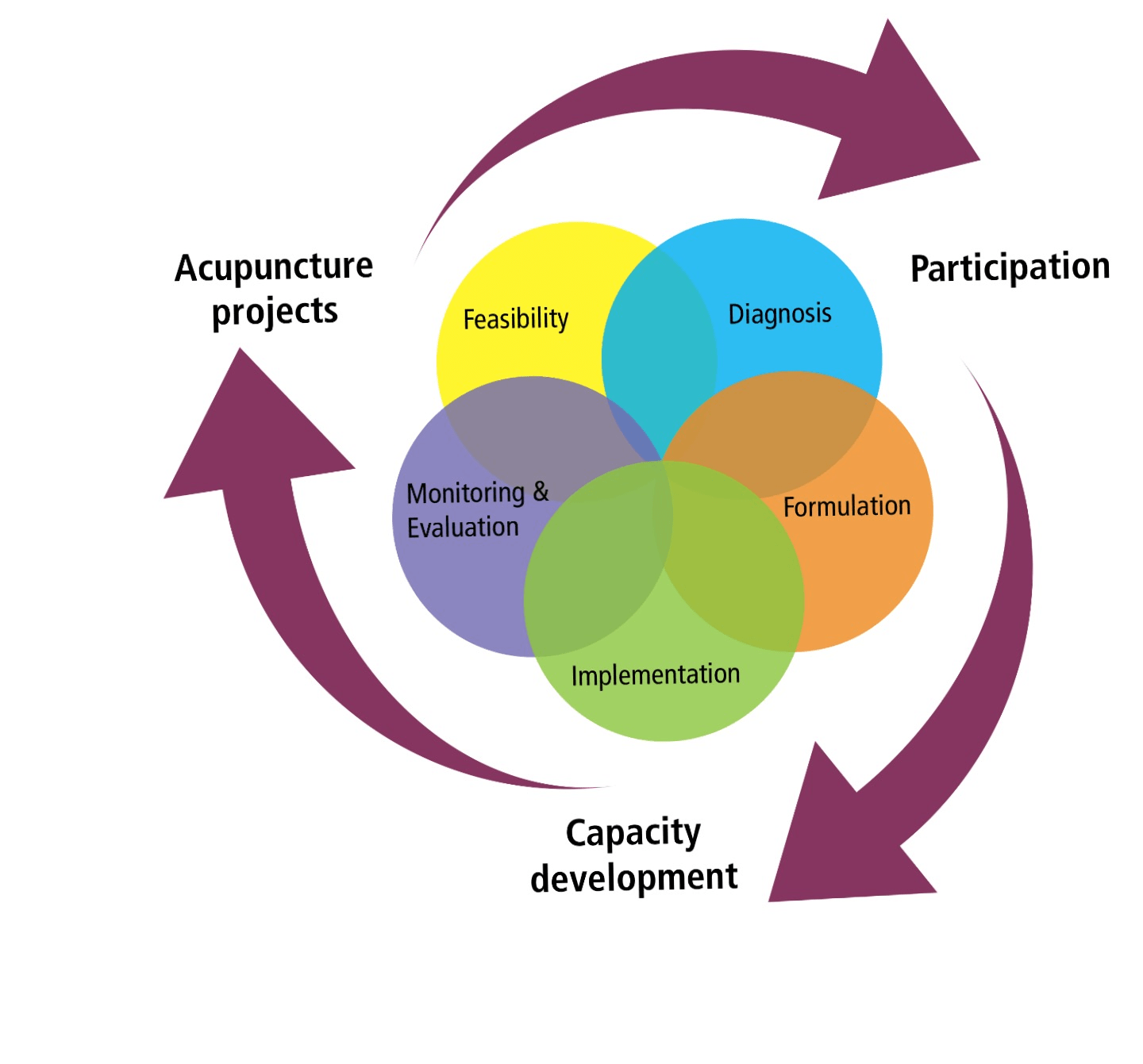
    This Guiding Framework outlines five NUP phases: feasibility, diagnosis, formulation, implementation and monitoring, and evaluation. In addition, the Framework considers the inclusion of the three NUP pillars: participation, capacity development, acupuncture projects resulting in iterative policy design. (Incidentally, ‘acupuncture projects’ is a phrase originally coined by Barcelonan architect and urbanist, Manuel de Sola Morales and developed by Finnish architect and social theorist Marco Casagrande, applying the tenets of acupuncture to urban renewal: just as you treat the points of blockage and let relief ripple throughout the body, so also localized initiatives can release pressure at strategic points, and thus release pressure for the whole city.)

    These five elements are simultaneous and overlapping in most cases and the Guide represents them in the following diagram:

    National Urban Policy Process.png

    It is expected that the National Urban Policy, once formulated and accepted by a national government, will manifest itself in transformations in Urban Legislation, Urban Economy and Urban Planning.

    How this framework can work for an emerging economy like India, I shall discuss in Part II of this post. Until then….

  • Will the New Urban Agenda work?

    “Habitat III” is shorthand for a major global summit, formally known as the United Nations Conference on Housing and Sustainable Urban Development, to be held in Quito, Ecuador, from 17 to 20 October 2016. The United Nations has called the conference, the third in a series that began in 1976, to “reinvigorate” the global political commitment to the sustainable development of towns, cities and other human settlements, both rural and urban. The product of that reinvigoration, along with pledges and new obligations, is being referred to as the New Urban Agenda. That agenda will set a new global strategy around urbanization for the next two decades. Habitat III offers Member States an opportunity to discuss a New Urban Agenda that will focus on policies and strategies that can result in effectively harnessing the power and forces behind urbanization.

    What will be the key elements to consider at Habitat III for creating a pattern of sustainable urban growth?

    Firstly, it is expected that member states will realize that the future of this planet is inescapably urban, and a National Urban Policy is therefore necessary to establish a connection between the dynamics of urbanization and the overall process of national development.

    Secondly, it is expected that a National Urbanization Policy will in turn result in the modernization and upgradation of the laws, institutions and systems of urban governance, creating the normative basis of action, the operational principles, organizational structures and institutional and societal relationships underlying the process of urbanization.

    Finally, while there is a strong positive correlation between economic growth and urbanization, this potential relationship is not spontaneous and self-generating. Habitat III could be the means to place the central pillars for robust urban economic development, such as:

    • Urban Planning: The vision of the city, its physical configuration, the definition of technical solutions, and environmental considerations are all determined through urban/regional planning. A reinvigorated urban planning will optimize economies of agglomeration, promote sustainable density, encourage social diversity and mixed-land uses, foster inclusiveness, maximize heterogeneity, promote livable public spaces and vibrant streets, and thus make the city more functional, maintaining environmental balances.
    • Local fiscal systems: To change from being instruments of revenue generation and budget management, to vectors of change which generate real development outcomes.
    • Investment in urban basic services: Proper planning allows for less costly provision of basic services such as water and sanitation, higher resilience, climate change mitigation and adaptation, poverty reduction and pro-poor policies.

    In short, the sponsors of Habitat III firmly believe that by embracing urbanization as a positive force and weaving equity into all development equations, sustainable urbanization may become a reality in our lifetimes, or at least by 2050, when two-thirds of humanity is expected to be urban.

    But how realistic are these hopes of sustainable urban growth in a country like India? Along with China and Nigeria, India will account for 37% of the projected growth of the urban population between 2014 and 2050, and contribute the highest number of additional urban dwellers by 2050 – a whopping 404 million!

    Let us examine the above UN aspirations in light of Indian reality.

    Firstly, one of Gandhiji’s most quoted slogans that ‘India lives in its villages’ has had such a negative impact on India’s psyche and cities, that it still lacks a National Urban Policy – 68 years after Independence. In fact the hero of many a Bollywood epic often begins life as a virtuous villager and through trials and tribulations ends up as a hardened criminal, only because of the ‘evil’ influence of a city. The reality is rather different as the rural communities still reek of superstition, casteism, family feuds, vendetta, summary justice and social oppression; while cities may be the only place an individual can experience freedom. That aside, the fact remains that while only 60% of India’s land is under cultivation, it supports 67% of its population leading to smaller and smaller land-holdings, no alternative employment, declining agricultural production, distress, despair, migration and eventually, farmers’ suicides. So India needs to develop its urban mindset before investing blindly in infrastructure and smart cities.

    Secondly, almost all the most crucial laws relevant to cities are a legacy of the British Raj with the Bombay Municipal Corporation Act dating as far back as 1888, which was to spawn offspring as far afield as Aden, Sri Lanka, Pakistan… The Land Acquisition Act too dates back to 1894. Therefore not only do the municipal laws need to be brought in line with the rest of the world, but power to manage cities must pass from a lethargic, permanent bureaucracy, to dynamic people’s representatives, as most successfully demonstrated by South American cities.

    Lastly, streamlining and modernizing land laws is crucial to any urban planning that Indian cities may indulge in. Otherwise they will continue in the present mode, where the people go and settle where they may, and the local body follows years later to charge tax, and perforce provide some basic services. The costs of retrofitting municipal infrastructure can be prohibitive, and entire ‘neighbourhoods’ may be born, live and decay, without even the solace of drinking water in their taps. So much for Indian urban planning…