Development and Governance

Tag: Indian Governance

  • Demagogues and Democracy

    Democracy and demagoguery have the same root: demos or Greek for ‘people’. So why is it that we value the first but decry the second?

    The highly educated ‘citizens of the world’ from privileged backgrounds who became leaders of the newly decolonized countries of the 1950s and 60s, were nonetheless loved and re-elected by their people and became quintessential democrats, articulating the hopes and aspirations of the common woman and man. These leaders gave us the Non-aligned Movement and the OAU and strengthened the various institutions under the United Nations. Within their countries, they did their best to undo the ravages of centuries of colonial rule by institution-building, redistributive justice, and vast welfare and poverty alleviation programmes. They also endeavoured to bring their countries into the modern era by developing a scientific temper through modern and universal education. By providing greater inclusion and equity in society and a more people-friendly and responsive administration, these pioneering democrats left us with the templates of good governance.

    This path of international cooperation led inevitably to a globalized and interconnected world in the last years of the previous century, and societies today have become irrevocably changed by the resulting technology and the concentration of capital in fewer and fewer hands. It was only to be expected that this new era of growing inequity and inequality and the corporatization of national policy would throw up its own leaders – and this has indeed come to pass from the Americas, through Europe, to Asia.

    Despite the liberalization and privatization of national economies, we have seen the demise of the liberal, the democrat, and the rise of the demagogue – a preacher and practitioner of principles contrary to democratic ideals: exclusion instead of inclusion, inequality instead of equity, narrow nationalism, centralized decision-making, polarization of society at large, and a deep discontent not addressed but allowed to simmer, so that it can erupt at the ‘right’ moment. We are living in an era of poor governance and can do little to change this state of affairs.

    This slide from democracy to demagoguery is as visible in the US today as in India. Does it mean that we subvert democracy to dislodge the demagogues, who remain immensely popular with large sections of their electorate, nonetheless. Or go back to the rule of an elite? That is the eternal dilemma facing all liberals today.

    It is essential to understand how the mind of a demagogue works, so that he can survive failure after failure and still feel secure:

    • A demagogue (by definition) believes that he knows best so he will eschew advice, dismantle advisory bodies and institutions, tear up treaties, trade agreements and protocols, build walls and surround himself with those who entirely agree with him, stifling dissent and rewarding sycophancy. This deprives him of insights, knowledge and information which are necessary for making the right decisions.
    • Secondly, demagogues tend to believe their own rhetoric. This makes them incapable of objectively analyzing the ground reality and learning from their mistakes, so no corrective action is ever taken.

    Take the case of India – the PM, a demagogue par excellence, promised to galvanize the Indian economy by bringing in Foreign Direct Investment (FDI) on an unprecedented scale, for which he travelled to every corner of the world. And soon the absolute figures were proudly touted around to show that the promise had been fulfilled. However, when economists began to query the authenticity of these claims, it emerged that absolute FDI figures were meaningless as all such figures grow from year to year like the population and GDP of a country. It is when we examine the FDI to GDP ratio that we notice how poor India’s performance has really been on this front. A clear case of believing one’s rhetoric without closer examination.
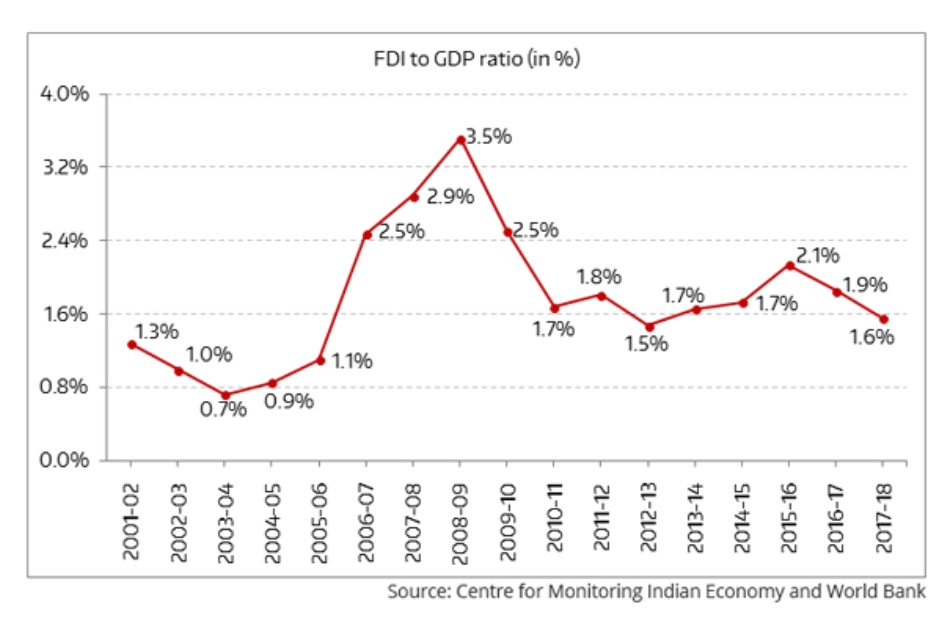
    INDIA FDI TO GDP RATIO

    The Indian Government has also given great publicity to the fact that India has climbed in the ‘Ease of doing business’ rankings because of the government’s efforts to cut red tape. Therefore, the following assessment by its own agency (NCAER) is all the more damning:
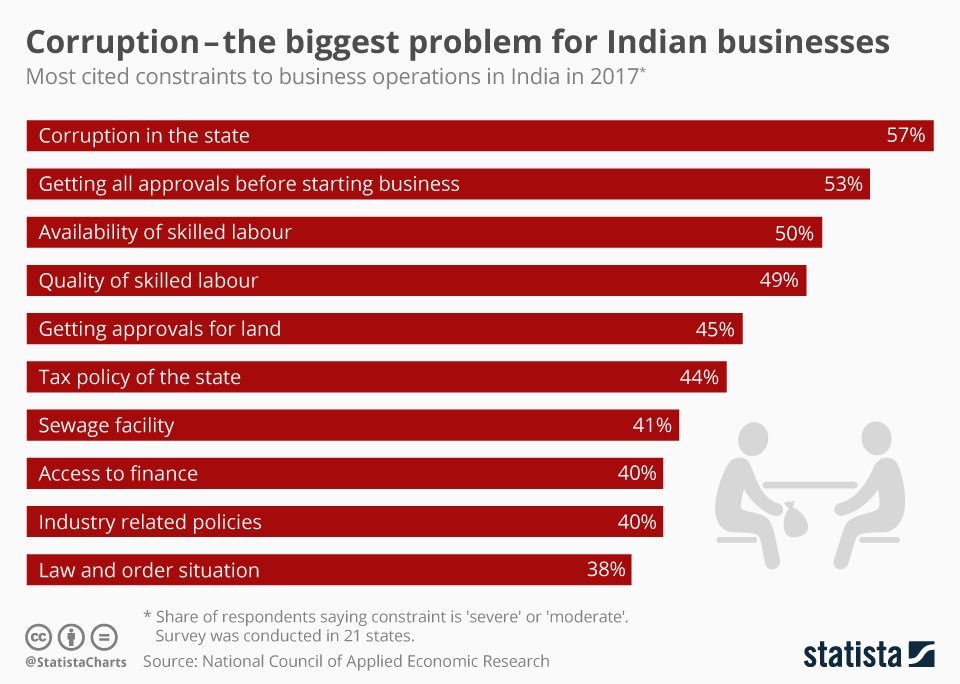
    Yet again, the demagogue cannot believe that his actions have directly or indirectly contributed to this state of affairs and instead of taking responsibility, will blame it upon his predecessors, the solar eclipse, the astral configuration, the Nehru family, whatever…

    Let us look again at these constraints in the light of government’s actions/inaction:

    Corruption: You cannot fight corruption on the one hand while institutionalizing it on the other by permitting unlimited, anonymous donations to political parties, where this money is brazenly used for buying votes in the villages and legislators in State Assemblies.

    Clearances: You cannot expect the administration to act expeditiously or efficiently when all decision making is centralized in a few hands, and tools of greater transparency like the Right to Information Act are being diluted to total ineffectiveness.

    Skilled Labour : You cannot launch instant solutions like Mission Skill India expecting it to produce a skilled workforce overnight, while grossly neglecting both universal primary and secondary education and vocational training, as these are long-term and resource-heavy commitments which do not fit into a 5-year electoral mindset.

    Land acquisition : You cannot tinker with Land Laws. As the government’s fiasco in diluting the social impact analysis and consent elements of the Right to Fair Compensation and Transparency in Land Acquisition, Rehabilitation and Resettlement Act, 2013 early in its tenure showed, land is an extremely emotive issue in rural India and can make or break a government. So, India’s land acquisition continues to be mired in endless red tape and litigation.

    Policy issues : There is immense confusion about most tax and financial policies of the present government, and businesses need unambiguity and clarity. There is no clear cut tax policy and it gets chopped and changed in every annual budget.

    Law and Order: This remains a great worry in an India where lynch mobs, communal riots, rapes and murders are the staple of daily news, and the government is increasingly perceived as being indifferent to the deteriorating situation.

    A clear case of blatant and repeated failures of governance.


    Does this mean that the next election will see a regime change? Unlikely. Please remember that the definition of a demagogue is: “… a leader who makes use of popular prejudices and false claims and promises in order to gain power”. So how long does it take to reawaken old prejudices about religion, caste, class, race or immigration to get re-elected? Meanwhile the ‘liberal democrat’ can go back to airing his discontent in 280 characters on Twitter. Sad indeed.
  • Independence Day

    When I started this blog, I wanted to keep tabs on the Indian Government’s promises of development and good governance, and after the third Independence Day in the Modi era, it seemed appropriate to review where the country finds itself today.

    I had always taught my students the UNDP version of Good Governance, for which I also gave them an easy mnemonic: E-PARTICLE: Efficiency and Effectiveness, Participation, Accountability, Responsiveness, Transparency, Inclusion, Consensus Orientation, Law (Rule of) and Equity. And I had defined Governance as Government + Citizen. Silly, silly me!

    As any search engine will now tell you, governance was first used and defined by the World Bank as “…the exercise of political powers to manage a nation’s affairs”. And according to the same august institution, the Worldwide Governance Indicators are: Voice and Accountability, Political Stability and absence of Violence/terrorism, Government Effectiveness, Regulatory Quality, Rule of Law, and Control of corruption. So by these criteria, both Saddam and Gaddafi were providing excellent governance, then why did the West have to wreak such havoc on two great nations in the name of regime change? Because big business decreed that it be so, mainly to safeguard their oil interests in these two benighted countries…

    In an excellent op-ed piece in the Hindu last year, G Sampath traces the origins of the this new ‘corporate-centric’ idea of good governance: “This trajectory – of aspirations first raised and then betrayed by economic reforms, leading to mass discontent, which zeroes in on corruption as the problem, with good governance presented as the solution – is very evident in recent Indian history. But it is by no means unique to India. As Jenkins points out, the “international anti-corruption consensus” has been a powerful vehicle for manoeuvring recalcitrant nations onto the neo-liberal track.” And of course, UNDP’s inclusion and equity are no longer relevant…

    What this means is that accountability is no more to the citizens, but to business and to investors, who are risking their money with expectations in return. Similarly, transparency has translated into ‘ease of business’, especially for foreign investors, “… who are tired of trying to find their way through the intricate webs of political patronage (also known as corruption) and often lose out to domestic capital, which enjoys a cultural advantage (so-called crony capitalism).” As for empowerment, the emphasis has shifted from universal rights, to individual ‘consumer’ rights, according to Sampath. And as for participation, this is again increasingly limited to the ‘haves’ with the disenfranchised and poor reduced to nameless ‘populations’ that simply do not matter!

    The inevitable conclusion is that the only ‘development’ model available under this paradigm of good governance is market-led development, which reduces a government to a facilitator of big business rather than a guarantor of the socio-economic rights of the citizens.

    Is this the ‘tryst with destiny’ that Nehruji referred to on that historic night 70 years ago? I should think not…


  • Business as usual – and damn the environment!

    (With the three main stories in India being about land grab in metros, possibly compromised elections, and deteriorating air quality in the national capital, this post – originally written 10 years ago – bears reposting.)

    Two stimuli for this post: the first being John Grisham’s searing novel Gray Mountain, about the havoc wreaked by Big Coal on the environment and people of small town Appalachia, in the United States, aided and abetted by unscrupulous law firms and corrupt politicians; and Donald Trump’s smug assertion that he has been ‘buying up’ politicians for years as a ‘donor’ to campaign funds, in anticipation of seeking their help in his business in the future.

    This is termed clientelism and when the clients are big industrialists and businessmen, it soon leads to capture of the economy to favour the rich. This deadly combination is popularly termed as crony capitalism.

    Some form of clientelism exists in all democracies where election campaigns are funded by private donations, and is therefore considered ‘legitimate’. However, when the donors call in the favours, that’s when it begins to undermine the very institutions of governance. And that is why clientelism and capture as part of the political culture are more pernicious in the long term, than overt corruption and bribery.

    India for the first time in its democratic history has in power a party which makes no bones about its links with big business, and boy are they in a hurry to call in the favours! So first, we had the amendments to the land bill, which virtually gives government carte blanche to acquire any land anywhere to be handed over to private parties for ‘infrastructure’ development. However, for once a united opposition has partially stymied moves to do away with the consent clause and the socio-economic surveys, mandatory in the unamended Act. I say partially, because the Centre can now pass the buck to State Governments, and as its party or allies are in power in the most industrialised States in India, the amendments can still sneak in through the back door.

    Already, the State Government of Maharashtra is contemplating an IT Policy offering greater incentives to IT Parks, like a Floor Space Index, or FSI (built-up to open land ratio) of 3 as against the 1 for commercial premises, and 2 for IT Parks. The proposed policy has also diluted the concept of IT-enabled services (ITES) to such an extent that every business which uses computers (practically everyone these days!) can claim ITES status and buy premises in these IT Parks, and get the benefits of lower stamp duty, utility charges and taxes.

    The question is ‘cui bono?’ Who benefits? Those self-same industrialists who were granted vast swathes of urban land in industrial zones at throwaway prices a few decades ago, and have let their manufacturing units go under with the influx of cheap Chinese imports. Well they can now build swanky IT Parks on their industrial land, get extra FSI, get tax concessions and sell their offices to alleged ITES companies and make huge profits. Something similar is also in the works for the private Special Economic Zones in the country.

    At the rural and tribal level, the government is also taking a much tougher line in dealing with those fighting for the land rights of indigenous people, branding all dissent as a ‘law and order’ problem, and even terrorism. And infrastructure projects are being cleared with such alacrity that environmental concerns are being pushed aside in haste.

    The latest sleight of hand comes in the form of the Compensatory Afforestation Fund Bill, 2015, which was introduced in the Lower House of Parliament on May 8, 2015. It essentially allows use of land in a Reserved Forest or Protected Area for infrastructure projects, upon the payment of a levy, which goes into a Compensatory Afforestation Fund, allowing for the planting of trees in another location, to compensate for the area of forest lost. But as every schoolkid knows, trees alone do not a forest make. What about bio-diversity? Or the displaced forest dwellers? Or the wildlife? The environmentalists can shout themselves hoarse, but who cares, so long as the area has a new power plant, a new 6-lane highway, or whatever…

    The rest of the world has closely scrutinised and criticised China for such development policies, but as the major beneficiaries of India’s ‘development’ are likely to be western MNCs, the global environmental and human development community is suspiciously silent.

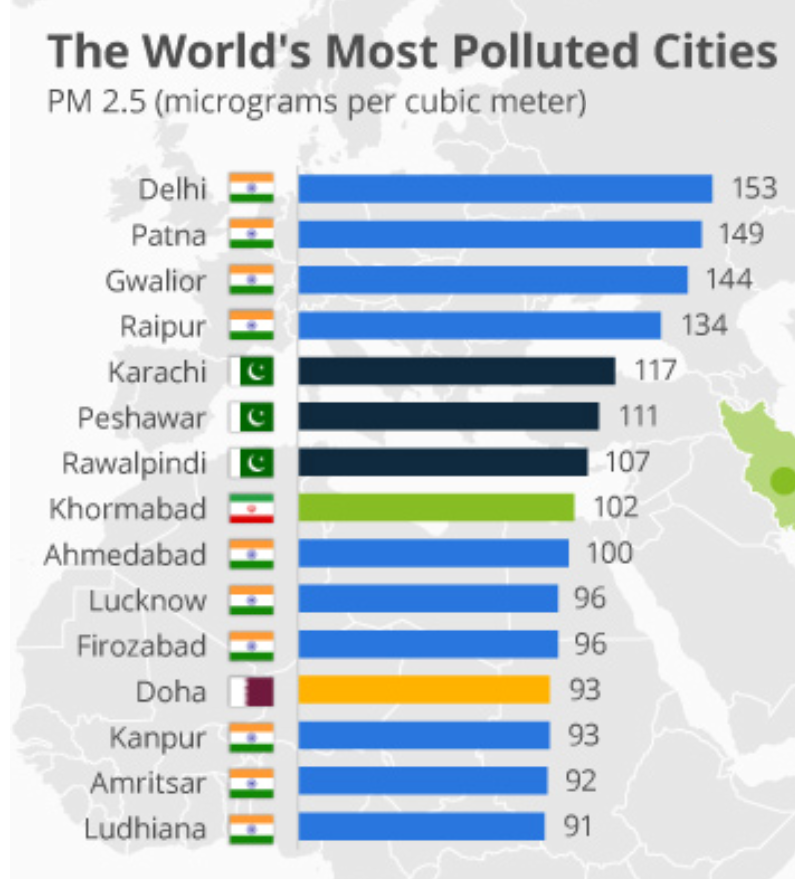
    In fact, in a recent infographic on the world’s 15 most polluted cities (based upon data from the World Economic Forum), Statista expressed surprise that these cities are not in China, as every westerner expected, but in India and Pakistan!

    Most Polluted Cities


    So tell me about it!