Development and Governance

Tag: Inclusion

  • Happy Republic Day: Can India ever become truly Inclusive?

    Clearly inspired by the French Revolution, the Preamble to the Constitution of India reads:

    WE, THE PEOPLE OF INDIA, having solemnly resolved to constitute India into a SOVEREIGN SOCIALIST SECULAR DEMOCRATIC REPUBLIC and to secure to all its citizens:

    JUSTICE, social, economic and political;

    LIBERTY of thought, expression, belief, faith and worship;

    EQUALITY of status and of opportunity; and to promote among them all

    FRATERNITY assuring the dignity of the individual and the unity and integrity of the Nation;

    IN OUR CONSTITUENT ASSEMBLY this twenty-sixth day of November, 1949, do

    HEREBY ADOPT, ENACT AND GIVE TO OURSELVES THIS CONSTITUTION.

    As it took 2 more months for India to formally become a Sovereign Republic, we celebrate Republic Day on the 26th of January every year, with a grand parade in New Delhi, usually with a foreign Head of State as Chief Guest. The entire parade, works the theme of Unity in Diversity to death, and brushes under the carpet the great dissensions, differences, divisions and disparities which plague us even 68 years later.

    This year however, the Government of India scored several own goals in the week leading up to the Republic Day. Firstly, the PM a la Marie Antoinette said in an interview, ‘They have no jobs? Then let them sell street food to survive…’. Then, in the face of gross government inaction, protesters against a movie actually stoned a school bus full of terrified children; and finally, Oxfam published its Commitment to Reducing Inequality (CRI) Index Report, which ranks not India but the INDIAN GOVERNMENT at a pathetically low 132 – all this, while the PM was exploring in Davos, ways to make India’s rich richer.

    Indian voters are said to exercise great freedom of choice each time they throw out the incumbent and bring in a new regime, which spends the first 2 years blaming the ‘legacy’ issues for its non-performance, and the last 18 months preparing to overcome its own incumbency factor before the next election. So the best time to judge a Government’s performance is in its third year – and that is why the present Government is facing severe scrutiny on every front: economic, governance and development.

    This dear reader, is why Oxfam’s CRI Index is so damning – because it measures the commitment of current governments, and this cannot be fobbed off by stories of ‘inherited’ problems, historical inequality, the caste system, the British colonial rule or whatever. This is the here and now and the present government is answerable – not its predecessors of any shape or colour.

    Interestingly, this Republic Day, the parade in Delhi had not one, but a clutch of Chief Guests – the Heads of State of ASEAN – who are in Delhi for a meeting. So how does India compare to the 5 founding members of ASEAN on the CRI Index? Let’s see…

    Country Spending on Health, Education, Social Protection Rank Progressive structure and incidence tax Rank Labour market policies to address inequality Rank Total CRI Rank
    Thailand 61 22 136 70
    Singapore 65 105 96 86
    Indonesia 121 34 114 101
    Philippines 101 80 122 104
    Malaysia 96 30 135 106
    INDIA 149 91 86 132

    Oxfam India offers blunt advice to the Government of India on how to improve its CRI ranking:

    Create an economy for all: Promote inclusive growth by ensuring that the income of the bottom 40% of the population grows faster than of the top 10% so that the gap between the two begins to close. This can be done by:

    • Promoting labour-intensive sectors that will create more jobs
    • Investing more in agriculture
    • Implementing fully the social protection schemes that exist

    Seal the leaking wealth bucket: Reduce extreme wealth and create a more equal opportunity country.

    • Tax the super-rich by re-introducing inheritance tax and increasing the wealth tax
    • Reduce and eventually do away with corporate tax breaks
    • Take stringent measures against tax evasion and tax avoidance
    • Increase public expenditures on health and education

    Bring data transparency: Produce and make available high quality data on income and wealth, and regularly monitor the measures the government takes to tackle the issue of rising inequality.

    In other words, go for INCLUSION. But does a government whose basic ethos is exclusivist and divisive, even begin to understand what inclusion means in modern development jargon, let alone devise and implement policies to bring it about in this most unequal of societies? (Who can forget Dumont’s classic definition of the species of humans in this society as Homo Hierarchicus?)

    It is time indeed to truly understand this concept in all its dimensions because it is the development phrase du jour and crops up in the UN’s Sustainable Development Goals, in the Smart Cities projects, and so on…

    The best explanation I have come across recently is in a World Bank Report East Asia and Pacific Cities – Expanding Opportunities for the Urban Poor. Incidentally, the Report covers the ASEAN countries mentioned above, besides China and Japan – home to the largest single city and urban agglomeration respectively. It begins with giving due credit to the East Asian countries in drastically reducing urban poverty, and any traveler there  will indeed vouch for the much better living conditions of the urban poor in East Asia, than in South Asian cities in India, Pakistan and Bangladesh.

    The writers of the report explain the expanding opportunities for the urban poor by consciously inclusive policies introduced by their governments.

    They identify three dimensions of inclusion:

    Economic Inclusion: refers to equitable access to jobs and income-generating activities, mechanisms of resilience to withstand shocks and removal of barriers to formal employment

    Spatial Inclusion: links equitable access to land, housing, infrastructure, and basic public services. Mobility is particularly important, given its role in connecting low-income residents to jobs, services, and amenities. Housing must be accessible, affordable and ensure good quality and safety

    Social Inclusion: relates to individual and group rights, dignity, equity, and security

    This Multidimensional Framework of Inclusion is graphically depicted in the report as under:
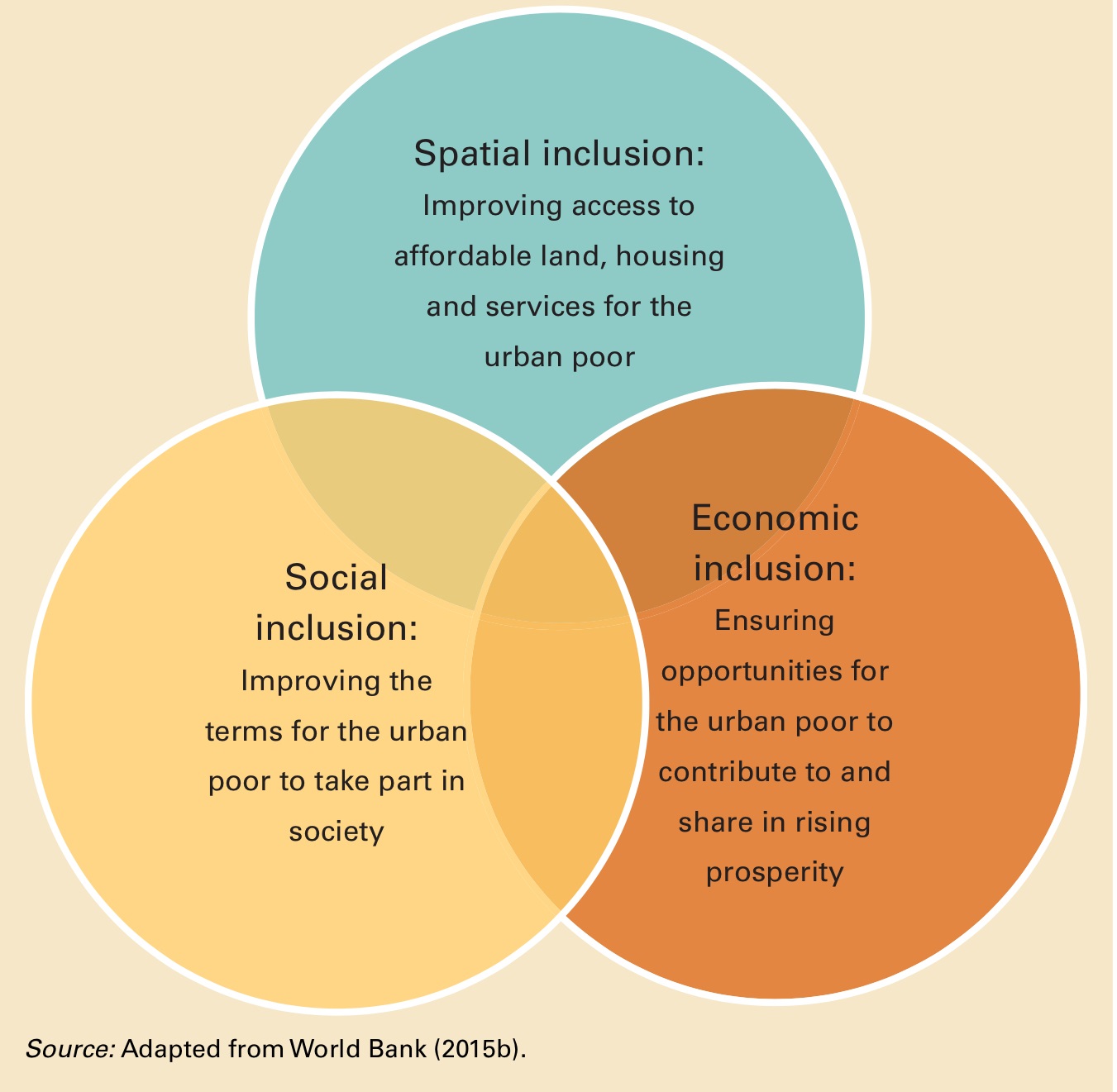
    Multidimensional Model of Inclusion

    What is noteworthy is that the three dimensions overlap, and government interventions cannot be designed and implemented piecemeal. We have seen the havoc caused to the environment in Gujarat in the name of ‘development’ during the last two decades, and a similar short-sighted approach to inclusion may end up as nothing more than ‘including’ India’s entire billion-plus population in an electronic, biometric database which is being regularly hacked, misused and abused.

    If the Government of India doesn’t show a greater commitment to long term investments in Education, Health and Social Protection, doesn’t introduce a more just taxation system, and doesn’t formalise the rapidly growing informal sectors of the economy and society, well then organisations like Oxfam will not keep quiet and India’s international credibility will take a further beating…


  • Good Governance

    One has observed a gradual fading out of a defining corpus of knowledge as one moves from Left to Right on the ideological spectrum. Thus the Marxists have an absolute embarrassment of riches on EVERY aspect of politics, economics and social dynamics; while even the middle of the road parties like the Congress have a legacy bequeathed by Mahatma Gandhi, Pandit Nehru, Dr Ambedkar and numerous others. Mr Mani Shankar Aiyar and Dr Sashi Tharoor are of course internationally read authors today, while the BJP now has Mr M J Akbar – never mind that he spent almost his entire career spewing vitriol against his new friends…

    Of course, the new regime in Delhi compensates by being ultra tech-savvy, but sadly a sound bite here and a tweet there do not a Corpus make… Underlying all the alliterative wisdom, slogans and campaigns, is one key word – Governance. We are told that the new Government will provide good governance, while the previous government was simply guilty of bad governance. Period.

    In explanation we are assured of quicker decisions, fewer referrals, and faster file movement – in short, more efficiency. (That the efficiency or inefficiency of any government eventually rests upon the capacity and motivation of our permanent bureaucracy is a sad truth the Government will soon discover).

    That aside, surely there is more to Governance than mere Government?

    Of course there is – and that’s you and me…

    Quite simply, GOVERNANCE = GOVERNMENT + CITIZENS

    So, to set the record straight on a complex concept like GOVERNANCE, let us look at the received wisdom on what constitutes GOOD GOVERNANCE, and what are its parameters… Thanks largely to the work of UN bodies like UNDP and UN-ESCAP, there is now a global consensus on these criteria:

    For the GOVERNMENT component of GOVERNANCE, these are:

    Efficiency and Effectiveness: Good governance means that processes and institutions produce results that meet needs, while making the best use of resources at their disposal. The concept of efficiency in the context of good governance also covers the sustainable use of natural resources and the protection of the environment. While efficiency is a relatively simple ratio of output upon input; effectiveness looks at outcomes and impact.

    Decentralization, Security and Sustainability: Good governance also means devolution of powers and resources to the local level. Local governments should be empowered with sufficient resources and autonomy to meet their responsibilities. Further, every individual has the inalienable right to life, liberty and the security of person. Insecurity has a disproportionate impact in further marginalising poor communities. Cities must strive to avoid human conflicts and natural disasters by involving all stakeholders in crime and conflict prevention and disaster preparedness. Security also implies freedom from persecution, forced evictions, and provides for security of tenure. On their part, local bodies must balance the social, economic and environmental needs of present and future generations. This should include a clear commitment to urban poverty reduction. Leaders of all sections of urban society must have a long-term, strategic vision of sustainable human development and the ability to reconcile divergent interests for the common good.

    For the CITIZENS’ INTERFACE component of Good Governance, we require:

    Participation: All men and women should have a voice in decision-making, either directly or through legitimate intermediate institutions that represent their interests. People are the principal wealth of nations; they are both the object and the means of sustainable human development. Participation also means civic engagement, which implies that living together is not a passive exercise: in cities, people must actively contribute to the common good. Furthermore, the civic capital of the poor must be recognised and supported.

    Accountability is a key requirement of good governance. Not only governmental institutions but also the private sector and civil society organisations must be accountable to the public and to their institutional stakeholders. In general an organisation or an institution is accountable to those who will be affected by its decisions or actions. (More on Social Accountability in a separate post…)

    Transparency is built on the free flow of information. Access to information is fundamental to this understanding and to good governance. Laws and public policies should be applied in a transparent and predictable manner. Elected and appointed officials and other civil servant leaders need to set an example of high standards of professional and personal integrity.

    Responsiveness: Good governance requires that institutions and processes try to serve all stakeholders within a reasonable time frame. The introduction of Citizens’ Charters and e-Governance are the first steps in measuring and monitoring the responsiveness of government bodies to the needs and demands of citizens.

    Inclusion of ALL stakeholders in decision-making which affects the lives of all citizens is an essential criterion of good governance. A society’s well-being depends on ensuring that all its members feel that they have a stake in it and do not feel excluded from the mainstream of society. This requires that all groups, but particularly the most vulnerable, have opportunities to improve or maintain their quality of life.

    Consensus Orientation: There are several actors (and as many viewpoints) in a given society, on what is in the best interest of the whole community and how this can be achieved. It also requires a broad and long-term perspective on what is needed for sustainable human development and how to achieve the goals of such development. This can only result from an understanding of the historical, cultural and social contexts of a given society or community, so that it becomes feasible to arrive on common ground and work together.

    Rule of Law: Legal frameworks should be fair and enforced impartially, particularly the laws on human rights. Impartial enforcement of laws requires an independent judiciary and an impartial and incorruptible police force.

    Equity: The enforcement of the rule of law and the distribution of public goods should not only be equitable, but perceived as such by all citizens. Inclusive societies provide everyone – be it the poor, the young or older persons, religious or ethnic minorities or the handicapped – with equitable access to nutrition, education, employment and livelihood, health care, shelter, safe drinking water, sanitation and other basic services.

    So far, we are yet to see any major breakthroughs in meeting ANY of these criteria – in fact, words like inclusion and equity invite derision rather than support; and the approach tends to be confrontational, rather than consensus oriented.

    The new Government really has its work cut out. Good Governance remains a distant dream, and 5 years may be too short a time to make good on extravagant electoral promises.

    Please surprise us, and convince the 69% who did not vote for you…