Development and Governance

Tag: Formalizing the Informal

  • Why we are still asking the wrong questions on Slums

    Published in Times of India, Pune on 14 November 2018. Lost and found. Posted here for you.

    Informal housing – or ‘slum’ as it is derisively called – has become the hallmark of all metros in the developing world, from Rio to Lagos to Nairobi to Mumbai.

    The evolution of slums in post-Independence India, however, is the stuff of legend, on which many a career in New Wave Indian Cinema of the 1970s was built….

    Several studies during this period revealed that the typical migrant to urban areas was a semi-skilled or skilled male, 18-35 years old, who sent a major share of his earnings back home to support his family.  Housing was a low priority for such a person and he was ready to squat or settle at any location which cost him the least of his hard-earned money. The social vacuum created by a separation from rural roots was compensated by congregating along ethnic, caste, linguistic and regional lines, and such arrangements provided a strong social support system to compensate for the break-up of the rural extended family.

    The downside of this has been ghettoization, which not only enhances strife and bigotry, but provides easy mobilization in violent crises – be they communal riots, industrial unrest, or underworld gang wars.

    In planning terms, the assumption that slums and urban poverty were co-extensive and coterminous led to numerous ad hoc ‘slum improvement’ schemes at this time, where it was naively assumed that upgrading living conditions in slums in a piecemeal fashion, would eliminate the scourge of poverty from our towns and cities.

    However, as the research and information base has grown, it has become clear that the relationship between urban poverty and slums is both tenuous and complex – especially as a second generation of slum dwellers, with few choices and little upward mobility, begin to emerge on the urban scene. They can look forward to a life only in the informal economy of the city, and given our outdated civic laws, even a new-born child in such a household, breaks a dozen laws as he or she draws its first breath…

    During the 1980s, urban slums could no longer be seen as extensions of rural poverty and became more or less autonomous. As thriving, self-sustaining social systems in their own right (Dharavi being an example), urban slums were no more synonymous merely with urban poverty. While urban poverty incidence has declined between the early 1970s and the late 1980s, there is no evidence of any decline of the slum population.  As a result, fewer people have access to safe drinking water and nearly 70% are reported to be without basic sanitation. 

    Poor housing, infrastructure and urban services are the problem, not poor people.

    The consequences of regarding urban poverty and slums as one and the same have been largely negative:

    Once a slum is recognized as such, subtle political forces prevent it from ever becoming de-notified and this has stigmatized entire communities of urban poor, doomed to be labeled ‘slum-dwellers’ for generation after generation. As a result, slums become powerful vote banks and can be mobilized for various anti-social activities like crime, extortion, land grabbing, strike breaking and communal violence.

    Meanwhile, badly designed slum upgradation schemes have set up an unsustainable regime of subsidies, inculcating the same dependency syndrome among beneficiaries, which was earlier seen only in Indian villages. Providing basic services in slums was made synonymous with poverty alleviation, and the neglect of health and education in urban slums continues to eat away at the human potential of slum populations, pushing them further and deeper into unemployment, under-employment and the informal sector.

    On the side of local government, there is a tendency to underestimate the ability of the urban poor to pay for services and they have to learn to ‘do without’ these services. Slum schemes with their emphasis on shelter and basic services, neglect informal enterprise, and compound the problem by making no effort to integrate the informal slum economy within the larger city economy.

    Almost all housing schemes continue to neglect the key issues of access, security of tenure, and affordability and it is this – the most visible housing dimension of urban poverty – which continues to scar Indian cities.

    Finally, with the entry of private commercial interests into slum rehabilitation projects currently being implemented across India, there is a danger of encroached government and municipal lands passing forever into private hands.

    This would be an irrecoverable loss of public assets for generations to come. Instead, Indian cities can perhaps take a leaf out of capitalist Singapore and communist China’s public housing and long-term lease policies to ensure development with equity.

    Related:

    Housing Dimension of Urban Poverty

    Cities without Shelter

    Formalizing the Informal – the only economic reform that matters

    Read more: Why we are still asking the wrong questions on Slums
  • Urbanization Trends in India

    India is one of the many countries which has never got around to formulating a National Urban Policy, even seventy years after Independence, and successive governments have just thrown money at the myriad problems of unplanned and undirected urban growth, with scant results and a perpetually deteriorating quality of life. India has the dubious distinction of hosting 9 of the 10 most polluted cities in the world. Therefore, it is incumbent on any incoming Indian Government that its policy makers take a step back and look at the urbanization trends in the country, before more of its precious resources (including scarce urban land) are handed over to the private sector, in the name of smart cities, or housing for the poor, or some other gimmick.


    The report of Census 2001 surprised urban experts by showing a downward trend in urbanization, first noticed in the 1991 Census, which had not been reversed, despite India’s notable successes on the economic front. Scholars of such phenomena had pinpointed four main reasons for this downturn :

    • As a result of the economic reforms of 1991, there had been a noticeable reduction in rural poverty, improvement in infrastructure and services, and a steady tertiarization of rural economies, reducing the flow of distress migration to cities
    • Secondly, with increasing global connectivity, the economic migration of people from small towns in search of education, skill building, and white-collar jobs, had reduced
    • Thirdly, villages on the periphery of big towns and/or with sizeable populations had resisted municipalization, chiefly because the local, landed power elite did not wish to relinquish control. The fear of higher taxation in an urban regime may also have dissuaded the rural citizenry, or perhaps, the host city (in a proposed merger) may have baulked at having its services and resources stretched over a wider area
    • Finally, it was believed that globalization itself was a cause for this downturn. As India transformed itself into a knowledge society, those on the wrong side of the digital and technological divide were put at a disadvantage. The knowledge sector tended to be capital intensive rather than labour intensive, and this discouraged unskilled labour from migrating.

    In the following decade of 2001-2010, the changes wrought by globalization on Indian society were well entrenched and urbanization picked up once again because:

    Liberalization brought foreign direct investment and MNCs demanded the dilution of India’s stringent, albeit humanitarian labour laws. Rightsizing and downsizing became the goal and social security (like pension schemes and medical aid) went out the door. This pushed more and more people into the informal sector, where they didn’t need to pay either direct or indirect taxes, and this in turn led to the further impoverishment of local bodies who had traditionally relied heavily on local business taxes like octroi.

    In the long term, informalization has a very insidious and deleterious effect on local economies. Anybody and everybody can aspire to ‘learn on the job’ and work as a plumber or electrician on a construction project without any qualifications, using shoddy materials from any fly by night ‘factory’ with no safety standards, and get paid for it in cash with no tax paid at any stage. Is it any wonder then, that buildings and bridges collapsing in Indian cities are a regular occurrence? And nobody is held accountable. Informalization also leads to extremely exploitative trade and labour practices, encourages forced labour and child labour, higher school dropout rates, and generally weakens a country’s human capital, so that one generation down the line, we have clearly lost our demographic dividend.

    Privatisation has led to a whole culture of unprecedented corruption and crony capitalism, especially in urban infrastructure. Even Government Schemes are now outsourced to private consultants, who have little or no local knowledge to make them effective and sustainable in the long run. The corporatization of basic municipal services, such as water supply and transport, further eats into the earnings of the local body and diminishes, rather than builds the capacity of municipal personnel. Further, unlike elected representatives, the bosses of these private and public corporates are not accountable to the people.

    The boost given to construction once again made cities attractive and pull migration brought in both semi-skilled and unskilled labour, who stayed on to boost the urban population, eking out a living in the informal sector and living in increasingly squalid settlements.

    It is noteworthy that although globalization and all its concomitants have dramatically raised the standards of living of the Indian urban middle class, and greatly reduced absolute poverty in the countryside, it has unfortunately skewed our priorities in favour of prestige projects like bullet trains instead of grassroots rail infrastructure; airports instead of bus stations; medical tourism instead of primary health care; business schools instead of primary schools; and so on.

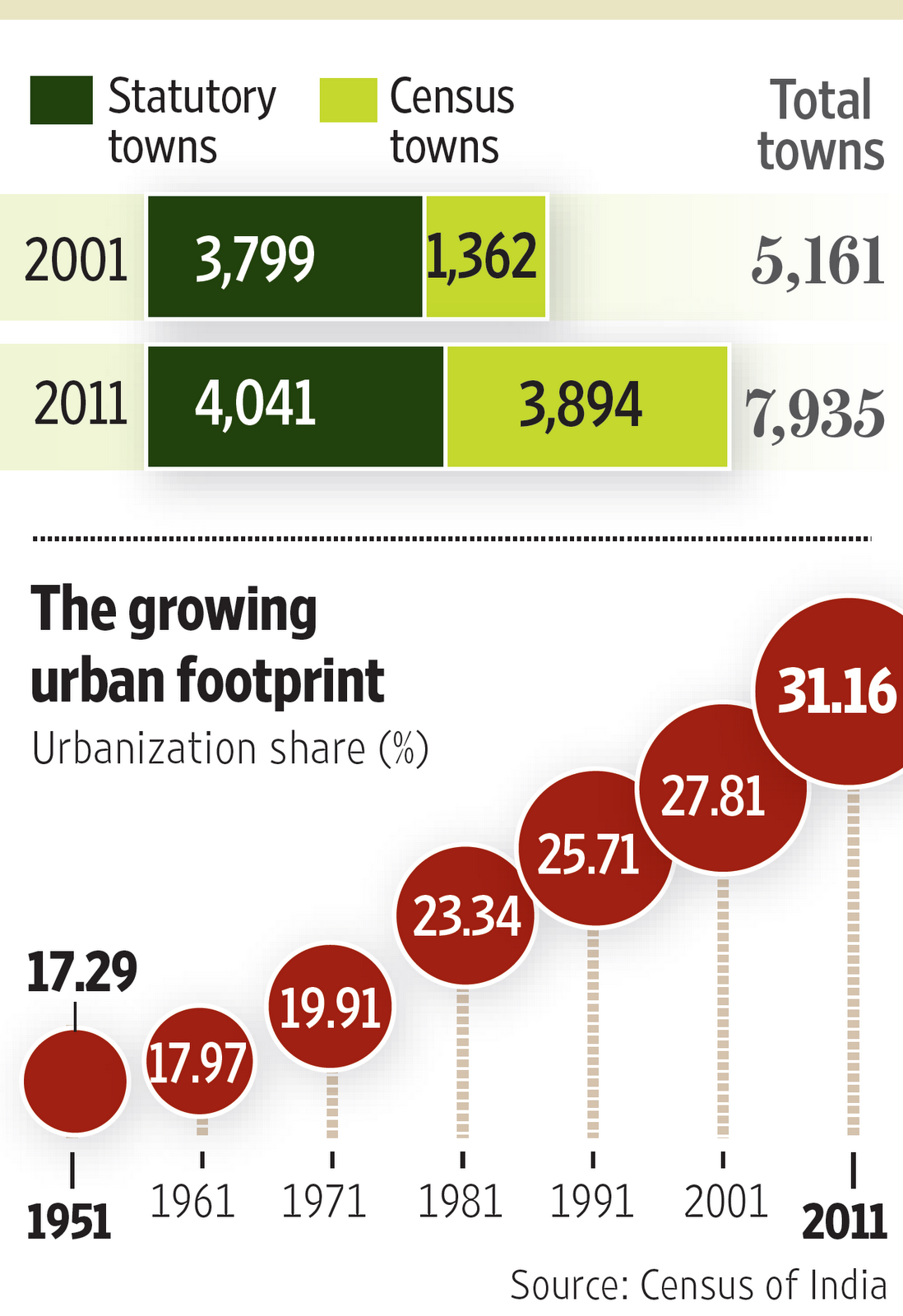
    The increased urbanization of India becomes quite clear in the Census 2011 report.

    Urbanization in India

    We see that by the time of the 2011 Census:

    • It was suddenly desirable to be urban’. The old landed elites had given way to the new rich, who had become wealthy beyond their wildest dreams by selling farmland on the peripheries of expanding metros, and now aspired for political power to match their financial clout – which could only happen in a new municipal/urban setting. This explains why although there were 7,935 towns in the country, only 468 or 6% had a population exceeding 100,000 (one lakh), that were home to around 265 million persons, constituting 70% of the total urban population! Which begs the question: what sort of towns (!) were the remaining 94%?
    • The 53 million-plus cities, where 42.6% of the urban population live, continued as the real ‘urban’ India. They were the hub of the old industrial sector and the new services sector. They continue to grow far beyond their carrying capacity and the impact on their environment has been devastating – whether through air pollution, toxicity in the food chain, dwindling groundwater, or recurring monsoon floods. These are the ‘generators of economic momentum’ for their regions and the country – pathetically inadequate, as their municipal governments are permanently impoverished, their tax bases are stagnant and non-viable, and informalization of both housing and the local economy is well over 40%.
    • The decline of the great urban symbols of British India, like Mumbai and Kolkata, foreshadowed in Census 2011, tell a sadder story: the abdication of power and responsibility by both, State and local governments, have given speculators a field day in these megacities, making real estate unaffordable to all but the super-rich. As the middle class gets pushed to the peripheries of these cities, the transport system reaches breaking point, and it makes more sense to opt for a relatively stress-free life in a smaller city. The archaic Rent Control Laws coupled with the absence of a clear title system prevents the growth of rental housing, further making these megacities unaffordable. With the exodus of formal sector economic activity to smaller metros/ towns, the vacuum is filled by the informal sector – reaching 68% in Mumbai, 62% in New Delhi, and 60% in Chennai.

    The United Nations estimates that 40% of India’s population will be urban by 2030, but if our cities continue into the next decade on their present trajectory, life would be a living hell in some dystopian concrete jungle. So, before that scenario unfolds, let us urge the next government to seriously formulate a National Urban Policy to revitalize India’s cities through a four-pronged approach:

    • Firstly, the decentralization of local Government to manageable ward level, which will ensure greater stakeholder participation in governance and will be a check on the arbitrary decisions of huge Municipal Corporations and parastatals, some of which have budgets larger than that of several smaller State governments
    • Secondly, a neighbourhood approach to city planning which is more organic and more Indian
    • Thirdly, a commitment to heavy investment in education and health to provide sustainable livelihoods beginning in our million-plus cities
    • Finally, hand-holding support to poor communities to enable them to formalize large informal sub-economies, so that they are gradually integrated into the city’s formal economy and eventually into the national economy.

  • Formalizing the Informal – the only economic reform that matters

    Two incidents last week: a friend’s enthusiastically launched ‘start-up’ is downsizing in less than a  year and will probably become ‘stop-down’ soon; and another friend’s 16 year old but spacious flat has been attracting great interest from the local small businessmen, even before she has put it on the market. In other words, the money in India is inexorably moving from the formal to the informal sector. With the advent of a hefty Goods and Services Tax, the situation will only get worse. And there is little the Government can do, or is willing to do, to stop this leaching away of its legitimate tax revenue.

    Given that its traditional support base has always been the urban business class, the ruling party is unlikely to take stringent action against this class which is the biggest beneficiary of that twilight zone of the informal sector that now covers over 68% of the economy of India’s commercial capital – Mumbai.

    By promising greater ease of business to attract domestic and foreign investors, the business-friendly and business-financed central government has weakened the regulatory framework to such an extent that it has opened the floodgates for environmentally irresponsible infrastructure projects, and the exploitation of child labour – now legitimized by allowing children to work in family businesses or ‘learn’ traditional crafts. (Though there is hardly any skill or craft to be learnt, at the cost of regular schooling, to serve tea in your uncle’s roadside cafe, is there?)

    Not quite familiar with consumer preferences in the West and the growing importance of ethical supply chains (especially among EU importers), both the Indian Government and the Indian business community are at a loss to understand why foreign direct investment in the country continues to remain sluggish.

    But domestic consumption continues to grow and this demand is increasingly being met by informal and semi-informal enterprise, both in services and light manufacturing. As a result, quality and safety standards are readily sacrificed to cut costs. Ever wondered why a plumber or carpenter brings along a drill with bare leads which he pushes into the nearest electric socket? Because there is no standardization in the electric fittings produced cheaply in some back alley, and no two plugs/sockets in India will ever be compatible… This haphazard style of ‘making do’ with whatever is available then gets eulogized in management books as the inherent Indian genius of ‘jugaad’ while its corollary of ‘Chalta hai’ or ‘anything goes’ is blamed for every social evil from corruption to traffic snarls… God save us from management gurus.

    But what of the workers in the informal sector? Most of them are likely to be poor male migrants from the North, with little education and only the skill of their specialization – which means they are exclusively employed in the construction, interior design or garment sectors. They also tend to belong to the lower castes and religious and ethnic minorities who have few opportunities for education and development on their home soil. They are ready to live and work in abysmal conditions so long as they make good money, to look after their families back home. In essence, as the informal sectors of the economy expand, so do the slums and informal settlements in a city – with all the concomitant consequences of anomie, alienation, violence and crime.

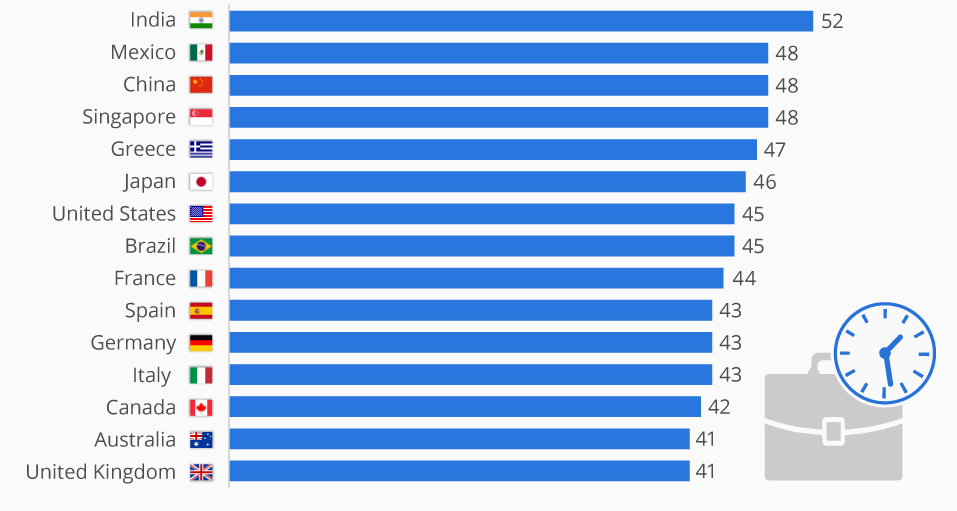
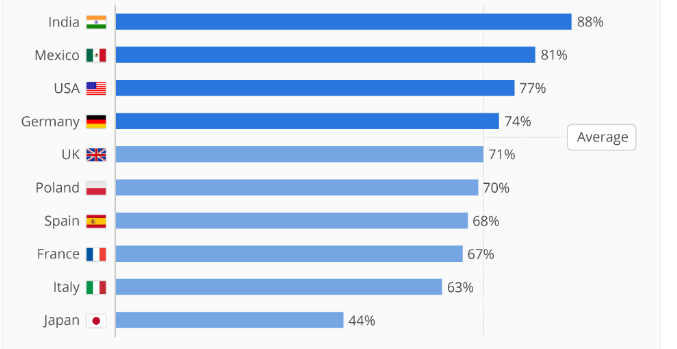
    And as the formal sector keeps shrinking under the onslaught of the informal, the job market shrinks, and those lucky enough to be born into a higher caste/class and able to afford the qualifications to work in the formal sector, are so grateful to find a job – any job – that Indian workers report the greatest sense of well-being in their jobs, while paradoxically also being the hardest working, as these two Statista infographics indicate:

    Percentage expressing well-being at work:

    STATISTA WELL-BEING AT WORK

    Working hours of Millennials (20-34 age group):

    STATISTA WHERE MILLENNIALS WORK LONGEST HOURS

    The point is that no amount of policy tweaking can swing a country’s economy this way or that because the way the economy works is inexorably tied to the way that society is organised. And all economic reform must necessarily be underpinned by social reform – greater equality of opportunity, inclusion, universal education, equitable regulation … and so on…