Development and Governance

Tag: Decentralization

  • When is a city truly ‘prosperous’?

    Published in Times of India, Pune on 21 December 2018. Lost and found. Posted here for you.

    A few years back, a visiting Minister of State who was in town to flag off the Marathon had commented that Pune appeared to be a ‘prosperous’ city. And I don’t think he was off the mark there. If you have lived here all your life you pick up the Pune zing of being ‘up and about’ and going about your business, with a goal and a schedule – whether the executive in his chauffeur-driven car, or the ‘bai’ (domestic) whizzing around her 6-7 jobs on her trusty two-wheeler.

    If we are to go only by ‘economic’ prosperity, then according to GDP, Pune takes seventh place behind Mumbai, Delhi, Kolkata, Bengaluru, Chennai, and Hyderabad. Which is not bad at all, because it is not a State Capital like the others.  

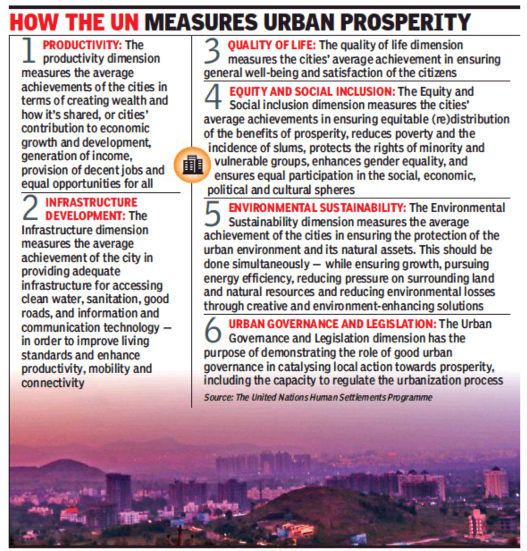
    So, what defines a city as prosperous, if not just GDP? According to the UN-Habitat:

    • First, a prosperous city contributes to economic growth through productivity, generating the income and employment that afford adequate living standards for the whole population.
    • Second, a prosperous city deploys the infrastructure, physical assets and amenities required to sustain both the population and the economy.
    • Third, prosperous cities provide social services like education, health, recreation, safety and security, required for improved living standards, enabling the population to maximize individual potential and lead fulfilling lives.
    • Fourth, a city is only prosperous to the extent that poverty and inequalities are minimal. No city can claim to be prosperous when large segments of the population live in abject poverty and deprivation (Mumbai, Kolkata please note!) This involves reducing the incidence of slums, homelessness and new forms of poverty.
    • Fifth, ensuring that the creation and (re)distribution of the benefits of prosperity do not destroy or degrade the environment; instead, the city’s natural assets are preserved for the sake of sustainable urbanization.

    So, if Pune is to appear prosperous to outsiders and host a happy and contented population, it needs to look at the pressure points, which need immediate attention, correction and upgradation.
    Pune and its satellite cities of Pimpri-Chinchwad, were blessed with excellent weather, an educated workforce and proximity to Mumbai and remain one of the most important civilian manufacturing hubs in India. As the city with the most prestigious defence and scientific establishments too, Pune offers the best work opportunities in both the public and private sectors and its citizens have prided themselves on a culture of high productivity. This culture made an easy transition to the burgeoning IT sector, as many majors set up hubs at the various software technology parks.

    However, the city’s high productivity is under threat from FAILING INFRASTRUCTURE – be it the unreliable power supply, the mediocre telecom networks and connectivity, or the lack of efficient public transport which cost millions of workhours lost in traffic jams.

    As regards sustaining everyday life, Pune is becoming more and more stressed in its WATER SUPPLY each passing year – chiefly due to a cumbersome sourcing mechanism, outdated treatment and distribution networks, and low capacity staff at the municipal level. The situation is made worse by an unregulated water tanker mafia and corruption which allows large-scale pilferage and diversion in the system.

    In the area of social services like health, sanitation and education, Pune is relatively better off but the chief hurdle is the MULTIPLICITY OF AGENCIES in these sectors – local, State and Central Government. Perhaps Maharashtra needs to learn from Kerala which thoroughly decentralized education and health to the local level and achieved not just 100% literacy and universal health coverage, but a Human Development Index rank on par with developed countries.

    As regards inequality and slums, Pune has long been an example to other cities with respect to providing basic services, high quality sanitation and total coverage in immunization of children in slums. Perhaps the need of the hour in Pune and elsewhere, is an INTEGRATED APPROACH to upgradation of slum housing (with the full participation of the residents) with new development control rules, emphasis on using recycled and indigenous materials, and providing public spaces for recreation and commercial activity in each settlement.

    Coming to the environment, Pune is again blessed with a very SAVVY POPULACE and an active (or as the bureaucracy feels, overactive) environment lobby – the ecologically sound Ganpati Visarjan (Immersion Ritual at the end of the Ganesh festival) is an example of the Punekar’s mature awareness of his/her responsibilities.

    What most citizens may not know is that Pune (along with other municipal corporations in Maharashtra) prepares an excellent annual ENVIRONMENT STATUS REPORT covering everything from air and water pollution, energy use, carbon footprints, forestation, housing to transport and waste management. The reports lay down the pressure points for the city and outline corrective measures. Sadly however, these insights are seldom if ever incorporated in either the city’s Development Plan, or the annual budget and the few incentive schemes offered to citizens – like a discount in Property Tax for installing rainwater harvesting systems – vanish in a haze of bureaucratic inertia.

    So, if an Indian city like Pune truly wants to remain a prosperous city, the State and Centre need to devolve resources and develop capacities at the local level, and the local leadership need to galvanize their workforce, exercise tighter regulation to curb petty corruption, and plan for a sustainable future for the city, based on sound scientific principles, rooted in a fast changing, environmentally challenged world.

    Related:

    Quality of Life in an Indian Context

  • Prospects for Prosperity of Indian Cities

    As we saw in the last post, the UN-Habitat’s Wheel of Prosperity has the 5 dimensions of prosperity interacting with each other; and prosperity depends directly on whether these interactions reinforce or undermine each other.

    wheel of prosperity 2

    We also saw that according to the UN-Habitat’s survey, both Delhi and Mumbai made it only to the category of moderate prosperity factors (0.600–0.699), characterised by:

    • Wider discrepancies among the 5 dimensions of prosperity
    • Institutional and structural failings
    • Less balanced development
    • Neat divide between rich and poor

    The main problem in integrating the 5 dimensions of prosperity in Indian cities is the growing informalisation of the city’s economy, with Mumbai having the dubious distinction of 68% of its economy being informal, while Delhi and Chennai have over 61% of informalisation. As mentioned in my earlier post, by operating in the 3 sectors of industry, enterprise, and housing, the informal economy weakens the national economy in the long run:

    • By pushing more and more of its practitioners deeper into poverty
    • By dissipating India’s age advantage, as deprivation leaches away at the human potential of generation after generation, denied access to education and skill building
    • By operating below the tax radar and denying taxes to the local, State and Central Governments
    • By untold damage to the urban environment, as a consequence of little or no monitoring or regulation

    Large scale informalisation weakens all the 5 dimensions of prosperity, because informal production seldom gets reflected in the productivity figures of the city – especially as India lacks a proper representational system (guaranteed by a local/state authority) of documenting land deals, goods produced, inventories maintained, or transactions completed.

    By acting below the tax radar, the informal economy deprives the local government of taxes, and a resource-strapped local body is hardly likely to provide adequate services like health, education, water and sanitation, which directly impacts quality of life.

    The informal sector thrives in any economy, only because it is profitable for the formal sector to have all, or part of its supply chain in the informal sector. This segment can provide cheap goods and services as it pays abysmally low wages and offers no social security to its workers, as it falls outside the ambit of the country’s labour laws, meant to safeguard worker rights. This means that millions of informal sector workers are perpetually caught up in a poverty trap, generation after generation – a situation exacerbated by the unavailability of affordable or rental housing. In fact I have a simple thumb rule, if according to the decadal Census, x% of a city’s population lives in slums, then x*1.3% of its economy must be in the informal sector! Such high prevalence of urban poverty and the policies which perpetuate it in Indian cities make a mockery of the equity and social inclusion dimension of prosperity.

    The informal industrial sector is also guilty of the worst pollution in a city, and being unmonitored and unregulated, there is no incentive for these enterprises to clean up their act, so there goes environmental sustainability!

    I have left infrastructure for the last, because every government in recent times looks upon urban infrastructure as its most tangible ‘mark’ on the horizon, and given a limited span of 5 years to ‘prove themselves’ they opt for quick fixes like roads, bridges and flyovers which only encourage more private vehicles, add to the pollution, and are hardly ‘inclusive’ in their exclusive use by the wealthy. Spending the same money on improving the quality of health and education, lowering the city’s carbon footprint, or upgrading the city’s water supply system makes more sense for Indian cities, but by the time their impact is seen, the election has come and gone…

    So instead, we are happy with news-bites, putting up huge statues of the icons of the day, and providing photo-ops for VIPs sweeping the streets to dump the garbage god knows where!

    In India it is called ‘good governance’…


    How then, can we go about making Indian cities more prosperous? Primarily by addressing the issues at the hub of the Wheel of Prosperity – Government institutions; and Laws and Urban Planning.

    Despite almost 70 years of independence, India does not have a national urban policy nor a National Urban Plan. When China opened up, the first thing it did was to invest billions in developing its National Central Cities and business hubs like Pu Dong in Shanghai and Shenzhen near Guangzhou. The Government investment earned magnificent returns, as China went on to become the world’s factory in the following decade. Indian Governments must realise that national investment in urban infrastructure is key to economic growth, and cannot be left at the mercy of the private sector, as happened under JNNURM and is going to happen again under the new regime..

    Plus (unlike Brazil) there has been no attempt in India to involve the community in urban management and planning, nor to subsume public housing in urban planning, as in Singapore.

    Further, taking a lesson from cities which rank much higher than us, we notice one common thread: they all have very strong, enabled and empowered local governments. India needs to follow suit. Although it is over 20 years since the 74th Constitutional Amendment, decentralisation has not really taken off, because only the functions have been delegated to the local level, not the resources, powers or personnel.

    As I had pointed out in my earlier post, the Mayor of Shanghai is such a powerful personage, that visiting Heads of States come calling whenever they visit China. He is assisted by a plethora of urban planners, administrators and engineers whose only concern is their home city of Shanghai. Contrast that with Mumbai, whose highest local official is the City Engineer, who is subject to a Municipal Commissioner and numerous Additional Municipal Commissioners, all officers of the Central Indian Administrative Service or IAS (who are generalist career civil servants and not  qualified urban professionals), posted by the State government for a short duration, to run local government! How amusing…

    The New York Police Department (consisting of officers who spend their entire careers serving the city) reports to its Mayor, an elected public official, while Delhi’s Police Commissioner is from the Central Indian Police Service (IPS), posted by the State Government for a couple of years to police the city, and report to some IAS Officer at the State Home Department!

    The same system prevails when it comes to urban planners, who are responsible not to the local body, but to the State Government’s Urban Development Department, headed (you guessed it!) by yet another IAS Officer. For instance in Maharashtra, if a city finds that its industries are moving further out from the city centre and the large swathes of land under factories will remain unutilised, it cannot authorise change of use to commercial or residential development, without the say-so of the State Government. So much for autonomy in local planning!

    This absence of qualified urban professionals (who are lifetime employees of a local government in charge of their city’s planning and development) is at the heart of misgovernance in Indian towns and cities. Without a strong local administration, it becomes impossible to elect and empower Mayors who can act as true CEOs of their cities, as in other parts of the world.

    However, given the clout of the Central permanent bureaucracy (which considers urban local bodies as plum postings), things are unlikely to change soon, and Indian cities will have to postpone their dreams of prosperity a little longer yet… no matter which political party is in power.