Development and Governance

Tag: China and India

  • Education in Asia and the Pacific

    The Asian Development Bank in its flagship annual report on Key Indicators for Asia and the Pacific 2015, includes a special chapter on education in the region. The key findings in this chapter are:

    • Developing Asia has made large strides in expanding access to education. Average years of schooling nearly doubled from 3.9 in 1970 to 8.0 in 2010
    • Skills remain weak in many parts of the region, due to gaps in both the quantity and quality of education provided
    • A failure to raise the quality of education will have consequences for growth prospects
    • Public educational expenditures are necessary, but not sufficient to improve learning outcomes
    • Families and firms also need to be involved in the region’s skill development agenda.

    Pretty obvious you would think, but having elucidated these issues, the report cannot really hide its private sector bias and meanders into all sorts of contradictions. For instance, stressing the importance of motivation among teachers, it goes on to suggest filling the vacancies on contract. Where in the world have you heard of temporary workers – insecure, underpaid and overworked – remaining truly motivated about their jobs, which never ever develop into a vocation?

    Similar ambiguities mark the redesign of school and college curricula – are they to be redesigned to empower the individual to play a more responsible role as a citizen, or to produce automatons for the assembly lines of private industry? Can higher education really bring together vocationalisation and the liberal arts? And so on…

    Nonetheless the report does contain some important data which one can interpret from a different perspective. Take the graph on country-wise data on the vocationalisation of secondary and technical education:

    ADB Report 1

    And compare People’s Republic of China in 2011 and India in 2012… Although India seems to have better coverage, the extent of vocationalisation of secondary and tertiary education in China far outranks India.

    Further, if we look at the sector-wise distribution of types of education received, what do we find?
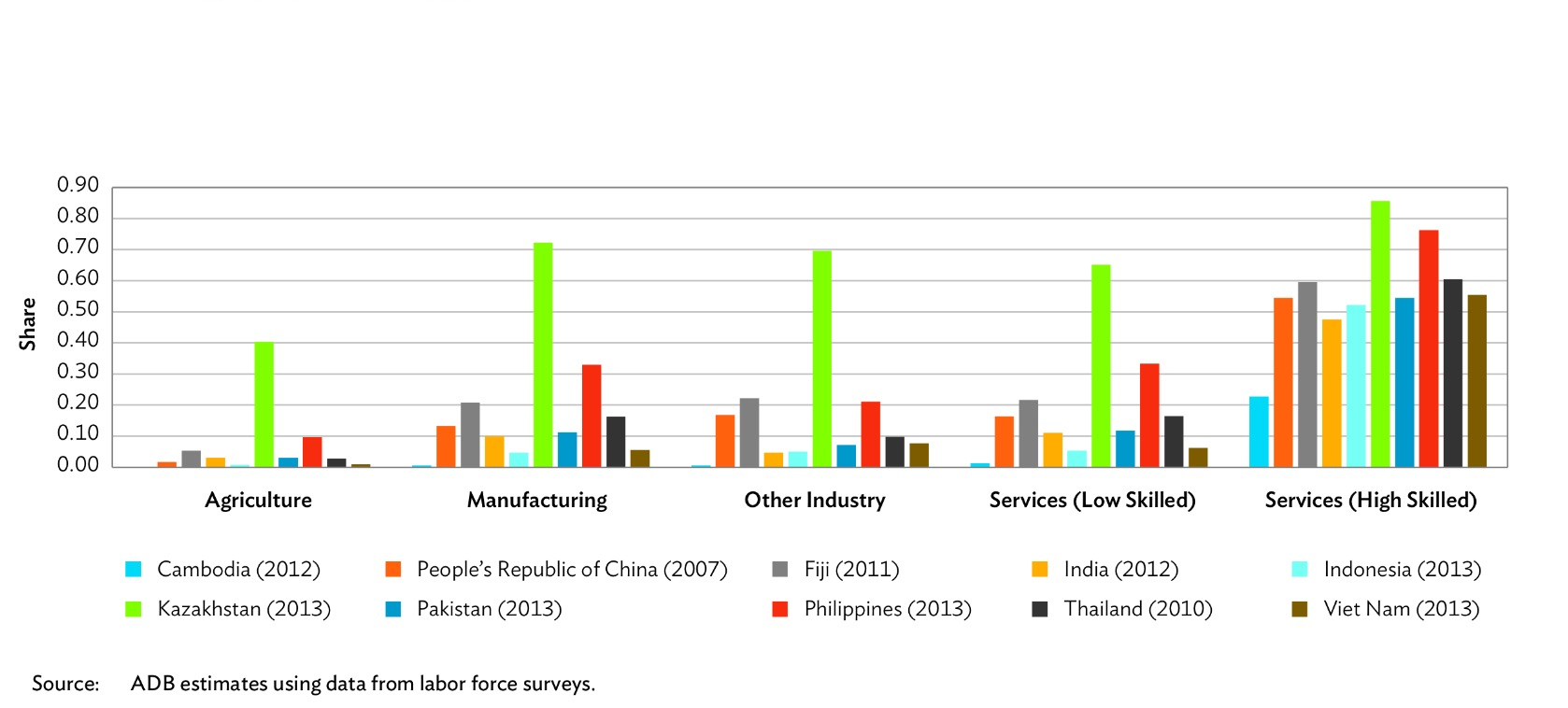
    ADB Report 2

    While China’s educated are represented in all sectors, including agriculture, India’s educated are overwhelmingly in the high-skill services sector.

    In my post China and India: Two roads diverged dated 29 November 2014, I had written:

    The benefits of the Chinese Revolution are most visible in the way the country raises and educates its children. The first major reform was the standardisation of the written language (Mandarin-Beijing dialect) across the country. Then, there was universal literacy and mass education, and eventually with a new higher education system geared to the country’s development needs, we see massive vocationalisation with an emphasis on technology in higher education. Today, there are no less than 4 Chinese and 4 Hong Kong based institutes/universities in the Asian Top-25, and not a single one from India.

    Higher Education in China has rapidly adapted to the global trend of internationalism, duly followed by indigenization of the knowledge gained. This means that the Chinese technocratic class is now geared to move from re-engineering western technology to innovation in its own right, and is encouraged through government investment to set up businesses in China itself. Contrast this with India, where IITs and IIMs, funded entirely by the humble Indian taxpayer, compete with each other in how many alumni they have been able to place in foreign companies – preferably in the USA!

    Furthermore, by opting to invest heavily in manufacturing industry, China has found a place for its unskilled, semi-skilled, skilled, and highly skilled workers, all in the same business matrix. Whereas, by opting for hi-tech services such as IT, India can provide the best opportunities only to its best and most educated workers, further fuelling the social and digital divide in the country.

    Thanks to ADB, I stand vindicated. And what a great way to conclude one’s 50th post in less than a year…
  • Beyond the Millennium Development Goals

    In developing countries, 2015 is a year of particular interest because it is the deadline for achieving the various targets under the Millennium Development Goals. To recap, the United Nations Development Programme (UNDP) saw a new hope for global action in the dawn of a new millennium, and this took the shape of the 8 Millennium Development Goals, which have shaped the development policies of many a nation for the last decade and a half.

    The original Millennium Development Goals, and their targets, were:

    GOAL 1: ERADICATE EXTREME POVERTY AND HUNGER

    Halve, between 1990 and 2015, the proportion of people whose income is less than $1.25 a day

    Achieve full and productive employment and decent work for all, including women and young people

    Halve, between 1990 and 2015, the proportion of people who suffer from hunger

    GOAL 2: ACHIEVE UNIVERSAL PRIMARY EDUCATION

    Ensure that, by 2015, children everywhere, boys and girls alike, will be able to complete a full course of primary schooling

    GOAL 3: PROMOTE GENDER EQUALITY AND EMPOWER WOMEN

    Eliminate gender disparity in primary and secondary education, preferably by 2005, and in all levels of education no later than 2015

    GOAL 4: REDUCE CHILD MORTALITY

    Reduce by two thirds, between 1990 and 2015, the under-five mortality rate

    GOAL 5: IMPROVE MATERNAL HEALTH

    Reduce by three quarters, between 1990 and 2015, the maternal mortality ratio

    Achieve, by 2015, universal access to reproductive health

    GOAL 6: COMBAT HIV/AIDS, MALARIA AND OTHER DISEASES

    Have halted by 2015 and begun to reverse the spread of HIV/AIDS

    Achieve, by 2010, universal access to treatment for HIV/AIDS for all those who need it

    Have halted by 2015 and begun to reverse the incidence of malaria and other major diseases

    GOAL 7: ENSURE ENVIRONMENTAL SUSTAINABILITY

    Integrate the principles of sustainable development into country policies and programmes and reverse the loss of environmental resources

    Reduce biodiversity loss, achieving, by 2010, a significant reduction in the rate of loss

    Halve, by 2015, the proportion of the population without sustainable access to safe drinking water and basic sanitation

    Achieve, by 2020, a significant improvement in the lives of at least 100 million slum dwellers

    GOAL 8: DEVELOP A GLOBAL PARTNERSHIP FOR DEVELOPMENT

    Develop further an open, rule-based, predictable, non-discriminatory trading and financial system

    Address the special needs of least developed countries

    Address the special needs of landlocked developing countries and small island developing States

    Deal comprehensively with the debt problems of developing countries

    In cooperation with the private sector, make available benefits of new technologies, especially information and communications


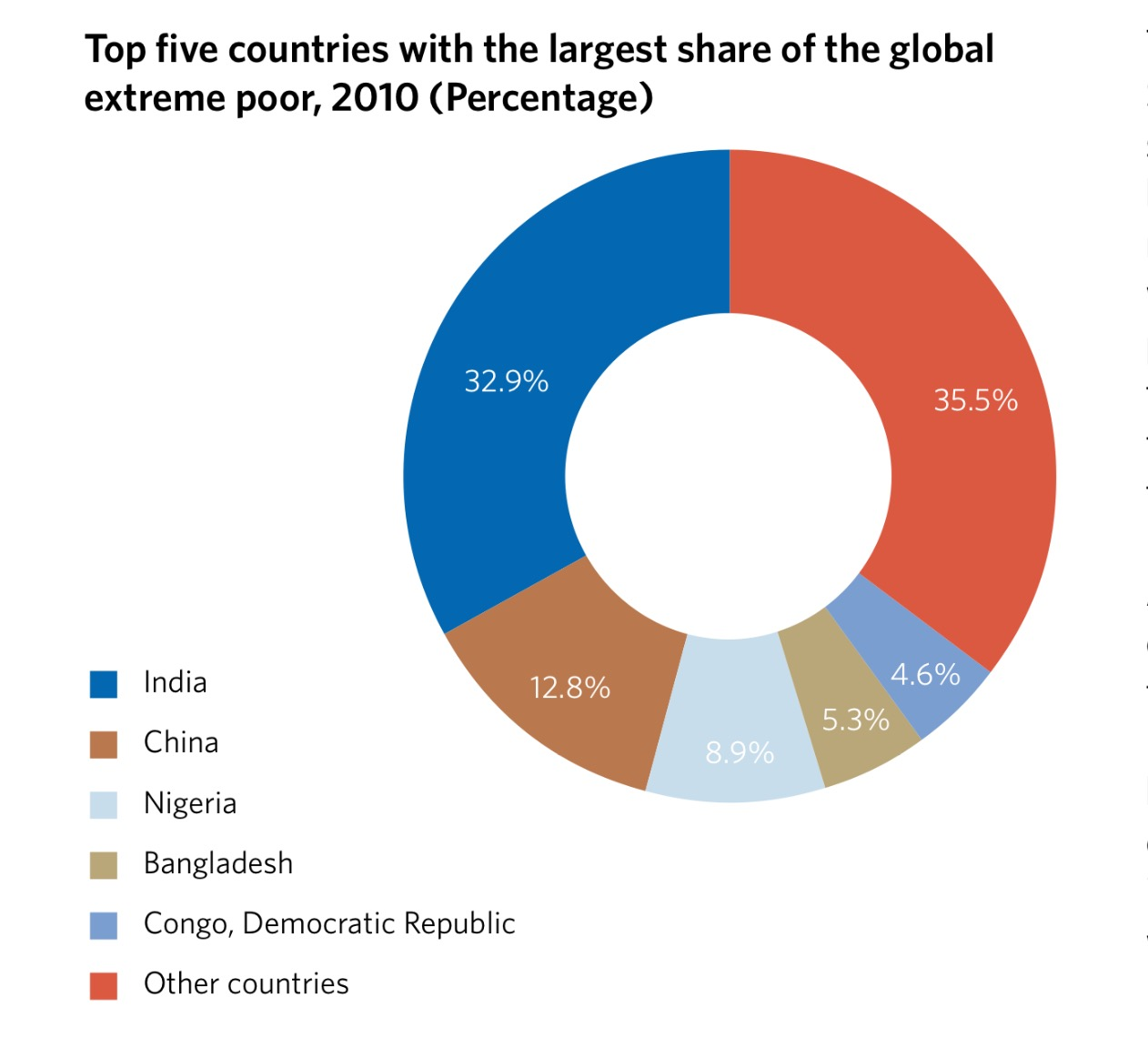
    As almost all the MDGs deal with different dimensions of poverty, the question to be asked here is how well (or badly) have the two demographic giants on the planet fared? Because the MDG targets basically dealt with halving this or that indicator, the expectation never was that poverty would indeed be eradicated in 15 years. It has been tackled with vigour in both India and China, and yet they have a long, long way to go:

    Poverty pie chart MDG post

    While China has largely secluded its poor in the countryside, India’s poor are everywhere – on street corners in the big metros; among the ill-educated and underemployed of the small towns, living lives of quiet desperation; amidst the small and marginal farmers with an anxious eye on the next monsoon which could spell the difference between choosing to live and choosing to die; and the poorest of the poor in the tribal districts of the country, with no private land to till, and all community resources lost to the greedy contractor.

    Many, like this blogger, have been trying to get the present government to look at the state of the nation’s poor, rather than posturing abroad to gain foreign direct investment – but to no avail. Well, if they don’t listen to us, they may perhaps listen to the 7.3 million people worldwide who are saying precisely the same thing. This was the number polled by UNDP in setting the goals for the next 15 years for all the countries in the world.

    Given the global concerns with issues like growing carbon footprints, climate change, and unsustainable development, the new goals targeted for 2030 are known as the Sustainable Development Goals, and are more than twice as many as the original MDGs. They are:

    1. End poverty in all its forms everywhere
    2. End hunger, achieve food security and improved nutrition, and promote sustainable agriculture
    3. Ensure healthy lives and promote well-being for all at all ages
    4. Ensure inclusive and equitable quality education and promote lifelong learning opportunities for all
    5. Achieve gender equality and empower all women and girls
    6. Ensure availability and sustainable management of water and sanitation for all
    7. Ensure access to affordable, reliable, sustainable and modern energy for all
    8. Promote sustained, inclusive and sustainable economic growth, full and productive employment, and decent work for all
    9. Build resilient infrastructure, promote inclusive and sustainable industrialization, and foster innovation
    10. Reduce inequality within and among countries
    11. Make cities and human settlements inclusive, safe, resilient and sustainable
    12. Ensure sustainable consumption and production patterns
    13. Take urgent action to combat climate change and its impacts
    14. Conserve and sustainably use the oceans, seas and marine resources for sustainable development
    15. Protect, restore and promote sustainable use of terrestrial ecosystems, sustainably manage forests, combat desertification and halt and reverse land degradation, and halt biodiversity loss
    16. Promote peaceful and inclusive societies for sustainable development, provide access to justice for all and build effective, accountable and inclusive institutions at all levels
    17. Strengthen the means of implementation and revitalise the global partnership for sustainable development

    Lest we forget…

    The Indian electorate does have a proclivity for throwing out governments which contemptuously ignore the poor – at the State level, and the Centre. Smart cities and busy expressways just don’t cut it with the village mother whose child has to trudge 10 kilometers to school – through rain and shine…

  • It’s all about the land…

    (Written in February 2015, long before the Russian SMO in Ukraine, and reposted because these issues are still relevant and largely remain unaddressed by the Indian Government.)

    An article I read on the ICH really shook me up, as it spoke about the real purpose behind the Ukraine coup and subsequent conflict – capturing the ‘granary’ of Europe, so that its lucrative agro-industries could be corporatized by western MNCs. And here we were naively assuming that wars were essentially fought over petrol and gas in the 21st Century!

    This article resonated with me particularly, as India is currently in the throes of a great debate between corporate promoters of infrastructure development, and protectors of those who make a living from the land which will be needed to develop this infrastructure – the millions of small and marginal farmers across the country.

    The occasion is the introduction in Parliament of the Bill amending the Right to Fair Compensation and Transparency in Land Acquisition, Rehabilitation and Resettlement Act, 2013 in such a way, that the social impact analysis and consent elements (which gave a voice to land owners) have been greatly undermined.

    So it boils down to the age-old rural-urban conflict, and how to allocate scarce resources like land in an equitable and just manner for the overall development of the nation.

    However, it is my personal view as a mere citizen that this is a false dichotomy. Greater efficiency in urban land use; and higher productivity on agricultural land are both achievable with a little forethought and planning, and can mitigate a lot of this false conflict.

    Let us look at urban land use first: Despite only 31% urbanization, India has the second largest urban population after China, and the differences in the Indian and Chinese approaches to urbanization have been amply covered in my earlier posts. (China and India: Two roads diverged… and China and India: Our cities, their cities)

    Essentially, I make a case for better land management, empowering of local urban government, and the densification of Indian cities to make them more efficient and citizen-friendly.

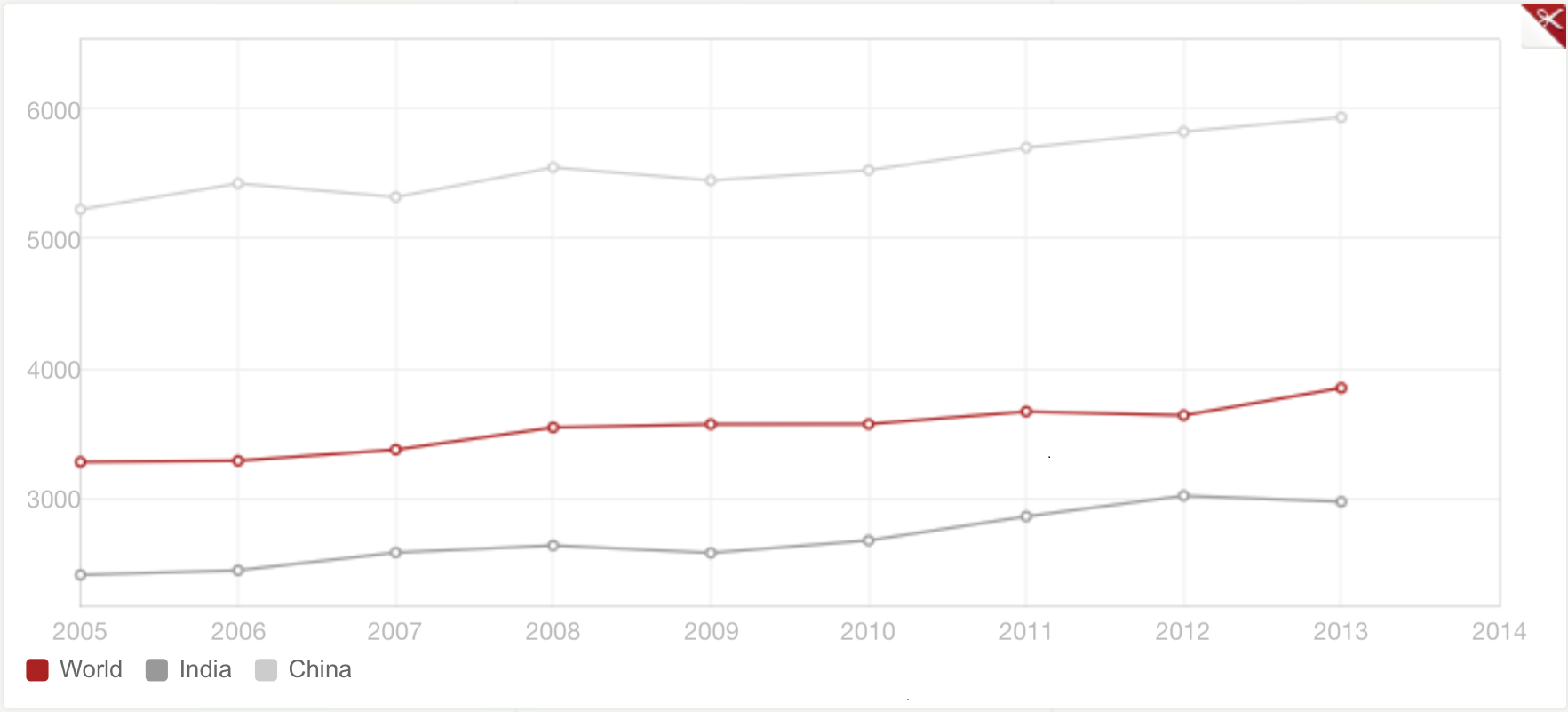
    Now look at the rural/agricultural scenario in these two countries, and one key indicator i.e. cereal production in kg/hectare:

    CEREAL PRODUCTION

    (Source: World Bank)

    Again, while Indian cereal production has remained consistently below the world average, China manages almost twice that. No wonder that 2013 estimates of the Indian economy put industry at 25.8%, the services sector at 56.9%, and agriculture at merely 17.4% of GDP.

    Slow agricultural growth (and not smart cities) should be the top priority of any Indian Government, as two thirds of India’s population depends on rural employment for a living. Ministers should be considering why current agricultural practices are neither economically nor environmentally sustainable, and why India’s yields for many agricultural commodities are consistently low.

    There are several reasons cited for this:

    • Firstly, acts of omission and commission by past governments (which a government promising ‘development’ and ‘good governance’ should be able to address, but won’t), like poorly maintained irrigation systems; absence of good extension services which facilitate the transfer of technology from the lab to the farm; poor roads; rudimentary market infrastructure; slow progress in implementing land reforms; inadequate or inefficient finance and marketing services for farm produce; and excessive regulation.
    • Secondly, the endemic poverty, illiteracy, general socio-economic backwardness of the Indian countryside. But as the current government has little time for advocates of human development like Dr Amartya Sen, I don’t see much hope there either…

    So constrained by its corporate backers, does this Government really have the will to do something for India’s farmers? They could start off by taking a leaf out of China’s book and pool agriculture land for economies of scale – maybe not as communes or collectives, but as cooperatives, which have proved so successful for sugarcane plantation in Maharashtra.

    Then there are alternatives to capital-intensive and heavy fertilizer dependent agriculture, which has only left behind a sad trail of rural indebtedness, despair and farmer suicides. Holistic farming systems which utilise locally appropriate knowledge, native wisdomand local labour  can successfully tertiarize rural economies and create significantly higher employment opportunities in the rural sector, thereby halting and reversing migration from rural to urban areas.

    Empowering farmers to ensure their own food and livelihood security through holistic farming systems, and through dispersed small industry based on agricultural produce, seems to be the only way forward.

    Sadly, instead of supporting small and marginal farmers through adequate budgetary allocations, the Central and State Governments have been expropriating their land for industrial corridors, townships and SEZs with huge incentives to their promoters, which eventually come out of the taxpayers’ pockets.

    It is rumoured that the proposed new capital for the state of Andhra Pradesh will be initially acquiring 30,000 acres of fertile, food-producing land – surely an extravagance India can ill afford.

    And the shiny new buildings there will produce a lot of food for thought perhaps, but none for the belly…

  • China and India: Our cities, their cities

    (Social media are full of people from all over the world drooling over the amazing infrastructure in Chinese cities. This, however is not because of some obscure oriental magic, but rather a result of deliberate policy and planning over several decades. I wrote this in 2014 after a visit to China and most of the institutional differences are very much in evidence even 12 years later. India has sadly, learnt nothing from its neighbour. )

    Shedding its rural, feudal past with a vengeance, China has officially tipped over – with 51% of its vast population now living in urban areas. This scale of urbanisation is unprecedented in human history and Chinese cities leave visitors awestruck and dumbfounded as they come in via the Maglev transit system, admire the skyline of a new Shanghai, visit its deep-sea harbour after driving over a 36 km sea bridge, or take off on a 1,460 km journey to Beijing by bullet train reaching there in four and a half hours flat!

    There are various enabling factors in China’s formidable infrastructure achievements:

    • Firstly, all urban land is owned and controlled by the local government, and made available for planned development once a plan is approved by the political decision-makers. In India, the urban administrator is not able to achieve even 20% of a 20-year DP because of the hassles in acquisition of private land for public purposes.
    • Secondly, infrastructure is created and developed by specialized technocrats in China, and maintained by retainers of local government; while in India most development bodies are headed by an officer from a generalist service like the IAS, with neither the technical expertise nor the continuity of tenure to see a long-term project through successfully. The indiscriminate entry of the private sector in developing and maintaining infrastructure in India is also considered a mixed blessing, and the leading source of corruption in government.
    • Moreover, resources raised from infrastructure development and urban growth accrue to the local government in China, and this encourages planned urbanization, unlike in India, where metropolitan planning bodies are State parastatals like the MMRDA, enriching the State of Maharashtra by exploiting the land in the city of Mumbai.
    • Planning decisions in China are not only publicised, but put in the public domain through magnificent state-of-the-art audio-visual feasts in their Planning Museums. In India, we have to be satisfied with a statutory ‘call-for-objections’ each time a Development Plan is formulated. There is little or no publicity given to planning decisions: residents of a locality are unaware of what is planned for their neighbourhood; and may wake up one fine morning to discover an abattoir or a crematorium next door!
    • Urbanization itself is greatly controlled in China: While the single-child norm takes care of growth through natural increase; immigration is controlled by the ‘hukou’ or residence permit system, which has built-in incentives like social security, and access to health and education. Anyone without an urban permit is automatically denied these benefits, and although there are squatter settlements in Chinese cities, these are normally at the periphery, unlike India where they dot the entire urban landscape in such profusion, and illegality. Similar controls in India would be deemed unconstitutional.
    • China tackles the problem of urban sprawl by densification, providing high FSI for both residential and commercial buildings (like Tokyo) and negating its worst impact through cheap and efficient public transport systems. Indian cities meanwhile, adhere to outdated and impractical plans for low form urbanisation – another sad legacy of British rule! The resulting urban sprawl and the poor public transport networks make commuting to work a daily hell for millions of people in India’s metros.
    • Like India, China too faces the problem of an informal economy, estimated at around 30%, but there are definite efforts made to formalise it through licensing, controls and provision of workplaces in the formal plan. These issues have remained largely unaddressed in India, leading to 60-68% informalisation of the economy in its metros.
    • Moreover, while manufacturing sector growth in China is incentivized through devices like SEZ’s, India has put most of its economic eggs in the services basket. Thus while the factories in China welcome equally the unskilled, semi-skilled and the highly-skilled worker; India’s IT sector has room only for the highly educated; and the less skilled get inexorably pushed into the growing informal sector.

    Indian urban managers and policy makers have a lot to learn from China:

    • Treat Urbanisation as a force for good, not evil. In 2005, China’s Ministry of Housing and Urban-Rural Development proposed the designation of prime cities as National Central Cities, as a first step in reforming urbanisation in China. These NCCs were described as a group of cities in charge of leading, developing, performing tasks in political, economic, and cultural aspects. Consequently, in February 2010, the ministry issued the “National Urban System Plan” and designated five major cities: Beijing and Tianjin in the Bohai Economic Rim; Shanghai in the Yangtze River Delta, Guangzhou in the Pearl River Delta, and Chongqing in western China. They also included Hong Kong as a Special National Central City. The NCCs’ sphere of influence has a great impact on the surrounding cities in terms of modernising and integrating services, infrastructure, finance, public education, social welfare, sanitation, business licensing and urban planning. The Ministry also makes mention of Regional Central Cities (RCCs) like Shenzhen, Nanjing, Wuhan, Shenyang, Chengdu, and Xi’an. India can learn a lot from this visionary approach to regional planning, and National Central City status will go a long way in revitalising the dying metros of yesteryear, like Kolkata and Mumbai.
    • An empowered Chief Executive is key to Local Economic Development. Visiting Mayors from South America and Europe are welcomed like heroes by local bodies in India. Mainly, because they are seen as vital agents of change and reform. Their Indian counterparts (with a few exceptions) have a largely ceremonial role, and the real executive power in Indian cities is vested in a civil servant, who is a State government permanent employee and has little or no investment in local concerns. Contrast this with the clout and powers of a mayor in a big Chinese city. A visit to the official website of the Mayor of Shanghai is a real eye-opener. In the last few months, the visiting foreign dignitaries who have called upon the Mayor include: the Belgian Ambassador, the Chilean Ambassador, Mayors of Dallas and Fort Worth, the Fijian President, the Governor of Yogyakarta in Indonesia, the Mayor of Colombo, the Vice President of South Sudan, the Russian Ambassador, and the President of Portugal. Now that is some clout, isn’t it?
    • Social planning is inextricably linked to land use planning. Not just China, but the capitalist Mecca of Singapore too indulges in fairly rigid social engineering whereby the government decides on where a family stays, where they dispose their garbage, and where their children go to school. Indian cities have a lot to learn from both these countries about the practical side of governance and making cities work, so that the maximum good of the maximum number is ensured and the yawning chasm between rich and poor is bridged to some extent – even if it means stricter laws and tighter enforcement for everyone.
    • Urban development means the full devolution of powers and resources to local government. In China, the benefits of local development accrue to the local government and so the city of Shanghai, for example, has a stake in building new infrastructure and planning new satellite towns because these will enrich the local government. In India, despite the recommendations of National and State Finance Commissions (under the 74th Constitutional Amendment Act) there has been inadequate devolution of resources to local governments, and where a city is a creator of wealth, these profits are creamed off by both State and Central Governments, while the local government struggles to make ends meet – the most obvious example being Mumbai, the largest single contributor to State and National GDP!
    • Urban planning thinks in centuries not decades. When China launched a massive construction boom, building new cities from scratch, the world was first alarmed, then amused, and is now awaiting the big crash. Because these cities are now ready but have nobody living there! But as Gandhiji rightly said: “First they ignore you, then they laugh at you, then they fight you, and then you win.” So perhaps, China will have the last laugh as they alone realise that projected needs and consequently, urban planning, need a much longer timeline than the mere 20 years so popular in India’s Development Plans. Moreover, it is much cheaper to build a city as a greenfield or brownfield project now than attempting to revitalise a dying city 20 years hence – as we have seen under JNNURM! As and when a city reaches carrying capacity, these new towns are ready to take the overflow. Further, unrealistic house prices (prevailing in Indian metros) have led to ever more slums in Mumbai and Delhi. By providing ready, available and affordable housing in and near existing metros, the Chinese have successfully tackled the problem of decongestion in a long-term time-frame. We should also remember that, unlike the West, relocation within China is a matter of Government policy and enforcement, and not left to the whims of market forces alone.
    • Natural resource management essential to prosperity. Another example of long-term planning is China’s heavy investment in natural resources abroad, to ensure that the factories in its cities don’t come to a standstill for lack of raw materials. For example, when China anticipated a drop in its virtual monopoly of rare earths, it was quick to tie up with Australian mining companies, to retain an upper hand. Rare earths are critical in the manufacture of smart phones, wind turbines and missiles. But what gets the West in a real tizzy is China’s foreign direct investment (FDI) in developing the infrastructure and natural resources of Africa. Interestingly, while the American President (despite his proclaimed African origins!) visited only 2 African countries in his first term, his Chinese counterpart visited 14. No wonder, Africa (long and brutally exploited by the West) is ready to welcome another country which helps its development but does not lay down pre-conditions like reform, nor threatens armed intervention in the name of democracy. Needless to say, such geo-strategic long-term planning in its national interest has evaded India for the last 67 years!
    • Connectivity is the safest route to mainstreaming marginal communities. One would not like to brush China’s problems with its ethnic minorities (like Tibet) under the carpet, but the fact remains that one of the greatest engineering marvels of this century has been the construction of the Beijing-Tibet Railway, against tremendous odds. The Chinese believe that connectivity is the shortest route to mainstreaming and national integration (and also allows for easier control and regulation, of course – which is why the British built railways in India so early on in their colonial rule!) Perhaps we can learn a few lessons from China, especially in mainstreaming the isolated N-E region of India. After all, civil unrest in any part of the country eventually affects the national economy.
    • Good governance also means efficiency and effectiveness. Two universally recognised indicators of good urban governance are efficiency and effectiveness, and it is visible everywhere in China – from the punctuality of the tour guide, to orderly queues in public places, to the unfailingly on-time trains and flights. Or the integrated 8-tiered transport hub at Shanghai International Airport. These are the little things which make city life a little easier, and are slowly disappearing from India’s urban dreamscape. Time to wake up and catch up with the world, India!

    Summarizing, the magic mantra in China seems to be: analyze, assess, plan and provide… 


    Whatever the divergence in their development paths and goals, India and China have a shared destiny as the two largest countries in an interconnected global economy, and they both need to take on board the hazards as well as the benefits of globalisation. Although both countries have taken long strides in developing infrastructure and economic growth, the Quality of Life and Human Development aspects have not received the same attention.

    India’s caste and class-riven society sees the gap between the rich and poor growing every day, as does the education and digital divide in the era of global connectivity. This is mirrored in the widening rural-urban divide in China, and the lack of individual liberties that democracies like India take for granted.

    Therefore, both India and China need to face up to several challenges of successful survival in changing times:

    • Firstly, how to ensure a more equitable distribution of their recent economic growth across caste, class, gender and region, while at the same time making their specialist areas globally competitive
    • Secondly, how to fix the trade-offs between universal human development and specialised infrastructure requirements
    • Thirdly, how to support the unorganised and informal sectors of the economy so that they yield sustainable livelihoods for the poor
    • Fourthly, how to adapt and universalize technology, especially information and communication technologies
    • And finally, how to realise the full potential of their prime resource – their large populations – to gain the edge in global negotiations…
  • China and India: Two roads diverged…

    There is a lot of talk in New Delhi and among the Government’s globe-trotting enthusiasts, about following the China Model for India’s development especially on two fronts: infrastructure development, and the manufacturing sector. However, let us pause a moment:

    If China runs 4 of the 10 fastest trains in the world – there is a reason…

    If just one District in China produces 50% of what the world buys, there is a reason…

    And I admit I am very partial to looking for reasons in the pages of history, rather than among the political rhetoric of an election campaign. So here goes…

    China and India have had somewhat similar histories, with civilizational continuity stretching back thousands of years. Both have had centuries of hierarchical social systems, with a very low status for women. Both suffered at least a century of humiliation at the hands of foreign traders, conquerors and colonizers before breaking free; and both became modern, independent nation-states at roughly the same time – 1949 and 1947. Both countries also suffered the trauma of partition/fragmentation at the time of independence – Taiwan broke away from China, while Hong Kong became a British dominion; and India was cleaved into two with the creation of Pakistan.

    However, it is after emerging as independent nation-states that the trajectory of these two Asian giants completely diverges:

      • While India opted for democracy; China chose the Marxist ‘proletarian’ road
      • While India chose centralized planning and governance as the route to development, China built up from the grassroots, village committee level
      • Political power in India flows from the top downwards, through a series of patron-client relationships; in China it rises from the village, to district, to regional capital to Beijing in the pyramidal structure of the Communist Party
      • As an eminent Indian historian once noted, India alone of all the newly independent colonies had the audacity to launch not one but 5 simultaneous revolutions – agricultural, social, national, industrial and urban. Naturally these varied revolutions could not keep pace with each other and after over six decades, India’s development directions still remain hazy. China meanwhile had no such ambiguities when it launched its Cultural Revolution, with the sole aim of tearing apart the fabric of the old feudal society and weaving it anew into a more modern, rationalist, pragmatic, egalitarian and secular pattern.

    It is ironic indeed that at the height of its Cold War with the Soviet Union, the West could only denounce and rant at the ‘excesses’ of this Cultural Revolution, and did not see in these excesses the seed of China’s future success – which the same West now admires so much. But as any neutral observer will tell you, perhaps it is these very ‘excesses’ which have made the Chinese miracle possible today.

    So what exactly were these transgressions?

    At the risk of being facetious, one can summarise them under the 4 Ls:

    Love: The most obvious excess was interference in the personal and family life of the population by enforcing restrictions (unique in human history) culminating in 1979, in the single-child norm.

    Land: The collectivization of all rural land, with ‘possessory rights of usufruct’ for 30 years; and the acquisition of all urban land by government (with a lease of 70 years to developers) were also considered as ‘excessive’ especially by the erstwhile feudal landlords.

    Lord: The outlawing of feudal lords on the one hand, and the abolition of religions loyal to a higher ‘Lord’ on the other, were quite repugnant to the rest of the world, and found to be violative of human rights and basic freedom of religion – never mind that the West was equally callous about the rights and freedoms of communists and atheists in their midst.

    Learning: This was the most far-reaching ‘excess’ of the Cultural Revolution, as schools of higher learning were closed and there was a deliberate process of dismantling the Western-educated elite. Intellectuals were put to the most demeaning physical labour in the countryside and told to adapt their knowledge to serving the peasants. These reforms also meant the end of the privileged civil service – after all, the word for bureaucrats everywhere comes from the Chinese word ‘mandarin’. It also cleared the decks for a complete revamping of the higher education system and its indigenisation to meet China’s immediate development needs.

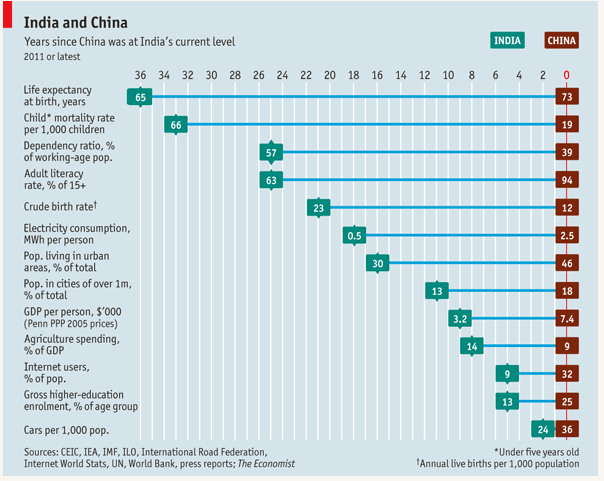
    As argued above, the Cultural Revolution put China on a path to development, while India was still floundering and experimenting amidst priorities that changed every five years – in the name of democracy. China’s focussed single-mindedness and its willingness to sacrifice today for prosperity tomorrow, set against India’s vacillations and contradictions are succinctly summarised in the chart below, showing the time lag between China’s achievement of a human development goal, and the number of years it did so ahead of India. (Courtesy: The Economist)

    India China

    For example, a child’s odds of surviving past their fifth birthday are as bad in India today as they were in China in the 1970s. Similarly, India’s income per head was about $3,200 in 2009 (holding purchasing power constant across time and between countries). China reached that level of development nine years earlier. This does not necessarily imply that India in 9 years’ time will be as rich as China is today. That is because China grew faster in the last nine years than India is likely to grow over the next nine.

    Let us now look at the ways in which China’s excesses of the 1960s, became the keystone of its successes in a globalised world, once Deng Xiaoping opened its doors to the world:

    • The Single Child Norm has helped to stabilise China’s population growth while India is all set to overtake it in the next few decades. This stabilisation has greatly increased opportunities for the individual, leading to greater equity. Moreover, it has at one stroke halved the incidence of poverty and thus broken the vicious cycle of deprivation in a single generation, while India continues to struggle with endemic and chronic poverty.
    • The collectivisation of rural land has made agriculture more productive through economies of scale, and provided rural livelihoods that are more sustainable, because a collective has better coping strategies in a crisis than an individual or a household. The lack of individual land ownership also makes rural society more egalitarian and less exploitative; and rural politics more participatory. In India, the absence of redistributive justice in land ownership is now acknowledged as the major cause of the insurgency in its predominantly tribal areas.
    • Similarly, the urban land in China is entirely owned by the Government, and this has allowed proper urban planning, redevelopment, infrastructure development and affordable housing, whereas in India, no Development Plan gets more than 20% implemented because of the difficulties of land acquisition, and the inevitable litigation through India’s tortuous judicial system.
    • According to some estimates, over 70% of Chinese are listed as being atheist or agnostic, while the remaining follow Shenism-Taoism, Buddhism, Islam and Christianity. Aspirants to the membership of the Communist Party have to affirm their atheism if they wish to progress in their political careers. The most obvious fall-out of this policy has been the true secularisation of Chinese society, with formerly religious practices being reduced to general public holidays, and State and religion being kept strictly apart. This too contributes to the pervasive egalitarianism in Chinese society. It also means that there are no constraints like caste on the opportunities available to Chinese students, whereas caste and related affirmative action programmes continue to remain a political tinderbox in India.
    • The benefits of the Chinese Revolution are most visible in the way the country raises and educates its children. The first major reform was the standardisation of the written language (Mandarin-Beijing dialect) across the country. Then, there was universal literacy and mass education, and eventually with a new higher education system geared to the country’s development needs, we see massive vocationalisation with an emphasis on technology in higher education.
    • Today, there are no less than 4 Chinese and 4 Hong Kong based institutes/universities in the Asian Top-25, and not a single one from India. Higher Education in China has rapidly adapted to the global trend of internationalism, duly followed by indigenisation of the knowledge gained. This means that the Chinese technocratic class is now geared to move from re-engineering western technology to innovation in its own right, and are encouraged through government investment to set up businesses in China itself. Contrast this with India, where IITs and IIMs, funded entirely by the humble Indian taxpayer, compete with each other in how many alumni they have been able to place in foreign companies – preferably in the USA!
    • Another programme recently launched is the teaching of English in all urban schools from the first grade itself. Furthermore, by opting to invest heavily in manufacturing industry, China has found a place for its unskilled, semi-skilled, skilled, and highly skilled workers, all in the same business matrix. Whereas, by opting for hi-tech services such as IT, India can provide the best opportunities only to its best and most educated workers, further fuelling the social and digital divide in the country.

    Therefore, we may safely conclude, that today’s China was born after a long and hard gestation, with thousands of lives lost and all the blood and thunder of revolution. They re-invented themselves. So must India – development is not a matter of simple ‘copy and paste’.

    In my next post, I shall be focussing on urbanisation in China and lessons therefrom, for urban planners and managers in India.