Development and Governance

Blog

  • Indian Urban Planning in limbo

    Clichés about Indian cities abound – the skyscrapers of the rich surrounded by the squalor of slums, the overcrowded public transport, the stray cows at the crossroads, the piles of garbage, the algae infested waterways, the polluted and unbreathable air… and successive governments have simply not had the time (because rural poverty required attention immediately after Independence) nor the inclination (because urban India has just 31% of the vote) to do anything about India’s dead and dying cities.

    To make matters worse, Indian urban planning has always been trapped in something of a time warp, still true to its British parentage, while countries like South Korea, Singapore and China have surged ahead and shown the world how millions of urban dwellers can live in cities that work, and are still people-friendly.

    Like all the laws governing Indian cities today, the planning laws too originated under British rule in the Bombay Town Planning Act of 1915, and it is quite understandable that the provisions of this law all hark back to ‘the green and pleasant land’ the law makers had left behind, and wished to recreate in India. Never mind that Britain had solved its population problems through forced and unforced emigrations to North America and the antipodes, while India’s population was still burgeoning!

    As a result, India was left tied to an outdated ‘low urban form’, strict zoning laws which militated against the poor, and development control rules (DCR) redolent of a past where the colonials lived in splendid bungalows, and the ‘natives’ lived in congested squalor. Remnants of this colonial past are still visible in the cantonment areas of cities like Pune, with crumbling bungalows (with empty stables!), huge tracts of vacant defence land, clubs (and even a racecourse!) occupying prime land in what could be the city’s Central Business District (CBD) if developed with an eye to the future instead of the past…

    Streamlining and modernizing land laws is crucial to any urban planning that Indian cities may indulge in, and integrated, culturally relevant, flexible and people-friendly urban planning allows for less costly provision of basic services such as water and sanitation, higher resilience, climate change mitigation and adaptation, poverty reduction and pro-poor policies.


    The cornerstone of current Indian urban planning is the Development Plan (DP), often described as the vision of the city, its physical configuration and growth in the foreseeable future, and the environmental considerations and technical solutions unique to the geography, history and social make-up of every city. It sets the agenda of what the city wants to do with itself in the next two to three decades. To make this vision a reality, the urban planner takes into account the various public requirements of the city and reserves lands, whether public or private, for those purposes. The plan also proposes conservation and preservation of areas that have natural, historical or architectural importance. The Development Plan also makes provisions for the city’s transportation and communication system such as roads, railways, airways and waterways, and parking facilities.

    The two instruments of a Development Plan are zoning, and reservation:

    • Zoning is the means whereby compatible land uses are grouped together, and incompatible uses segregated – such as manufacturing industry and residential areas.
    • Reservations for public purposes include schools, colleges and educational institutions, medical and public health facilities, markets, social welfare and cultural institutions, theatres and places of public entertainment, religious buildings, burial grounds and crematoria, government buildings, open spaces and playgrounds, natural reserves and sanctuaries, dairies, sites for public utilities such as water supply and sewerage, fire stations, other community sites, service industries and industrial estates.

    In order to successfully implement the Development Plan, the municipal body needs to be empowered and this is done through Development Control Rules (DCR). These rules deal with the manner in which building permission can be obtained, the general building requirements, and aspects of structural safety and services. Access, layouts, open spaces, area and height limitations, lifts, fire protection, exits and parking requirements are all stipulated in the DCR. Similarly, structural design, quality of material and workmanship, and inspections during construction are spelt out. The control of floor space use, tenement densities, and the Transfer of Development Rights (TDR) are some of the most crucial issues dealt with by these rules.

    Although Development Planning is the path to city development all across the world, the sad fact is that in most Indian cities, not even 10% of a DP gets actually implemented. In fact, while all the tedious processes of approval, amendment and land acquisition are going on, the citizens have built their houses and moved in, without waiting for the infrastructure promised in the DP. Once an area becomes inhabited, the best a municipal body can do is retrofitting the essentials like water supply and sewerage, at huge cost. In this way are our ‘planned’ cities unplanned.

    Urban Planning because of its control of that most precious commodity in an overcrowded country (land) is also susceptible to major subversion and scams. A well-documented case is that of the prime land tied up in Mumbai’s dead and dying textile mills, until the Supreme Court of India intervened to permit their brownfield redevelopment by the mill owners, with due reservations for public amenities and housing. The problem here arose from a little sleight of hand by vested interests. The Government of Maharashtra had introduced the Development Control Rules (DCR) in 1991, under which a mill owner was permitted to sell or redevelop his land, provided one-third was surrendered to the municipal corporation for public amenities and another third to the Maharashtra Housing and Area Development Authority (MHADA) for low-cost housing. The remaining third was the owner’s. Ten years later, it surreptitiously amended this clause to make it apply only to vacant land – as distinct from the entire footprint of the mill. As a result, the first mill which would have surrendered 5,641 sq m for open space and 4,616 sq m to MHADA, got away with forfeiting just 474 sq m and 388 sq m respectively. In the case of Modern Mills, the corresponding figures are 8,626 versus 1,163 sq m as open space, and 7,058 sq m versus nothing for housing. Even this open space is often subsumed within the redeveloped complexes (mill to mall) and is not public space, strictly speaking.

    This tendency to play fast and loose with planning laws and development control rules when it comes to big land owners in urban areas is deliberate, as it gives a lot of discretion to public officials and is the biggest source of corruption in local government. The ultimate losers, as always, are the unfortunate citizens of these cities, who keep getting pushed to the outer peripheries, as homes in the central areas have become simply unaffordable even for top earning professionals.

    Lastly, when the very raison d’être of great cities has been manufacturing, how can they survive de-industrialization? They don’t. While de-industrialization may hollow out a western city, in India, de-industrialization ‘leaves the world to darkness and to me…’ The stalwart of the informal sector, living a life of quiet misery and departing life unmourned and unlamented. How and when will India reinvent its Bombays and Madrases? Perhaps by renaming them yet again?


    According to UN Habitat, “…the city of the 21st century is one that transcends the form and functionality of previous models, balancing lower energy costs with a smaller ecological footprint, more compact form, and greater heterogeneity and functionality. This city safeguards against new risks and creates conditions for a higher provision of public goods, together with more creative spaces for imagination and social interaction.

    The city of the 21st century is one that:

    • Reduces disaster risks and vulnerabilities for all, including the poor, and builds resilience to any adverse forces of nature
    • Stimulates local job creation, promotes social diversity, maintains a sustainable environment and recognizes the importance of public spaces
    • Creates harmony between the five dimensions of prosperity and enhances the prospects for a better future
    • Comes with a change of pace, profile and urban functions and provides the social, political and economic conditions of prosperity…”
  • World Development Report 2019: The Changing Nature of Work

    It had to happen I suppose. After the World Development Report 2018 on Learning to Realize Education’s Promise, it was only to be expected that the World Development Report 2019 would look at the Changing Nature of Work.

    Last year, the President of the World Bank Group, Jim Yong Kim reminded us how education helped his country to rise from the ashes of war: “Today, not only has [South] Korea achieved universal literacy, but its students also perform at the highest levels in international learning assessments. It’s a high-income country and a model of successful economic development.” This year he reminds us that “investing in Human Capital is not just a concern of ministers of health and education; it should also be a top priority for heads of state and ministers of finance.” Simple economics indeed!

    The Report points out that the nature of work is changing in several ways:

    1. Digital technology is gradually replacing the traditional input-output production process, with the global platform marketplace which brings together producers, providers and customers in a multi-sided model
    2. The skill set required of workers today is shifting from manual skills to socio-behavioural, which require higher cognitive skills and greater adaptability
    3. There is a global shift from manufacturing to services, which again requires a differently skilled workforce and only those countries which have invested heavily in human capital (like Singapore and South Korea) have used this opportunity to move from developing to developed country status
    4. South Asia, on the other hand, has again missed the boat in this regard, and the result has been the unrelenting informalization of their economies, with a concomitant poor quality of life for their citizens

    The Report suggests areas in which governments need to act promptly, to ensure that they are not left behind by the rest of the world, often frittering away their demographic dividends:

    • Investment in human capital, particularly early childhood education, to develop high-order cognitive and socio-behavioral skills in addition to foundational skills.
    • Enhanced social protection. A solid guaranteed social minimum and strengthened social insurance, complemented by reforms in labor market rules in some emerging economies, would achieve this goal.
    • More fiscal space for public financing of human capital development and social protection.

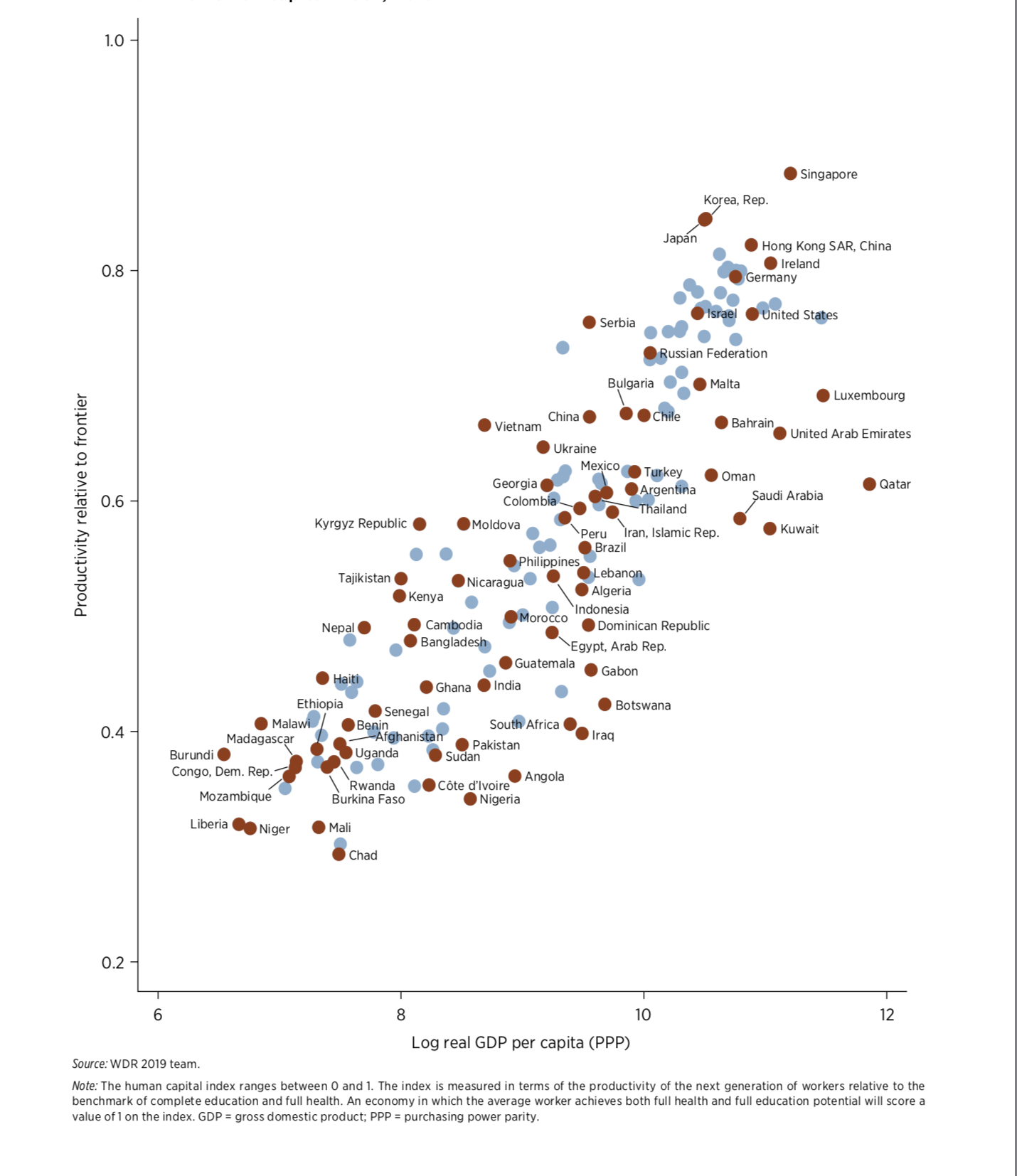
    To back up its argument, the Report presents its first Human Capital Index for ranking its member nations. The index follows the trajectory from birth to adulthood of a child born in a given year, and quantifies the milestones in this trajectory in terms of their consequences for the productivity of the next generation of workers.

    It has three components:

    1. a measure of whether children survive from birth to school age (age 5)
    2. a measure of expected years of quality-adjusted school which combines information on the quantity and quality of education
    3. two broad measures of health—stunting rates and adult survival rates.

    The HCI calculated for nations is graphically presented as below:

    The World Bank’s Human Capital Index has really set the cat among the pigeons, by calling to account governments like the present one in India, which only chase growth in GDP at the cost of long-term human development of future generations. The Indian Government has cried foul about the data used in this Index, but statistical hassles notwithstanding, it is very clear that the present government has grossly neglected the human, social and environmental aspects of development in favour of physical infrastructure alone. And as we know, sustainable livelihoods can be provided only when ALL five types of capital are amply provided and balanced – human, social, natural, physical and financial. 

    No wonder then, it may well be the issue of livelihoods in both urban and rural areas which may see drastic political changes across India in the coming days and months…


  • Looming Water Crisis in Indian Cities


    While the pollution of cities like New Delhi grabs world headlines, with the Supreme Court threatening to ban all private vehicles in the national capital, there is little public and media interest in another looming catastrophe for all Indian cities – the deteriorating water supply.

    India’s water consumption is projected to touch 843 billion cubic meters (bcm) by 2025 against the current availability of 695 bcm. By 2050, the country will need 1,180 bcm of water, and at the same time groundwater is being depleted at unsustainable rates. These are the conclusions of a new report by the Niti Aayog (formerly the Planning Commission), and its author, Avinash Mishra, goes on: “We’re in dire straits and we need to change our approach to tackle the crisis, otherwise the situation will become so grim that the shortages will knock down our GDP by 6 percentage points in over a decade.”

    The water situation has worsened gradually over the years and is rooted (as most of India’s problems are) in too much politics, and too little governance.

    The problems begin with sourcing of water for big cities like Chennai, Mumbai and Delhi. At the institutional level, urban local bodies do not have control of the source which is either with the Irrigation Department or parastatals, whose first priority is, naturally, agriculture.

    Secondly, the groundwater of a city remains largely in private hands and is tantamount to theft, as the aquifers supplying water to private wells are a common natural resource for everyone. The Groundwater Surveys and Development Agency (GSDA) of the State Government has identified 4,500 wells in a major city like Pune, but only 200 borewells are registered with the Pune Municipal Corporation (PMC). The result of this discrepancy has been the growth of a tanker mafia, with the average citizen at its mercy for his/her daily water supply. Again, only 150 water tanker suppliers are registered with the Corporation, while hundreds more operate below the radar – often tapping the PMC’s own supplies illegally, to sell at a premium to the hapless citizen.

    The ‘Dynamic Ground Water Resources of India’, a report published by the Central Ground Water Board, defines the stage of development of groundwater as the percentage of utilisation of groundwater with respect to recharge. The chart below shows the extreme overutilization of groundwater in major Indian cities:

    Groundwater in Major Indian CitiesMeanwhile, unchecked extraction by urban farmers and wealthy residents has caused groundwater levels to plunge to record lows, and the 21 major cities shown above, are expected to run out of groundwater by 2020, affecting 100 million people.
    To make matters worse, an estimated 70% of India’s water is contaminated with arsenic, fluoride, salinity, nitrates, industrial effluents, organic and inorganic solid waste. Further, only one-third of its wastewater is currently treated, meaning raw sewage flows into rivers, lakes and ponds – and eventually gets into the groundwater.

    A municipal corporation’s woes though, are only just beginning – having made this low-quality water drinkable at great cost in terms of treating agents and electric power for purification, it must further spend millions to distribute the treated water through an antiquated distribution network, losing further through illegal tapping and leakages in the system – often as high as 40%. The heavy physical losses, low pressure and intermittent supplies, lead to back siphoning and further contamination of water in the distribution network.

    Of course, the consumer at the other end is never happy with the result, curses the Corporation for not providing water 24×7, and will take to the street to protest even a paltry hike in his monthly bill. Water, it is argued, is a ‘gift of nature’ and should be free. In reality, the heavy subsidy on drinking water is the main reason for the impoverishment of municipal bodies the world over. The Pune Municipal Corporation, for instance, spends Rs 11 to provide 1000 litres of water, and recovers only Rs 5 – a subsidy of Rs 6 for every thousand litres, multiplied a thousand-fold, takes a heavy toll of its inadequate resources.

    The financial situation of municipal bodies was not helped by replacing buoyant local taxes and levies (like Octroi) with grants from the Central kitty, routed and delayed by the State Government. It is estimated that although the Centre will compensate cites like Mumbai on par with their last receipts when Octroi was replaced by a consolidated Goods and Services Tax (GST), the loss to the Municipal Corporation in terms of the buoyancy and immediacy built into Octroi, could mean anywhere between 10-15% loss of revenue.

    The problem arising from the complexity of the institutional arrangements, the machinations of the informal water sector, and the huge imbalance between revenue and expenditure, all make urban water supply a city manager’s worst nightmare.

    However, all is not lost – municipal bodies themselves can do a lot to improve operational efficiency in the sourcing and supply of water to their citizens. An effective, professional and dedicated workforce will go a long way in preventing the massive losses through illegal connections and leakages. Most municipal bodies have water supply departments which are grossly understaffed, and this increases their dependence upon private contractors whom it can neither monitor, control nor regulate. This adds greatly to the inefficiency of the city’s water supply as a whole.

    Municipal Corporations must also stem the leakage losses due to the corruption amid its own staff, whereby private contractors will fit a broad-gauge supply line to a particular building or locality, while it is shown at half that gauge in the municipal records.

    Demand side management of costing and pricing of water also needs to be modernized, learning from good practices across the world. Currently, most Indian cities have only a fraction of their connections metered, but the bulk of their non-commercial users pay a lump sum as part of their annual Property Tax – and this has no relation whatsoever, to the actual quantity of water used in a year by that property owner. As the poor are limited in the amount of water they can store, the greatest beneficiaries of the subsidy are the middle class, who may indiscriminately use the expensively provided water for drinking, bathing, flushing their toilets, or washing their cars. While a more discriminatory pricing system like the Increasing Block Tariff or IBT will ensure that the available subsidies go to the deserving, the conservation of water through rainwater harvesting and recycling schemes could also be incentivized through a system of rebates on tariff.


    Sadly, one thing is clear – just like climate change and air pollution, dwindling water supplies must be tackled by all countries on a war footing. There simply aren’t enough tomorrows left with the human race…

  • Quality of Life in a Global and Indian Context

    (Published in 2018, and still relevant.)

    Quality of Life is being increasingly discussed in India – the older generation laments its passing and TV Gurus propose that we use it to measure the Government’s performance before the next election. Then again, there are sporadic reports from foreign agencies ranking Indian cities globally at 116, or 126, or whatever. And we shake our heads in sorrow. But have you ever wondered how ‘quality’ of life can be measured with such accuracy in ‘quantities’? And who exactly is measuring it and why?

    The whole QOL craze is a product of our increasingly interconnected global economy. Multinationals needed an easy base number to calculate the salaries of expatriate workers and an index was needed to work out the costs of children’s education, medical care, and ‘hardship’ allowances for conveniences unavailable in a foreign posting.

    The best known of these indices is the Mercer Index for Quality of Life. It evaluates local living conditions in more than 450 cities according to 39 factors, grouped in 10 categories: political and social environment, economic environment, cultural environment, medical and health considerations, schools and education, public services and transportation, recreation, consumer goods availability, rental housing including household appliances, furniture and maintenance services, and lastly, natural environment/climate and record of natural disasters.

    QOL Determinants

    As expected, the prime cities of over-resourced and underpopulated Western Europe, Australia or Canada take the top spots. Interestingly, if we list the best 20 cities on the Mercer Index and compare them with the 20 most populous cities, we will find that not one city from the second list figures in the first. So, one can safely conclude that as a city grows in size, beyond its carrying capacity, the first casualty will always be the quality of life of its citizens.

    Does this mean that the world’s largest urban agglomerations are doomed to linger in the nether regions of such scales year after year – with their citizens forever deprived of a decent quality of life? I don’t think so.

    Instead of constantly validating our happiness by western criteria, why can’t Indian (and Asian) cities set their own standards for judging Quality of Life? These would be firmly anchored in each country’s social, cultural and political realities and would resonate well with the people, besides comparing one city with another on the true quality of life; not just the level of services available.


    To work out an Indian QOL Index, the following questions need to be asked. These can be answered using our own urban experience and data locally available with various government agencies, parastatals, professional bodies and NGOs. (Note: These can readily be adapted for other countries too, taking local socio-political factors into account.)

    Political and Social Environment

    • Do women feel safe living by themselves and traveling at all hours across the city?
    • What is the city’s performance in Centrally-sponsored programmes for the poor – in terms of livelihoods, self-help groups and subsidized housing?
    • What is the Police record in tackling crime and maintaining Law and Order in the city?
    • Are there mohalla (community) committees to defuse a potential conflict before violence breaks out?
    • How active is the voluntary sector in the city?
    • How successful are public awareness and sensitization campaigns on various social issues?

    Economic Environment

    • What is the city’s contribution to the Central and State exchequer in terms of various direct and indirect taxes?
    • What is the access and availability of banking and financial services in the city?
    • Are there Special Economic Zones, IT Parks and other facilities, earmarked for industries and services?
    • Does the city have a domestic/international airport, a railway junction/station?
    • How well is the city connected to national and international e-retail networks?
    • What are the rents per square foot for commercial premises in the city’s CBD?
    • How many businesses in the city are registered under the Shop and Establishments Act?
    • How efficient are the public utilities like power and broadband connectivity?
    • What is the standard of municipal services in the areas of public transport, water supply, sanitation, solid waste management, etc?

    Housing and related issues

    • What percentage of the city’s economy and housing are in the informal sector?
    • How many notified slums does the city have?
    • What is the average monthly rent for a 1000 sq ft apartment?
    • What are the average monthly maintenance charges in a cooperative society?
    • What percentage of the city’s housing is owner-occupied?

    Schools and Education

    • Is the number of schools adequate for 100% coverage of the school going population?
    • What is the average student to teacher ratio in the city schools?
    • Do municipal and ZP schools offer children the same learning opportunities as private schools?
    • What is the availability and affordability of institutions of higher learning? Are they equally accessible to locals as to outsiders?

    Health and Sanitation

    • How does the Public Health machinery respond to a crisis, epidemic or disaster?
    • Is Primary Health Care (PHC) available and accessible in every corner of the city?
    • What is the city’s doctor to patient ratio?
    • What is the city’s hospital bed to patient ratio?
    • How many specialist medical and diagnostic services are available in the city’s hospitals?
    • How many 24-hour pharmacies does the city have?
    • What is the city’s record in mass immunization campaigns?
    • What percentage of the city’s housing is connected to the main sewage line?
    • How many public toilets does the city have per 1000 users?

    Natural Environment

    • Is there a city policy on monitoring and limiting air, noise and water pollution?
    • What are the average annual pollution levels for the city as a whole?
    • Are the public spaces and green cover available in the city adequate for its population?
    • Is the water supply in the city adequate per WHO norms? How much is actually supplied per day per capita?

    Cultural Environment

    • Does the city government finance, subsidize and encourage cultural activities?
    • Does the city organize annual festivals of Literature, Art, Music, Drama?
    • How many Libraries, Art Galleries, Drama theatres, Cinema theatres and multiplexes does the city have?
    • Are there local handicrafts and artisan groups? Does the city provide them subsidized business support?

    And so on…

    Such an Index will not only be meaningful to Indians, but will also facilitate policy formulation at the city level, and allow cities to compete with one another to offer a better quality of life to all their citizens.

  • Poverty now an ascribed status?

    While I was writing a piece on understanding urban poverty for a newspaper, I was struck by the fact that being poor has become as much an ascribed status across the world, as race, gender and caste. In other words, you live and die with what you are born into – an accident of birth that marks you for life. And you start ‘paying’ for this accident in the womb itself – with a malnourished mother giving birth to a chronically undernourished child.

    Look at the state of children today – at the forefront of every conflict, born and growing up with the sound of rockets and bombs in their ears – not their mother’s lullabies. Escaping war only to succumb to entirely treatable diseases like cholera, ravaging their malnourished little bodies. All across the world, what begins as politics and resource grabbing, ends up as another humanitarian crisis where the children of the poor continue to pay the price for being born at the wrong place at the wrong time: whether in Syria, Yemen, Gaza, or Myanmar.

    If a child of a poor household escapes being born in a war zone, it will have other conflicts to endure – child labour, trafficking, slavery, sexual exploitation, little food and less education. In other words, no aspiration or escape from the terrible conditions he or she is born into – only a childhood lost forever.

    The Sustainable Development Goals may speak of ending poverty in the next decade or so, but see how the world is treating its future generations: children make up the majority of those living in extreme poverty. In 2013, an estimated 385 million children lived on less than US$1.90 per day. Still, these figures are unreliable due to huge gaps in data on the status of children worldwide. And this income data by itself is far from sufficient to truly gauge the depth of deprivation among poor children worldwide.

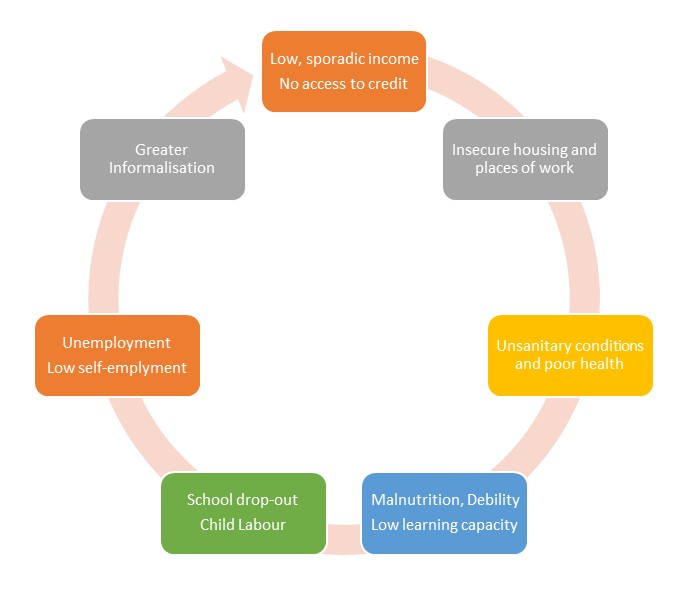
    Gone are the days when poverty, especially urban poverty was measured merely by the lack of income, or resources. As Robert McNamara pointed out as far back as 1980: the deprivations of the absolute poor “… go beyond income. And in many cases, even if their income were higher… they could not by that fact alone free themselves from their difficulties. The reason is that absolute poverty is a complicated web of circumstances, all of them punitive, that reinforce and strengthen one another.”

    And the reinforcement covers all dimensions like low income, little or no access to credit, lack of security of tenure, unsanitary living and working conditions, malnutrition and poor health, low learning capacity and lifelong unemployment and underemployment.

    Trapped in this vicious circle, can the poor ever break out on their own?

    Cycle of Poverty

    Obviously not. But there are several points at which a government can break the cycle, provided it has the political will not to sell out to the rich, and to agree with McNamara when he says: “To reduce and eliminate massive absolute poverty lies at the very core of development itself. It is critical to the survival of any decent society.”

    Governments, especially those in South Asia, need to realize that the universalization of primary and secondary education is key to all future development – social, industrial and economic. Schools themselves can become an agency to monitor the nutritional status of children and their immunization against the deadliest childhood diseases besides spreading the message about hygiene and sanitation.

    With the basic education structure in place, social evils like child and forced labour can be eliminated from society, and the future workforce can continue learning long enough to move to vocational and professional education, which will enable employment in the formal sectors of the economy and gradual formalization of the tiny, micro and informal sectors through proper registration, record and regulation by the government.

    South Asian countries must also put in place a representational system for all assets, liabilities, and inventories of the poor to give them access to institutional finance. The absence of such a system is one of the reasons that the poor and their assets cannot be mainstreamed into the local, regional and national economies in these countries, resulting in huge losses to governments in terms of unassessed and uncollected taxes.

    But these things have been said again and again and nobody seems to care anymore.

    I hang my head in shame…

  • Demagogues and Democracy

    Democracy and demagoguery have the same root: demos or Greek for ‘people’. So why is it that we value the first but decry the second?

    The highly educated ‘citizens of the world’ from privileged backgrounds who became leaders of the newly decolonized countries of the 1950s and 60s, were nonetheless loved and re-elected by their people and became quintessential democrats, articulating the hopes and aspirations of the common woman and man. These leaders gave us the Non-aligned Movement and the OAU and strengthened the various institutions under the United Nations. Within their countries, they did their best to undo the ravages of centuries of colonial rule by institution-building, redistributive justice, and vast welfare and poverty alleviation programmes. They also endeavoured to bring their countries into the modern era by developing a scientific temper through modern and universal education. By providing greater inclusion and equity in society and a more people-friendly and responsive administration, these pioneering democrats left us with the templates of good governance.

    This path of international cooperation led inevitably to a globalized and interconnected world in the last years of the previous century, and societies today have become irrevocably changed by the resulting technology and the concentration of capital in fewer and fewer hands. It was only to be expected that this new era of growing inequity and inequality and the corporatization of national policy would throw up its own leaders – and this has indeed come to pass from the Americas, through Europe, to Asia.

    Despite the liberalization and privatization of national economies, we have seen the demise of the liberal, the democrat, and the rise of the demagogue – a preacher and practitioner of principles contrary to democratic ideals: exclusion instead of inclusion, inequality instead of equity, narrow nationalism, centralized decision-making, polarization of society at large, and a deep discontent not addressed but allowed to simmer, so that it can erupt at the ‘right’ moment. We are living in an era of poor governance and can do little to change this state of affairs.

    This slide from democracy to demagoguery is as visible in the US today as in India. Does it mean that we subvert democracy to dislodge the demagogues, who remain immensely popular with large sections of their electorate, nonetheless. Or go back to the rule of an elite? That is the eternal dilemma facing all liberals today.

    It is essential to understand how the mind of a demagogue works, so that he can survive failure after failure and still feel secure:

    • A demagogue (by definition) believes that he knows best so he will eschew advice, dismantle advisory bodies and institutions, tear up treaties, trade agreements and protocols, build walls and surround himself with those who entirely agree with him, stifling dissent and rewarding sycophancy. This deprives him of insights, knowledge and information which are necessary for making the right decisions.
    • Secondly, demagogues tend to believe their own rhetoric. This makes them incapable of objectively analyzing the ground reality and learning from their mistakes, so no corrective action is ever taken.

    Take the case of India – the PM, a demagogue par excellence, promised to galvanize the Indian economy by bringing in Foreign Direct Investment (FDI) on an unprecedented scale, for which he travelled to every corner of the world. And soon the absolute figures were proudly touted around to show that the promise had been fulfilled. However, when economists began to query the authenticity of these claims, it emerged that absolute FDI figures were meaningless as all such figures grow from year to year like the population and GDP of a country. It is when we examine the FDI to GDP ratio that we notice how poor India’s performance has really been on this front. A clear case of believing one’s rhetoric without closer examination.

    INDIA FDI TO GDP RATIO

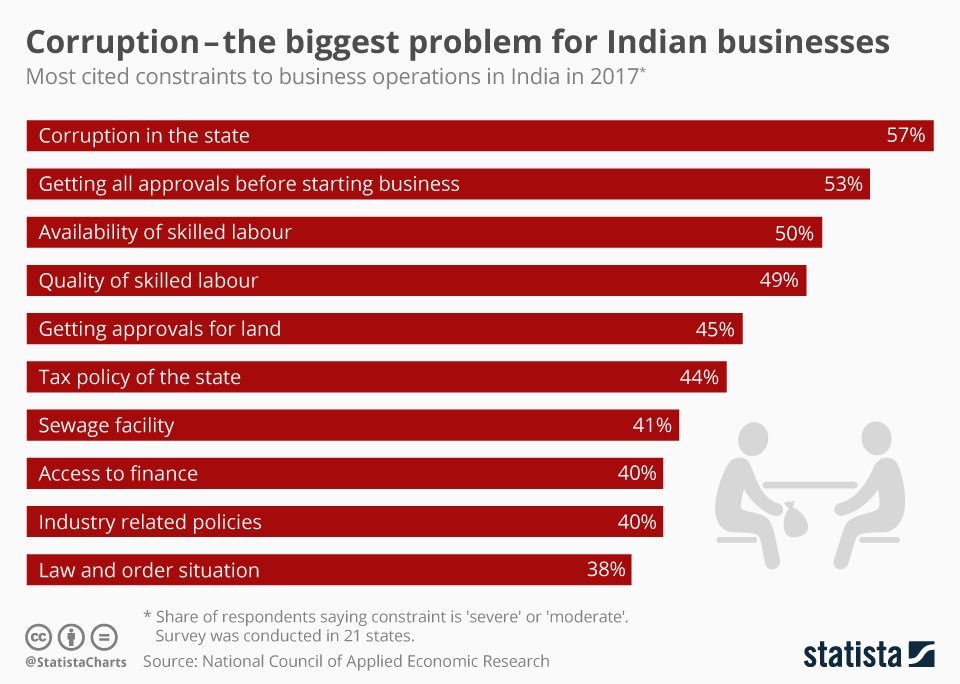
    The Indian Government has also given great publicity to the fact that India has climbed in the ‘Ease of doing business’ rankings because of the government’s efforts to cut red tape. Therefore, the following assessment by its own agency (NCAER) is all the more damning:

    Yet again, the demagogue cannot believe that his actions have directly or indirectly contributed to this state of affairs and instead of taking responsibility, will blame it upon his predecessors, the solar eclipse, the astral configuration, the Nehru family, whatever…

    Let us look again at these constraints in the light of government’s actions/inaction:

    Corruption: You cannot fight corruption on the one hand while institutionalizing it on the other by permitting unlimited, anonymous donations to political parties, where this money is brazenly used for buying votes in the villages and legislators in State Assemblies.

    Clearances: You cannot expect the administration to act expeditiously or efficiently when all decision making is centralized in a few hands, and tools of greater transparency like the Right to Information Act are being diluted to total ineffectiveness.

    Skilled Labour : You cannot launch instant solutions like Mission Skill India expecting it to produce a skilled workforce overnight, while grossly neglecting both universal primary and secondary education and vocational training, as these are long-term and resource-heavy commitments which do not fit into a 5-year electoral mindset.

    Land acquisition : You cannot tinker with Land Laws. As the government’s fiasco in diluting the social impact analysis and consent elements of the Right to Fair Compensation and Transparency in Land Acquisition, Rehabilitation and Resettlement Act, 2013 early in its tenure showed, land is an extremely emotive issue in rural India and can make or break a government. So, India’s land acquisition continues to be mired in endless red tape and litigation.

    Policy issues : There is immense confusion about most tax and financial policies of the present government, and businesses need unambiguity and clarity. There is no clear cut tax policy and it gets chopped and changed in every annual budget.

    Law and Order: This remains a great worry in an India where lynch mobs, communal riots, rapes and murders are the staple of daily news, and the government is increasingly perceived as being indifferent to the deteriorating situation.

    A clear case of blatant and repeated failures of governance.


    Does this mean that the next election will see a regime change? Unlikely. Please remember that the definition of a demagogue is: “… a leader who makes use of popular prejudices and false claims and promises in order to gain power”. So how long does it take to reawaken old prejudices about religion, caste, class, race or immigration to get re-elected? Meanwhile the ‘liberal democrat’ can go back to airing his discontent in 280 characters on Twitter. Sad indeed.

  • WDR 2018: Learning to realize Education’s Promise

    It is very interesting to compare how the great Asian nation states of today emerged from the chaos of World War II and subsequent decolonization. While Japan, China, South Korea and other East Asian countries each dismantled their old feudal order (at great human cost) to step into a modern and more egalitarian world; the fragments of what was the Indian sub-continent were kept busy in confrontation and conflict with each other, while the old feudal hierarchies flourished with a patina of modernity, albeit in discarded Western garb.

    The choice to build a society of equals (with a natural outcome of inclusion in all policy, precept and practice) has been East Asia’s greatest strength and nowhere has inclusion paid richer dividends than in the universalization of education and the consequent enhancement of human capital for nation building. South Asia meantime, has concentrated on building elite institutions for the elite. Full stop.

    In his introduction to the World Bank’s World Development Report (WDR) 2018: LEARNING – TO REALIZE EDUCATION’S PROMISE, the President of the World Bank Group, Jim Yong Kim, gives the example of his own country “… After the Korean War, the population was largely illiterate and deeply impoverished. Korea understood that education was the best way to pull itself out of economic misery, so it focused on overhauling schools and committed itself to educating every child—and educating them well. Coupled with smart, innovative government policies and a vibrant private sector, the focus on education paid off. Today, not only has Korea achieved universal literacy, but its students also perform at the highest levels in international learning assessments. It’s a high-income country and a model of successful economic development.”

    The World Development Report this year is a refreshing change in that it looks at quality not quantity, effectiveness not efficiency, learning not schooling. Moreover, it admits that the global learning crisis is a moral crisis and schooling without learning is a wasted opportunity. “… More than that, it is a great injustice: the children whom society is failing most are the ones who most need a good education to succeed in life.”

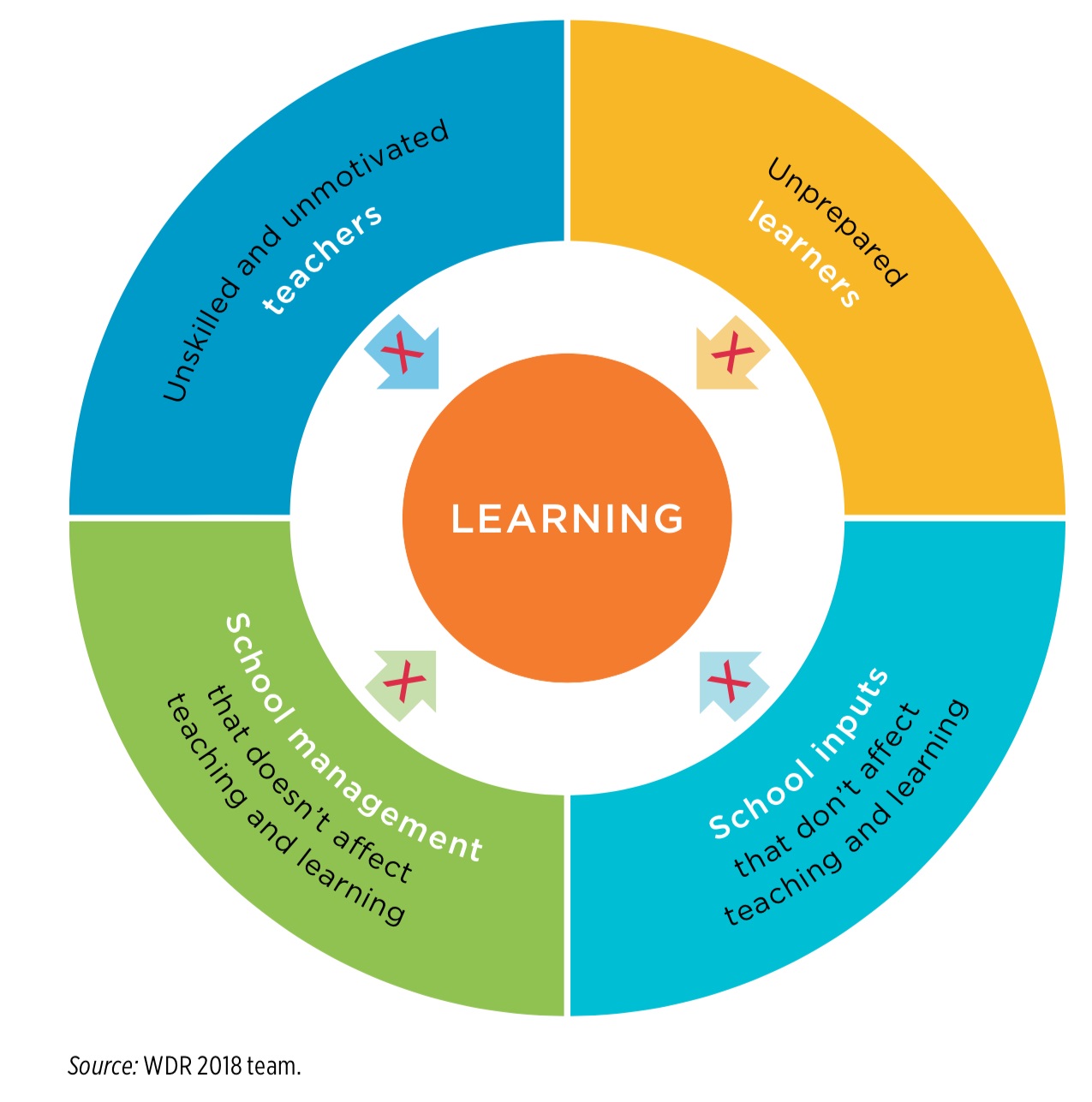
    The WDR 2018 sums up the reasons for the learning crisis, and the four immediate factors that break down:

    WDR2018 CHART 2
    Unprepared learners: Across the world, students from poorer households have more problems learning than those from richer households. Because of deprivation and malnutrition, a child’s innate learning ability is not fully developed and many come from homes where both parents may be illiterate/uneducated. The artifacts of learning, like books, are absent from the environment as the child grows to the age of enrollment, and child experts agree that if by the age of three, a child’s brain has not developed its full potential, it is unlikely to do so later.

    Unskilled and unmotivated teachers: Poor training and the subsequent lack of knowledge and pedagogical tools make teachers in most developing countries a hindrance rather than a help to learning. The situation is made worse by widespread absenteeism with little or no monitoring and evaluation.

    School inputs: Necessary resources often fail to reach classrooms or to affect learning when they do. One normally expects that with adequate resources, the quality of education would improve. However, resources in the hands of unmotivated and unskilled teachers are seldom deployed effectively and may have little or no impact on learning outcomes. (The other side of the coin is that one has seen highly motivated and dedicated voluntary workers achieving impressive results with few, if any, material resources in roadside ‘schools’ for street children or in the slums of large Indian cities.)

    School management: Poor management and governance often undermine schooling quality. Although effective school leadership does not raise student learning directly, it does so indirectly by improving teaching quality and ensuring effective use of resources.

    The Report goes on to suggest three complementary strategies to realize education’s promise and prioritize learning, not just schooling. It argues that achieving learning for all will require countries to:

    • Assess learning to make it a serious goal. Information itself creates incentives for reform, but many countries lack the right metrics to measure learning.
    • Act on evidence to make schools work for learning.
    • Align actors to make the entire system work for learning.

    Finally, the WDR 2018 points out that the rapid technological change of recent years has led to major shifts in the nature of work, and the demand for new skills will require “… foundational skills that allow individuals to size up new situations, adapt their thinking, and know where to go for information and how to make sense of it.”


    If the learning crisis continues to remain unaddressed, then countries like India will forever lose their demographic dividend, and sink into a low-productivity-and-endemic-poverty trap, which they have so assiduously fought to break out of, in the past 70 years…

    “If your plan is for one year, plant rice. If your plan is for ten years, plant trees. If your plan is for one hundred years, educate children.”
    KUAN CHUNG (7TH CENTURY BC)


  • Happy Republic Day: Can India ever become truly Inclusive?

    Clearly inspired by the French Revolution, the Preamble to the Constitution of India reads:

    WE, THE PEOPLE OF INDIA, having solemnly resolved to constitute India into a SOVEREIGN SOCIALIST SECULAR DEMOCRATIC REPUBLIC and to secure to all its citizens:

    JUSTICE, social, economic and political;

    LIBERTY of thought, expression, belief, faith and worship;

    EQUALITY of status and of opportunity; and to promote among them all

    FRATERNITY assuring the dignity of the individual and the unity and integrity of the Nation;

    IN OUR CONSTITUENT ASSEMBLY this twenty-sixth day of November, 1949, do

    HEREBY ADOPT, ENACT AND GIVE TO OURSELVES THIS CONSTITUTION.

    As it took 2 more months for India to formally become a Sovereign Republic, we celebrate Republic Day on the 26th of January every year, with a grand parade in New Delhi, usually with a foreign Head of State as Chief Guest. The entire parade, works the theme of Unity in Diversity to death, and brushes under the carpet the great dissensions, differences, divisions and disparities which plague us even 68 years later.

    This year however, the Government of India scored several own goals in the week leading up to the Republic Day. Firstly, the PM a la Marie Antoinette said in an interview, ‘They have no jobs? Then let them sell street food to survive…’. Then, in the face of gross government inaction, protesters against a movie actually stoned a school bus full of terrified children; and finally, Oxfam published its Commitment to Reducing Inequality (CRI) Index Report, which ranks not India but the INDIAN GOVERNMENT at a pathetically low 132 – all this, while the PM was exploring in Davos, ways to make India’s rich richer.

    Indian voters are said to exercise great freedom of choice each time they throw out the incumbent and bring in a new regime, which spends the first 2 years blaming the ‘legacy’ issues for its non-performance, and the last 18 months preparing to overcome its own incumbency factor before the next election. So the best time to judge a Government’s performance is in its third year – and that is why the present Government is facing severe scrutiny on every front: economic, governance and development.

    This dear reader, is why Oxfam’s CRI Index is so damning – because it measures the commitment of current governments, and this cannot be fobbed off by stories of ‘inherited’ problems, historical inequality, the caste system, the British colonial rule or whatever. This is the here and now and the present government is answerable – not its predecessors of any shape or colour.

    Interestingly, this Republic Day, the parade in Delhi had not one, but a clutch of Chief Guests – the Heads of State of ASEAN – who are in Delhi for a meeting. So how does India compare to the 5 founding members of ASEAN on the CRI Index? Let’s see…

    Country Spending on Health, Education, Social Protection Rank Progressive structure and incidence tax Rank Labour market policies to address inequality Rank Total CRI Rank
    Thailand 61 22 136 70
    Singapore 65 105 96 86
    Indonesia 121 34 114 101
    Philippines 101 80 122 104
    Malaysia 96 30 135 106
    INDIA 149 91 86 132

    Oxfam India offers blunt advice to the Government of India on how to improve its CRI ranking:

    Create an economy for all: Promote inclusive growth by ensuring that the income of the bottom 40% of the population grows faster than of the top 10% so that the gap between the two begins to close. This can be done by:

    • Promoting labour-intensive sectors that will create more jobs
    • Investing more in agriculture
    • Implementing fully the social protection schemes that exist

    Seal the leaking wealth bucket: Reduce extreme wealth and create a more equal opportunity country.

    • Tax the super-rich by re-introducing inheritance tax and increasing the wealth tax
    • Reduce and eventually do away with corporate tax breaks
    • Take stringent measures against tax evasion and tax avoidance
    • Increase public expenditures on health and education

    Bring data transparency: Produce and make available high quality data on income and wealth, and regularly monitor the measures the government takes to tackle the issue of rising inequality.

    In other words, go for INCLUSION. But does a government whose basic ethos is exclusivist and divisive, even begin to understand what inclusion means in modern development jargon, let alone devise and implement policies to bring it about in this most unequal of societies? (Who can forget Dumont’s classic definition of the species of humans in this society as Homo Hierarchicus?)

    It is time indeed to truly understand this concept in all its dimensions because it is the development phrase du jour and crops up in the UN’s Sustainable Development Goals, in the Smart Cities projects, and so on…

    The best explanation I have come across recently is in a World Bank Report East Asia and Pacific Cities – Expanding Opportunities for the Urban Poor. Incidentally, the Report covers the ASEAN countries mentioned above, besides China and Japan – home to the largest single city and urban agglomeration respectively. It begins with giving due credit to the East Asian countries in drastically reducing urban poverty, and any traveler there  will indeed vouch for the much better living conditions of the urban poor in East Asia, than in South Asian cities in India, Pakistan and Bangladesh.

    The writers of the report explain the expanding opportunities for the urban poor by consciously inclusive policies introduced by their governments.

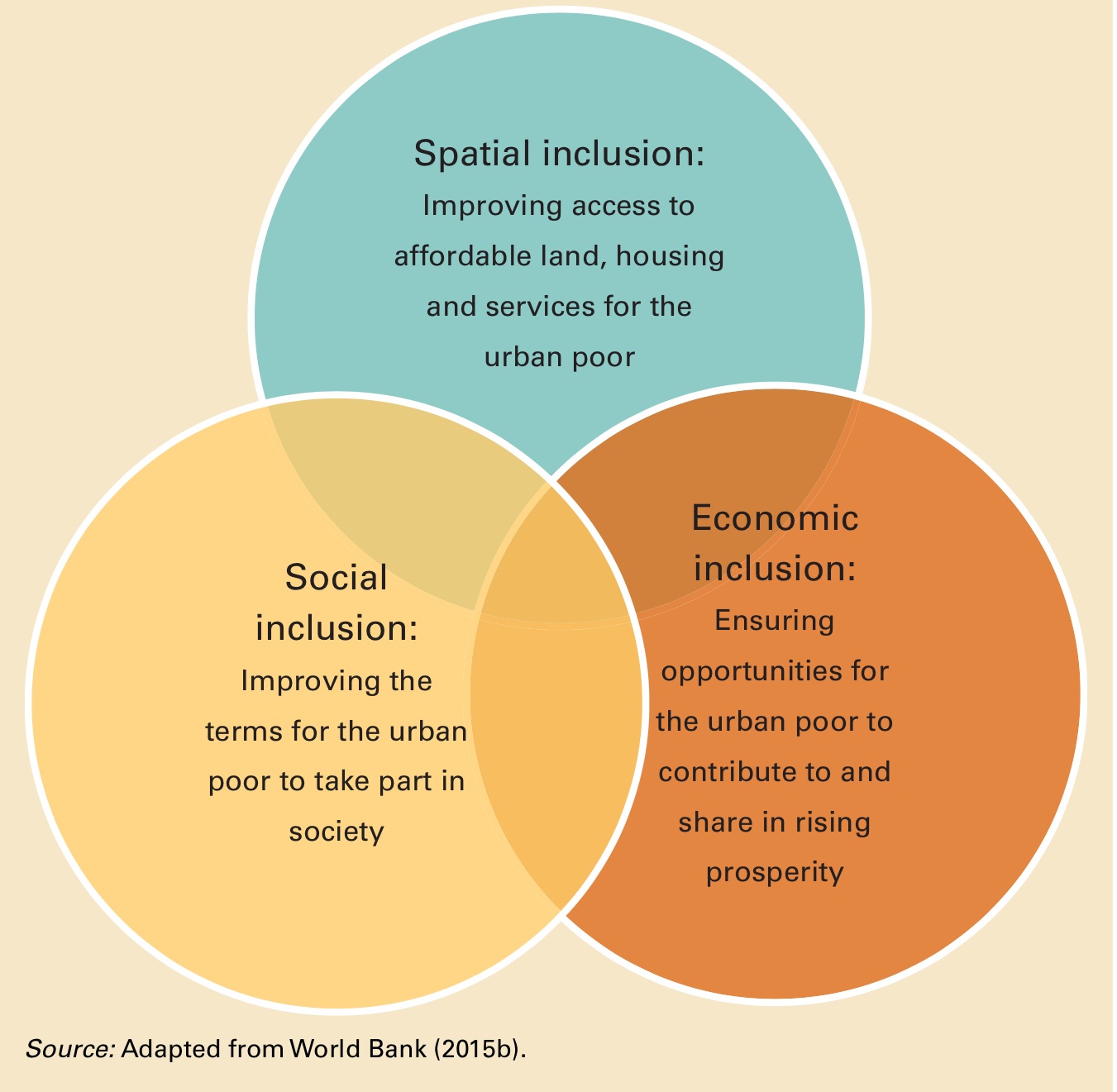
    They identify three dimensions of inclusion:

    Economic Inclusion: refers to equitable access to jobs and income-generating activities, mechanisms of resilience to withstand shocks and removal of barriers to formal employment

    Spatial Inclusion: links equitable access to land, housing, infrastructure, and basic public services. Mobility is particularly important, given its role in connecting low-income residents to jobs, services, and amenities. Housing must be accessible, affordable and ensure good quality and safety

    Social Inclusion: relates to individual and group rights, dignity, equity, and security

    This Multidimensional Framework of Inclusion is graphically depicted in the report as under:

    Multidimensional Model of Inclusion

    What is noteworthy is that the three dimensions overlap, and government interventions cannot be designed and implemented piecemeal. We have seen the havoc caused to the environment in Gujarat in the name of ‘development’ during the last two decades, and a similar short-sighted approach to inclusion may end up as nothing more than ‘including’ India’s entire billion-plus population in an electronic, biometric database which is being regularly hacked, misused and abused.

    If the Government of India doesn’t show a greater commitment to long term investments in Education, Health and Social Protection, doesn’t introduce a more just taxation system, and doesn’t formalise the rapidly growing informal sectors of the economy and society, well then organisations like Oxfam will not keep quiet and India’s international credibility will take a further beating…


  • Development? Governance?

    After 75 posts on this blog, one may be forgiven for sitting back and letting readers explore whatever was said over the last three years. I am gratified that various search engines have serendipitously landed people from over 132 countries on this site, and many have bookmarked it and returned to browse from time to time. Thank you.

    However, a WordPress notification wished me a happy anniversary, and I revisited the ABOUT page to check out my original motives for starting this blog: to explain the much misused terms of governance, corruption and development being arbitrarily thrown about in India’s political discourse at the time of the 2014 election, which brought to power a conservative, right-wing, market friendly party (the BJP) and routed the old establishment party – the INC, or Congress (please note this is not the legislative body it is in the US, but a political party in India.)

    So let us indeed look at how these concepts have evolved and are understood, 42 months down the line:

    Governance: I had covered the theory of Good Governance in one of my earliest posts, where I explain the relation between governance and government, and explain the globally accepted criteria for good governance: Good Governance

    However, it has totally escaped this regime that government is subsumed within governance which has the empowered citizen at its heart. There is a similar ignorance of concepts like rule of law, consensus orientation, probity, code of ethics, freedom of information, conflict of interest, protocol, chain of command etc. As a result, the present government doesn’t score too well on providing either efficient and effective government, or participatory, accountable, responsive, transparent, inclusive or equitable governance.

    The shortcomings of the ruling cabinet in terms of education, experience and exposure are very evident in the fact that almost ALL of the schemes and programmes of the previous government have been continued with NO substantive change except in their names. Never mind that most of these programmes had huge flaws which this cabinet of innocents continues to propagate. But if you throw out the baby (research, monitoring and evaluation wing) with the bath water (Planning Commission) who will point out these flaws and suggest ways to correct them? Instead, by farming out evaluation of important and costly schemes to private consultants, Indian data has lost a lot of its credibility among multilateral research organizations, and gained no real insights for future policy formulation.

    Other institutions are also being undermined – whether the Reserve Bank of India, the Election Commission, or various federal and state investigative agencies. Further, the federal structure is itself under threat as decision making has become non-consultative and centralized (e.g. demonetization), and financial allocations to State Governments are becoming increasingly politicized – being used in election campaigns as threats or promises.

    Corruption: The entire corruption narrative in India is limited to favours granted in return for bribes/cash. This is rather simplistic, and if it affects the common man then this type of corruption continues unabated among the petty bureaucracy no matter which party is in power. That is a fact of life in India. I had tried to broaden this debate by showing how capture and clientelism are equally detrimental to national interest (The 3 Cs- Corruption, Clientelism, Capture). Three years on, the great Indian people are at last getting to understand what is meant by ‘capture’ or crony capitalism as our social media prefer.

    But clientelism remains more elusive – the best example of that is seen during elections in largely rural States like UP, where a village chief or mukhia can deliver an entire village’s vote for a promise of future personal benefit – like a share in a Central Government infrastructure project, or a ticket in the next State election. As this pattern of bottom up electoral victories is repeated, we will all get a better understanding of clientelism. It is noteworthy that virtually nobody has been brought to book, or even formally charged, in the various ‘scams’ the previous government and its coalition partners were allegedly guilty of – again clientelism in action: support us today and go scot free tomorrow. Simple.

    Development: I had sarcastically hinted that development would be reduced to acquiring bullet trains, never dreaming how true this would be – literally! Never mind that the rest of the country’s infrastructure is among the poorest globally. Of course, this reduction of all ‘development’ to physical infrastructure, ignoring concepts of ‘human development’, will remain the most damaging legacy of the present government, as it will become the key deciding factor in 2019, as it was in 2014.

    This tunnel vision is coupled with attitudes of climate change denial and loosening of ecological regulations in the sanctioning of megaprojects and it augurs ill for India’s achievement of the UNDP’s Sustainable Development Goals – which would be a tragedy, because India had done better than expected in the previous Millennium Development Goals. Interestingly, attempts to achieve the MDGs and thus governance in favour of the poor and disadvantaged, necessarily pushed the UPA Government and the Congress Party to the ideological Left and away from their 1991 image of pro-free market globalists. And in my humble opinion, this was the real cause for the Congress Government’s defeat in 2014.

    The Indian electorate was not tuned to fashionable ideas like the Rights Approach to development…

    You see, the disgruntled middle level ‘dominant castes’ in India have such a sense of entitlement that they see any action in favour of the poor, the disadvantaged and minorities as appeasement and will not allow rights-based programmes to succeed. Sadly, even in 21st Century India, your politics and opportunities continue to be decided by an accident of birth.

    I had clarified in an earlier post (India an Aspirational Society? Not yet… ) that India would never be a truly ‘aspirational society’ without greater equality, better distribution of wealth, unity of purpose and civility. Sadly, all these ideals are in tatters just three and a half years down the line, and Indian society and polity have never been as divided, discriminatory and raucous as they are today.

    One consequence of these attitudes has been the conscious marginalization of India’s poor, which now manifests itself in greater hunger, deprivation, malnutrition, higher school dropout rates, poorly educated human resources, increase in child and forced labour, distress migration, farmer suicides and ever greater informalisation of the economy, livelihoods, and urban housing. And frankly, nobody in power gives a damn. The Opposition too is patently moving from the Left to the Right of Centre, with the entire electoral focus shifting to businesses and the ‘entitled’ middle castes (as in Gujarat), with no mention at all of the poor…


    Sadly, it is this disempowered but enfranchised section of the population who can even now deliver the votes needed (a mere 31%) to elect the next government. All that the incumbents have to do is use the standard right wing tools of diversion, emotion, commotion, coercion and subversion to ensure another term. These are the means which bring and retain the neocons in power from North to South America, to Israel to South East Asia…

    But is this democracy, you may wonder… Of course it is. Because what else will give us the ‘moral’ high ground vis-à-vis autocratic China and Russia ? (I am sure this resonates a bit with my American readers too…)


  • Latin America: Damned to be violent forever?

    When I wrote the last post on this subject, Latin America: Populations are also People in April 2015, I felt quite optimistic about the future of that region, with no less than 14 Left wing governments elected, and the Gini Coefficient of Inequality steadily moving downward for the whole region. The hope was that the slow but steady human development in these societies would reduce the glaring inequalities, and this would decelerate crime and therefore violence…

    But this was not to be…

    As explained in another post, WDR 2017: Revisiting Corruption, Capture and Clientelism, quoting Dr Jong-Sung You – every time an attempt is made at redistributive justice, the aggrieved elite forced to give up their privileges, react with allegations of ‘corruption’ to affect regime change, bring in a rich-friendly government and ‘capture’ the economy. This has happened in Brazil, Argentina and is under way in Venezuela, while the world focuses its energies on the Middle East, and the drama in the White House.

    And all the good done in terms of social and human development in the first decade of the millennium is gradually undone, leaving Latin America as prone as ever to violence and crime, as seen below:

    Latin American Homicide Rates

    Therefore, it was with special interest that I read a recent World Bank Publication Stop the Violence in Latin America – A Look at Prevention from Cradle to Adulthood by Laura Chioda.

    The Report makes several important points about what it calls the physiognomy of crime and violence in Latin America and the Caribbean (LAC Region):

    • The relationship between crime and development is highly nonlinear: crime can increase as income rises.
    • Economic development per se does not seem sufficient to curb violence: development must occur at a fast enough pace and be inclusive
    • The relationship between crime and inequality is confounded by poverty. If inequality matters for crime, it matters at the local level
    • Not all unemployment is created equal; age and quality of employment opportunities matter.
    • However, employment per se is not sufficient to deter criminality
    • Development has a dark side. What benefits the formal economy may also benefit illegal markets

    These ideas are very thought provoking. And as the Report correctly points out, the extent of crime and violence is not unique to Latin America and the Caribbean. It just so happens that the region has been a playground for global politics, located as it is in the backyard of the country which invented organized crime, has the most liberal gun laws, and boasts the highest prison population in the world – the USA.

    It suits the US to hide its poor and corrupt policing and enforcement in the areas of drug and human trafficking, and put the onus on the perpetually ‘criminal and violent’ poor neighbours in the South – an image constantly reinforced in entertainment and the mainstream media.

    Furthermore, being relatively small and extremely urbanized, crime statistics in the LAC are much easier to compile and publish than other more populous and rural developing countries, such as those in South Asia and Africa – which are equally prone to violence and crime. The only difference I see is that while in Latin America, violence is closely related to organized crime and therefore driven largely by economic forces, in Asia and Africa the causes of violence are more likely to be social  – tribalism, racism, casteism, communalism, gender discrimination, domestic violence, family disputes over land… and so on. And these are the crimes most difficult to record and catalogue .

    Which doesn’t mean they are NOT as destructive as drug dealing or gang wars.