Development and Governance

Category: Urban Issues

  • Cities of Asia and the Pacific

    UN Habitat and UN-ESCAP together released the report The State of Asian and Pacific Cities 2015, and its key finding is that the speed and scope of urbanisation in the region is unprecedented. Between 1980 and 2010, cities here grew by around one billion people, and another one billion will be added by 2040. The urban population at mid-year per region as defined in World Urbanisation Prospects (2014) illustrates this most dramatically:

    Urban Population mid-year Region-wise

    All Asia and Pacific sub-regions are experiencing urban growth at higher rates than overall population growth. While the region as a whole does not yet have the high urbanisation levels of North America (81.5%), Latin America and the Caribbean (79.5%) or Europe (73.4%), by 2018 half of the Asia and Pacific population will be living in the region’s towns and cities. By 2050, urban areas will account for nearly two out of three people. By 2050, cities in China and India alone will have grown by an additional 696 million – India by 404 million and China by 292 million.

    Paradoxically, while the region is home to 17 megacities (which are starting to give way to huge mega-urban regions that encompass cities, towns, villages and rural areas), they only accommodate a little over 10% of the region’s urban dwellers and 7% of its total population. The bulk of urban dwellers live in small and medium-size cities, “… where much of the region’s urban transition is actually unfolding. Yet, despite their increasing significance, most small cities face their future with limited human, financial, and organisational resources.”

    The Report is subtitled Urban Transformations: Shifting from quantity to quality and therein lies the rub.

    If cities in Asia and the Pacific are to continue as the engines of growth for their national economies, they have to reinvent urban planning to make cities more sustainable and inclusive – and the fact that the world’s most polluted and disparate cities are all to be found in this region, underlines the urgency for a new planning model.

    First of all, there is a need for new paradigms of urban governance, especially in the growing megaregions, which are extremely difficult to manage holistically. Perhaps the experiment in Tamil Nadu under the previous State Government of decentralising urban governance while centralising urban infrastructure may provide both greater efficiency in the delivery of services, and economies of scale in upgrading infrastructure.

    Secondly, as advocated on this site time and again, perhaps the small and medium towns of countries like India (where the bulk of the urban population lives) could be reinvented as agricultural hubs, bringing both sustainability and prosperity to the agricultural sector, and creating new avenues of employment in the towns and cities by tertiarising the rural economy.

    Finally, the biggest challenge for governments in Asia and the Pacific remains the growing urban poverty and vulnerability, often grossly underestimated, and therefore unaddressed. The Report estimates that a third of the region’s urban residents lack access to adequate shelter, clean energy, safe drinking water and sanitation while the urban informal sector continues to grow rapidly. Unless some attempts are made to formalize the informal sectors in both economic activity and housing, poverty and the omnipresent slum will continue to mar the Asian urban story in the foreseeable future.

    Next time round we could perhaps take a look at the emerging challenges for cities around the world.



  • Will the New Urban Agenda work?

    “Habitat III” is shorthand for a major global summit, formally known as the United Nations Conference on Housing and Sustainable Urban Development, to be held in Quito, Ecuador, from 17 to 20 October 2016. The United Nations has called the conference, the third in a series that began in 1976, to “reinvigorate” the global political commitment to the sustainable development of towns, cities and other human settlements, both rural and urban. The product of that reinvigoration, along with pledges and new obligations, is being referred to as the New Urban Agenda. That agenda will set a new global strategy around urbanization for the next two decades. Habitat III offers Member States an opportunity to discuss a New Urban Agenda that will focus on policies and strategies that can result in effectively harnessing the power and forces behind urbanization.

    What will be the key elements to consider at Habitat III for creating a pattern of sustainable urban growth?

    Firstly, it is expected that member states will realize that the future of this planet is inescapably urban, and a National Urban Policy is therefore necessary to establish a connection between the dynamics of urbanization and the overall process of national development.

    Secondly, it is expected that a National Urbanization Policy will in turn result in the modernization and upgradation of the laws, institutions and systems of urban governance, creating the normative basis of action, the operational principles, organizational structures and institutional and societal relationships underlying the process of urbanization.

    Finally, while there is a strong positive correlation between economic growth and urbanization, this potential relationship is not spontaneous and self-generating. Habitat III could be the means to place the central pillars for robust urban economic development, such as:

    • Urban Planning: The vision of the city, its physical configuration, the definition of technical solutions, and environmental considerations are all determined through urban/regional planning. A reinvigorated urban planning will optimize economies of agglomeration, promote sustainable density, encourage social diversity and mixed-land uses, foster inclusiveness, maximize heterogeneity, promote livable public spaces and vibrant streets, and thus make the city more functional, maintaining environmental balances.
    • Local fiscal systems: To change from being instruments of revenue generation and budget management, to vectors of change which generate real development outcomes.
    • Investment in urban basic services: Proper planning allows for less costly provision of basic services such as water and sanitation, higher resilience, climate change mitigation and adaptation, poverty reduction and pro-poor policies.

    In short, the sponsors of Habitat III firmly believe that by embracing urbanization as a positive force and weaving equity into all development equations, sustainable urbanization may become a reality in our lifetimes, or at least by 2050, when two-thirds of humanity is expected to be urban.

    But how realistic are these hopes of sustainable urban growth in a country like India? Along with China and Nigeria, India will account for 37% of the projected growth of the urban population between 2014 and 2050, and contribute the highest number of additional urban dwellers by 2050 – a whopping 404 million!

    Let us examine the above UN aspirations in light of Indian reality.

    Firstly, one of Gandhiji’s most quoted slogans that ‘India lives in its villages’ has had such a negative impact on India’s psyche and cities, that it still lacks a National Urban Policy – 68 years after Independence. In fact the hero of many a Bollywood epic often begins life as a virtuous villager and through trials and tribulations ends up as a hardened criminal, only because of the ‘evil’ influence of a city. The reality is rather different as the rural communities still reek of superstition, casteism, family feuds, vendetta, summary justice and social oppression; while cities may be the only place an individual can experience freedom. That aside, the fact remains that while only 60% of India’s land is under cultivation, it supports 67% of its population leading to smaller and smaller land-holdings, no alternative employment, declining agricultural production, distress, despair, migration and eventually, farmers’ suicides. So India needs to develop its urban mindset before investing blindly in infrastructure and smart cities.

    Secondly, almost all the most crucial laws relevant to cities are a legacy of the British Raj with the Bombay Municipal Corporation Act dating as far back as 1888, which was to spawn offspring as far afield as Aden, Sri Lanka, Pakistan… The Land Acquisition Act too dates back to 1894. Therefore not only do the municipal laws need to be brought in line with the rest of the world, but power to manage cities must pass from a lethargic, permanent bureaucracy, to dynamic people’s representatives, as most successfully demonstrated by South American cities.

    Lastly, streamlining and modernizing land laws is crucial to any urban planning that Indian cities may indulge in. Otherwise they will continue in the present mode, where the people go and settle where they may, and the local body follows years later to charge tax, and perforce provide some basic services. The costs of retrofitting municipal infrastructure can be prohibitive, and entire ‘neighbourhoods’ may be born, live and decay, without even the solace of drinking water in their taps. So much for Indian urban planning…

  • Why our cities cannot be run as businesses

    Very simply, cities cannot be run as businesses because urban governance is more than just government. It is government + people. And while a business can clearly classify all its stakeholders (share-holders, management, workers, suppliers and distributors), how does a city draw the lines – between the property owners and the squatters? Between the tax-payers and the indigent? Between the empowered citizens and the illegal migrants? Between the rich and the poor? Between the natives and the newcomers? Between the producers and the consumers? Between the governed and the government? Between local demands and regional priorities? And so on…

    Thus while a business can be satisfied with mere efficiency, a city needs to look at effectiveness. There is little merit in computerized property tax bills, if the tax base has not been updated for the last twenty years, is there? Ditto with completing a pumping station on time, if the water delivery continues to be erratic and unreliable. City dwellers are more interested in the water in their taps than the technology which gets it there.

    Similarly, a business doesn’t really care about participation, equity or inclusion while an urban government must necessarily provide for it.

    Accountability in business is often merely a matter of financial accounting and compliance with various government norms – if they were accountable to society at large, we wouldn’t need a law of torts, or liability clauses in every business contract. A city on the other hand, is held to account in every election by its citizens, and there are a large number of mechanisms available today, for citizens to monitor and pull up their local governments.

    These thoughts have come to mind because the Indian media are rife with news of grand new urban initiatives being announced by the Central Government. The urban rejuvenation programme (AMRUT) is essentially a reworking of the erstwhile government’s Jawaharlal Nehru National Urban Renewal Mission (JNNURM) which this writer had an opportunity to closely observe from conception to execution to demise… and the summary judgment on JNNURM across the country has been – too many private sector consultants at every stage! Again the proclivity to run a city like a business…

    Brazil seems to have had a similar experience as the mayor of Sao Paulo admitted in an interview in 2013: “The previous economic model was very private-sector orientated, so the reaction of the local community was very negative. We need to rebalance the equation so development is not seen as a threat,” he said. “People consider politicians as bad people so it is important to get them involved personally. If they feel a sense of ownership then they don’t complain.”

    The fact that the JNNURM then, and AMRUT now, are deeply influenced by organizations like USAID and the Asian Development Bank explains this ‘cities as businesses’ approach, where a Business Development Plan got renamed as a City Development Plan, and almost all reforms made mandatory, had a financial angle – and somewhere along the line we forgot what a mish-mash the urban scene in India is, with thousands of small market towns, ancient pilgrim towns, bustling cities, and dysfunctional megacities with huge informal sectors, all getting the same treatment.

    The present Indian government is already receiving a lot of flak for massive cuts in social welfare programmes, discontinuing the consent and Social Impact Analysis from the Land Bill, and replacing unconditional transfers in the social security net with contributory (and therefore conditional) insurance schemes. It appears to put infrastructure and industry before people and the environment – and this attitude is again coming to the fore as India launches a very ambitious Smart Cities project. The many IT consultants are of course looking enviously at Songdo in South Korea or Masdar in the UAE, and hoping to create something similar in India. But do Indians really want this kind of super-efficient but impersonal urban experience? And what minute percentage could eventually afford to live in such a place? Well nobody’s asking these awkward questions.

    As the Prime Minister attends a BRICS meeting, he can perhaps pick up a few tips from Brazil about a more participatory and humane approach, seen in the Smart City Initiative to prepare Rio for the Olympics:

    Rio Smart City

    Only such a holistic approach; which balances the human development, infrastructure and environmental aspects; and formulated with the active participation of the residents of a city, can make it SMART in the long run.

  • City Prosperity

    The consensus among urban experts is that a ‘good’ city for the 21st century is one that is people-centred and capable of integrating the tangible and intangible aspects of prosperity, and shedding the inefficient, unsustainable forms and functionalities of the city of the previous century.

    We have long been lamenting the growing disparity, inequity, poverty, deprivation and lack of choice and voice in cities across the developing world, which are largely a legacy of the post-colonial cities of former colonies, which simply did not have the capacity or resources to move away from the inherited British, Spanish, French or Portuguese forms of urban local governance.

    As these problems seem to be overwhelming us, the UN-Habitat in its flagship publication, the State of the World’s Cities, took a refreshing new look at urban management in its 2012-13 Report, and came up with the idea of replacing the urban poverty paradigm with that of city prosperity.

    According to this Report, “… prosperity implies success, wealth, thriving conditions, and well-being as well as confidence and opportunity. In general terms, a prosperous city offers a profusion of public goods and develops policies and actions for sustainable use, and allows equitable access to ‘commons’…

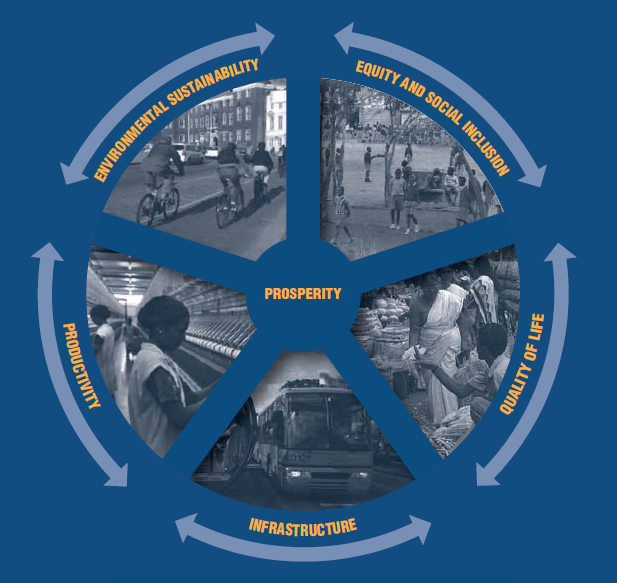
    The Report conceptualises city prosperity along 5 parameters:

    First, a prosperous city contributes to economic growth through productivity, generating the income and employment that afford adequate living standards for the whole population

    Second, a prosperous city deploys the infrastructure, physical assets and amenities – adequate water, sanitation, power supply, road network, information and communications technology, etc. – required to sustain both the population and the economy

    Third, prosperous cities provide the social services – education, health, recreation, safety and security, etc. – required for improved living standards, enabling the population to maximize individual potential and lead fulfilling lives

    Fourth, a city is only prosperous to the extent that poverty and inequalities are minimal. No city can claim to be prosperous when large segments of the population live in abject poverty and deprivation. This involves reducing the incidence of slums and new forms of poverty

    Fifth, the creation and (re)distribution of the benefits of prosperity do not destroy or degrade the environment; instead, the city’s natural assets are preserved for the sake of sustainable urbanization.

    The 5 aspects are combined in the Wheel of Urban Prosperity, and their interconnectedness and interactivity is very apparent:

    Prosperity Wheel

    The Report then goes on to calculate the City Prosperity Index (CPI) of a number of large cities across the world, and its findings make for interesting reading.

    Cities CPI

    So there India, you have it: Both the national and financial capital make it only to Cities with moderate prosperity factors (0.600–0.699), characterised by:

    • Wider discrepancies among the 5 dimensions of prosperity
    • Institutional and structural failings
    • Less balanced development
    • Neat divide between rich and poor.

    And remember, both New Delhi and Mumbai are the best-resourced cities in India – the first because the Central Government lavishes a lot upon its showcase capital; the second because it has the perhaps the highest ‘City to National GDP’ ratio of 4.0  (this is just 1.2 for Tokyo, 1.3 for Sydney, 1.6 for NYC). The smaller Indian cities are much worse off in terms of the City Prosperity Index.

    In my next post, I hope to examine ways in which changes in policies and practices may actually make Indian cities more prosperous.

    See you then…

  • Quality of Life in Cities

    When the urban population of the planet crossed 50% in 2007, our world was forever changed. Those who believed in cities as the hallmark of human civilization let off a silent cheer. Others were filled with fear, as they contemplated yet more crowding of already crowded cities; a greater concentration of the world’s poor in these cities; deteriorating urban infrastructure; and a growing threat to the global environment.

    Two sets of figures clearly encapsulate this dichotomy.

    Top 10 Megacities (Population > 10 million) in 2014: Tokyo, Delhi, Seoul, Shanghai, Mumbai, Mexico City, Sao Paulo, Beijing, Lagos, Osaka

    Top 10 on Mercer Quality of Life (QOL) Index 2014: Vienna, Zurich, Auckland, Munich, Vancouver, Düsseldorf, Frankfurt, Geneva, Copenhagen, Sydney

    Comparing the two lists we find that:

    • Not ONE city in the first list is represented in the second.
    • EVERY city in the Mercer list is in the ‘developed’ world and are beneficiaries of the colonial era – either through trade (North and Western Europe); or as settlers where the native population was too weak to defend their land and resources (Canada and Australasia). Furthermore, the developed countries are free from population pressure on their facilities and infrastructure, because fertility rates have been steadily declining, and immigration is strictly regulated.
    • NEARLY 70% of megacities are in the so-called ‘developing world’, with a history of being the victims of colonial rule. Moreover the countries with the most megacities are also the most populous in the world, putting tremendous pressure on services and infrastructure.

    Therefore one may safely conclude that as a city or town grows in size the first casualty is always the Quality of Life enjoyed by its citizens.

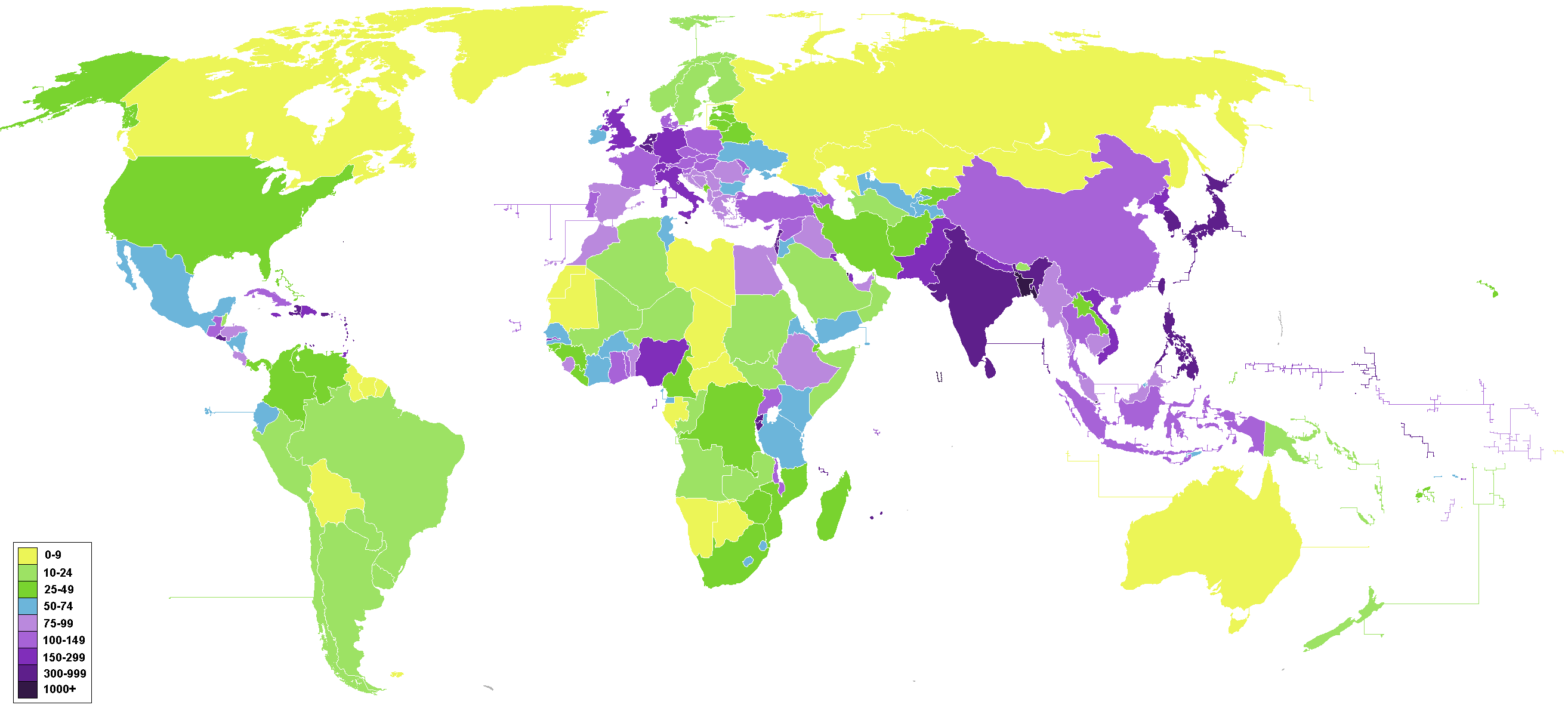
    The map of population density brings this point vividly to life:

    World_population_density_map

    The second largest land mass, Canada, has a total population of 35 million, less than the total population of just one urban agglomeration – Tokyo-Yokohama. Similarly, the population of Australia (which has a much bigger area than India) is almost exactly equal to just one Indian city- the National Capital Region Delhi.

    So with such immense resources at the disposal of such few, is it any wonder that Canadian and Australian cities figure so high in any QOL Index?!

    The inexorable growth of megacities is often due to the migration of the rural poor to towns and cities, leading to the urbanisation of poverty. The increasing heterogeneity of urban populations, brings its own pressures in terms of ethnic and class schisms and has a negative effect on the quality of life and makes the city difficult to govern.

    By inference from the indicators of quality of life, one may go a step further to conclude that as a city grows beyond its natural carrying capacity, it suffers from deteriorating infrastructure and services, leading to disease and deprivation.

    The urbanisation of poverty and the informalisation of the local economy often lead to a spurt in encroachments; slums; and squatter settlements. The political aftermath of this informalisation is a subsidy culture, impractically low user charges, and further impoverishment of local governments.

    … and so are the best planned cities, unplanned.

    As things now stand, it is highly unlikely that any of the 10-million plus population cities will see things improve. The drought-risk map below, issued by the World Resources Institute is a further reminder of the tough times ahead:

    drought-risk World Resources Inst

    What quality of life can we offer to the unborn millions of these parched cities?

    Quality of Life is essentially a subjective measure about how cost effective, convenient, healthy, satisfying and secure life can be in a city. Several organisations publish such lists as a guide for foreign investors and expatriate workers, and the Mercer Index is one of the best known scales in this business. The Mercer study is based on detailed assessments and evaluations of 39 key ‘quality of life’ determinants which include everything from political stability, banking services, law and order; to the availability of health, education, transport and cultural activities.

    We have already seen that cities offering the best quality of life tend to be in the developed half of the world – most usually in Europe and Australasia. So why is this so? We need to look for answers in the history of colonization, urbanisation and industrialization to understand…

    The post-World War II years may have been an era of growth in North America and Western Europe; but this development came at a great cost to the rest of the world. The self-serving trade regime of the rich countries stunted the growth of the poor, and plunged them into a debt trap from which few emerged unscathed. The deterioration of the subsistence rural economies of developing countries brought a further influx of distress migrants to the cities – and so the saga continues: be it Lagos in Nigeria, Kolkata in India, or Sao Paulo in Brazil.

    Meanwhile, heavy manufacturing industry continued to grow, and as the western powers moved their most labour-intensive sectors to the developing world, they created a series of highly polluted, congested and over-industrialised cities from Bangkok to Santiago. Even where MNCs were not welcome in the 60s and 70s (as in India and China), it became impossible to put the industrial genie back in the bottle, and cities like Mumbai, Shanghai, Chennai and Ahmadabad were the result.

    It is no wonder then, that megacities today are witness to growing disparity among the rich and poor; increasing disempowerment of vast swathes of society; and a slow drain of their wealthiest and best educated to friendlier cities abroad.

    … And the global inequity continues.

    While High QOL countries are also high consumers of energy the ill effects of their large ‘Carbon Footprints’ put the entire world at risk through global warming and climate change.

    Sadly, the western world has raised the energy stakes so high by centuries of reckless use that countries like China and India have to fuel their own development at great cost to their own people and the global environment. The major challenge before these two countries is how to balance industry (necessary for job creation) and cleaner environments to enhance the Quality of Life of future generations.

    In its haste to atract foreign and domestic investment in industry, the present Indian Government has shown a total lack of understanding of the environmental issues, despite the havoc wrought on the environment in Gujarat.

    The much touted ‘cleanliness drive’ launched across Indian cities will remain a superficial cosmetic exercise, unless a serious effort is made to balance human well-being with human greed…

    In my next post, I hope to disuss the Sustainable Livelihood Framework in the context of urban poverty.

  • China and India: Our cities, their cities

    (Social media are full of people from all over the world drooling over the amazing infrastructure in Chinese cities. This, however is not because of some obscure oriental magic, but rather a result of deliberate policy and planning over several decades. I wrote this in 2014 after a visit to China and most of the institutional differences are very much in evidence even 12 years later. India has sadly, learnt nothing from its neighbour. )

    Shedding its rural, feudal past with a vengeance, China has officially tipped over – with 51% of its vast population now living in urban areas. This scale of urbanisation is unprecedented in human history and Chinese cities leave visitors awestruck and dumbfounded as they come in via the Maglev transit system, admire the skyline of a new Shanghai, visit its deep-sea harbour after driving over a 36 km sea bridge, or take off on a 1,460 km journey to Beijing by bullet train reaching there in four and a half hours flat!

    There are various enabling factors in China’s formidable infrastructure achievements:

    • Firstly, all urban land is owned and controlled by the local government, and made available for planned development once a plan is approved by the political decision-makers. In India, the urban administrator is not able to achieve even 20% of a 20-year DP because of the hassles in acquisition of private land for public purposes.
    • Secondly, infrastructure is created and developed by specialized technocrats in China, and maintained by retainers of local government; while in India most development bodies are headed by an officer from a generalist service like the IAS, with neither the technical expertise nor the continuity of tenure to see a long-term project through successfully. The indiscriminate entry of the private sector in developing and maintaining infrastructure in India is also considered a mixed blessing, and the leading source of corruption in government.
    • Moreover, resources raised from infrastructure development and urban growth accrue to the local government in China, and this encourages planned urbanization, unlike in India, where metropolitan planning bodies are State parastatals like the MMRDA, enriching the State of Maharashtra by exploiting the land in the city of Mumbai.
    • Planning decisions in China are not only publicised, but put in the public domain through magnificent state-of-the-art audio-visual feasts in their Planning Museums. In India, we have to be satisfied with a statutory ‘call-for-objections’ each time a Development Plan is formulated. There is little or no publicity given to planning decisions: residents of a locality are unaware of what is planned for their neighbourhood; and may wake up one fine morning to discover an abattoir or a crematorium next door!
    • Urbanization itself is greatly controlled in China: While the single-child norm takes care of growth through natural increase; immigration is controlled by the ‘hukou’ or residence permit system, which has built-in incentives like social security, and access to health and education. Anyone without an urban permit is automatically denied these benefits, and although there are squatter settlements in Chinese cities, these are normally at the periphery, unlike India where they dot the entire urban landscape in such profusion, and illegality. Similar controls in India would be deemed unconstitutional.
    • China tackles the problem of urban sprawl by densification, providing high FSI for both residential and commercial buildings (like Tokyo) and negating its worst impact through cheap and efficient public transport systems. Indian cities meanwhile, adhere to outdated and impractical plans for low form urbanisation – another sad legacy of British rule! The resulting urban sprawl and the poor public transport networks make commuting to work a daily hell for millions of people in India’s metros.
    • Like India, China too faces the problem of an informal economy, estimated at around 30%, but there are definite efforts made to formalise it through licensing, controls and provision of workplaces in the formal plan. These issues have remained largely unaddressed in India, leading to 60-68% informalisation of the economy in its metros.
    • Moreover, while manufacturing sector growth in China is incentivized through devices like SEZ’s, India has put most of its economic eggs in the services basket. Thus while the factories in China welcome equally the unskilled, semi-skilled and the highly-skilled worker; India’s IT sector has room only for the highly educated; and the less skilled get inexorably pushed into the growing informal sector.

    Indian urban managers and policy makers have a lot to learn from China:

    • Treat Urbanisation as a force for good, not evil. In 2005, China’s Ministry of Housing and Urban-Rural Development proposed the designation of prime cities as National Central Cities, as a first step in reforming urbanisation in China. These NCCs were described as a group of cities in charge of leading, developing, performing tasks in political, economic, and cultural aspects. Consequently, in February 2010, the ministry issued the “National Urban System Plan” and designated five major cities: Beijing and Tianjin in the Bohai Economic Rim; Shanghai in the Yangtze River Delta, Guangzhou in the Pearl River Delta, and Chongqing in western China. They also included Hong Kong as a Special National Central City. The NCCs’ sphere of influence has a great impact on the surrounding cities in terms of modernising and integrating services, infrastructure, finance, public education, social welfare, sanitation, business licensing and urban planning. The Ministry also makes mention of Regional Central Cities (RCCs) like Shenzhen, Nanjing, Wuhan, Shenyang, Chengdu, and Xi’an. India can learn a lot from this visionary approach to regional planning, and National Central City status will go a long way in revitalising the dying metros of yesteryear, like Kolkata and Mumbai.
    • An empowered Chief Executive is key to Local Economic Development. Visiting Mayors from South America and Europe are welcomed like heroes by local bodies in India. Mainly, because they are seen as vital agents of change and reform. Their Indian counterparts (with a few exceptions) have a largely ceremonial role, and the real executive power in Indian cities is vested in a civil servant, who is a State government permanent employee and has little or no investment in local concerns. Contrast this with the clout and powers of a mayor in a big Chinese city. A visit to the official website of the Mayor of Shanghai is a real eye-opener. In the last few months, the visiting foreign dignitaries who have called upon the Mayor include: the Belgian Ambassador, the Chilean Ambassador, Mayors of Dallas and Fort Worth, the Fijian President, the Governor of Yogyakarta in Indonesia, the Mayor of Colombo, the Vice President of South Sudan, the Russian Ambassador, and the President of Portugal. Now that is some clout, isn’t it?
    • Social planning is inextricably linked to land use planning. Not just China, but the capitalist Mecca of Singapore too indulges in fairly rigid social engineering whereby the government decides on where a family stays, where they dispose their garbage, and where their children go to school. Indian cities have a lot to learn from both these countries about the practical side of governance and making cities work, so that the maximum good of the maximum number is ensured and the yawning chasm between rich and poor is bridged to some extent – even if it means stricter laws and tighter enforcement for everyone.
    • Urban development means the full devolution of powers and resources to local government. In China, the benefits of local development accrue to the local government and so the city of Shanghai, for example, has a stake in building new infrastructure and planning new satellite towns because these will enrich the local government. In India, despite the recommendations of National and State Finance Commissions (under the 74th Constitutional Amendment Act) there has been inadequate devolution of resources to local governments, and where a city is a creator of wealth, these profits are creamed off by both State and Central Governments, while the local government struggles to make ends meet – the most obvious example being Mumbai, the largest single contributor to State and National GDP!
    • Urban planning thinks in centuries not decades. When China launched a massive construction boom, building new cities from scratch, the world was first alarmed, then amused, and is now awaiting the big crash. Because these cities are now ready but have nobody living there! But as Gandhiji rightly said: “First they ignore you, then they laugh at you, then they fight you, and then you win.” So perhaps, China will have the last laugh as they alone realise that projected needs and consequently, urban planning, need a much longer timeline than the mere 20 years so popular in India’s Development Plans. Moreover, it is much cheaper to build a city as a greenfield or brownfield project now than attempting to revitalise a dying city 20 years hence – as we have seen under JNNURM! As and when a city reaches carrying capacity, these new towns are ready to take the overflow. Further, unrealistic house prices (prevailing in Indian metros) have led to ever more slums in Mumbai and Delhi. By providing ready, available and affordable housing in and near existing metros, the Chinese have successfully tackled the problem of decongestion in a long-term time-frame. We should also remember that, unlike the West, relocation within China is a matter of Government policy and enforcement, and not left to the whims of market forces alone.
    • Natural resource management essential to prosperity. Another example of long-term planning is China’s heavy investment in natural resources abroad, to ensure that the factories in its cities don’t come to a standstill for lack of raw materials. For example, when China anticipated a drop in its virtual monopoly of rare earths, it was quick to tie up with Australian mining companies, to retain an upper hand. Rare earths are critical in the manufacture of smart phones, wind turbines and missiles. But what gets the West in a real tizzy is China’s foreign direct investment (FDI) in developing the infrastructure and natural resources of Africa. Interestingly, while the American President (despite his proclaimed African origins!) visited only 2 African countries in his first term, his Chinese counterpart visited 14. No wonder, Africa (long and brutally exploited by the West) is ready to welcome another country which helps its development but does not lay down pre-conditions like reform, nor threatens armed intervention in the name of democracy. Needless to say, such geo-strategic long-term planning in its national interest has evaded India for the last 67 years!
    • Connectivity is the safest route to mainstreaming marginal communities. One would not like to brush China’s problems with its ethnic minorities (like Tibet) under the carpet, but the fact remains that one of the greatest engineering marvels of this century has been the construction of the Beijing-Tibet Railway, against tremendous odds. The Chinese believe that connectivity is the shortest route to mainstreaming and national integration (and also allows for easier control and regulation, of course – which is why the British built railways in India so early on in their colonial rule!) Perhaps we can learn a few lessons from China, especially in mainstreaming the isolated N-E region of India. After all, civil unrest in any part of the country eventually affects the national economy.
    • Good governance also means efficiency and effectiveness. Two universally recognised indicators of good urban governance are efficiency and effectiveness, and it is visible everywhere in China – from the punctuality of the tour guide, to orderly queues in public places, to the unfailingly on-time trains and flights. Or the integrated 8-tiered transport hub at Shanghai International Airport. These are the little things which make city life a little easier, and are slowly disappearing from India’s urban dreamscape. Time to wake up and catch up with the world, India!

    Summarizing, the magic mantra in China seems to be: analyze, assess, plan and provide… 


    Whatever the divergence in their development paths and goals, India and China have a shared destiny as the two largest countries in an interconnected global economy, and they both need to take on board the hazards as well as the benefits of globalisation. Although both countries have taken long strides in developing infrastructure and economic growth, the Quality of Life and Human Development aspects have not received the same attention.

    India’s caste and class-riven society sees the gap between the rich and poor growing every day, as does the education and digital divide in the era of global connectivity. This is mirrored in the widening rural-urban divide in China, and the lack of individual liberties that democracies like India take for granted.

    Therefore, both India and China need to face up to several challenges of successful survival in changing times:

    • Firstly, how to ensure a more equitable distribution of their recent economic growth across caste, class, gender and region, while at the same time making their specialist areas globally competitive
    • Secondly, how to fix the trade-offs between universal human development and specialised infrastructure requirements
    • Thirdly, how to support the unorganised and informal sectors of the economy so that they yield sustainable livelihoods for the poor
    • Fourthly, how to adapt and universalize technology, especially information and communication technologies
    • And finally, how to realise the full potential of their prime resource – their large populations – to gain the edge in global negotiations…