Development and Governance

Category: Urban Issues

  • Our cities cannot be run just as businesses

    Published in Times of India, Pune in October 2018. Lost and found. Posted here for you.

    Very simply, large cities cannot be run as businesses because urban governance is more than just government. It is government + people. And while a business can clearly classify all its stakeholders (share-holders, management, workers, suppliers and distributors), how does a city draw the lines – between the property owners and the squatters? Between the tax-payers and the untaxed? Between the rich and the poor? Between the empowered citizens and the illegal migrants? Between the natives and the newcomers? Between the producers and the consumers? Between the governed and the government? Between local demands and regional priorities? 

    Thus, while a business can be satisfied with mere efficiency, a city needs to look at effectiveness. There is little merit in computerized property tax bills, if the tax base has not been updated for the last twenty years, is there? Ditto with completing a pumping station on time, if the water delivery continues to be erratic and unreliable. City dwellers are more interested in the water in their taps than in the technology which gets it there.

    Similarly, a business doesn’t really care about participationequity or inclusion while an urban government must necessarily provide for it.

    Accountability in business is often merely a matter of financial accounting and compliance with various government norms – if they were accountable to society at large, we wouldn’t need a law of torts, or liability clauses in every business contract. A city on the other hand, is held to account in every election by its citizens, and there are a large number of mechanisms available today, for citizens to monitor and pull up their local governments.

    These thoughts have come to mind as the citizens’ reactions to initiatives like AMRUT and Smart Cities are turning sour. Because they were (mis)led into believing that a little tweaking of software here, and a beautified road there would make them instantly more mobile and therefore more productive.  That has not happened. Instead, the mistakes of the erstwhile government’s JNNURM have been repeated in duplicate, with private consultants running the show and the State and Local bodies who are expected to execute, complete and maintain the various infrastructure projects, sulking in the sidelines as before. 

    The fact that the JNNURM then, and AMRUT now, are deeply influenced by organizations like the ADB explains this ‘cities as businesses’ approach, where a Business Development Plan got renamed as a City Development Plan, and almost all reforms made mandatory, had a financial angle – and somewhere along the line we forgot what a mish-mash the urban scene in India is, with thousands of small market towns, ancient pilgrim towns, bustling cities, and dysfunctional megacities with huge informal sectors, all getting the same treatment.

    Perhaps India needs to look at its BRICS partners for a lesson or two… Brazil had a similar experience, as the mayor of Sao Paulo admitted in an interview in 2013: “The previous economic model was very private-sector orientated, so the reaction of the local community was very negative. We need to rebalance the equation so development is not seen as a threat,” he said. “People consider politicians as bad people so it is important to get them involved personally. If they feel a sense of ownership then they don’t complain.” 

    So, the Brazilians took a different approach when preparing for the Olympics in Rio. They broadened the framework of a Smart City to include every aspect of the citizens’ lives: public safety, social programmes, healthcare, education, transportation, energy, water and the environment. And the tools used were smarter buildings and urban planning, and better government and agency administration. Only such a holistic approach which balances the human development, infrastructure and environmental aspects, and formulated with the active participation of the residents of a city, can make a city SMART in the long run.

    But who will convince the many IT consultants looking enviously at Songdo in South Korea or Masdar in the UAE, and hoping to create something similar in India? They don’t seem to realize that Indians may not really want this kind of super-efficient but impersonal urban experience. Nor that only a minute percentage could eventually afford to live in such a place! 

    Related:
    Good Governance

  • How we could resolve our growing Garbage Problem

    Published in Times of India, Pune on 1 May 2019. Lost and found. Posted here for you.

    According to the latest World Bank estimates, the world generates 2.01 billion tonnes of municipal solid waste annually, and global waste is expected to grow to 3.40 billion tonnes by 2050. Worldwide, waste generated per person per day averages 0.74 kilogrammes, but ranges widely, from 0.11 in the poorest countries, to 4.54 kilogrammes in high-income countries – which generate about 34% of the world’s waste, although they only account for 16% of the world’s population.

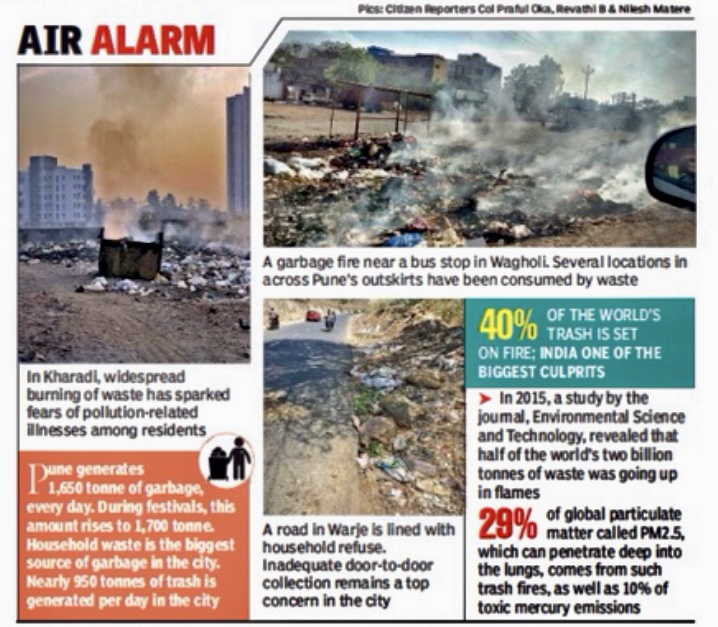
    Around the world, almost 40% of waste is disposed of in landfills. About 19% undergoes materials recovery through recycling and composting, and 11% is treated through modern incineration, while the remaining is openly dumped. More disturbing for the planet’s future is that at least 33% of the waste generated, is not managed in an environmentally safe manner.

    The most common form of waste collection across the world, is door-to-door. In this model, trucks or small vehicles are used to pick up garbage outside of households at a predetermined frequency. In certain localities, communities may dispose off waste in a central container or collection point where it is picked up by the municipality and transported to final disposal sites. In lower-middle-income countries like India, collection rates are about 51%. Improvement of waste collection services is a critical step to reduce pollution and thereby to improve human health and longevity.

    The city of Pune in Western India generates 1600 -1700 tons of solid waste per day, with 160 trucks deployed to collect waste door-to-door. In addition to household waste, the bulk generators are construction and demolition waste, garden waste, and biomedical waste. 

    Pune Region has set up 200 material recovery centres, to reduce, reuse, recycle and recover 170 to 180 MT of plastic waste it generates per day, but 10,000 MT of e-waste per annum continues to pose a challenge. The downside of a green and beautiful Pune, is of course the huge quantities of garden waste generated – 60 to 70 MT per day – and a separate collection system is in place for collecting the waste, shredding it and transporting it to a centralised processing system.

    Waste disposal practices vary significantly by income level and region, and as nations prosper economically, waste is managed using more sustainable methods. Construction and use of landfills, is commonly the first step toward sustainable waste management. 

    The darker side of waste disposal is that richer countries often export their electronic waste to poorer countries and this e-waste contains toxic substances such as lead, mercury, cadmium, arsenic and flame retardants. Once in a landfill, these toxic materials seep out into the environment, contaminating land, water and the air, and harming the local community. In addition, devices are often dismantled in primitive conditions, and those who work at these sites suffer frequent bouts of illness, and long-term diseases.

    The ship-breaking yard at Alang in Gujarat is notorious for the chronic illnesses of its workforce, and is sardonically referred to as ‘Alang se Palang’ – death bed. On-site medical facilities at such places are either absent or totally inadequate. 

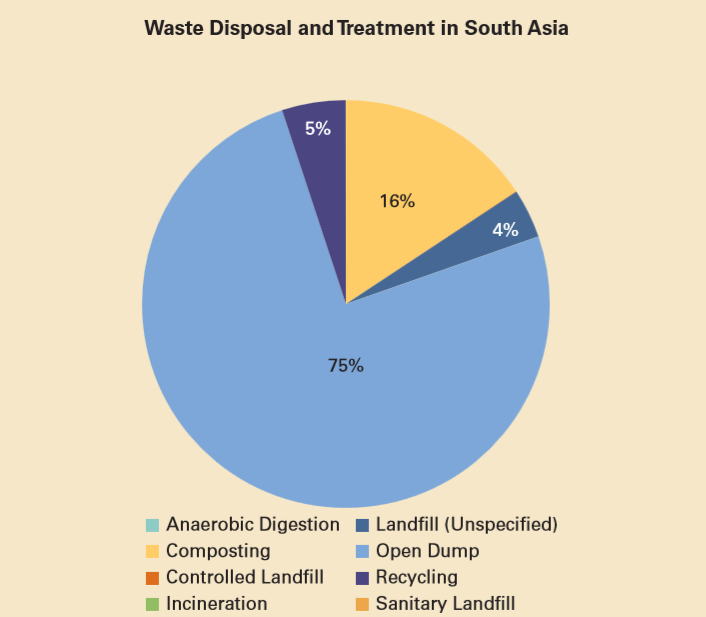
    The South Asia Region, where India is the largest country, generated 334 million tonnes of waste in 2016, at an average of 0.52 kilogram per capita daily, with 57% characterized as food and green waste. About 44% of waste is collected in South Asia, mainly through door-to-door systems, and three-fourths of waste is currently openly dumped, although improvements to collection systems and construction of sanitary final disposal sites are under way.

    It is estimated that basic solid waste management systems covering collection, transport, and sanitary disposal in low-income countries cost $35 per tonne at a minimum, and often much more. Systems that include more advanced approaches for waste treatment and recycling, naturally cost more – from $50 to $100 per tonne. 

    Almost all low-income countries, and a limited number of high-income countries, such as the Republic of Korea and Japan, subsidize domestic waste management from national or local budgets. The PMC sets aside 20.5% of Annual Rateable Value of one’s property as Conservancy Tax, in your annual property tax bill. Given that the base figure itself is often a gross undervaluation and seldom updated and all property taxes are non-buoyant, this amount is totally inadequate to cover the ever-rising costs of labour, transport, treatment and disposal. As a result, the local government has to depend on State and Central Government subsidies, and as with any subsidized service, the customer is never satisfied with the quality and adequacy of service provided. 

    Although public-private partnerships could potentially reduce the burden on local government budgets, the experience of such services in Indian cities has not been very encouraging.

    Thus, we are basically left with three options and some tough choices, if our cities are not to disappear in mounds of garbage:

    • Increase Fee collection – a move sure to meet with great resistance
    • Strengthen household waste collection systems by active collaboration of both the waste generators (at the housing society level), and NGOs or Collectives of professional waste collectors 
    • Decentralize the waste collection, treatment and disposal systems to Ward level. 

    Costs of Corruption

  • Development should never mean just flyovers and roads

    Published in Times of India, Pune on 4 July 2019. Lost and found. Posted here for you.

    Development at its most basic may be defined as ‘directed growth‘. And that direction is decided by the type of government in power and its ideology: some may look upon development as building infrastructure, others as building human capital.

    Conservative governments throughout history have looked upon ‘development’ as an opportunity to leave their mark on history and the landscape quit literally. Great kings have built pyramids, palaces, highways, aqueducts, temples, churches and mosques for their sprawling capitals – and in modern terms, when a government has a 5-year timeframe to work in, it makes more sense to build flyovers, than plant trees.

    This idea of development as physical infrastructure took root soon after Independence, when heavy industries like steel were in a boom period across the world, and oil was cheap. So, with an abundance of steel one naturally built skyscrapers, bridges, towers and railways.

    Heavy infrastructure of this kind naturally congregates around big metros, which soon become overcrowded and environmentally noxious. There also comes a tipping point when the old residents begin to curse the newcomers to their city and local governments cannot spare the resources to service fringe areas adequately. As urban sprawl takes over, a planned city becomes slowly unplanned…

    Meanwhile the small towns in the surrounding region resent this skewed development and keep sending their young to these overcrowded metros to seek their fortunes, because urban planners concentrate their efforts only in the big cities – and soon we all end up living in urban hell!

    This tendency to equate development with roads, bridges and flyovers has several negative consequences:

    • Firstly, although investment in infrastructure may raise economic activity and thus the GDP, it doesn’t really create secure, long-term employment in the country. Most infrastructure projects are designed and executed by people already in permanent government jobs in the railways or PWD, and the future maintenance of the infrastructure will be in the hands of the permanent employees of the municipal corporation, so no new long-term jobs are created. Only a very few temporary, low-skill jobs may be created during the construction phase, with little or no impact on the labour market.
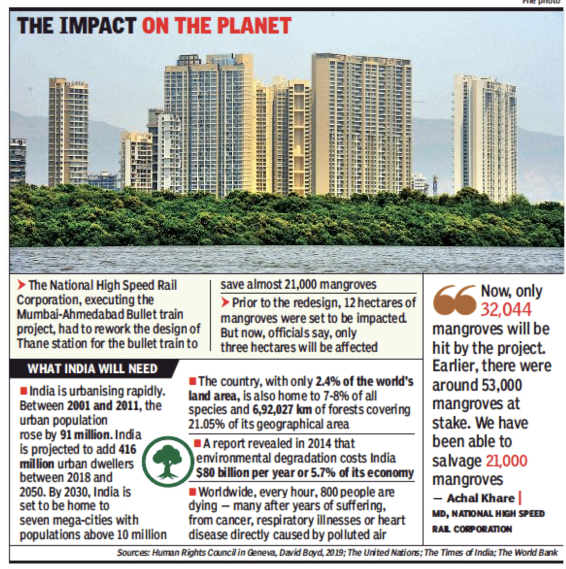
    • Secondly, if a government is obsessed with creating just infrastructure, there is always a tendency to bend the environmental guidelines to expedite land acquisition for projects, with disastrous consequences for the biodiversity and natural safeguards of the project area. The draining of the mangrove swamps of Kurla for the Bandra-Kurla Complex is now accepted as the primary cause for the repeated monsoon flooding of Mumbai, and something similar has happened to Nagpur with the unnecessary concreting of all its roads. It is axiomatic that the number of vehicles in a city will rise as the road network of a city expands, and it is the unprecedented growth of roads and fly-overs which has added to Delhi’s breathing problems.
    • Thirdly, single-minded concentration on infrastructure draws public funds away from basic services like education and health care, which are the true cornerstones of achieving ‘human’ development in a society. Without adequate attention to education, health and nutrition, countries like India risk losing their demographic dividend of a young society. And this only aggravates the schisms and tiers in society as future generations have to compete for every crumb of a rapidly shrinking pie.

    It is noteworthy that ALL three of Asia’s tech giants first invested in the universalisation and then the vocationalisation of education, to literally lift themselves up by the bootstraps and resurrect their devastated economies: Japan after WW2, South Korea after the Korean War, China after the Cultural Revolution. Only after attaining a fair and equitable human development did these countries move into mega infrastructure development.

    India meanwhile, did build up a welfare state after the ravages of colonial rule, but somewhere in the heady days of the IT revolution of the 90s, we seem to have lost track and opted for more visible and tangible signs of connectivity as development, which has unfortunately only made the rich richer, and left vast swathes of India’s population far, far behind.

    Post-Independence, India also had the vision to set up a world class infrastructure for higher education, science and technology, but somehow these elite institutions came at the cost of universal education, and hinterland India had to be satisfied with a Green Revolution.

    Consequently, India entered the twenty-first century with a billion-plus cell phones but not enough drinking water in every village. In fact, we have all recently seen villagers pointing to toilet blocks and pavements as proof of the ‘development’ brought in by a, b, or c although their eyes cloud over with doubt if asked about jobs, their children’s future and better livelihoods. 

    The fall-out of this singularly material approach has been the great Indian tradition of offering last minute freebies just before an election (an approach that ALL political parties are guilty of.)

    It’s like keeping an excellent racehorse thirsty the night before a big race, and just before starter’s orders, giving it a large bucket of water which it laps up. The wretched horse will run its heart out in gratitude, but with a belly full of water, it can never win a race.

    And the punters who bet against the poor horse will carry their winnings away, laughing all the way to the bank. Such is life!

    Related:

    Business as usual – and damn the environment!

    Infrastructure Projects in India

  • How we can transform cities to make them more resilient

    Published in Times of India Pune on 27 December 2019. Lost and found. Posted here for you.

    Indian cities have faced tremendous problems over the last few years and in most cases the action or inaction of various levels of Government have been to blame. For instance, while poor dam management and concretization of natural drain systems have caused flooding, poor regulation of illegal structures by municipal bodies is the main reason for factory fires and wall collapses.

    So, the question is, how do we make our cities more resilient?

    The Rockefeller Foundation defines Urban Resilience as: “… the capacity of individuals, communities, institutions, businesses, and systems within a city to survive, adapt, and grow no matter what kinds of chronic stresses and acute shocks they experience.”

    It is our belief that Indian towns and cities suffer from chronic stresses, rather than acute shocks like say, earthquakes and tsunamis, which plague other metros. These chronic stresses include shortage of drinking water, annual flooding, building collapse, seasonal viral disease outbreaks, heightened air pollution in post-harvest season, traffic congestion, and increasing social unrest.

    Most of these stresses can be tackled at the city level itself if our municipal bodies are enabled to provide adequate services like water supply, sanitation and waste management and have the appropriate social infrastructure like schools, clinics, hospitals and first responder services. State Governments can then ensure the equitable distribution of natural resources, like water, among urban and rural areas and provide the intercity connectivity to promote economic development. The Central Government can ensure that the local bodies are adequately funded.

    Alas, this is not so. In fact, our cities have never been as incapacitated and under-resourced as they are now, since Independence.

    The reasons for this are manifold. As the contribution of the agricultural sector to GDP has shrunk over the years, Central Governments have become more and more dependent on cities with their manufacturing and services sectors, to balance the Union Budget. In its haste to standardize, the Government has rushed through with a Goods and Services Tax (GST) to replace a buoyant tax like Octroi, and large metros like Mumbai and Pune have been severely hit by this change.

    Our municipal bodies are still caged in outdated laws like the Bombay Municipal Corporation Act of 1888 and its brood of municipal acts across the sub-continent. The colonial mindset built into these Acts, is a basic mistrust of the ‘natives’ – so you have an Officer selected by the Centre, posted by the State to run a Local Government. With neither a memory of the past, nor an understanding of the present, he or she is expected to formulate a vision for the city’s future!

    Many attempts have been made to strengthen local government through the 74th Amendment to the Constitution (1992) and the setting up of Finance Commissions, but political interests at the State level have not allowed true devolution of power to local level. A Model Municipal Law formulated in 2000 had few takers and upgrading the post of Mayor to a sort of CEO also came to nothing.

    The Police and Fire Departments of the city of New York come under the Mayor’s command – remember Mayor Giuliani of 9/11 fame? A visit to the website of the Mayor of Shanghai is also a revelation – not one King, Emir, President or PM on a State Visit to China misses calling upon the Mayor of Shanghai and discussing international deals and treaties. That is what an empowered Mayor means in practical terms, and I am quite sure that barely 5% of our citizens even know the mayor’s name in Indian cities.

    The Municipal Corporations have also been losing out on their human capital, as infrastructure projects are now largely privatized. The erstwhile JNNURM and its subsequent progeny brought in a whole new business model of city management – so much so that a City’s vision document was prepared by one consultant, the DPR by another, and sanctioned at the Ministry by a third consultant. I leave the rest to your imagination…

    In the heavily financed ‘housing for the poor’ schemes, projects were again privatized, with NGOs and commercial builders replacing Consultants.

    In short, when the Municipal Corporation is so weakened in terms of its functions, finances and human resources, how can it be expected to make the city resilient?

    Eventually, it is left to the common citizens to pull the city up by its bootstraps after every man-made or natural disaster. One may sing the praises of the eternal ‘spirit’ of Mumbai, but every time there is a flood, a bomb blast, a terror attack, a collapsed building or a fire, the spirit becomes a little dimmed. In the long run, it is not a catastrophe that kills a person or a city but a chronic disease which hollows out the body or the city from within. Mumbai had been labelled a dying city by many experts since the 2011 Census, and one dreads to think what the 2021 Census will reveal about our tired metros…

    What is needed is to put in place systems, institutions and mechanisms which make citizen participation in local government a fact of daily life, so that this immense force for good can be rapidly mobilised in an emergency .

    A good example of channeling citizen effort is the Kudumbashree Scheme of Kerala:

    Related:

    Urbanisation Trends in India

    Read more: How we can transform cities to make them more resilient
  • The Tiny Circle Inside Which Most of the Planet Lives

    Published in Times of India, Pune on 29 November 2018. Lost and found. Posted here for you.

    It is quite a paradox that while issues like global warming, the rise of the dollar, and global geopolitics are the staples of our conversations, we look no further than the garbage on the sidewalk to define our city and country – never realizing our key position in the world of today and tomorrow.

    There is however, a legend of the Internet, known as the Valeriepieris Circle, which sets the record straight, getting across its message simply, visually and effectively.

    It is essentially the tightest circle which can be drawn on a 2-D map, wherein more people live inside the circle than outside it. To give you an idea of the density of population in the circle, just ONE Metropolitan Region (Greater Tokyo Area) has a population greater by a million, than that of the second largest country in the world – Canada; while the population of Shanghai exceeds the total population of Australia by another million.

    Which brings us to another statistic: 21 of the world’s 35 megacities with a population more than 10 million or 1 crore; and 11 of the 15 cities contributing the most to global GDP by 2030, are in this circle. On the negative side, not ONE city in the top 45 cities on the global QOL Index is in this circle, but 9 of the 10 most polluted cities are!

    All Asia and Pacific sub-regions are experiencing urban growth at higher rates than overall population growth. By 2050, urban areas will account for nearly two out of three people, and cities in China and India alone will have grown by an additional 696 million – India by 404 million and China by 292 million.

    Paradoxically, while the region is home to so many megacities, they only accommodate a little over 10% of the region’s urban dwellers. The bulk of urban dwellers live in small and medium cities, where much of the region’s urban transition is actually unfolding. Yet, despite their increasing significance, most small cities face their future with limited human, financial, and organizational resources – as any visitor to a small town (the ubiquitous Indian ‘native place’) can confirm.

    The biggest challenge for governments in Asia and the Pacific remains their growing urban poverty and vulnerability in the face of natural and man-made disasters, often grossly underestimated, and therefore unaddressed. It is estimated that a third of the region’s urban residents lack access to adequate shelter, clean energy, safe drinking water and sanitation. Unless some attempts are made to formalize the informal sectors in both economic activity and housing, poverty and the omnipresent slum will continue to mar the Asian urban story in the foreseeable future.

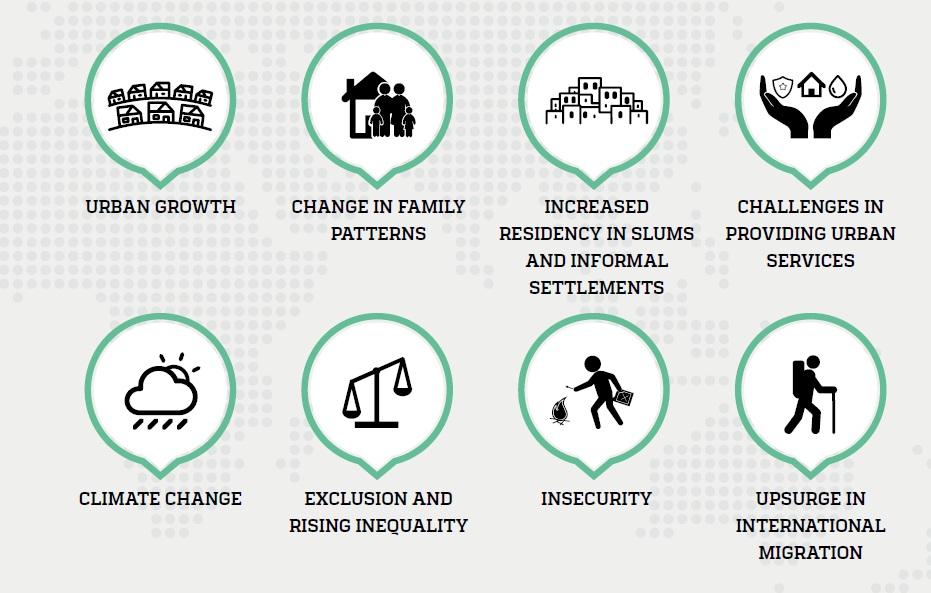
    As the UN-Habitat World Cities Report 2016 clearly pointed out: Cities are operating in economic, social, and cultural ecologies that are radically different from the outmoded urban model of the 20th century, and persistent urban issues include urban growth, changes in family patterns, growing number of urban residents living in informal settlements, and the challenge of providing urban services. Adding to these problems are emerging urban issues like climate change, exclusion, increasing inequality, rising insecurity and social tensions, and an upsurge in internal and international migration.

    As regards housing, most government efforts have focused on helping the middle class to achieve home-ownership in a formal sector that only they can afford. The housing policies put in place through the enabling approach have failed to promote adequate and affordable housing for the low-income groups, and slums continue to be one of the most visible faces of poverty in our cities. The spatial concentration of poor and unskilled workers in segregated residential quarters acts as a poverty trap with severe job restrictions, high rates of gender disparities, deteriorated living conditions, social exclusion and marginalization, and a high incidence of crime.

    Cities continue to be the generators of economic growth across the region, but only those which have got their act together in terms of infrastructure and services, culturally appropriate planning norms, efficient public transport and mobility, and capitalization of land resources will matter globally in the years to come. Sadly, Indian megacities are tired, old and neglected, and will become national liabilities rather than assets as time goes by.

    By 2030, global demand for energy and water is expected to grow by 40 and 50 per cent respectively, and our cities will get more and more polluted, our water more contaminated. In urban areas, climate change impacts like heat waves, heavy rains and droughts can compound one another, making disaster risk management more complex. Just keeping a city clean is becoming more labour intensive and costly every day, and solid waste management dominates municipal annual budgets in low- and middle-income countries, with shares of 30 to 50 per cent.

    As we watch our compatriots wearing masks in the thick Delhi smog, as they continue to light crackers to celebrate Diwali, the question we have to ask is do Indians really care?  May be if we started realising the immensity of problems facing our cities, we would insist upon political parties providing a workable National Urban Framework to: strengthen and empower local governments, decentralise power, devolve resources, take a more flexible and Indian approach to town planning, provide genuine accountability, and develop the administrative capacity to implement public policies.

    Next election let us ask for liveable cities.

    Next election let us ask for the moon

    Related:

    Cities of Asia and the Pacific

  • What a Waste

    What a Waste 2.0 – A global Snapshot of Solid Waste Management to 2050, is one of those comprehensive and well-researched reports which only an organization with the expertise and global reach of the World Bank could produce.

    Taking an overview of every aspect of waste management first globally, then region by region, this report can inform many a local SWM policy paper or augment a scholarly thesis.

    I shall simply repeat some of its key observations, so that a hitherto neglected aspect of urban governance viz. solid waste management, is adequately covered on this blog.

    Waste Composition

    Composition of waste changes with time and technology and naturally, the waste of our times reflects the wants of our times:

    Waste Generation

    The world generates 2.01 billion tonnes of municipal solid waste annually, with at least a third of that not managed in an environmentally safe manner. Worldwide, waste generated per person per day averages 0.74 kilogram but ranges widely, from 0.11 to 4.54 kilograms. Though they only account for 16% of the world’s population, high-income countries generate about 34% of the world’s waste. When looking forward, global waste is expected to grow to 3.40  billion tonnes by 2050.

    Waste Collection

    The most common form of waste collection is door-to-door. In this model, trucks or small vehicles are used to pick up garbage outside of households at a predetermined frequency. In certain localities, communities may dispose of waste in a central container or collection point where it is picked up by the municipality and transported to final disposal sites. In lower-middle-income countries like India, collection rates are about 51%. Improvement of waste collection services is a critical step to reduce pollution and thereby to improve human health and longevity.

    Waste Disposal

    Around the world, almost 40% of waste is disposed of in landfills. About 19% undergoes materials recovery through recycling and composting, and 11% is treated through modern incineration, while the remaining is openly dumped. Waste disposal practices vary significantly by income level and region, and as nations prosper economically, waste is managed using more sustainable methods. Construction and use of landfills is commonly the first step toward sustainable waste management.

    The darker side of waste disposal is that richer countries often export their electronic waste to poorer countries and this e-waste contains toxic substances such as lead, mercury, cadmium, arsenic and flame retardants. Once in a landfill, these toxic materials seep out into the environment, contaminating land, water and the air, and harming the local community . In addition, devices are often dismantled in primitive conditions, and those who work at these sites suffer frequent bouts of illness, and long-term diseases.

    Key Insights about South Asia

    The South Asia region, where India is the largest country, generated 334 million tonnes of waste in 2016, at an average of 0 .52 kilogram per capita daily, with 57% characterized as food and green waste. About 44% of waste is collected in South Asia, mainly through door-to-door systems, and three-fourths of waste is currently openly dumped, although improvements to collection systems and construction of sanitary final disposal sites are underway.

    Financing and Cost Recovery across the World

    • According to the Report, basic solid waste management systems covering collection, transport, and sanitary disposal in low-income countries cost $35 per tonne at a minimum and often much more.
    • Solid waste management is a large expenditure item for cities and typically comprises nearly 20 percent of municipal budgets in low-income countries, more than 10 percent in middle-income countries, and 4 percent in high-income  countries. Budgets can be much higher in certain  cases.
    • Systems that include more advanced approaches for waste treatment and recycling cost more, from $50 to $100 per tonne or  more. The choice of waste management methodology and technology depends highly on the local context and capacity for investments and ongoing management.
    • User fees range from an average of $35 per year in low-income countries to $170 per year in high-income countries. Full cost recovery from user fees is largely limited to high-income countries. Almost all low-income countries, and a limited number of high-income countries, such as the Republic of Korea and Japan, subsidize domestic waste management from national or local budgets.
    • Although public-private partnerships could potentially reduce the burden on local government budgets, they could result in compromises in service quality when not structured and managed properly.
    • Local governments provide about 50 percent of investments for waste services, and the remainder is typically provided through national government subsidies and the private sector.
    • When political support for increasing user fees for households to cost recovery levels is limited, cross-subsidizing from payments by waste generators (for  example, the commercial sector) can help reduce the burden on local government  budgets. Commercial fees range from about $150 per year in low-income countries to $300 in high-income  countries.
    • Volume-based waste fees have been successful in countries like Austria, Korea, and the Netherlands but are still uncommon because they require coordinated planning and strong  enforcement. Households and commercial institutions in low-income countries are typically charged a flat fee that is collected on a door-to-door basis.

    Results based financing

    The Report makes the following recommendations:

    • Increase fee collection, such as by matching a portion of the fees collected by the managing institution
    • Promote source separation, waste reduction, and recycling, such as by providing a stipend to neighborhoods that sort and separate an adequate quantity of clean recyclables
    • Strengthen waste collection and transportation, such as by paying waste collectors upon successful and timely delivery of waste to the final disposal site
    • Design efficient infrastructure projects, such as by making loans or grants for a new landfill project contingent on successful construction of various phases
    • Defray risk for investors and increase investments, such as by delaying payments until proof of service success or completion of infrastructure
  • National Urban Policy – Part II

    Today is Guru Poornima in India – a day to honour and respect our teachers, and to be fondly remembered by one’s students. Also an occasion to lament the disappearance of teachers who believed every subject should convey to its learners a sense of history, a continuity with the past, an understanding of the context for the present, and an envisioning of alternatives for the future.

    Instead we have economists lamenting the lack of an institutional memory in the institutions of governance in India; a POTUS who has so muddied the waters that it is well-nigh impossible to tell real news from fake news; surveys of American law-makers who have no clue about the difference between Sunni and Shia Islam… and the dumbing down of generation after generation across the world, fed as they are on sound bites, instant images and 140 characters of wisdom. These phenomena are a direct consequence of the waves of globalization, privatization and liberalization which hit the world c.1990, and were reinforced by the simultaneous growth of Information Technology and the Internet.

    It is against this background that we realize how difficult it is to formulate and articulate any national policy – let alone something as complex as a National Urban Policy for a very diverse, highly rural and conservative society like India.

    Time was, India was ruled by learned scholars, philosophers and historians who produced volume after volume of crystalized wisdom, even if it was replete with the Fabian idealism learnt in the groves of academe in England – Mahatma Gandhi, Pandit Nehru, Dr Ambedkar, and so many more. Even as recently as 1988, the National Commission on Urbanization, chaired by an eminent architect, produced a report fit to be turned into perhaps the only important urban law passed in independent India – the 74 CAA. There have been other excellent pieces of conceptualization like the Rakesh Sharma Report on Infrastructure, or the Ishar Judge Ahluwalia report on urban governance and infrastructure. However, however, however… for reasons of party political advantage, all work carried out by the previous government has been chucked in the bin and been replaced by ‘copy and paste’ flyers and websites on subjects like Smart Cities and Urban Renewal and left to a handful of self-styled urban ‘consultants’ and bottom feeders with virtually NO concept of the evolution of orthogenetic (pre-colonial) and heterogenetic (post-colonial) cities across the Indian sub-continent; its largely agrarian society and values; its distress and economic migrations; its dwindling manufacturing sector and growing services sector; and, most of all, the worsening situation in urban housing and land management.

    Therefore, given these immense challenges, India (and other developing countries) need to develop a National Urban Policy out of necessity, as a means of retrofitting, to direct and control the inevitable urbanization of their countries, before the urban situation is beyond redemption and the lives and livelihoods of millions of their citizens are put at high risk.

    As I had mentioned in my last post, the UN-Habitat’s Guiding Framework on National Urban Policy had mentioned the 5 step process of:

    Feasibility: Understanding…
    – What a NUP can and cannot achieve
    – What constitutes urbanization in a particular country
    – Role of national, regional and local governments and consensus building about these roles
    – History, facts and figures

    Diagnosis: Identifying …
    – The key actors and stakeholders
    – The problems that the policy is expected to address
    – The opportunities provided by the NUP
    – The goals and objectives of the Policy

    Formulation: Assess…
    – The various policy options available
    – The capacity of the institutions and mechanisms of urban governance
    – The efficacy of the means for constant monitoring and evaluation

    Implementation: putting in place…
    – An implementation plan
    – A timeline
    – An institutional and legislative framework
    – Structure for proper delegation, decentralization and devolution

    Monitoring and Evaluation: continuous process to…
    – Assess the efficiency, effectiveness and dynamics of policy implementation
    – Loop back evaluation results as learning and capacity building


    All this is fine as theoretical frameworks go, but applying the UN-Habitat framework on a ‘one-size-fits-all’ basis in India and elsewhere will flounder on the very first issue of what constitutes urbanization.

    The Census of India in 1961, defined an urban area as:

    – Firstly, those settlements that were given urban civic status, like corporation, municipality and cantonment by the State Governments, and were recognised as ‘statutory’ towns.
    – Secondly, ‘census town’, applied to areas which met the following criteria: (1) population size of 5000 or more; (2) density of at least 400 persons per square kilometre; (3) at least 75% of the male workers to be engaged outside agriculture.

    As urban development is a State subject in the Constitution of India, there is quite a bit of variation in identifying Statutory Towns across States, making comparisons difficult. State Governments have been declaring overgrown villages as municipalities with great alacrity, often in the neighbourhood of existing metros. As these metros expand, land-owners on the periphery acquire overnight wealth and in order to match their new economic clout with political power, displace the traditional landed elite by the simple expedient of having their home village declared an urban area.

    According to the Government of India Census 2011 there are 7,935 urban centres or townships that house the 377 million urban citizens of the country. Of these, the 53 million-plus urban agglomerations account for 160.7 million persons (or 42.6%), and the remaining 217 million – or more than half of the total urban population of India – live in small and medium sized towns.

    So the question arises: should there be two parts to India’s National Urban Policy

    • One for the million-plus cities with emphasis on telecommunication, connectivity, quality public utilities, tertiary education and health care and infrastructure – to encourage the growing services sector and consolidate and centralize manufacturing
    • Another for the small and medium towns acting as the traditional agricultural hubs for their immediate hinterland, with good roads, telecommunication, infrastructure, primary and secondary health care and education to develop agro-industries which will be the acupressure points to relieve rural distress

    Worth a thought, wouldn’t you say..?


  • National Urban Policy – Part I

    In a book published in 2000, one had lamented the fact that even after 50 years of independence, India had no National Urban Policy. It was a very naive conclusion: One cannot forget that at the time of Independence, the tragedy of Partition and the havoc of colonial rule required the Indian government to concentrate solely on the famine stalking the Indian countryside, and cities had to be left to fend for themselves.

    However, this neglect of urban areas also meant that outdated and retrograde laws inherited from the British colonial masters continue to rule the way Indian cities are governed to this day. For example the Bombay Municipal Corporation Act of 1888 spawned all the municipal legislation not just in India, but also surrounding areas like Pakistan, Sri Lanka and eventually Bangladesh. There was also no effort to update the Land Acquisition Act of 1894, and the new Act proposed in 2013 and drastically amended since, is mired in party politics and yet to become law. Finally, the eminently ‘British’ Town Planning laws and procedures were imported wholesale to India without any modification to make them relevant to the Indian urban scenario.

    The problem with retaining these colonial laws is that they were premised on a deep distrust of the ‘natives’ and gave too many powers to the permanent civil servant at the helm of municipal affairs, and this bifurcation of powers between a permanent bureaucracy and representatives elected for 5 years continues to hamstring local governments, and breeds corruption, clientelism and capture in the local economy.

    These issues are not exclusive to India and continue to dog former colonies in Asia, Africa and Latin America as well, and this widespread malaise prompted UN-Habitat, the urban organization of the UN, to draw up guidelines for formulation of national urban policies.

    The basic premise of the NUP: A Guiding Framework is that given the increasing clout of cities in national economies in a globalized world, federal governments have the opportunity and responsibility to establish the “rules of the game”. The Report emphasizes that in addition to setting a vision for their cities, countries must establish a financing and implementation framework to realize that vision.

    The structure of this framework will determine:

    • The responsibility for implementation
    • The powers delegated
    • The resources allocated
    • The monitoring and evaluation process, and
    • The enforcement mechanisms to ensure follow-through

    The guide makes it very clear that without strong, effective “rules” within the national urban policy, neither cities nor countries can achieve the goals set out within the foundational vision.

    A well-constructed national urban policy can establish a clear, cohesive vision for sustainable urban growth and development. At the same time, it can create systems that empower cities with the freedom to make the right choices on sustainable solutions for their unique contexts — and to ensure the financial resources to invest in them.

    Interestingly, while debate on the NUP Framework in the developing countries is focused on greater privatization, liberalization, infrastructure and business; in the advanced economies the focus is clearly on putting people at the centre of national urban policies, emphasizing the environmental aspects of sustainable urban development and highlighting the role of cities in decelerating climate change.

    A National Urban Policy should enable national governments to control and direct urbanization and capitalize on the opportunities it offers, for the sustainable and equitable development of the country as a whole, without negatively impacting global well-being. Further, as the Guide rightly points out, working within a national policy framework will promote good practices, innovative management, stakeholder consultation, capacity development and evaluation of country policy processes. Integrating these lessons into future policy practice can promote systems change and institutional learning.

    This Guiding Framework outlines five NUP phases: feasibility, diagnosis, formulation, implementation and monitoring, and evaluation. In addition, the Framework considers the inclusion of the three NUP pillars: participation, capacity development, acupuncture projects resulting in iterative policy design. (Incidentally, ‘acupuncture projects’ is a phrase originally coined by Barcelonan architect and urbanist, Manuel de Sola Morales and developed by Finnish architect and social theorist Marco Casagrande, applying the tenets of acupuncture to urban renewal: just as you treat the points of blockage and let relief ripple throughout the body, so also localized initiatives can release pressure at strategic points, and thus release pressure for the whole city.)

    These five elements are simultaneous and overlapping in most cases and the Guide represents them in the following diagram:

    National Urban Policy Process.png

    It is expected that the National Urban Policy, once formulated and accepted by a national government, will manifest itself in transformations in Urban Legislation, Urban Economy and Urban Planning.

    How this framework can work for an emerging economy like India, I shall discuss in Part II of this post. Until then….

  • Inclusive Cities – But who pays?

    (This post was written in 2016, when countries like India, and the UN, still set global agendas, made plans, formulated schemes and cared for the well-being of all the people of this planet and where development meant HUMAN development. Then COVID-19 happened to divert the world’s attention followed by the Russian SMO in Ukraine which diverted the attention of European countries, which usually took the lead in such matters. Meantime public outrage at increasing poverty and inequality has been diverted to protesting the genocide in Gaza.

    In India, the Government used the Corona Epidemic to indefinitely postpone the decadal census and in the absence of reliable Census data, Indian planning has come to a halt. The hasty privatisation of public assets is making all planning redundant, and governance has been replaced by politics, with huge freebies being handed out of taxpayers money, to buy votes for various parties.

    This is being reposted here to remind the reader of the urgent need for once again focusing on issues like inclusion, especially in the failing cities of Asia. )

    The world today is becoming increasingly difficult to classify along old ideological strands of left and right, or liberal and conservative. Essentially, it is divided between those who have benefited greatly from globalization, and those who have qualms about its impact on the environment and the vulnerable.

    While the new right believes in a free market, wealth accumulation, exclusivity, exceptionalism and stronger state protection; the new left today is defined less by working class solidarity (virtually destroyed in any case, by 25 years of globalization) and more by its concern for the environment, renewable energy, climate change, gender discrimination and universally acceptable and ‘politically correct’ causes like child labour, slavery, LGBT rights and extreme poverty. The new left mantras are: Inclusion, Sustainability and Equity. And they are spattered all across the latest draft (18 July 2016) of the UN-Habitat’s New Urban Agenda, expected to be discussed, modified and accepted at the Habitat III in Quito, come October.

    A look at the Agenda’s principles and commitments makes this point very clear:

    1. Leave no one behind, by ending poverty in all its forms and dimensions, including the eradication of extreme poverty, by ensuring equal rights and opportunities, socio-economic and cultural diversity, integration in the urban space, enhancing livability, health and well-being; promoting safety and eliminate all forms of discrimination and violence; ensuring public participation; and providing equal access for all to physical and social infrastructure and basic services.

    2. Sustainable and inclusive urban economies, by leveraging the agglomeration benefits of well-planned urbanization, high productivity, competitiveness and innovation; ensuring full and productive employment creation and equitable access for all to economic and productive resources and opportunities; preventing land speculation; and promoting secure land tenure.

    3. Environmental sustainability, by promoting clean energy, resource and land use efficiency in urban development, as well as protecting ecosystems and biodiversity, including adopting healthy lifestyles in harmony with nature; ensuring sustainable consumption and production patterns; building urban resilience; reducing disaster risks; and mitigating and adapting to climate change.

    The draft agenda then moves on to transformative commitments for sustainable urban development, covering everything like: growing inequality and discrimination in cities; growth of internal, international and crisis migration; inadequate housing and social infrastructure; and paucity of safe public spaces. On institutions of urban governance, the agenda commits to facilitate grassroots democracy and also look beyond city-specific governments, to larger regional mechanisms.

    Please bear in mind that this is an agenda for a fast changing world, where the face of urbanization will be definitively Asian:

    Urbanization by 2030

    And that is why, when it comes to the commitments to the urban economy, I find it too rose-tinted, idealistic and impractical. For instance point #51 reads:

    “We commit to recognize the working poor in the informal economy, particularly women, as contributors and legitimate actors of the urban economies, including the unpaid and domestic workers. We further commit to develop a gradual approach to formalization with a view to facilitating the transition from the informal to the formal economy, extending access to legal and social protections to informal livelihoods, as well as support services to the informal workforce.”

    If the new urban age is going to be essentially Asian, then there are two fallacies in the above point: The urban informal sector is no more the exclusive realm of the urban poor; and the assumption that efforts to formalize the informal will be welcomed by the practitioners of informality is also false – at least in the prevailing Asian context.

    In India, for example, if you are redecorating your house, it is possible to procure the services of a decorator, builder, plumber, electrician, AC man without paying a penny tax, and you may even buy the materials in cash (without receipt) and save some more on tax! It is the middle class, and not the poor, who keep the urban informal sector going. Secondly, although everybody likes the idea of ‘inclusive’ municipal services, nobody likes the idea of ‘inclusive’, rates and user charges to pay for them. As a result, every hike proposed by municipal officers tends to get shot down by our elected representatives as being ‘anti-people’, thus ensuring their victory in the next election… And the infrastructure and services continue to deteriorate because of inadequate funding.

    So if Habitat III is to be more than a talking shop for the international ‘urban mafia’, the New Urban Agenda needs to be more grounded in reality (and increasingly, the Asian reality) and propose more practical ways of making both income and expenditure truly ‘inclusive’ at the local level.


  • Cities without Shelter…

    The maiden edition of UN Habitat’s World Cities Report (WCR 2016) reviews the changing face of urbanization in the last 20 years, covering the period when the global urban population hit the critical 50% mark, and our world was forever changed.

    It identifies and discusses the following key issues or challenges before our cities, citizens and local and federal governments:

    Emerging Issues in World City Report 2016

    Of particular interest to countries like India is the section on Slums and Informal Settlements. UN-Habitat defines slums as “… a contiguous settlement that lacks one or more of the following five conditions: access to clean water, access to improved sanitation, sufficient living area that is not overcrowded, durable housing and secure tenure.” The WCR 2016 clearly avers that “…slums are the products of failed policies, poor governance, corruption, inappropriate regulation, dysfunctional land markets, unresponsive financial systems, and a lack of political will.”

    And what is apparently true of the world, is true of India as well. In spades.

    The WCR 2016 draws a dismal picture of government efforts to address the problem of informal settlements, across the world:

    • Over the last 20 years, housing has not been central to national and international development agendas, and urban land management and administration have suffered as a result
    • The housing policies put in place through the enabling approach have failed to promote adequate and affordable housing
    • Inequality, focus on homeownership, speculation and neglect of rental housing have gone on unchecked
    • Most involvement by governments has focused on helping the middle class to achieve home-ownership in a formal sector that only they can afford
    • The dependence on the private sector to provide housing has steadily increased across the world

    The Report suggests the following policy initiatives at all tiers of government, to address the issue of adequate and affordable housing:

    • If the emerging future of cities is to be sustainable, a new approach that places housing at the centre of urban policies is required, to re-establish the important role of housing in achieving sustainable urbanization
    • At the national level, the goal is to integrate housing into national urban policies
    • At the local level, the importance of housing must be reinforced within appropriate regulatory frameworks, urban planning and finance, and as part of the development of cities and people.

    Nobody in India is paying the least attention, as housing subsidies for the poor are rapidly replaced by ‘subsidized housing loans’ and initiatives like Smart Cities run into local resistance, because they are seen as a means of further enrichment of multinational IT firms, by raising local tariffs and taxes. RIP!

    And as the Government of India jettisons all rights-based approaches in the social sector, the situation in the country’s slums will only get worse. Urban land transactions have bred land and construction mafias, which have totally penetrated and undermined local governments; engendered corruption on an unimaginable scale in State and Central Governments; and transferred huge tracts of public lands into private hands through the back door – in the name of the poor. Where else but in Mumbai can a rich man buy a 5 bedroom penthouse, signing 4 different contracts with the developer for 4 ‘lower income’ flats ‘merged’ into one while the government authorities conveniently looked the other way? And even the beleaguered and heavily indebted middle class must turn its hard earned ‘white’ money into ‘black’ to appease the property developer who demands part of the price of a house in this form, to avoid paying taxes. None of the successive governments of various ideological hues has done anything to address these woes, and none will, because the builders’ lobby is simply too strong and influential.

    So it goes in various guises across the world, as the global housing shortage is expected to hit a billion by 2025…