Development and Governance

Category: Urban India

  • Our cities cannot be run just as businesses

    Published in Times of India, Pune in October 2018. Lost and found. Posted here for you.

    Very simply, large cities cannot be run as businesses because urban governance is more than just government. It is government + people. And while a business can clearly classify all its stakeholders (share-holders, management, workers, suppliers and distributors), how does a city draw the lines – between the property owners and the squatters? Between the tax-payers and the untaxed? Between the rich and the poor? Between the empowered citizens and the illegal migrants? Between the natives and the newcomers? Between the producers and the consumers? Between the governed and the government? Between local demands and regional priorities? 

    Thus, while a business can be satisfied with mere efficiency, a city needs to look at effectiveness. There is little merit in computerized property tax bills, if the tax base has not been updated for the last twenty years, is there? Ditto with completing a pumping station on time, if the water delivery continues to be erratic and unreliable. City dwellers are more interested in the water in their taps than in the technology which gets it there.

    Similarly, a business doesn’t really care about participationequity or inclusion while an urban government must necessarily provide for it.

    Accountability in business is often merely a matter of financial accounting and compliance with various government norms – if they were accountable to society at large, we wouldn’t need a law of torts, or liability clauses in every business contract. A city on the other hand, is held to account in every election by its citizens, and there are a large number of mechanisms available today, for citizens to monitor and pull up their local governments.

    These thoughts have come to mind as the citizens’ reactions to initiatives like AMRUT and Smart Cities are turning sour. Because they were (mis)led into believing that a little tweaking of software here, and a beautified road there would make them instantly more mobile and therefore more productive.  That has not happened. Instead, the mistakes of the erstwhile government’s JNNURM have been repeated in duplicate, with private consultants running the show and the State and Local bodies who are expected to execute, complete and maintain the various infrastructure projects, sulking in the sidelines as before. 

    The fact that the JNNURM then, and AMRUT now, are deeply influenced by organizations like the ADB explains this ‘cities as businesses’ approach, where a Business Development Plan got renamed as a City Development Plan, and almost all reforms made mandatory, had a financial angle – and somewhere along the line we forgot what a mish-mash the urban scene in India is, with thousands of small market towns, ancient pilgrim towns, bustling cities, and dysfunctional megacities with huge informal sectors, all getting the same treatment.

    Perhaps India needs to look at its BRICS partners for a lesson or two… Brazil had a similar experience, as the mayor of Sao Paulo admitted in an interview in 2013: “The previous economic model was very private-sector orientated, so the reaction of the local community was very negative. We need to rebalance the equation so development is not seen as a threat,” he said. “People consider politicians as bad people so it is important to get them involved personally. If they feel a sense of ownership then they don’t complain.” 

    So, the Brazilians took a different approach when preparing for the Olympics in Rio. They broadened the framework of a Smart City to include every aspect of the citizens’ lives: public safety, social programmes, healthcare, education, transportation, energy, water and the environment. And the tools used were smarter buildings and urban planning, and better government and agency administration. Only such a holistic approach which balances the human development, infrastructure and environmental aspects, and formulated with the active participation of the residents of a city, can make a city SMART in the long run.

    But who will convince the many IT consultants looking enviously at Songdo in South Korea or Masdar in the UAE, and hoping to create something similar in India? They don’t seem to realize that Indians may not really want this kind of super-efficient but impersonal urban experience. Nor that only a minute percentage could eventually afford to live in such a place! 

    Related:

    Good Governance

  • India’s cities are running out of water

    Published in Times of India, Pune in August 2018. Lost and found. Posted here for you.

    It may seem a little perverse to speak of a looming water crisis in the midst of heavy monsoon downpours, but the sad truth is that India’s water consumption is projected to touch 843 billion cubic meters (bcm) by 2025 against the current availability of 695 bcm. By 2050, the country will need 1,180 bcm of water, and at the same time groundwater is being depleted at unsustainable rates. These are the conclusions of a new report by the Niti Aayog, and its author, Avinash Mishra, goes on: “We’re in dire straits and we need to change our approach to tackle the crisis, otherwise the situation will become so grim that the shortages will knock down our GDP by 6 percentage points in over a decade.” 

    The problems begin with sourcing of water for big cities like Pune, Mumbai and Delhi. At the institutional level, urban local bodies do not have control of the source which is either with the Irrigation Department or parastatals like the Maharashtra Jeevan Pradhikaran, whose first priority is, naturally, agriculture. 

    Secondly, the groundwater of a city remains largely in private hands and is tantamount to theft, as the aquifers supplying water to private wells are a common natural resource for everyone. The Groundwater Surveys and Development Agency (GSDA) of the State Government has identified 4,500 wells in Pune, but only 200 borewells are registered with the PMC. The result of this discrepancy has been the growth of a tanker mafia, with the average Punekar at its mercy for his/her daily water supply. Again, only 150 water tanker suppliers are registered with the Corporation, while hundreds more operate below the radar – often tapping the PMC’s own supplies illegally, to sell at a premium to the hapless citizen.  

    To make matters worse, an estimated 70% of India’s water is contaminated with arsenic, fluoride, salinity, nitrates, industrial effluents, organic and inorganic solid waste. Further, only one-third of its wastewater is currently treated, meaning raw sewage flows into rivers, lakes and ponds – and eventually gets into the groundwater. Meanwhile, unchecked extraction by farmers and wealthy residents has caused groundwater levels to plunge to record lows, and 21 major cities will run out of groundwater by 2020, affecting 100 million people. 

    But a municipal corporation’s woes are only just beginning – having made this low-quality water drinkable at great cost in terms of treating agents and electric power for purification, it must further spend crores to distribute the treated water through an antiquated distribution network, losing further through illegal tapping and leakages in the system (PMC estimates the loss to be as high as 40%). The heavy physical losses, low pressure and intermittent supplies, lead to back siphoning and further contamination of water in the distribution network. 

    Of course, the consumer at the other end is never happy with the result, curses the Corporation for not providing water 24×7, and will take out morchas to protest even a 10-rupee hike in his monthly water bill. Water, it is argued, is a ‘gift of nature’ and should be free. In reality, the heavy subsidy on drinking water is the main reason for the impoverishment of municipal bodies the world over. The Pune Municipal Corporation, for instance, spends Rs 11 to provide 1000 litres of water, and recovers only Rs 5 – a subsidy of Rs 6 for every thousand litres, multiplied a thousand-fold, takes a heavy toll of its inadequate resources.

    The financial situation of municipal bodies was not helped by replacing buoyant local taxes like Octroi with grants from the Central kitty, routed and delayed by the State Government. It is estimated that although the Centre will compensate cites like Mumbai on par with their last receipts when Octroi was replaced by GST, the loss to the Corporation in terms of buoyancy and immediacy built into Octroi, could mean anywhere between 10-15% loss of revenue. The problem arising from the complexity of the institutional arrangements, the machinations of the informal water sector, and the huge imbalance between revenue and expenditure, all make urban water supply a city manager’s worst nightmare. 

    However, all is not lost – municipal bodies themselves can do a lot to improve operational efficiency in the sourcing and supply of water to their citizens. An effective, professional and dedicated workforce will go a long way in preventing the massive losses through illegal connections and leakages. The PMC has a permanent maintenance staff of only 1800 and must depend upon private contractors whom it can neither monitor, control nor regulate. This adds greatly to the inefficiency of the city’s water supply as a whole.  

    Demand side management of costing and pricing of water also needs to be modernised, learning from the good practices across the world. Currently, Pune has only 23% of its (mostly commercial) connections metred, but the bulk of its non-commercial users pay a lump sum as part of their annual property tax – and this has no relation whatsoever, to the actual quantity of water used in a year by that property owner. As the poor are limited in the amount of water they can store, the greatest beneficiaries of the subsidy are the middle class, who may indiscriminately use the expensively provided water for drinking, bathing, flushing their toilets, or washing their cars. While a more discriminatory pricing system like the Increasing Block Tariff or IBT will ensure that the available subsidies go to the deserving, the conservation of water through rainwater harvesting and recycling schemes could also be incentivised through a system of rebates on tariff. 

  • How to create empowerd Local Governments in India

    Published in Times of India, Pune, on 12 January, 2019. Lost and found. Reposted here for you.

    It would be amusing, if it were not sad – but every time one reads citizens’ demands or looks at the pictures sent by citizen reporters, one sees a limited obsession with just four things: garbage, potholes, traffic congestion and overflowing drains. The typical reader of our English press seems to believe that the Municipal Corporation is simply a recalcitrant and lazy servant, who collects a salary (property tax) from us and does nothing in return. Moreover, that money is either lost to corruption or in subsidizing the parasitic poor because they are captive vote banks.

    Nothing could be further from the truth.

    We Indians seem to have ingrained in our minds the image of the municipality as cleaners, scavengers, firefighters, recorders of births and deaths, and providers of water for men and cattle going back to Kautilya’s Arthashastra. The image of municipal officer as regulator got further exaggerated by the ‘kotwal’ mentioned in the ‘Ain-e-Akbari’ and of course the British formalized this image of local government in the mother of all municipal laws – the Bombay Municipal Act of 1888.

    This history has led to 3 major misconceptions among the formal sector or white-collar citizens of Indian cities:

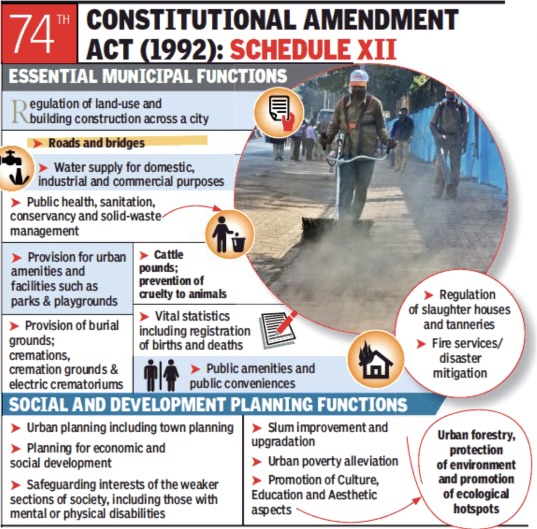
    Firstly, many believe that the Corporation merely performs a regulatory and conservancy role. This is not true. As seen from the box, the 74th Constitutional Amendment (1992) extended the role of urban local bodies to Development Planning, Poverty Alleviation and Social Sectors, under Schedule XII. But do we ever see our citizens mention the adequacy or inadequacy of a school or clinic in an area? Of course not. After all, the reader would never dream of sending her child to a municipal school, though her maid and driver will – because they have no choice! Never mind that the Pune Municipal Corporation (PMC) runs one of the poshest, entirely e-learning based schools in Sahakarnagar!

    Secondly, we the payers of Property Tax think we are bank rolling the Corporation’s annual budget. Far from it – believe me, the poorest woman is paying tax on every grain of salt she buys at the kiranawala (grocery) and part of it goes to the Municipal Corporation, earlier as Octroi, and now as the Goods and Services Tax (GST). And surprisingly, in the larger cities this indirect tax component is anything from 10-20% higher than the Property Tax collection.

    In the matter of subsidies, certain programmes for the poor are financed directly by Central Government or donor agencies, and others by State Government grants – not from local taxes. The most obvious local subsidy is on water supply (with the Pune Municipal Corporation spending Rs 11 and charging Rs 5 per 1,000 litres) but because of the indiscriminate pricing system, the biggest beneficiaries are not the hutment dwellers but people like us, with the luxury of huge storage tanks in our posh societies. 

    Thirdly, in the present dispensation, the local government is very limited in its activities and choices by various State Government departments and parastatals. For instance, it is the State Motor Vehicle Department which makes big money from an unbridled registration of new vehicles, but it falls to the Local Government to provide parking and roads. Similarly, while parastatals like MSRDC may construct flyovers, their subsequent upkeep is a burden on local government, even though they had no say in the quality of the original construction.

    Even the supply of water released to a city is controlled by the State Irrigation Department, and Corporations are charged commercial rates for power installations by Electricity Boards, even when used for street lighting in public spaces. Moreover, even the most senior level local employees of a Corporation ultimately report to Officers from a Central Service, posted by a State Government for a period of three years or less, with no historical memory of the city’s past, nor long term interest in the city’s future. So much for Local Government autonomy.

    Of course, we the citizens are not doing our bit to make the city liveable. With a middle class which considers individual mobility from the age of 16 a birth right, the congestion of private vehicles on our roads is inevitable – and when the pollution caused by these vehicles reaches Delhi levels, we will, of course, blame the municipal authorities. Ditto with garbage. How many housing societies start off with earnest vermicomposting, only to abandon it in a month, as all the composting worms have died because the wet garbage fed to them had bits of indigestible plastic?

    And how long do we care about maintaining our rain harvesting systems? Nobody knows how effective the collection is every monsoon, but we do crib about the PMC not giving us the 5% tax incentive in every Society AGM. In fact, all it takes is a visit to the nearest Cooperative Court to see the huge number of cases resulting from squabbling among members of Cooperative Housing Societies. This is the ONE chance at self-government we were given – and look at the mess.

    It is not this writer’s case that urban local bodies are the exemplars of every virtue. Only that instead of complaining about the shortcomings of the present system, we need to fight for systemic reforms – the Constitution of India provides us with the tools of transformation. All we need is to use our votes to push State Governments into taking our cities seriously and empowering our Local Governments and devolving the necessary resources and manpower to make them viable.

  • Why we have no real say over our Public Transport Systems

    Published in Times of India, Pune on 14 November 2019. Lost and found. Posted here for you.

    In an article published almost exactly a year ago, I had pointed out the huge impact of British colonial rule on Indian cities and towns – especially their love of low-form urbanization, which had proved to be utterly unsuitable and unsustainable for India’s teeming millions.

    By limiting the Floor Space Index (FSI – Built-up permitted wrt land available) in Indian cities, we have forced people to settle further and further from the city centre and their places of work, education and healthcare. Moreover, because our national priorities immediately after Independence were food security and rural distress, our cities never really had the resources to provide the public transport networks, which would make a sprawling city viable – as London is.

    Any latter-day attempts at densification fail because our existing infrastructure like water pipes, sewerage lines, power supply, simply cannot cope with high rises. Both the ill-conceived JNNURM and its progeny AMRUT and the SMART cities programme have found the limits of retrospective infrastructure upgradation, to our (the taxpayers’) immense cost.

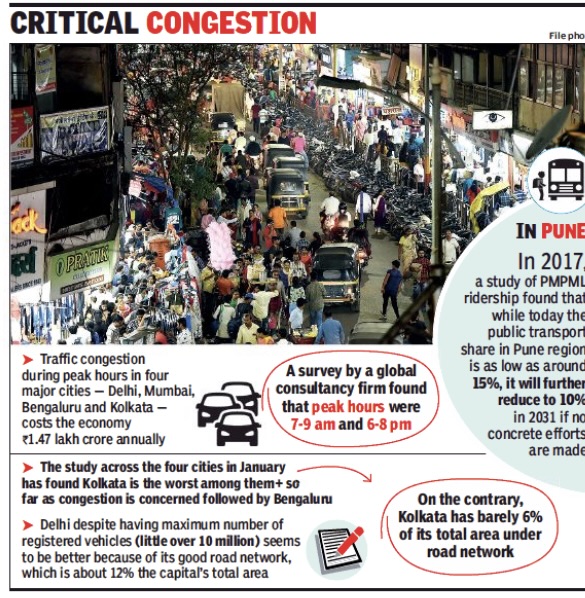
    The lack of adequate public transport has inevitably led to a growth in private vehicles, increasing pollution, and unsustainable traffic congestion on our roads. Further, retrofitting today’s cities with public transport networks like the metro are hugely expensive – not just in terms of the capital outlay but also the opportunity and social costs of the upheaval caused during construction, as Pune citizens are only too aware of.

    The sharp rise in the private ownership of motor vehicles and the multiple modes of private transport have made traffic management a nightmare, leading to an unacceptably high rate of serious and fatal road accidents. The upgradation of roads and networks is extremely expensive if done retrospectively and therefore the only way out is to integrate transport planning into urban planning at all levels – locality, city or region.

    Just look at the facts:

    • There are over 210 million vehicles on Indian roads and more than 90% are privately owned
    • Percentage of land under road for Class I Indian cities is 16% compared to 29% in USA, with 1.6 million km of non-rural roads
    • Inadequate road length leads to congestion, pollution, higher fuel consumption, with peak hour speeds limited to 5 – 10 km/h
    • Suspended Particulate Matter in India’s 3 largest cities is greater than 3 – 4 times WHO maximum acceptable level
    • At the ground level we find that manufacturers use the same truck engine and chassis for all buses, and therefore, Indian cities have few, if any, buses especially designed for intra-city travel, further adding to the inefficiency of the system.

    Part of the reason for the growing crisis has been that urban transport management in India is a case of all responsibility and no authority for local governments. For instance, it is the State Government which formulates Development Plans which lead to urban sprawl, but it is the local body which must provide subsidized public transport. Yet again, registration of new vehicles being a very lucrative source of income for State Governments, there is no incentive to limit their number, and it is left to local bodies to provide parking and road space for them.

    When it comes to the building of new expressways and flyovers, the contracts are given either to large private firms or to parastatals like MSRDC, NHAI or BMRDA. It is noteworthy that ALL parastatals are accountable only to their respective State or Central Government, and not the local authorities.

    The same is the case with rail-based transport systems like metros, which depend totally for expertise and execution on the Indian Railways and its subsidiaries, which are under the Central Government, and are seldom geared to handle local issues and concerns. Once these large projects are handed over, their maintenance and upkeep become a further responsibility for municipal bodies.

    So, like everything else in India, we need a paradigm shift in our patterns of urban planning and urban governance – and that dear reader is unlikely in the near future…

    Related:

    Deteriorating Services and Infrastructure in India

  • Why we must turn Regional Planning on its head, now

    Published in Times of India, Pune on 28 March 2019. Lost and found. Posted here for you.

    Thanks to the efforts of scholars like Dr Tharoor, we are becoming aware of the ravages of colonial rule in India. The bottom line is that all colonization throughout human history has had a dual commercial motive: firstly, through unjust taxation of a subjugated population, and secondly, through the stripping of a country’s natural and human resources.

    As these resources had to be transported back to the mother country, it is only natural that post-colonial cities were essentially gateways for the export of raw materials and import of finished goods – whether as ports on the coast, or railheads inland. In India, the British extracted our resources in the form of cotton, indigo, forest produce, jute, tea, grains and minerals. Hence the rapid development of Chennai, Mumbai and Kolkata. Their only interest in the hinterland was in extracting all they could without spending anything on infrastructure or services in rural areas. Thus, poverty became endemic in the Indian countryside, and today’s farmer distress has deep roots in the great famines of the 1930s and 40s.

    Now, 70 years after Independence, every Government has tried to address these issues of rural neglect in a piecemeal fashion – sector by sector e.g. rural roads, rural housing, rural sanitation, rural health, but the results have not matched the resources poured in.

    This is where Regional Planning comes in.

    It is not something new, but unfortunately, Indian Regional Planning has traditionally been left to urban planners and they have never been able to rise beyond the standard British formula of land use, transport and communication routes, water supply and drainage, preservation of areas, and reservations of sites for new towns.

    It’s almost as if the big city is endowing its poor rural sisters with that ultimate gift of modernity – more urbanization. Like creating 5-star Industrial Townships like Ranjangaon in the heart of good agricultural territory! In fact, with the worldwide decline in heavy manufacturing, the Special Economic Zones (SEZs) of yesteryear have quietly fizzled out, with the only beneficiaries being the business houses who promoted them, who are now the owners of vast swathes of rural and tribal lands, generously ‘acquired’ for them by Government agencies themselves.

    As currently understood, a major aspect of the Regional Plan is metropolitan decentralisation and the redistribution of the population, city functions and activities of the Mother City. In other words, it is a classic case of ‘top-down’ planning doomed to failure in a rapidly changing globalised world.

    However, as the headline suggests, maybe it is time to turn Regional Planning on its head.

    So, let’s begin with the villages. India, because of its density of population has always had market towns at the hub of a circle of villages – going back to Vedic times. These market towns have in most cases been reduced to overgrown villages or small municipalities or census towns. So why not concentrate on their revival first? Let us rebuild the spokes of the wheel of which each market town is a hub through good all-weather roads, telecommunication links, broadband connectivity, adequate water and electricity.

    The next layer can be developing the social infrastructure like schools, polytechnics, colleges, hospitals, mother and child care centres, and financial infrastructure like banks and business centres. The only industry to be allowed in these hub towns would be agroindustries and food processing, and modern polluting industries would be strictly kept out.

    To enable these hubs to function properly, the full allocation of education, health, irrigation and forestry funds should be delegated to the local authority, as has been done successfully in Kerala. The local economic development and environmental and water management will also be the responsibility of the local body. As the area becomes more productive, there should be financial incentives for the local body like higher allocation from GST collected.

    In this way, we will be tertiarizing the rural economy, creating non-agricultural jobs in small towns, using local resources in a sustainable manner, and reducing migration to cities in search of higher education and good health care. So, if we adopt this approach, we end up with multi-nodal development and these nodes or hubs can all be networked through transport and communication links.

    As we approach the medium range towns, the Regional Plan must concentrate on upgrading basic municipal services and infrastructure, which will make these towns more liveable and discourage migration to the big city. These medium towns must also provide the tertiary level of services like Universities and Multispeciality Hospitals. Such towns should focus on developing local entrepreneurs by providing affordable industrial galas, shopping malls, and reliable power, water, transport and communication. Such towns can also become cargo hubs for produce from the market towns, with the emphasis being on developing rail and water transport rather than 6-lane highways which play havoc with the environment.

    Coming to the Mother City, the emphasis must be on efficient public transport, power, water supply and environmental management with good connectivity to outlying areas, the rest of the country and abroad. With these facilities in place, the productivity of a city is bound to go up and this growth must be encouraged through higher allocations from taxes earned, more autonomy and less interference by State Governments in local matters. This will make local governments more responsive and accountable to their citizens.

    Finally, the already existing forest and conservation laws need to be stringently adhered to, so that the rights of forest dwellers and the legacy of future generations are preserved.

    In the present bleak scenario of polluted cities, urban sprawl, dwindling water sources, depleted forests and land hoarding, we all need to think outside the box, and plan for our country’s future.

    Related

    Indian Urban Planning in limbo

    Read more: Why we must turn Regional Planning on its head, now
  • When is a city truly ‘prosperous’?

    Published in Times of India, Pune on 21 December 2018. Lost and found. Posted here for you.

    A few years back, a visiting Minister of State who was in town to flag off the Marathon had commented that Pune appeared to be a ‘prosperous’ city. And I don’t think he was off the mark there. If you have lived here all your life you pick up the Pune zing of being ‘up and about’ and going about your business, with a goal and a schedule – whether the executive in his chauffeur-driven car, or the ‘bai’ (domestic) whizzing around her 6-7 jobs on her trusty two-wheeler.

    If we are to go only by ‘economic’ prosperity, then according to GDP, Pune takes seventh place behind Mumbai, Delhi, Kolkata, Bengaluru, Chennai, and Hyderabad. Which is not bad at all, because it is not a State Capital like the others.  

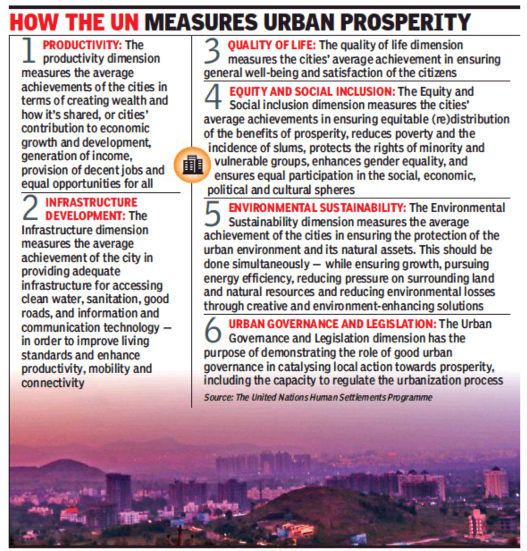
    So, what defines a city as prosperous, if not just GDP? According to the UN-Habitat:

    • First, a prosperous city contributes to economic growth through productivity, generating the income and employment that afford adequate living standards for the whole population.
    • Second, a prosperous city deploys the infrastructure, physical assets and amenities required to sustain both the population and the economy.
    • Third, prosperous cities provide social services like education, health, recreation, safety and security, required for improved living standards, enabling the population to maximize individual potential and lead fulfilling lives.
    • Fourth, a city is only prosperous to the extent that poverty and inequalities are minimal. No city can claim to be prosperous when large segments of the population live in abject poverty and deprivation (Mumbai, Kolkata please note!) This involves reducing the incidence of slums, homelessness and new forms of poverty.
    • Fifth, ensuring that the creation and (re)distribution of the benefits of prosperity do not destroy or degrade the environment; instead, the city’s natural assets are preserved for the sake of sustainable urbanization.

    So, if Pune is to appear prosperous to outsiders and host a happy and contented population, it needs to look at the pressure points, which need immediate attention, correction and upgradation.

    Pune and its satellite cities of Pimpri-Chinchwad, were blessed with excellent weather, an educated workforce and proximity to Mumbai and remain one of the most important civilian manufacturing hubs in India. As the city with the most prestigious defence and scientific establishments too, Pune offers the best work opportunities in both the public and private sectors and its citizens have prided themselves on a culture of high productivity. This culture made an easy transition to the burgeoning IT sector, as many majors set up hubs at the various software technology parks.

    However, the city’s high productivity is under threat from FAILING INFRASTRUCTURE – be it the unreliable power supply, the mediocre telecom networks and connectivity, or the lack of efficient public transport which cost millions of workhours lost in traffic jams.

    As regards sustaining everyday life, Pune is becoming more and more stressed in its WATER SUPPLY each passing year – chiefly due to a cumbersome sourcing mechanism, outdated treatment and distribution networks, and low capacity staff at the municipal level. The situation is made worse by an unregulated water tanker mafia and corruption which allows large-scale pilferage and diversion in the system.

    In the area of social services like health, sanitation and education, Pune is relatively better off but the chief hurdle is the MULTIPLICITY OF AGENCIES in these sectors – local, State and Central Government. Perhaps Maharashtra needs to learn from Kerala which thoroughly decentralized education and health to the local level and achieved not just 100% literacy and universal health coverage, but a Human Development Index rank on par with developed countries.

    As regards inequality and slums, Pune has long been an example to other cities with respect to providing basic services, high quality sanitation and total coverage in immunization of children in slums. Perhaps the need of the hour in Pune and elsewhere, is an INTEGRATED APPROACH to upgradation of slum housing (with the full participation of the residents) with new development control rules, emphasis on using recycled and indigenous materials, and providing public spaces for recreation and commercial activity in each settlement.

    Coming to the environment, Pune is again blessed with a very SAVVY POPULACE and an active (or as the bureaucracy feels, overactive) environment lobby – the ecologically sound Ganpati Visarjan (Immersion Ritual at the end of the Ganesh festival) is an example of the Punekar’s mature awareness of his/her responsibilities.

    What most citizens may not know is that Pune (along with other municipal corporations in Maharashtra) prepares an excellent annual ENVIRONMENT STATUS REPORT covering everything from air and water pollution, energy use, carbon footprints, forestation, housing to transport and waste management. The reports lay down the pressure points for the city and outline corrective measures. Sadly however, these insights are seldom if ever incorporated in either the city’s Development Plan, or the annual budget and the few incentive schemes offered to citizens – like a discount in Property Tax for installing rainwater harvesting systems – vanish in a haze of bureaucratic inertia.

    So, if an Indian city like Pune truly wants to remain a prosperous city, the State and Centre need to devolve resources and develop capacities at the local level, and the local leadership need to galvanize their workforce, exercise tighter regulation to curb petty corruption, and plan for a sustainable future for the city, based on sound scientific principles, rooted in a fast changing, environmentally challenged world.

    Related:

    Quality of Life in an Indian Context

  • Smart use of Unutilized Land can boost Affordable Housing

    Published in Times of India Pune on 12 September 2019. Lost and found. Posted here for you.

    This article was prompted by a question: Will it ever be possible to get a flat for Rs 45,00,000 in the prime areas of Pune? And my immediate response was No… and then, why not? Let me explain.

    Those of the Doordarshan (Public Service Television) generation who grew up in Pune Cantonment still remember how all our friends lived within walking distance in the streets flanking Main Street, how we walked to an excellent school and got a great education without breaking the bank, and our older siblings cycled to college – and the few posh ones in school lived in Koregaon Park, beyond which was the wilderness.

    Crossing the river to Fergusson College one discovered an almost identical habitation pattern around the peths (bazars) and wadas (family compounds) off Laxmi Road, and the better off lived in the bungalows around Deccan Gymkhana.

    Then life happened. We moved on to Murdoch’s Star TV and the new generation moved out to Silicon Valley and Dubai, Canada and Australia. But they did come back and invest in a flat back home, and while Saifee Street moved en masse to Fakhri Hills, the ‘city-walas’ moved to Kothrud.

    Meantime, there was a concerted effort by retirees to make a home in Pune and while the suburbs of Aundh and Pashan attracted those from the many educational and scientific institutes in the area, Salunke Vihar and NIBM grew into attractive localities for the ex-Army types where even today, you only hear chaste Kendriya Vidyalaya (Central School) Hindi spoken. The aspirational and business classes meanwhile, extended beyond the much-coveted Bund-KP area to Kalyani Nagar, and the nouveau riche IT class sought its own enclaves everywhere from Kharadi to Hinjewadi.

    Things were booming and Pune was growing until the bubble burst around 2007-2008. Pune’s real estate sector had priced itself out of the market – they didn’t realize that even the best amenities will not attract buyers on the outskirts because people would rather have good schools and hospitals in the neighbourhood, rather than posh gyms and swimming pools in increasingly unaffordable gated societies, stuck in the middle of nowhere. The developers had twisted the screws by reducing the carpet areas of flats while charging exorbitant rates for super built up premises, with large terraces being sold at the same price as covered areas. Finally, the worm turned and people stopped buying. Period.

    In development parlance all social sectors like education, health and housing are governed by the 3 As: Availability, Accessibility and Affordability.

    So, when we talk of urban housing, we essentially talk about the availability, accessibility and affordability of land in a city. For equity and inclusion, a city needs to make available an adequate mixed-income housing stock, which is equally accessible and affordable to the rich and the poor alike. And when a city achieves that, it prospers like Singapore – the city with the best Quality of Life in Asia.

    Coming to the case of Pune, we find that land is indeed available, but it is not accessible to the housing sector because of colonial hangovers, retrograde laws and outdated provisions – and so Punekars do not have affordable housing. We refer of course to the vast swathes of unutilized defence land in the Cantonment areas, and large tracts of government-acquired land tied up in defunct factories in the MIDC Pimpri-Chinchwad area.

    If the most high-security defence establishments in the Pashan Area can be entrusted to the jurisdiction of the Pune Municipal Corporation, there is really no need for a separate and impoverished Cantonment Board to look after a racecourse, a few schools, a fish market, some shops and restaurants and heaps of crumbling old bungalows.

    There is a simple solution: Why not consolidate all this unused land under a single government authority on the lines of the National Housing Board of Singapore? This way, we can plan affordable housing in both parts of Pune and ensure that the infrastructure provided is clean, green and state-of-the-art.

    As these would be greenfield rather than redevelopment projects, they can be planned de novo as high-rise structures with ample scope to compensate both the defence ministry and private industrialists, with housing enclaves for their personnel, or for commercial sale. This can be termed the Pune Model and applied gradually to other Indian cities where land is trapped in large government or private holdings.

    It is very essential that the Housing Board remain a Government entity, because all public-private enterprises in India tend to be dogged by cost overruns, NPAs and manipulation.

    Sadly, one doubts that this will happen – because as the supply rises to match demand, house prices will fall, and the screws will be tightened on the government by both the real estate speculators and the corporates likely to lose their massive land holdings.

    So no, it doesn’t seem likely that you will get a flat for under Rs 4.5 million in Pune any time soon…

    Related:

    Cities without Shelter

  • Why we are still asking the wrong questions on Slums

    Published in Times of India, Pune on 14 November 2018. Lost and found. Posted here for you.

    Informal housing – or ‘slum’ as it is derisively called – has become the hallmark of all metros in the developing world, from Rio to Lagos to Nairobi to Mumbai.

    The evolution of slums in post-Independence India, however, is the stuff of legend, on which many a career in New Wave Indian Cinema of the 1970s was built….

    Several studies during this period revealed that the typical migrant to urban areas was a semi-skilled or skilled male, 18-35 years old, who sent a major share of his earnings back home to support his family.  Housing was a low priority for such a person and he was ready to squat or settle at any location which cost him the least of his hard-earned money. The social vacuum created by a separation from rural roots was compensated by congregating along ethnic, caste, linguistic and regional lines, and such arrangements provided a strong social support system to compensate for the break-up of the rural extended family.

    The downside of this has been ghettoization, which not only enhances strife and bigotry, but provides easy mobilization in violent crises – be they communal riots, industrial unrest, or underworld gang wars.

    In planning terms, the assumption that slums and urban poverty were co-extensive and coterminous led to numerous ad hoc ‘slum improvement’ schemes at this time, where it was naively assumed that upgrading living conditions in slums in a piecemeal fashion, would eliminate the scourge of poverty from our towns and cities.

    However, as the research and information base has grown, it has become clear that the relationship between urban poverty and slums is both tenuous and complex – especially as a second generation of slum dwellers, with few choices and little upward mobility, begin to emerge on the urban scene. They can look forward to a life only in the informal economy of the city, and given our outdated civic laws, even a new-born child in such a household, breaks a dozen laws as he or she draws its first breath…

    During the 1980s, urban slums could no longer be seen as extensions of rural poverty and became more or less autonomous. As thriving, self-sustaining social systems in their own right (Dharavi being an example), urban slums were no more synonymous merely with urban poverty. While urban poverty incidence has declined between the early 1970s and the late 1980s, there is no evidence of any decline of the slum population.  As a result, fewer people have access to safe drinking water and nearly 70% are reported to be without basic sanitation. 

    Poor housing, infrastructure and urban services are the problem, not poor people.

    The consequences of regarding urban poverty and slums as one and the same have been largely negative:

    Once a slum is recognized as such, subtle political forces prevent it from ever becoming de-notified and this has stigmatized entire communities of urban poor, doomed to be labeled ‘slum-dwellers’ for generation after generation. As a result, slums become powerful vote banks and can be mobilized for various anti-social activities like crime, extortion, land grabbing, strike breaking and communal violence.

    Meanwhile, badly designed slum upgradation schemes have set up an unsustainable regime of subsidies, inculcating the same dependency syndrome among beneficiaries, which was earlier seen only in Indian villages. Providing basic services in slums was made synonymous with poverty alleviation, and the neglect of health and education in urban slums continues to eat away at the human potential of slum populations, pushing them further and deeper into unemployment, under-employment and the informal sector.

    On the side of local government, there is a tendency to underestimate the ability of the urban poor to pay for services and they have to learn to ‘do without’ these services. Slum schemes with their emphasis on shelter and basic services, neglect informal enterprise, and compound the problem by making no effort to integrate the informal slum economy within the larger city economy.

    Almost all housing schemes continue to neglect the key issues of access, security of tenure, and affordability and it is this – the most visible housing dimension of urban poverty – which continues to scar Indian cities.

    Finally, with the entry of private commercial interests into slum rehabilitation projects currently being implemented across India, there is a danger of encroached government and municipal lands passing forever into private hands.

    This would be an irrecoverable loss of public assets for generations to come. Instead, Indian cities can perhaps take a leaf out of capitalist Singapore and communist China’s public housing and long-term lease policies to ensure development with equity.

    Related:

    Housing Dimension of Urban Poverty

    Cities without Shelter

    Formalizing the Informal – the only economic reform that matters

    Read more: Why we are still asking the wrong questions on Slums
  • Rethinking India’s Urbanization

    With no apologies for a little diversion into the history of colonialism: because we cannot plan the future if we forget the power plays of the past…

    It is well documented that while the European colonizers chiefly plundered Africa for its gold, diamonds and equally precious human resources, their interest in India was mainly for what its broken and bleeding peasantry produced – cotton, indigo, jute, tea to enrich imperial businesses, and food grains to feed the British army through the two World Wars.

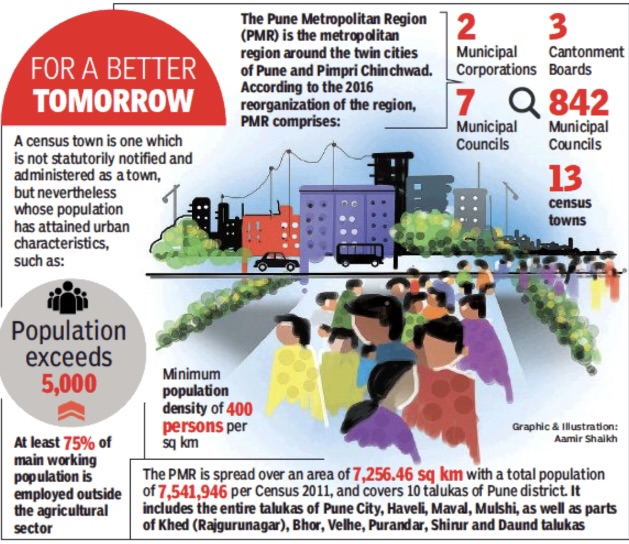
    And given the differences between Africa and India, this was a very shrewd business decision. While even today Africa holds only 15% of the global population and has a population density of just 87 per sq km, Asia with 60% of the world behind its borders, is densely packed with 246 persons per sq km. So naturally, Africans were historically widely dispersed over vast spaces and preferred small village communities to urbanization, while the Indus Valley Civilization dates back 5000 years. Over the centuries, different rulers have left their mark on the Indian urban landscape in the shape of pilgrim centres, temple towns, handicraft towns, military forts, princely capitals, maritime ports and agricultural hubs. However, these towns were essentially orthogenetic i.e. born from the soil and culture of India. But colonialism was to change all that …

    The colonizers in Africa basically needed exit points to carry out their nefarious human trafficking, and these cities soon grew and became primate for an entire region and most are still the capitals of modern African States. In India, the same need for developing exit points for colonial trade led to the creation of the port cities of Chennai (Madras), Mumbai (Bombay) and Kolkata (Calcutta) in the 1600s. However, although these ports were the chief cities in their respective regions, they could not develop into primate cities because of the highly developed pre-colonial cities spread across the sub-continent, which remained a repository of Indian culture and values throughout the days of British Rule – which also explains why the western proselytization of Africa could not be replicated in the Indian subcontinent.

    Many Indian cities were ‘repurposed’ by the British: as ‘hill stations’, railway towns, mining towns, tea estates or military cantonments and those that couldn’t, served their purpose as conduits of agricultural produce to the exit points. Therefore, it is no surprise that modern facilities like schools, universities and hospitals were concentrated only in these ports where the colonizers did business – the Indian hinterland was left to rot, and that neglect made rural poverty endemic in India, and is the chief cause of farmer distress even today.

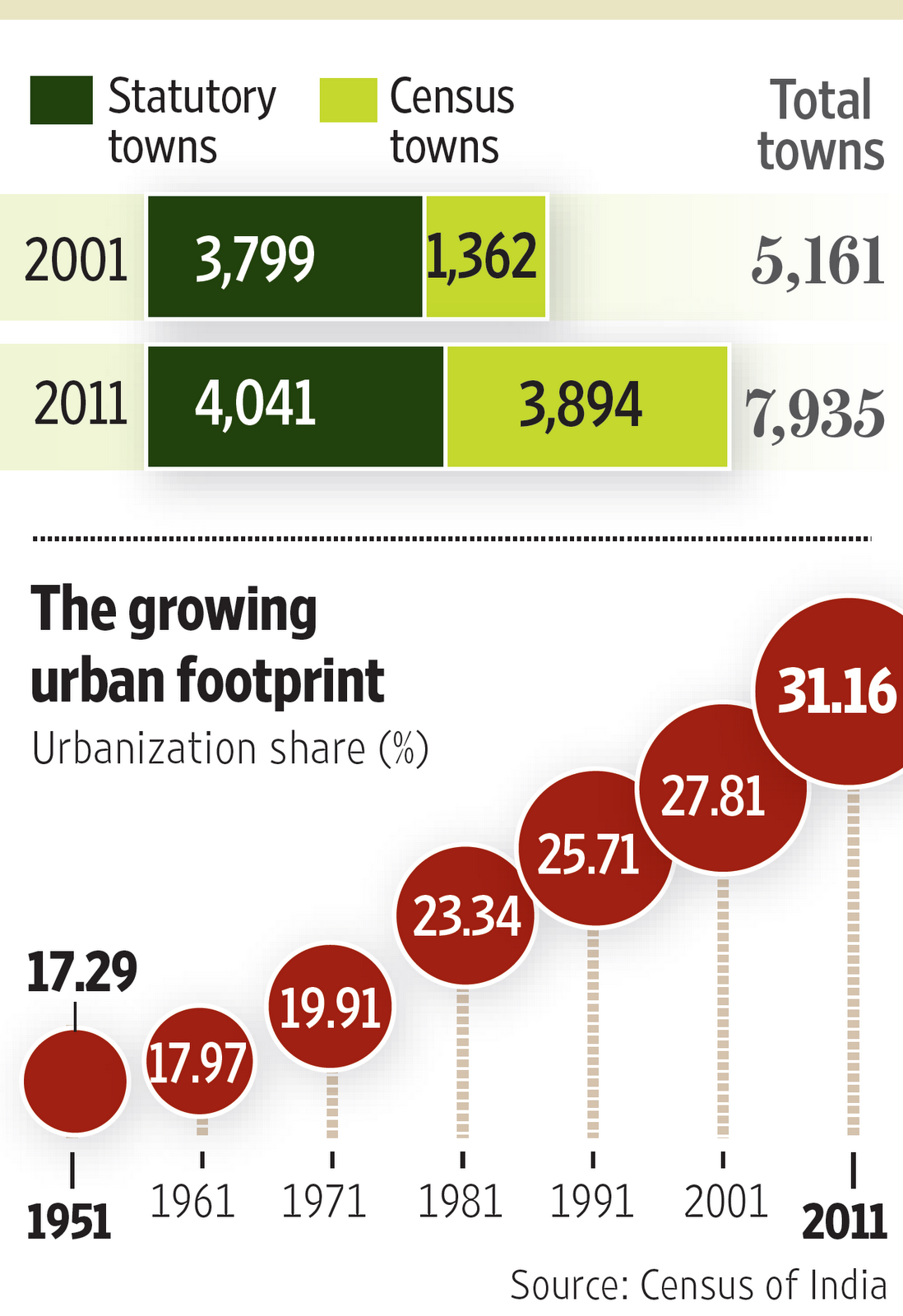
    Now, 70 years after Independence, we find that India still lives in its villages (as Mahatma Gandhi famously said) with only 31% urbanization reported in Census 2011. As the figures below indicate, even this low urbanization is greatly skewed towards the larger metros with smaller towns only fit as launching pads for new migrants to the big bad city, because their local economies are virtually non-existent and can create no jobs, nor build careers. This skewness is largely a result of the Indian penchant for top-down, low-form urban planning, learnt from the British, who hankered after their own ‘green and pleasant land’, and rather unrealistically, tried to recreate it in the teeming tropics!
    It is indeed ironic that India’s colonial hang-over has been replaced now by a very American neo-colonialism, where cities are supposed to be run like businesses, with maximum corporatization and zero inclusion. This was the undoing of both the JNNURM of the last Government, and the Smart City Initiative of the present one. (See: Why our cities cannot be run as businesses)

    Instead of developing rural areas under a separate ministry, sector by sector (rural roads, rural housing, rural sanitation, rural health, etc), why not take a more holistic approach which recognizes the rural-urban continuum at the heart of Indian society, economy and polity? After all, China built its entire fast rail network on the basis of urban migrants going home to their native villages for the Chinese New Year!

    This is where Regional Planning comes in.

    It is not something new, but unfortunately, Indian Regional Planning has traditionally been left to urban planners and they have never been able to rise beyond the standard British formula of land use, transport and communication routes, water supply and drainage, preservation of areas, and reservations of sites for new towns. It’s almost as if the big city is endowing its poor rural sisters with that ultimate gift of modernity – more urbanization. Like creating 5-star Industrial Townships in the heart of good agricultural territory! In fact, with the worldwide decline in heavy manufacturing, the Special Economic Zones (SEZs) of yesteryear have quietly fizzled out, with the only beneficiaries being the business houses who promoted them, who are now the owners of vast swathes of rural and tribal lands, generously ‘acquired’ for them by Government agencies themselves.

    As currently understood, a major aspect of the Regional Plan is metropolitan decentralization and the redistribution of the population, city functions and activities of the Mother City. In other words, it is a classic case of ‘top-down’ planning doomed to failure in a rapidly changing globalized world.

    However, as the title suggests, maybe it is time to rethink India’s urbanization…

    So, let’s begin with the villages. India, because of its density of population has always had market towns at the hub of a circle of villages – going back to Vedic times. These market towns have in most cases been reduced to overgrown villages or small municipalities or census towns. So why not concentrate on their revival first? Let us rebuild the spokes of the wheel of which each market town is a hub through good all-weather roads, telecommunication links, broadband connectivity, adequate water and electricity.

    The next layer can be developing the social infrastructure like schools, polytechnics, colleges, hospitals, mother and child care centres, and financial infrastructure like banks and business centres in each of these hub towns, which are likely to have a population of 20,000-50,000. The only industry to be allowed in these towns would be agro-industries and food processing, and modern polluting industries like tanneries would be strictly kept out.

    To enable these hubs to function properly, the full allocation of education, health, irrigation and forestry funds should be devolved to the local authority, as has been done successfully in Kerala. The local economic development and environmental and water management will also be the responsibility of the local body. As the area becomes more productive, there should be financial incentives for the local body like higher allocation from the Goods and Services Tax (GST) collected.

    In this way, we will be tertiarizing the rural economy, creating non-agricultural jobs in small towns, using local resources in a sustainable manner, and reducing migration to cities in search of higher education and good health care. So, if we adopt this approach, we end up with multi-nodal development and these nodes or hubs can all be networked through transport and communication links.

    As we approach the medium range towns, the Regional Plan must concentrate on upgrading basic municipal services and infrastructure, which will make these towns more liveable and discourage migration to the big city. These medium towns must also provide the tertiary level of services like Universities and multispeciality hospitals. Such towns should focus on developing local entrepreneurs by providing affordable industrial sheds, shopping malls, and reliable power, water, transport and communication. These towns can also become cargo hubs for produce from the market towns, with the emphasis being on developing rail and water transport rather than 6-lane highways which play havoc with the environment.

    Coming to the Mother City, the emphasis must be on efficient public transport, power, water supply and environmental management with good connectivity to outlying areas, the rest of the country and abroad. With these facilities in place, the productivity of a city is bound to go up and this growth must be encouraged through higher allocations from taxes earned, more autonomy and less interference by State Governments in local matters. This will make local governments more responsive and accountable to their citizens.

    Finally, the already existing forest and conservation laws need to be stringently adhered to, so that the rights of forest dwellers and the legacy of future generations are preserved.

    In the present bleak scenario of polluted cities, urban sprawl, dwindling water sources, depleted forests and land hoarding, governments need to think outside the box, and plan for India’s future.


  • Urbanization Trends in India

    India is one of the many countries which has never got around to formulating a National Urban Policy, even seventy years after Independence, and successive governments have just thrown money at the myriad problems of unplanned and undirected urban growth, with scant results and a perpetually deteriorating quality of life. India has the dubious distinction of hosting 9 of the 10 most polluted cities in the world. Therefore, it is incumbent on any incoming Indian Government that its policy makers take a step back and look at the urbanization trends in the country, before more of its precious resources (including scarce urban land) are handed over to the private sector, in the name of smart cities, or housing for the poor, or some other gimmick.


    The report of Census 2001 surprised urban experts by showing a downward trend in urbanization, first noticed in the 1991 Census, which had not been reversed, despite India’s notable successes on the economic front. Scholars of such phenomena had pinpointed four main reasons for this downturn :

    • As a result of the economic reforms of 1991, there had been a noticeable reduction in rural poverty, improvement in infrastructure and services, and a steady tertiarization of rural economies, reducing the flow of distress migration to cities
    • Secondly, with increasing global connectivity, the economic migration of people from small towns in search of education, skill building, and white-collar jobs, had reduced
    • Thirdly, villages on the periphery of big towns and/or with sizeable populations had resisted municipalization, chiefly because the local, landed power elite did not wish to relinquish control. The fear of higher taxation in an urban regime may also have dissuaded the rural citizenry, or perhaps, the host city (in a proposed merger) may have baulked at having its services and resources stretched over a wider area
    • Finally, it was believed that globalization itself was a cause for this downturn. As India transformed itself into a knowledge society, those on the wrong side of the digital and technological divide were put at a disadvantage. The knowledge sector tended to be capital intensive rather than labour intensive, and this discouraged unskilled labour from migrating.

    In the following decade of 2001-2010, the changes wrought by globalization on Indian society were well entrenched and urbanization picked up once again because:

    Liberalization brought foreign direct investment and MNCs demanded the dilution of India’s stringent, albeit humanitarian labour laws. Rightsizing and downsizing became the goal and social security (like pension schemes and medical aid) went out the door. This pushed more and more people into the informal sector, where they didn’t need to pay either direct or indirect taxes, and this in turn led to the further impoverishment of local bodies who had traditionally relied heavily on local business taxes like octroi.

    In the long term, informalization has a very insidious and deleterious effect on local economies. Anybody and everybody can aspire to ‘learn on the job’ and work as a plumber or electrician on a construction project without any qualifications, using shoddy materials from any fly by night ‘factory’ with no safety standards, and get paid for it in cash with no tax paid at any stage. Is it any wonder then, that buildings and bridges collapsing in Indian cities are a regular occurrence? And nobody is held accountable. Informalization also leads to extremely exploitative trade and labour practices, encourages forced labour and child labour, higher school dropout rates, and generally weakens a country’s human capital, so that one generation down the line, we have clearly lost our demographic dividend.

    Privatisation has led to a whole culture of unprecedented corruption and crony capitalism, especially in urban infrastructure. Even Government Schemes are now outsourced to private consultants, who have little or no local knowledge to make them effective and sustainable in the long run. The corporatization of basic municipal services, such as water supply and transport, further eats into the earnings of the local body and diminishes, rather than builds the capacity of municipal personnel. Further, unlike elected representatives, the bosses of these private and public corporates are not accountable to the people.

    The boost given to construction once again made cities attractive and pull migration brought in both semi-skilled and unskilled labour, who stayed on to boost the urban population, eking out a living in the informal sector and living in increasingly squalid settlements.

    It is noteworthy that although globalization and all its concomitants have dramatically raised the standards of living of the Indian urban middle class, and greatly reduced absolute poverty in the countryside, it has unfortunately skewed our priorities in favour of prestige projects like bullet trains instead of grassroots rail infrastructure; airports instead of bus stations; medical tourism instead of primary health care; business schools instead of primary schools; and so on.

    The increased urbanization of India becomes quite clear in the Census 2011 report.

    Urbanization in India

    We see that by the time of the 2011 Census:

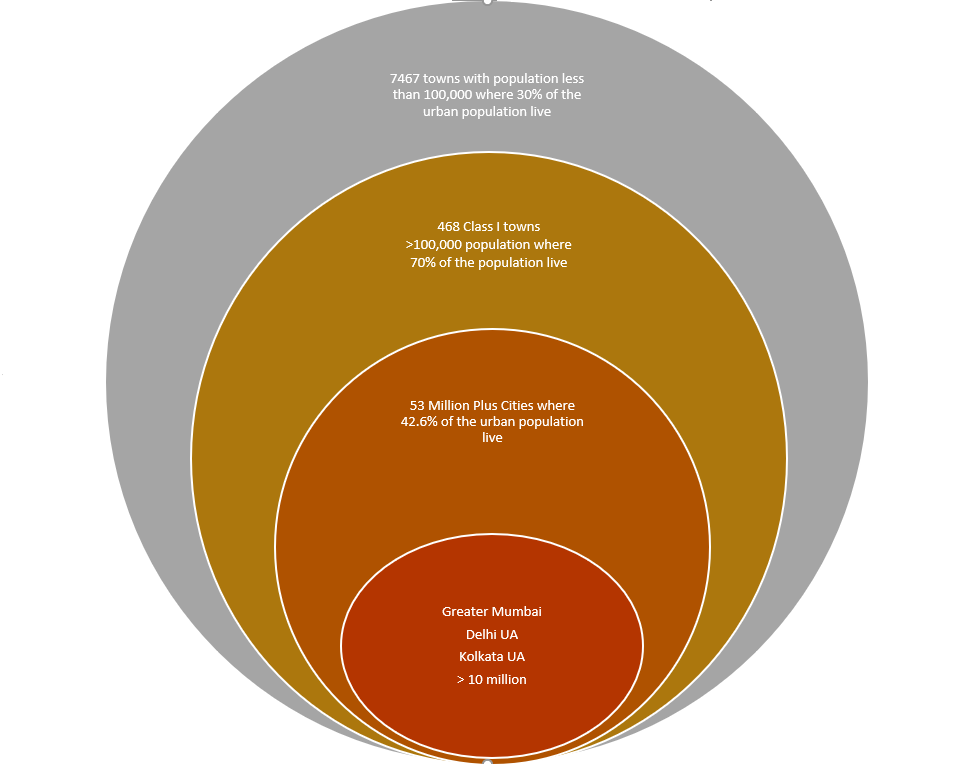
    • It was suddenly desirable to be urban’. The old landed elites had given way to the new rich, who had become wealthy beyond their wildest dreams by selling farmland on the peripheries of expanding metros, and now aspired for political power to match their financial clout – which could only happen in a new municipal/urban setting. This explains why although there were 7,935 towns in the country, only 468 or 6% had a population exceeding 100,000 (one lakh), that were home to around 265 million persons, constituting 70% of the total urban population! Which begs the question: what sort of towns (!) were the remaining 94%?
    • The 53 million-plus cities, where 42.6% of the urban population live, continued as the real ‘urban’ India. They were the hub of the old industrial sector and the new services sector. They continue to grow far beyond their carrying capacity and the impact on their environment has been devastating – whether through air pollution, toxicity in the food chain, dwindling groundwater, or recurring monsoon floods. These are the ‘generators of economic momentum’ for their regions and the country – pathetically inadequate, as their municipal governments are permanently impoverished, their tax bases are stagnant and non-viable, and informalization of both housing and the local economy is well over 40%.
    • The decline of the great urban symbols of British India, like Mumbai and Kolkata, foreshadowed in Census 2011, tell a sadder story: the abdication of power and responsibility by both, State and local governments, have given speculators a field day in these megacities, making real estate unaffordable to all but the super-rich. As the middle class gets pushed to the peripheries of these cities, the transport system reaches breaking point, and it makes more sense to opt for a relatively stress-free life in a smaller city. The archaic Rent Control Laws coupled with the absence of a clear title system prevents the growth of rental housing, further making these megacities unaffordable. With the exodus of formal sector economic activity to smaller metros/ towns, the vacuum is filled by the informal sector – reaching 68% in Mumbai, 62% in New Delhi, and 60% in Chennai.

    The United Nations estimates that 40% of India’s population will be urban by 2030, but if our cities continue into the next decade on their present trajectory, life would be a living hell in some dystopian concrete jungle. So, before that scenario unfolds, let us urge the next government to seriously formulate a National Urban Policy to revitalize India’s cities through a four-pronged approach:

    • Firstly, the decentralization of local Government to manageable ward level, which will ensure greater stakeholder participation in governance and will be a check on the arbitrary decisions of huge Municipal Corporations and parastatals, some of which have budgets larger than that of several smaller State governments
    • Secondly, a neighbourhood approach to city planning which is more organic and more Indian
    • Thirdly, a commitment to heavy investment in education and health to provide sustainable livelihoods beginning in our million-plus cities
    • Finally, hand-holding support to poor communities to enable them to formalize large informal sub-economies, so that they are gradually integrated into the city’s formal economy and eventually into the national economy.