Development and Governance

Category: India

  • Indian Diaspora

    A rather strange picture of Indian women IT professionals wearing hijab, with the occasional bindi (the dot on the forehead worn by Hindu women) eagerly clicking selfies with a visibly discomfited Indian PM visiting that bastion of conservative Islam – Saudi Arabia! Oh what shapes and flavours does the Indian diaspora take!
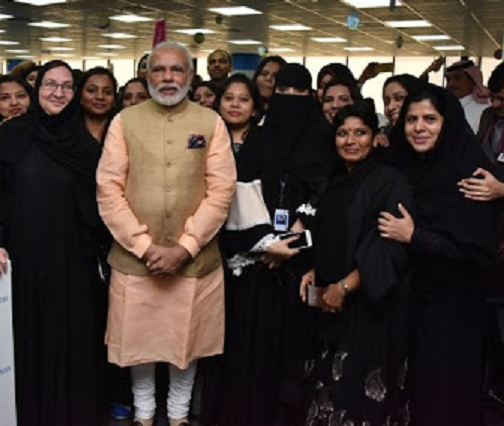
    MODI IN RIYADH


    Indians in the old days (like their Chinese contemporaries) had a taboo against overseas travel, as crossing the ocean meant loss of caste. So it was only the acute labour shortage in the colonies after the abolition of slavery, that saw large scale migrations of indentured Indian labourers, sent forth to sweat and build in the distant outreaches of the British Empire – from the rubber plantations of Malaya, to the sugarcane farms of Mauritius and the Caribbean, to the railways of East and South Africa… Indentured labour began in 1833, at the end of slavery, and continued until 1920. Most persons of Indian origin in these countries are descendants of these indentured labourers, 25-40% of whom would be women, allowing those who decided to settle in these distant lands to remain endogamous, procreate, and retain their distinct Indian ethnicity to this day.

    In East Africa, after the efforts of these pioneers had opened up the countries and their vast resources, a second wave of Indian migrants headed that way from the western State of Gujarat – not to build railways, but build economies through trade, industry and business. The East African Gujaratis were to become immensely wealthy, powerful (and some would say arrogant) throughout East Africa, when Idi Amin burst their bubble by ordering out thousands of them in 1970. Most of those expelled migrated onwards to the UK, USA and Canada and only a few chose to return home to India. It is these families who are now most prominent in the medium grade hospitality sector in North America – often referred to as the ‘motel Patels’.

    The next wave of migrants came essentially from Kerala to the Gulf, after the quadrupling of oil prices, post-1973. The first arrivals may well have been blue collar workers, but following the rapid socio-economic development of the Gulf countries, the demand grew for Indian professionals like architects, engineers and doctors. Back in India, the Gulf boom was to have a tremendous impact on the families of these workers (many from minority groups) who had their first experience of some financial security, enabling them to purchase property and educate their children. Thanks to the remittances of these hard-working folk, entire families could move up the social ladder from working to middle class in a single generation.

    Of course, the IT boom was to push another generation of worker-migrants further afield to Silicon Valley, and along with the Chinese, the Indian diaspora ranks among the most successful communities in the US and Canada.

    Whenever we talk numbers in India, comparisons with China are inescapable. The Economist had this very interesting infographic shading in the Diasporas of both countries:
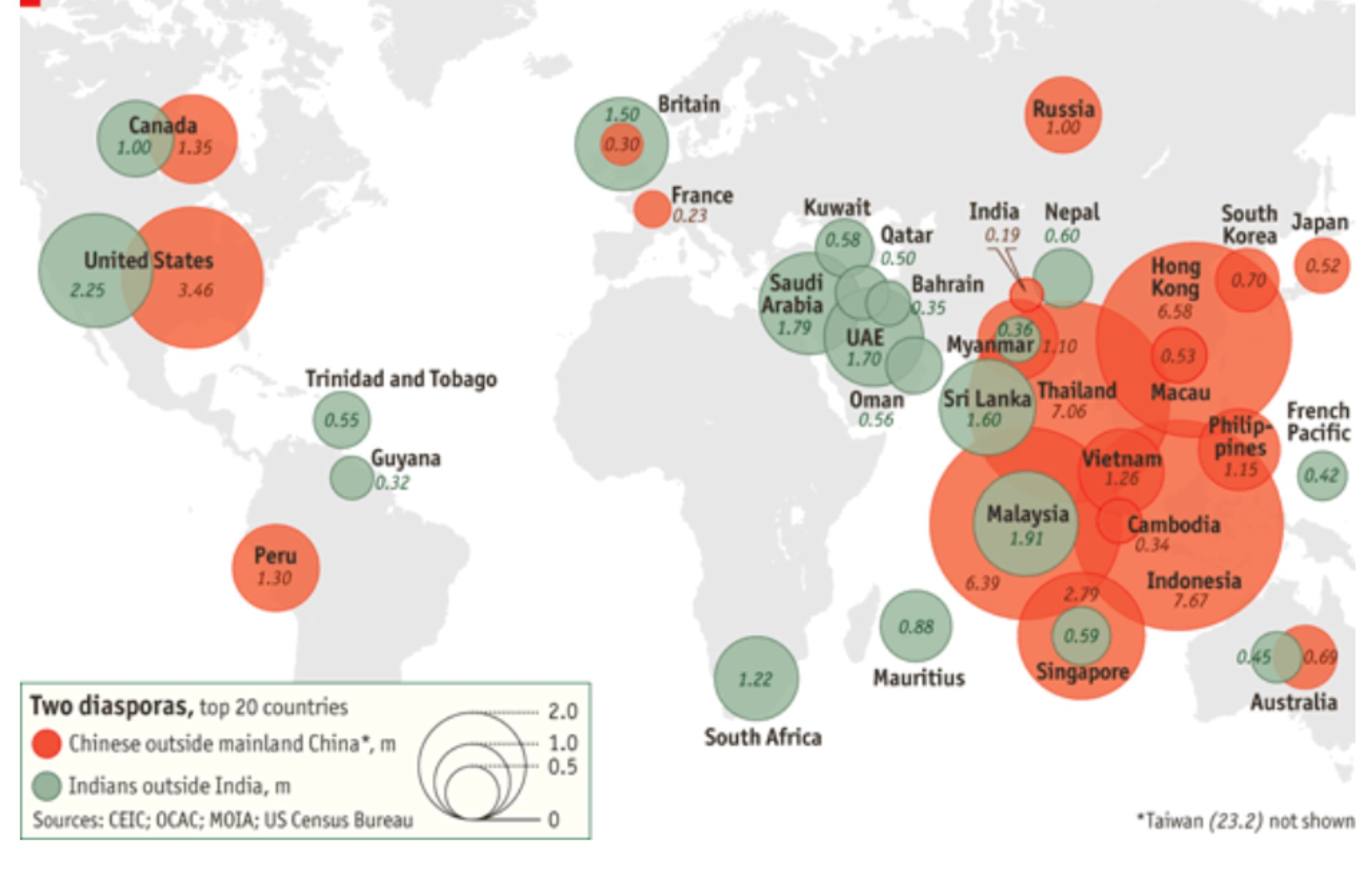
    Chinese Indian Diaspora

    The Chinese spread in South-East Asia is phenomenal, although such a high presence in distant Peru is indeed intriguing. It is believed that the post-globalization surge that China witnessed was made possible only because of the heavy investment in the motherland by the Chinese Diaspora, already close knit, well networked, wealthy and influential. Sadly, the Indian Diaspora has not contributed even a fraction of this to India’s development.

    In the CARIM report on “India´s Engagement with its Diaspora in Comparative Perspective with China”, Kathryn Lum points out that while China can claim success in attracting a significant number of “sea turtles” back to Chinese universities and research parks, and has also been very successful in attracting ethnic Chinese Foreign Direct Investment, the FDI figures from the Indian diaspora have been disappointingly low, although India is still the leading recipient of remittances worldwide. The challenge for India, according to the report, “… is to build upon its already significant diaspora infrastructure in order to attract higher levels of investment, business formation and to boost diaspora-related initiatives in Indian states that have been relatively deficient in this area to date.”


    However, in my humble opinion, no amount of pop star type rallies or selfie-fests or ‘diaspora infrastructure’ are going to garner results for the most diaspora-friendly Prime Minister in Indian history, unless his government gets its act together to:

    • Enhance its human development ranking and shed the eternal Indian image abroad of inequity, poverty and injustice
    • Vocationalise its secondary and tertiary education to build up a highly skilled workforce
    • Ensure ethical practices throughout the supply chain in the manufacturing sector with tighter controls over child labour and forced labour, so that Indian goods do not get blacklisted abroad, and
    • Guarantee that the institutionalized corruption at Local and State Government level is rooted out completely – despite the election promises, the scale of graft has, if anything, gone up dramatically in scale…


  • Happy Republic Day India – yet again…

    Happy Republic Day India. Remember it not as yet another opportunity for Amazon and Flipkart to slash their prices, but as the day when ‘We the People’ defined our very humanity and quintessential Indianness – by giving ourselves a sublimely inclusive Constitution.

    Exactly a year ago, I had explored just how far we had strayed from the spirit of the Preamble to the Constitution. This year I would like to remind Indians of their Fundamental Rights, which need to be fought over, cherished and nurtured, lest we lose them forever.

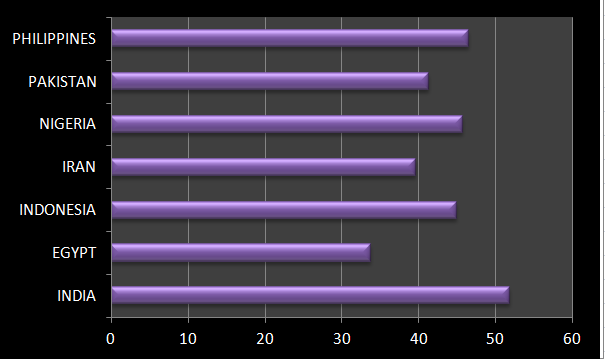
    The Right to Equality is one of the chief guarantees of the Constitution. It is embodied in Articles 14–16, which collectively encompass the general principles of equality before law and non-discrimination, and Articles 17–18 which collectively further the philosophy of social equality. And yet, inequality in India has never been higher as these figures from the World Economic Forum indicate:

    GINI COEFFICIENT FROM WEF DATA

    (Gini Coefficient as percentage, an indicator of income inequality. The higher it is, the greater the inequality)

    Right to Freedom: Article 19 guarantees six freedoms in the nature of civil rights, which are available only to citizens of India. These include the freedom of speech and expression, freedom of assembly without arms, freedom of association, freedom of movement throughout the territory of India, freedom to reside and settle in any part of the country of India and the freedom to practise any profession. And yet, Indians from one part of the country continue to be branded as outsiders in other parts of their own motherland…

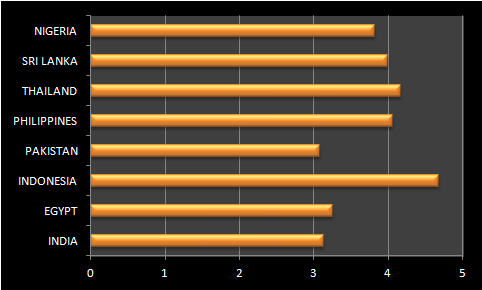
    The Right against Exploitation, contained in Articles 23–24, lays down certain provisions to prevent exploitation of the weaker sections of the society by individuals or the State. Article 23 provides prohibits human trafficking, making it an offence punishable by law, and also prohibits forced labour or any act of compelling a person to work without wages where he was legally entitled not to work or to receive remuneration for it. Yet again, per WEF figures, India lags far behind when it comes to curbing forced and child labour, and providing productive work and adequate compensation to its people:

    EMPLOYMENT AND WAGE INDICATORS FROM WEF DATA

    (Performance rated on a scale of 1-7, with India doing marginally better than only Pakistan)

    The Right to Freedom of Religion, covered in Articles 25–28, provides religious freedom to all citizens and ensures a secular state in India. According to the Constitution, there is no official State religion, and the State is required to treat all religions impartially and neutrally. Article 25 guarantees all persons the freedom of conscience and the right to preach, practice and propagate any religion of their choice. How sorry then to find that the Government’s own National Crime Records Bureau (NCRB) gives us a League Table of the worst communal incidents in Indian States and the death toll in such incidents for 2014-15:

    COMMUNAL RIOTS 2014-15 FROM NRCB

    The Cultural and Educational Rights, given in Articles 29 and 30, are measures to protect the rights of cultural, linguistic and religious minorities, by enabling them to conserve their heritage and protecting them against discrimination. The jury is still out on a number of such cultural practices considered inhuman or inhumane, while cultural issues continue to be politicised by all concerned – whether it is jallikattu or the beef ban.

    So, on this day, let us all reinforce our faith in the Constitution as we “… continue to complain; to demand; to rebel…” as urged by the President of India in his speech today.

    Jai Hind!


  • Remembering Gandhi

    Today is the  birth anniversary of Mahatma Gandhi. And particularly poignant, as the admirers of his assassin are now out in the open at home, and state and individual violence has reached unprecedented levels across the world.

    I remember visiting the Yerawada Jail in Pune to discuss a training programme for the Prison Department, when the Jail Superintendent showed us the register from 1922 when Gandhiji was brought there to serve a 6 year sentence. There in a bold copperplate, fading to sepia, were the details of this simple man who would one day move his nation and eventually the world.

    The British jailer had meticulously recorded that he was clad in a dhoti and a shirt, carried a pen and a watch, and had 16 rupees and 8 annas (or some such) in his pocket and the distinguishing mark was a mole on his arm. I found this simple litany so moving that it brought tears to my eyes… and for a minute I could actually see his frail form in that very room, standing at that very table having his life inventoried by a stranger.

    The cramped cell where Gandhiji was held has now been turned into a memorial with the surrounding yard lovingly cared for by prisoners who are often serving life sentences themselves. I could imagine how uncomfortable this cell would have been as the hot afternoon sun blazed through its bars. And to think that people like Gandhi and Nehru did most of their writing in places like this! There is now a charkha there, to mark the hours Gandhiji spent spinning cotton, while he thought of a million things, perhaps… his own personal style of meditation.

    gandhi

    Nehru mourned the passing of the Mahatma with his characteristic eloquence:

    “Friends and comrades, the light has gone out of our lives, and there is darkness everywhere, and I do not quite know what to tell you or how to say it. Our beloved leader, Bapu as we called him, the father of the nation, is no more. Perhaps I am wrong to say that; nevertheless, we will not see him again, as we have seen him for these many years, we will not run to him for advice or seek solace from him, and that is a terrible blow, not only for me, but for millions and millions in this country.”

    And the years have gone by… And to this generation of aspiring Indians, what is Gandhi other than a face on the currency notes, the name of the main street in every Indian town, and a national holiday to mark his birth? His very philosophy is now reduced to a bunch of quotations on the  internet, to be incorporated into the speeches of politicians and visiting dignitaries, and almost expunged from Indian textbooks.

    But Bapu himself was ever the realist, humble to the last, with no grand dreams of immortality, who actually said:

    “There is no such thing as Gandhism, and I do not want to leave any sect after me. I do not claim to have originated any new principle or doctrine. I have simply tried in my own way to apply the eternal truths to our daily life and problems…The opinions I have formed and the conclusions I have arrived at are not final. I may change them tomorrow. I have nothing new to teach the world. Truth and nonviolence are as old as the hills.”

    And therein lies the man’s true greatness..

  • Kerala: God’s own country?

    Today a diversion to India’s own Chile, that sliver of a state along its west coast – Kerala. This is the quintessential spice state which was trading with Sumeria and Mesopotamia and Egypt, thousands of years ago. A land of sea-farers, Kerala is a proud part of modern India, yet utterly unique. Management Gurus will tell you that while the perpetual dependence on rain-fed agriculture has made Indians fatalistic and accepting, the people of Kerala have always been enterprising and risk-takers as they farmed the sea rather than the land. And the fact that the annual Southwest Monsoon first strikes Kerala, ensures that its fields and plantations are ever lush, earning it the sobriquet of God’s own country. Heaven with forests, backwaters and divine cuisine…

    Naturally, tourism is a big part of the Kerala economy and it can satisfy everyone – the beachcombers, the wildlife enthusiasts and the mountain trekkers. And of course, history buffs. Kerala is reputed to be the entry point of all three Abrahamic traditions into India – Judaism, Christianity and Islam. It was also briefly the final resting place of Vasco da Gama, before he was reinterred back home.

    Kerala 1  Kerala2

    In the modern day, Kerala has the highest literacy rate, the best gender ratio and consequently tops the Human Development Index among Indian States in report after report. Its flagship Kudumbashree programme based upon women’s self-help groups has banished abject poverty from the countryside, and empowered its women far beyond their sisters elsewhere in India. However (and there is always a ‘however’), Kerala also enjoys the dubious distinction of being the most densely populated State in the industrialized South and West of the country – 819 souls per square km according to Census 2011. Simply too many people on too little land available for agriculture or industrial development. Consequently, ever since the oil boom of the 1970s, Kerala’s chief export has been its people. The tallest structures in Dubai, the freeways in Abu Dhabi, the grand mosques in Saudi Arabia are all a result of the blood, sweat and tears of these stalwarts from Kerala.

    Back home, this exodus mostly of young, single males has had a dramatic effect. While their families have prospered on these Gulf remittances, a disproportionate number of girls have been forced into the labour market, and none more so than in the profession of nursing. It is estimated that 80% of the membership of the Indian Nursing Association hails from Kerala, and they are ubiquitous in hospitals across India, and all over the Arab world, if not further afield.

    Indian media prominently displayed pictures of Kerala nurses evacuated from Iraq, and later Yemen, where one supervisor heroically rescued not just her staff but also the patients, by negotiating with the attacking rebels. But these tales of heroism hide a more sinister truth. Why are these girls forced to look for work in such dangerous parts of the world? Quite simply, because they get much higher salaries than would ever be possible to earn in India. And they all have harrowing tales of indebtedness to tell – having borrowed heavily first to qualify as nurses, and then to pay agents to find them the jobs.


    The moral of the story for me is that human development implies not just making more people literate, or bringing down the mortality rates; but also providing access to free higher education, and sustainable livelihoods to all within their community, or at least within their country. And neither the State Governments nor the Central Government show an iota of interest in human and community well-being, as they chase ever higher economic growth, at any cost.


  • Indian Independence and Globalization

    As someone born long after India gained Independence, one heard of Jawaharlal Nehru’s first Independence Day speech only from one’s elders and betters and got to actually hear it years later, only after the advent of the Internet. That scratchy recording from the radio archives; that emotion-laden voice, on the verge of breaking; those extempore words in an alien language…

    “Long years ago we made a tryst with destiny, and now the time comes when we shall redeem our pledge, not wholly or in full measure, but very substantially. At the stroke of the midnight hour, when the world sleeps, India will awake to life and freedom. A moment comes, which comes but rarely in history, when we step out from the old to the new, when an age ends, and when the soul of a nation, long suppressed, finds utterance. It is fitting that at this solemn moment, we take the pledge of dedication to the service of India and her people and to the still larger cause of humanity.”

    And what a pledge it proved to be! Nehru had inherited a partitioned land, a ravaged countryside, little or no manufacturing industry and famine stalking the masses at every turn. His first task was to interpret independence as self-reliance and address the abysmal poverty of the common Indian. Hence the Green Revolution to provide basic food security, and setting up of mega industries in the public sector, to provide employment in urban areas.

    In tandem was the establishment of the Indian Institutes of Technology, the Indian Institutes of Management, the National Defence Academy, and scientific research institutions like the National Laboratories, TIFR, BARC, ISRO and many more.

    Internationally, Nehru’s vision of Non-alignment protected India from the worst excesses of the Cold War, wreaking havoc all around us – South-East Asia, Africa and Latin America. Of course, the devil is always in the detail, and man is mortal, so Nehru could not redeem his pledge in its entirety, but he did leave behind a legacy of vision and daring.

    So what happened to derail Project Independent India? In a word – globalization. Ever since India chose this path, one has not heard any Prime Minister either make a pledge to the people of India, or show the courage to go it alone in the interests of the country. We are all too busy chasing Foreign Direct Investment and let the devil take the hindmost…

    In reality, the globalized world economy has deeply fragmented production processes, labour markets, political entities and societies, creating a plethora of interest groups and lobbies which have undermined the integrity of civil society and its rights and entitlements across the world. This is becoming increasingly visible in rich and poor countries in the form of growing disparity between places, people and groups. In India, globalization is manifested in much greater income inequalities and growing agrarian distress.

    In the international realm, the once proud Indian foreign office bows quietly to Washington in voting or abstaining on UN resolutions, and surrenders quietly to tough terms of international trade. Globalization, spearheaded largely by MNCs, now decides which domestic land laws need to be amended and which social issues can be ignored – like child labour, informalisation of urban economies, land rights of indigenous people, deteriorating health and education, pollution, environmental degradation and so on…

    Advocates of globalization claim that greater international connectivity has enhanced accountability of governments. True. But the global elite still get away with murder – they call it collateral damage, of course. The UN bodies, International Courts of Justice and other fora are as biased in favour of the West as before, so what has really changed for the better?

    The recent referendum in Scotland was precisely about this – globalization or independence? As is the ongoing ideological conflict in Greece. And look what happened there – economically weaker countries have quietly given up the battle and taken their humble places in the new global pecking order, and all’s well with God’s Earth! Even that bastion of hope – Cuba – is in a hurry to jump on to the globalization bandwagon… apparently globalization is as inevitable as death and taxes.

    So as India celebrated its 68th Independence Day this August, isn’t it time to take stock of where we are headed and why? To whose benefit? And at whose cost?

    It is time for India to break out of this global thraldom, and awaken once again to life and freedom…

  • Happy Republic Day India

    26 January is celebrated each year in India with great pomp, pride and ceremony, as it commemorates the day independent India gave to itself, its own Constitution, crafted with love, care and pride by India’s intellectual elite of the time – almost all educated in England in the age of ‘liberal’ Fabianism.

    This idealism (with a soupçon of the French Revolution) is best reflected in the PREAMBLE which captures the very essence of the Constitution:

    WE, THE PEOPLE OF INDIA, having solemnly resolved to constitute India into a SOVEREIGN SOCIALIST SECULAR DEMOCRATIC REPUBLIC and to secure to all its citizens:

    JUSTICE, social, economic and political;

    LIBERTY of thought, expression, belief, faith and worship;

    EQUALITY of status and of opportunity; and to promote among them all

    FRATERNITY assuring the dignity of the individual and the unity and integrity of the Nation;

    IN OUR CONSTITUENT ASSEMBLY this twenty-sixth day of November, 1949, do

    HEREBY ADOPT, ENACT AND GIVE TO OURSELVES THIS CONSTITUTION.

    So how well are these lofty sentiments understood in the raucous India of today? Let us see…

    SOVEREIGN means putting the national interest above all else

    SOVEREIGN DOES NOT MEAN converting India into an instrument of another’s geo-political strategy

    SOCIALIST means inclusive growth

    SOCIALIST DOES NOT MEAN changing the rules of play to favour the rich

    SECULAR means separation of State and Religion, and equal respect for all religions

    SECULAR DOES NOT MEAN engineering communal violence for electoral gain, or making the minorities feel so alienated and insecure that they turn to violence themselves

    DEMOCRATIC means moving forward on a basis of consensus

    DEMOCRATIC DOES NOT MEAN seeking constant confrontation with one’s political opponents

    REPUBLIC means the people are supreme

    REPUBLIC DOES NOT MEAN that Indians who do not even live in India can decide its destiny

    JUSTICE means social, economic and political equity

    JUSTICE DOES NOT MEAN over 31.3 million cases pending in Indian courts and the consequent brutalization of over 2,80,000 unconvicted undertrials languishing in Indian jails; or the summary justice meted out by ‘khap panchayats’ (village courts)

    LIBERTY means the liberty of thought, expression, belief, faith and worship;

    LIBERTY DOES NOT MEAN the banning of this book, or the censoring of that film, or the rewriting of history, or honour killings, or reconversions, or offering to ‘cure’ homosexuality…

    EQUALITY of status and of opportunity means just that

    EQUALITY DOES NOT MEAN that the top 10% hold 74% of the country’s total wealth, while the bottom 10% hold just 0.2%

    FRATERNITY means assuring the dignity of the individual and the unity and integrity of the Nation

    FRATERNITY does not mean blatantly racist attacks on Indian citizens from the North Eastern states, on the streets of the national capital…

    Happy Republic Day, India!

    Let us rediscover the Constitution we gave ourselves 65 years ago…


  • India an Aspirational Society? Not yet…

    (Since this was written in January 2015, India is more divided than ever – economically, socially, politically. Aspiration has given way to cynicism and despair and people are largely disconnecting from any larger vision for themselves or the country. Sad.)

    Visitors to India are struck by the existence of 2 Indias – that inhabited by the middle and upper classes, who have probably received a western education and are fluent in English and 2-3 local languages; and the vast majority of those that “…also serve, who only stand and wait…” The first are the type you would come across at any American campus – a class of the privileged imbued with a sense of entitlement, who will clean their apartments, drive carefully and work hard when abroad; but employ at least one or more ‘servants’ when at home to wash, clean, cook, sort their garbage, and run errands for them.

    These are the ‘citizens’ of the world’s largest democracy, with all the benefits that citizenship implies: participation in the sovereignty of the state, and driven by a moral and ethical purpose. The laws of the land flow from citizens’ response to a situation, which are validated by government to become the law of the land, conferring rights and imposing limits on all citizens. Citizenship strengthens, empowers and enables. This is what the world perceives as the ‘civil society’ in India.

    The vast majority of Indians, however, are imbued with a sense of fatalism and are merely the ‘public’ or populations which are a creation of government: they are identifiable, classifiable, and describable by empirical or behavioural criteria, and are amenable to statistical techniques like censuses and sample surveys. (Labels like ‘backward’ castes, Project-Affected Persons, Small and Marginal farmers, Landless Labourers, rag-pickers, scavengers, street hawkers, physically and mentally handicapped persons, actually occur in various laws and government schemes!)

    Membership of a population diminishes, disempowers and disenfranchises. This is not ‘civil society’ in the accepted sense, and it took the eminent writer Partha Chatterjee to give them a name. He called them Political Society, in his book the Politics of the Governed (2004).

    According to Chatterjee, the marginalized sections of society first seek legitimacy by declaring themselves as a group or community, and then negotiate directly with the ruling political class based on their numbers and ability to swing elections. In fact they function as ‘vote banks’ – a particularly pejorative term in middle class discourse in India.

    The dynamics of demanding accountability at both these levels is very interesting. While civil society is more comfortable dealing with the permanent professional bureaucracy (People Like Us); political society prefers to deal directly with its elected representatives. Once approached, it is up to the elected representatives to instruct the bureaucracy to take up the issue, mostly through arrangements outside of legality. And it is these paralegal arrangements, which prevent tighter regulation of informal businesses; procure that coveted contract; or halt the demolition of an illegal slum.

    So civil society and political society have long coexisted in Independent India in the mould of the centuries-old caste system (with modern class overtones) – interdependent, yet independent.

    However, since 1991 and the economic reforms which pinned India to the global economy, the lines of this social divide have began to blur for several reasons:

    Politics of Coalition Governments: Following the State of Emergency declared in 1975, there was a splintering of political parties across the ideological spectrum, and the emergence of regional parties, which meant that clear majorities at the Centre and State elections were a distant memory, and coalitions forced together strange bedfellows from either side of this social divide – the most notable being the coalition between the comfortably middle class BJP and the street savvy Shiv Sena in Maharashtra in 1995.

    Affirmative Action: Reservations for the disadvantaged in higher education and government jobs for over 40 years, have also helped move millions across the social divide.

    Liberalization, Privatization and Globalization have created new career paths and speeded up the mobility in society.

    Peri-urbanization or the growth of cities into the hinterland has created a class of the new rich, whose hitherto unproductive lands have shot up manifold in value, once they become part of a city.

    NGO-CBO Collaboration: In a post-internet global community, Non-Government Organizations (NGOs) have had the means and the willingness to set up Community-based Organizations or CBOs (often at the insistence of international donor agencies) and this collaboration has increasingly built bridges across the social divide.

    Formal-Informal Interactions: The opening up of the Indian economy has allowed private investments (both foreign and domestic) in everything from infrastructure, to financial services, to e-retail, and this means that the formal sectors are hugely dependent on the informal sector somewhere along their supply chains. This has brought in a new set of interdependencies into the civil-political society equation.

    Commercialization of Higher Education: Post-1991, there has been a boom in private institutions of higher education and it is possible to ‘buy’ a seat in every type of institution – IT, Medicine, Engineering. This has enabled expatriate workers and the new rich to educate their children, and examples of a rickshaw driver’s son or daughter holding a prestigious post in a scientific institution, are now commonplace.

    This blurring of lines between the governed and those who govern, has given rise to a new generation who have the same aspirations as their contemporaries around the world. And coming of age, they have been a key factor in the 2014 election.

    The question is can India now be termed an aspirational society? I think not yet…

    Writing in The Washington Times on September 8, 2014, Richard W. Rahn argues that:

    “Hong Kong, like Singapore, South Korea, Chile and Switzerland are aspirational societies, rather than societies consumed with envy, like France. Work, saving and investment are not punished in aspirational societies, and there tend to be less social conflict and a higher level of civility. The United States used to be an aspirational society, but has increasingly become an envious society.”

    Recent events in USA (with the Police forces accused of racism) and France (with its banlieue ghettoization of immigrants) contrasted with the peaceful protests in Hong Kong; do vindicate Rahn’s point of civility and unity of purpose being key to a society becoming an aspirational society. One may also add lower economic and social disparity to this mix. Chile from the above list of aspirational societies, has perhaps the most egalitarian society among comparable countries.

    The seeds of an aspirational society are there in India in this ‘bridge’ generation. The question is can the government rein in its extremist fringe which thrives on divisiveness, and can all political parties come together on a common purpose and action plan. And can a party that came to power on promises of development, also make this development inclusive

    Only time will tell…