Development and Governance

Category: India

  • Independence Day 2021 : Redeeming the Pledge

    At Midnight on the 15th of August 1947, India won its freedom from British Colonial Rule and on that historic occasion, Pandit Jawaharlal Nehru, the first Prime Minister of India delivered the famous Tryst with Destiny speech, which ranks amongst one of the greatest speeches of the last century, in any language.

    Long years ago we made a tryst with destiny, and now the time comes when we shall redeem our pledge, not wholly or in full measure, but very substantially. At the stroke of the midnight hour, when the world sleeps, India will awake to life and freedom.

    He went on to outline the many challenges the new nation, bent and broken by centuries of servitude, more diverse and ungovernable than any other on the planet, faced…

    Freedom and power bring responsibility. The responsibility rests upon this Assembly, a sovereign body representing the sovereign people of India. Before the birth of freedom, we have endured all the pains of labour and our hearts are heavy with the memory of this sorrow. Some of those pains continue even now. Nevertheless, the past is over and it is the future that beckons us now.

    That future is not one of ease or resting but of incessant striving so that we may fulfill the pledges we have so often taken and the one we shall take today. The service of India means, the service of the millions who suffer. It means the ending of poverty and ignorance and poverty and disease and inequality of opportunity.

    And it was this Nehruvian Vision which makes it possible for every Indian to look back with pride at what has been so painstakingly and assiduously achieved, in the face of adversity, scarcity, conflict and constraint:

    Lately however, it is becoming more and more difficult to keep India’s tryst with destiny, as we seem to be moving backward from the road to human development, which changed a billion lives for the better, over 75 long years.

    Some indications:

    • The Pew Research Centre, using World Bank data, has estimated that the number of poor in India (with income of $2 per day or less in purchasing power parity) has more than doubled to 134 million from 60 million in just a year due to the pandemic-induced recession. This means, India is back in a situation to be called a “country of mass poverty” after 45 years
    • As manufacturing jobs dry up, workers are returning to the low-productivity farm sector. Getting back to a higher growth trajectory will require getting people out of this disguised unemployment and into more gainful productive employment. The Centre for Monitoring Indian Economy (CMIE) has been monitoring these numbers and its Consumer Pyramids Household Survey shows that these numbers have been steadily rising in recent years. The government’s own Periodic Labour Force Survey (PLFS) shows that employment in agriculture, as a percentage of total employment, has gone up from 42.5% in 2018-19 to 45.6% in 2019-20. In other words, our labour force is in reverse gear and the situation can only grow worse, resulting in India forfeiting its demographic dividend
    • Globally, India fell 20 places in ten years on the WORLD PRESS FREEDOM INDEX – from 122 in 2010 to 142 in 2020. This story is becoming all too familiar, whether it is the World Development Index, the Social Progress Index, the Human Development Index and a myriad other global indices and criteria

    Nehruji ended his speech with rousing words indeed:

    We have hard work ahead. There is no resting for any one of us till we redeem our pledge in full, till we make all the people of India what destiny intended them to be. We are citizens of a great country on the verge of bold advance, and we have to live up to that high standard. All of us, to whatever religion we may belong, are equally the children of India with equal rights, privileges and obligations. We cannot encourage communalism or narrow-mindedness, for no nation can be great whose people are narrow in thought or in action.

    To the nations and peoples of the world we send greetings and pledge ourselves to cooperate with them in furthering peace, freedom and democracy.

    And to India, our much-loved motherland, the ancient, the eternal and the ever-new, we pay our reverent homage and we bind ourselves afresh to her service.

    Jaihind!
  • Republic Day 2021

    India marks 26 January as its Republic Day – the day WE THE PEOPLE gave unto ourselves a Constitution wherein we resolved that India was to be a SOVEREIGN, SOCIALIST, SECULAR, DEMOCRATIC REPUBLIC, which would secure to all its citizens:

    JUSTICE, social, economic and political; LIBERTY of thought, expression, belief, faith and worship; EQUALITY of status and of opportunity; and to promote among them all FRATERNITY assuring the dignity of the individual and the unity and integrity of the Nation.

    To bring about a just, free, egalitarian and fraternal society, the Constitution of India granted ALL its citizens, certain FUNDAMENTAL RIGHTS:

    The Right to Equality is one of the chief guarantees of the Constitution. It is embodied in Articles 14–16, which collectively encompass the general principles of equality before law and non-discrimination, and Articles 17–18 which collectively further the philosophy of social equality.

    Right to Freedom: Article 19 guarantees six freedoms in the nature of civil rights, which are available only to citizens of India. These include the freedom of speech and expression, freedom of assembly without arms, freedom of association, freedom of movement throughout the territory of India, freedom to reside and settle in any part of the country of India and the freedom to practise any profession.

    The Right against Exploitation, contained in Articles 23–24, lays down certain provisions to prevent exploitation of the weaker sections of the society by individuals or the State. Article 23 prohibits human trafficking, making it an offence punishable by law, and also prohibits forced labour, or any act of compelling a person to work without wages where he was legally entitled not to work or to receive remuneration for it.

    The Right to Freedom of Religion, covered in Articles 25–28, provides religious freedom to all citizens and ensures a secular state in India. According to the Constitution, there is no official State religion, and the State is required to treat all religions impartially and neutrally. Article 25 guarantees all persons the freedom of conscience and the right to preach, practice and propagate any religion of their choice.

    The Cultural and Educational Rights, given in Articles 29 and 30, are measures to protect the rights of cultural, linguistic and religious minorities, by enabling them to conserve their heritage and protecting them against discrimination.

    In a year burned into human memory by the Corona Pandemic, India has added several cuts and bruises of its own to its fragile social fabric, with scant regard for these fundamental rights, or even basic human rights.

    Yet one lives in hope of things stabilizing for the better in the new year.

    Happy Republic Day. Jai Hind!

  • Independence Day 2020: Nothing to be happy about

    I wrote my last Independence Day post from a hotel room in Singapore. And it was essentially a Requiem for my beloved country, adapted from Gurudev Tagore’s famous prayer.

    From a distance, any sentient Indian would have known that something was deeply troubling the soul of India in August 2019 – a sense of foreboding and impending doom… and a great churning was in the offing. And that did come to pass. The CAA, NRC and NPR may have been the trigger, but the protests across the country and across all sections of society spoke of a much, much deeper malaise – of lost opportunities and the inevitability of failure. Of an uncertain future and an unchangeable past. Of love and hate and cuts and slashes in the social fabric. Of bleeding wounds and breaking hearts…

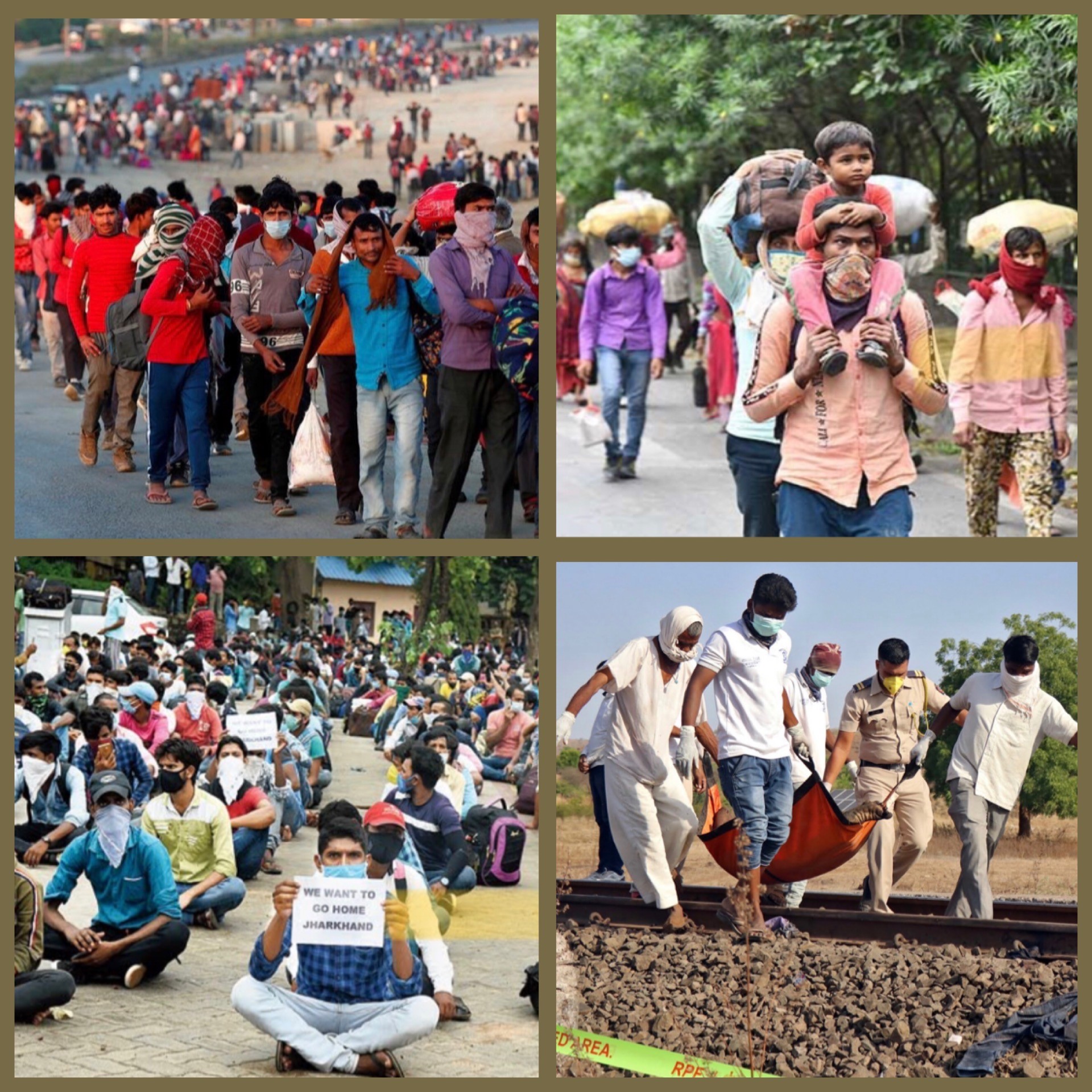
    And then this happened… An exodus of biblical proportions as the migrant labourers, left stranded by the CORONA Lockdown, began their long journey home.

    The Indian middle classes were shocked to the core. The seamless services that we city dwellers were so used to had vanished. The urban informal economy was stripped naked to reveal the odious exploitation of man by man. The poor, so long invisibilized,were made visible. And we were left shaking our heads and looking for reasons of where we went wrong.

    It was then that I recalled something I had written in these pages in November 2014:

    And here were my meanderings made flesh in this most brutal fashion. No writer with even an iota of sensitivity wishes to be vindicated in such a distressing way. Nor do I.

    That was why I could not bring myself to put pen to tablet for such a long time.

    But as these brave forgotten armies trudge back to the same satanic mills and construction sites, surely we too can find the courage to spread the word and record our fads and foibles for perpetuity.

    Jai Hind!

  • Republic Day 2020 : Time for stocktaking

    When I started this blog in November 2014, I wanted to make occasional assessments of how the incoming Government of India would deliver good governance – one of its major campaign promises.

    And what better occasion than today, when a Republic celebrates a Constitution that has been in effect for 70 glorious years, which has transformed a post-colonial basket case into a proud member of the comity of nations, which binds together more ethnicities and diversities than any other nation-state on the planet, and where a vast swathe of the population is suddenly feeling so vulnerable that the eyes of the world are watching every move of its elected government.

    So let’s begin with the UN Paradigm of good governance, and assess the Indian Government‘s performance objectively for each indicator, based upon reliable media reports and facts and data…

    Good Governance Indicators Performance of Indian Government (2014-19) from media headlines Assessing Government Performance Remarks
    Efficiency 355 Infrastructure projects with cost overrun of ₹3880 billion: Economic Times Nov 2019 FAIL INEFFICIENT
    Effectiveness Demonetisation drive that cost 1.5 m jobs, failed to uncover black money: The Guardian August 2018 FAIL INEFFECTIVE
    Participation Most schemes like SBA, Smart Cities, PMAY etc have not produced the desired results because their design, implementation and monitoring have been left entirely to bureaucrats and consultants with little or no public participation: Various Media Reports FAIL CENTRALIZED
    Accountability Umpteen examples of corruption cases against politicians being dropped once they switch allegiance to the ruling party. BJP campaigners proudly claim their party is a ‘washing machine’ : HW News, The Wire Oct 2019 FAIL UNACCOUNTABLE
    Responsiveness Not ONE senior minister deputed to discuss grievances with protesters, even after a month : All media reporting on Shaheen Bagh Protests, January 2020 FAIL UNRESPONSIVE
    Transparency Right to Information Act modified to curtail its independence : Economic Times Oct 2019 FAIL OPAQUE
    Inclusion Citizenship Amendment Act perceived as exclusionary and discriminatory : UN Human Rights Commission FAIL MAJORITARIAN
    Consensus Orientation Governance by brute majority, not consensus building : Parliamentary Proceedings FAIL MONOLITHIC
    Rule of Law Disregard for Rule of Law in crushing protest and dissent : Media Reports from UP, JMI, AMU, JNU : December 2019 FAIL AGGRESSIVE
    Equity Heightened disparity : Oxfam Report on growing disparity in India: ‘… economic inequality is being added to a society that is already fractured along the lines of caste, religion, region and gender.’ January 2020 FAIL DISCRIMINATORY

    Sadly, this means that we have ended up with a government that is monolithic, majoritarian, aggressive, and discriminatory in attitude, unaccountable, opaque and unresponsive in action, centralized in its decision making,  and incompetent and ineffective in its outcomes. Certainly not good governance…

    Happy Republic Day all the same.

  • Indian Independence Day 2019

    INDIA THEN: A PRAYER

    Where the mind is without fear and the head is held high

    Where knowledge is free

    Where the world has not been broken up into fragments by narrow domestic walls

    Where words come out from the depth of truth

    Where tireless striving stretches its arms towards perfection

    Where the clear stream of reason has not lost its way into the dreary desert sand of dead habit

    Where the mind is led forward by thee into ever-widening thought and action

    Into that heaven of freedom, my Father, let my country awake

    (Guru Rabindranath Tagore)

    INDIA NOW: A REQUIEM

    Where the mind is full of fear and the head is bowed low before the mighty

    Where knowledge is for sale to the highest bidder

    Where the world has been broken up into fragments by narrow domestic walls

    Where words are more likely to be fake news than the truth

    Where tireless striving stretches its arms to point out the imperfections of others

    Where the clear stream of reason has lost its way into the dreary desert sand of dead habit and irrationality

    Where the mind is led backward in thy name into ever-narrowing thought and obscurantism

    From this nightmare of servitude my Father, let my country awake

  • Republic Day 2019: Pivotal for India’s Constitution

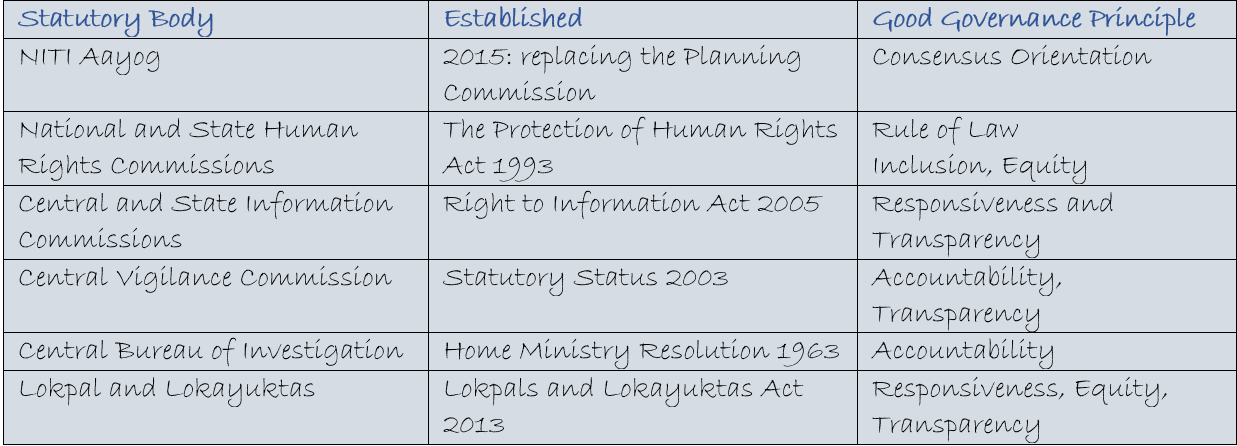
    Every year at this time, I share my deepest personal views about that most revered of documents – the Constitution of India. To my understanding, the Constitution is the equivalent of the ‘niyat’ of a devout Muslim before prayer – the purest ‘intention’ from the heart. It articulates the purest intentions of ‘We, the People’ to build a nation which cherishes the values of liberty, equality and fraternity, and endeavours to establish the basic principles of good governance – efficiency, effectiveness, subsidiarity, participation, equity, inclusion, accountability, transparency, responsiveness, consensus orientation and most importantly, the rule of law.

    That is why the Constitution has created the following institutions/bodies to enable the delivery of good governance:

    We should bear in mind that every successive parliament, assembly and government in India has taken an oath to abide by this Constitution, and consequently, every new statutory body since Independence has been created by these law-makers under the appropriate enactment, and within the spirit and framework of the Constitution of India, with necessary checks and balances from the judiciary.

    The major non-constitutional bodies in India are:

    So why do I say that Republic Day 2019 is pivotal for India’s Constitution? Because it is the first time since the formulation of the Constitution in 1949-50 that there are questions being raised about its relevance, coverage, ideals and mechanisms. The credibility of all the institutions either created within the Constitution or within its framework, is being systematically undermined by the Central and State Governments who seem to have forgotten their own oaths of office.

    The ball is now in the court of the people of India. Who will they empower in the next election? Will they rise as one to protect this cherished aspiration of a billion people? Or will they drop all pretence of being true to its ideals and lead the country into an amoral vacuum?

  • Happy Republic Day: Can India ever become truly Inclusive?

    Clearly inspired by the French Revolution, the Preamble to the Constitution of India reads:

    WE, THE PEOPLE OF INDIA, having solemnly resolved to constitute India into a SOVEREIGN SOCIALIST SECULAR DEMOCRATIC REPUBLIC and to secure to all its citizens:

    JUSTICE, social, economic and political;

    LIBERTY of thought, expression, belief, faith and worship;

    EQUALITY of status and of opportunity; and to promote among them all

    FRATERNITY assuring the dignity of the individual and the unity and integrity of the Nation;

    IN OUR CONSTITUENT ASSEMBLY this twenty-sixth day of November, 1949, do

    HEREBY ADOPT, ENACT AND GIVE TO OURSELVES THIS CONSTITUTION.

    As it took 2 more months for India to formally become a Sovereign Republic, we celebrate Republic Day on the 26th of January every year, with a grand parade in New Delhi, usually with a foreign Head of State as Chief Guest. The entire parade, works the theme of Unity in Diversity to death, and brushes under the carpet the great dissensions, differences, divisions and disparities which plague us even 68 years later.

    This year however, the Government of India scored several own goals in the week leading up to the Republic Day. Firstly, the PM a la Marie Antoinette said in an interview, ‘They have no jobs? Then let them sell street food to survive…’. Then, in the face of gross government inaction, protesters against a movie actually stoned a school bus full of terrified children; and finally, Oxfam published its Commitment to Reducing Inequality (CRI) Index Report, which ranks not India but the INDIAN GOVERNMENT at a pathetically low 132 – all this, while the PM was exploring in Davos, ways to make India’s rich richer.

    Indian voters are said to exercise great freedom of choice each time they throw out the incumbent and bring in a new regime, which spends the first 2 years blaming the ‘legacy’ issues for its non-performance, and the last 18 months preparing to overcome its own incumbency factor before the next election. So the best time to judge a Government’s performance is in its third year – and that is why the present Government is facing severe scrutiny on every front: economic, governance and development.

    This dear reader, is why Oxfam’s CRI Index is so damning – because it measures the commitment of current governments, and this cannot be fobbed off by stories of ‘inherited’ problems, historical inequality, the caste system, the British colonial rule or whatever. This is the here and now and the present government is answerable – not its predecessors of any shape or colour.

    Interestingly, this Republic Day, the parade in Delhi had not one, but a clutch of Chief Guests – the Heads of State of ASEAN – who are in Delhi for a meeting. So how does India compare to the 5 founding members of ASEAN on the CRI Index? Let’s see…

    Country Spending on Health, Education, Social Protection Rank Progressive structure and incidence tax Rank Labour market policies to address inequality Rank Total CRI Rank
    Thailand 61 22 136 70
    Singapore 65 105 96 86
    Indonesia 121 34 114 101
    Philippines 101 80 122 104
    Malaysia 96 30 135 106
    INDIA 149 91 86 132

    Oxfam India offers blunt advice to the Government of India on how to improve its CRI ranking:

    Create an economy for all: Promote inclusive growth by ensuring that the income of the bottom 40% of the population grows faster than of the top 10% so that the gap between the two begins to close. This can be done by:

    • Promoting labour-intensive sectors that will create more jobs
    • Investing more in agriculture
    • Implementing fully the social protection schemes that exist

    Seal the leaking wealth bucket: Reduce extreme wealth and create a more equal opportunity country.

    • Tax the super-rich by re-introducing inheritance tax and increasing the wealth tax
    • Reduce and eventually do away with corporate tax breaks
    • Take stringent measures against tax evasion and tax avoidance
    • Increase public expenditures on health and education

    Bring data transparency: Produce and make available high quality data on income and wealth, and regularly monitor the measures the government takes to tackle the issue of rising inequality.

    In other words, go for INCLUSION. But does a government whose basic ethos is exclusivist and divisive, even begin to understand what inclusion means in modern development jargon, let alone devise and implement policies to bring it about in this most unequal of societies? (Who can forget Dumont’s classic definition of the species of humans in this society as Homo Hierarchicus?)

    It is time indeed to truly understand this concept in all its dimensions because it is the development phrase du jour and crops up in the UN’s Sustainable Development Goals, in the Smart Cities projects, and so on…

    The best explanation I have come across recently is in a World Bank Report East Asia and Pacific Cities – Expanding Opportunities for the Urban Poor. Incidentally, the Report covers the ASEAN countries mentioned above, besides China and Japan – home to the largest single city and urban agglomeration respectively. It begins with giving due credit to the East Asian countries in drastically reducing urban poverty, and any traveler there  will indeed vouch for the much better living conditions of the urban poor in East Asia, than in South Asian cities in India, Pakistan and Bangladesh.

    The writers of the report explain the expanding opportunities for the urban poor by consciously inclusive policies introduced by their governments.

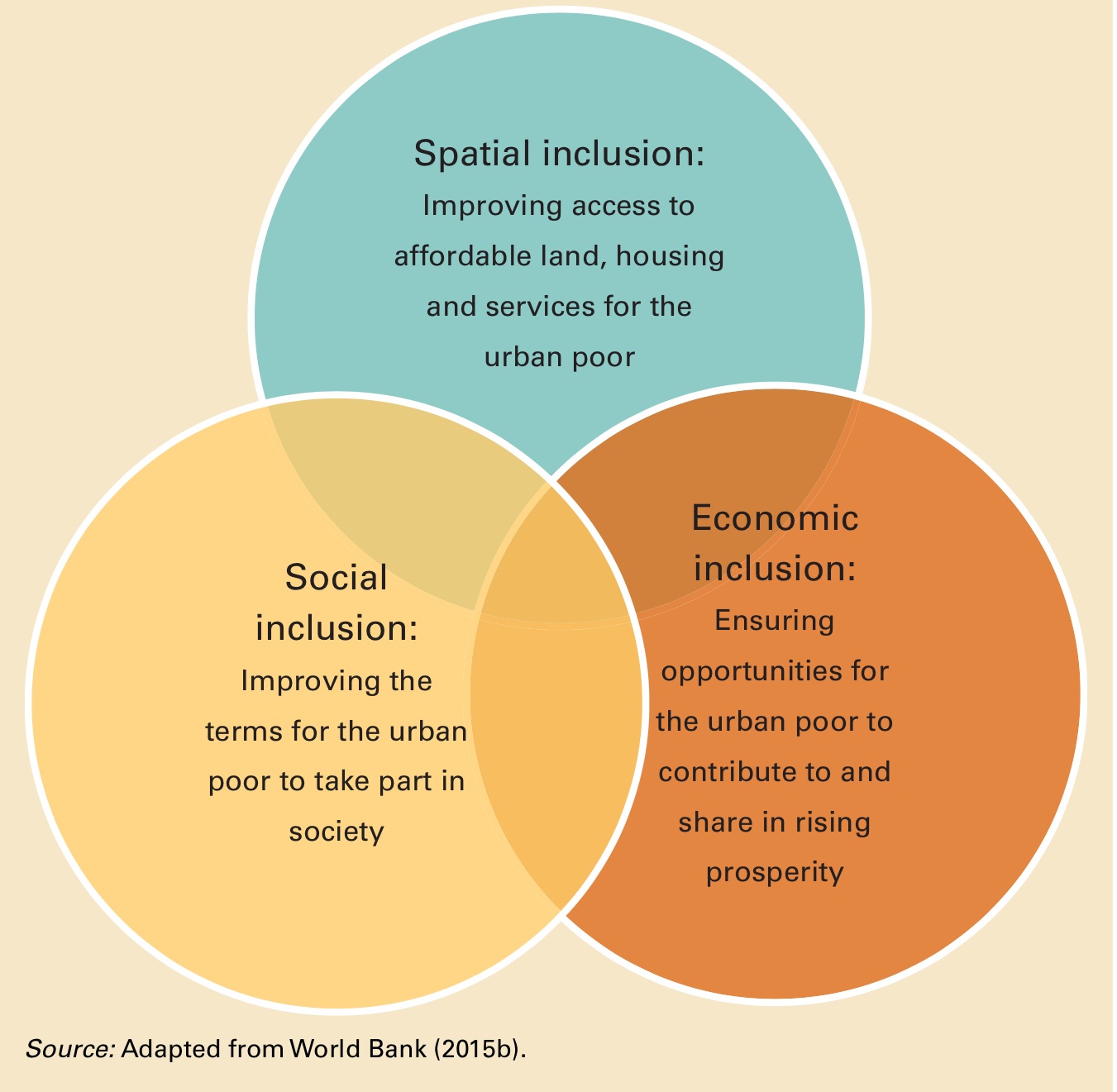
    They identify three dimensions of inclusion:

    Economic Inclusion: refers to equitable access to jobs and income-generating activities, mechanisms of resilience to withstand shocks and removal of barriers to formal employment

    Spatial Inclusion: links equitable access to land, housing, infrastructure, and basic public services. Mobility is particularly important, given its role in connecting low-income residents to jobs, services, and amenities. Housing must be accessible, affordable and ensure good quality and safety

    Social Inclusion: relates to individual and group rights, dignity, equity, and security

    This Multidimensional Framework of Inclusion is graphically depicted in the report as under:

    Multidimensional Model of Inclusion

    What is noteworthy is that the three dimensions overlap, and government interventions cannot be designed and implemented piecemeal. We have seen the havoc caused to the environment in Gujarat in the name of ‘development’ during the last two decades, and a similar short-sighted approach to inclusion may end up as nothing more than ‘including’ India’s entire billion-plus population in an electronic, biometric database which is being regularly hacked, misused and abused.

    If the Government of India doesn’t show a greater commitment to long term investments in Education, Health and Social Protection, doesn’t introduce a more just taxation system, and doesn’t formalise the rapidly growing informal sectors of the economy and society, well then organisations like Oxfam will not keep quiet and India’s international credibility will take a further beating…


  • Development? Governance?

    After 75 posts on this blog, one may be forgiven for sitting back and letting readers explore whatever was said over the last three years. I am gratified that various search engines have serendipitously landed people from over 132 countries on this site, and many have bookmarked it and returned to browse from time to time. Thank you.

    However, a WordPress notification wished me a happy anniversary, and I revisited the ABOUT page to check out my original motives for starting this blog: to explain the much misused terms of governance, corruption and development being arbitrarily thrown about in India’s political discourse at the time of the 2014 election, which brought to power a conservative, right-wing, market friendly party (the BJP) and routed the old establishment party – the INC, or Congress (please note this is not the legislative body it is in the US, but a political party in India.)

    So let us indeed look at how these concepts have evolved and are understood, 42 months down the line:

    Governance: I had covered the theory of Good Governance in one of my earliest posts, where I explain the relation between governance and government, and explain the globally accepted criteria for good governance: Good Governance

    However, it has totally escaped this regime that government is subsumed within governance which has the empowered citizen at its heart. There is a similar ignorance of concepts like rule of law, consensus orientation, probity, code of ethics, freedom of information, conflict of interest, protocol, chain of command etc. As a result, the present government doesn’t score too well on providing either efficient and effective government, or participatory, accountable, responsive, transparent, inclusive or equitable governance.

    The shortcomings of the ruling cabinet in terms of education, experience and exposure are very evident in the fact that almost ALL of the schemes and programmes of the previous government have been continued with NO substantive change except in their names. Never mind that most of these programmes had huge flaws which this cabinet of innocents continues to propagate. But if you throw out the baby (research, monitoring and evaluation wing) with the bath water (Planning Commission) who will point out these flaws and suggest ways to correct them? Instead, by farming out evaluation of important and costly schemes to private consultants, Indian data has lost a lot of its credibility among multilateral research organizations, and gained no real insights for future policy formulation.

    Other institutions are also being undermined – whether the Reserve Bank of India, the Election Commission, or various federal and state investigative agencies. Further, the federal structure is itself under threat as decision making has become non-consultative and centralized (e.g. demonetization), and financial allocations to State Governments are becoming increasingly politicized – being used in election campaigns as threats or promises.

    Corruption: The entire corruption narrative in India is limited to favours granted in return for bribes/cash. This is rather simplistic, and if it affects the common man then this type of corruption continues unabated among the petty bureaucracy no matter which party is in power. That is a fact of life in India. I had tried to broaden this debate by showing how capture and clientelism are equally detrimental to national interest (The 3 Cs- Corruption, Clientelism, Capture). Three years on, the great Indian people are at last getting to understand what is meant by ‘capture’ or crony capitalism as our social media prefer.

    But clientelism remains more elusive – the best example of that is seen during elections in largely rural States like UP, where a village chief or mukhia can deliver an entire village’s vote for a promise of future personal benefit – like a share in a Central Government infrastructure project, or a ticket in the next State election. As this pattern of bottom up electoral victories is repeated, we will all get a better understanding of clientelism. It is noteworthy that virtually nobody has been brought to book, or even formally charged, in the various ‘scams’ the previous government and its coalition partners were allegedly guilty of – again clientelism in action: support us today and go scot free tomorrow. Simple.

    Development: I had sarcastically hinted that development would be reduced to acquiring bullet trains, never dreaming how true this would be – literally! Never mind that the rest of the country’s infrastructure is among the poorest globally. Of course, this reduction of all ‘development’ to physical infrastructure, ignoring concepts of ‘human development’, will remain the most damaging legacy of the present government, as it will become the key deciding factor in 2019, as it was in 2014.

    This tunnel vision is coupled with attitudes of climate change denial and loosening of ecological regulations in the sanctioning of megaprojects and it augurs ill for India’s achievement of the UNDP’s Sustainable Development Goals – which would be a tragedy, because India had done better than expected in the previous Millennium Development Goals. Interestingly, attempts to achieve the MDGs and thus governance in favour of the poor and disadvantaged, necessarily pushed the UPA Government and the Congress Party to the ideological Left and away from their 1991 image of pro-free market globalists. And in my humble opinion, this was the real cause for the Congress Government’s defeat in 2014.

    The Indian electorate was not tuned to fashionable ideas like the Rights Approach to development…

    You see, the disgruntled middle level ‘dominant castes’ in India have such a sense of entitlement that they see any action in favour of the poor, the disadvantaged and minorities as appeasement and will not allow rights-based programmes to succeed. Sadly, even in 21st Century India, your politics and opportunities continue to be decided by an accident of birth.

    I had clarified in an earlier post (India an Aspirational Society? Not yet… ) that India would never be a truly ‘aspirational society’ without greater equality, better distribution of wealth, unity of purpose and civility. Sadly, all these ideals are in tatters just three and a half years down the line, and Indian society and polity have never been as divided, discriminatory and raucous as they are today.

    One consequence of these attitudes has been the conscious marginalization of India’s poor, which now manifests itself in greater hunger, deprivation, malnutrition, higher school dropout rates, poorly educated human resources, increase in child and forced labour, distress migration, farmer suicides and ever greater informalisation of the economy, livelihoods, and urban housing. And frankly, nobody in power gives a damn. The Opposition too is patently moving from the Left to the Right of Centre, with the entire electoral focus shifting to businesses and the ‘entitled’ middle castes (as in Gujarat), with no mention at all of the poor…


    Sadly, it is this disempowered but enfranchised section of the population who can even now deliver the votes needed (a mere 31%) to elect the next government. All that the incumbents have to do is use the standard right wing tools of diversion, emotion, commotion, coercion and subversion to ensure another term. These are the means which bring and retain the neocons in power from North to South America, to Israel to South East Asia…

    But is this democracy, you may wonder… Of course it is. Because what else will give us the ‘moral’ high ground vis-à-vis autocratic China and Russia ? (I am sure this resonates a bit with my American readers too…)


  • REPUBLIC DAY INDIA

    Here’s wishing my fellow Indians a Happy Republic Day, arguably the most important day in the country’s modern history, because on that day, we, the people of India, gave to ourselves the Constitution of a sovereign, socialist, secular and democratic Republic.

    In my post last year I had looked at the Fundamental Rights of Indian Citizens enshrined in the Constitution, so why not even the books with a look at our Fundamental Duties, this year? As these fundamental duties cannot be enforced by writs, and can only be promoted by constitutional methods, they do not make the news as often as a high profile case on the violation of Fundamental Rights.

    Nonetheless, our Fundamental Duties define the very essence of Indianness  and the essential oneness and inclusion of a vastly diverse society such as ours.

    A gentle reminder:

    It shall be the duty of every citizen of India:

    • To abide by the Constitution and respect its ideals and institutions, the National Flag and the National Anthem;
    • To cherish and follow the noble ideals which inspired our national struggle for freedom;
    • To uphold and protect the sovereignty, unity and integrity of India;
    • To defend the country and render national service when called upon to do so;
    • To promote harmony and the spirit of common brotherhood amongst all the people of India transcending religious, linguistic and regional or sectional diversities; to renounce practices derogatory to the dignity of women;
    • To value and preserve the rich heritage of our composite culture;
    • To protect and improve the natural environment including forests, lakes, rivers and wild life, and to have compassion for living creatures;
    • To develop the scientific temper, humanism and the spirit of inquiry and reform;
    • To safeguard public property and to abjure violence;
    • To strive towards excellence in all spheres of individual and collective activity so that the nation constantly rises to higher levels of endeavour and achievement.”

    And which were the values that drove our Independence struggle and our subsequent endeavours at nation-building? Justice, Liberty, Equality, Fraternity as so poetically enunciated in the Preamble to the Constitution…

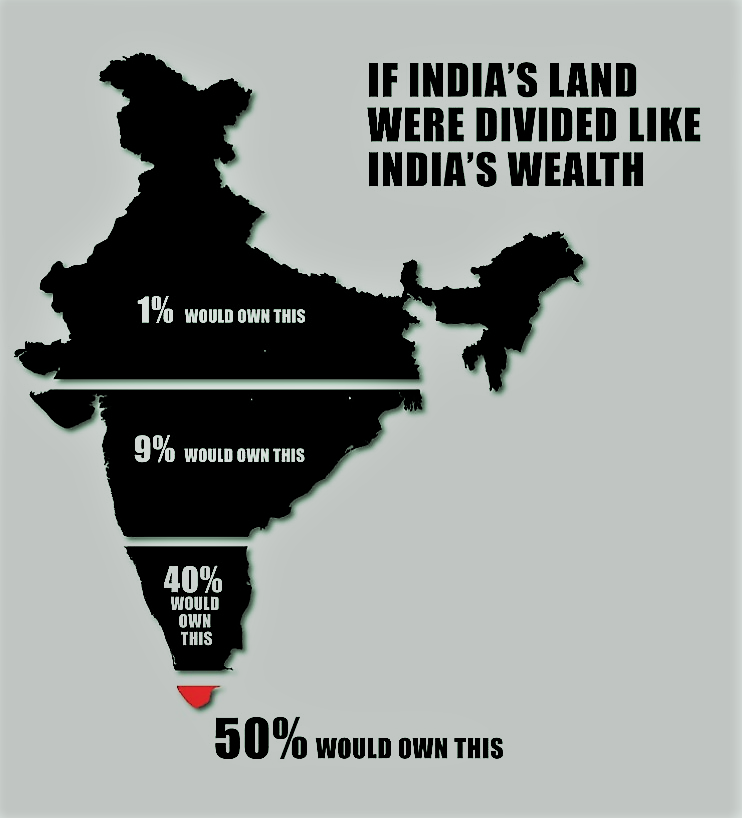
    So in this election season, let citizens evaluate their candidates based on their commitment to these values and their efforts at ensuring sustainable, equitable, inclusive and just development for all Indians, so that the map of India can never be so cruelly used to depict its inequalities as this:

    indian-disparities

    Jai Hind!

  • Independence Day

    When I started this blog, I wanted to keep tabs on the Indian Government’s promises of development and good governance, and after the third Independence Day in the Modi era, it seemed appropriate to review where the country finds itself today.

    I had always taught my students the UNDP version of Good Governance, for which I also gave them an easy mnemonic: E-PARTICLE: Efficiency and Effectiveness, Participation, Accountability, Responsiveness, Transparency, Inclusion, Consensus Orientation, Law (Rule of) and Equity. And I had defined Governance as Government + Citizen. Silly, silly me!

    As any search engine will now tell you, governance was first used and defined by the World Bank as “…the exercise of political powers to manage a nation’s affairs”. And according to the same august institution, the Worldwide Governance Indicators are: Voice and Accountability, Political Stability and absence of Violence/terrorism, Government Effectiveness, Regulatory Quality, Rule of Law, and Control of corruption. So by these criteria, both Saddam and Gaddafi were providing excellent governance, then why did the West have to wreak such havoc on two great nations in the name of regime change? Because big business decreed that it be so, mainly to safeguard their oil interests in these two benighted countries…

    In an excellent op-ed piece in the Hindu last year, G Sampath traces the origins of the this new ‘corporate-centric’ idea of good governance: “This trajectory – of aspirations first raised and then betrayed by economic reforms, leading to mass discontent, which zeroes in on corruption as the problem, with good governance presented as the solution – is very evident in recent Indian history. But it is by no means unique to India. As Jenkins points out, the “international anti-corruption consensus” has been a powerful vehicle for manoeuvring recalcitrant nations onto the neo-liberal track.” And of course, UNDP’s inclusion and equity are no longer relevant…

    What this means is that accountability is no more to the citizens, but to business and to investors, who are risking their money with expectations in return. Similarly, transparency has translated into ‘ease of business’, especially for foreign investors, “… who are tired of trying to find their way through the intricate webs of political patronage (also known as corruption) and often lose out to domestic capital, which enjoys a cultural advantage (so-called crony capitalism).” As for empowerment, the emphasis has shifted from universal rights, to individual ‘consumer’ rights, according to Sampath. And as for participation, this is again increasingly limited to the ‘haves’ with the disenfranchised and poor reduced to nameless ‘populations’ that simply do not matter!

    The inevitable conclusion is that the only ‘development’ model available under this paradigm of good governance is market-led development, which reduces a government to a facilitator of big business rather than a guarantor of the socio-economic rights of the citizens.

    Is this the ‘tryst with destiny’ that Nehruji referred to on that historic night 70 years ago? I should think not…