Development and Governance

Category: India

  • Independence Day 2025

    The 15th of August marks the day that India achieved its independence from Britain in 1947. It has indeed kept its tryst with destiny in many areas like poverty alleviation, health, infrastructure and education, but never in its 78 years has it looked so weakened and at the mercy of other countries, as it does today.

    Independence? What independence?

    Four years ago, Afghanistan was liberated from the 20-year American occupation and got Independence on 15 August 2021. Since then it has seen massive investments (and therefore, control) by China in its three main areas of interest: security (against separatists), connectivity (access to Central Asia for its Belt and Road Initiative) and Mining. In fact it is now as vassalised by China as Pakistan. 

    Independence? What independence?

    By a curious irony, on 15 August 2025, the world sees a summit meeting of its two most belligerent power blocs, at Anchorage, Alaska. This meeting between the leaders of Russia and the United States has been designated by some observers as Yalta 2.0. The original Yalta Summit of 1945, ended up carving post-war Europe between the West and the Soviet Union, and this time it is expected that Ukraine will be similarly divided between a victorious Russia and giant corporate conglomerates of the West. 

    Somewhere along the way the sanctions against Russian oil will be lifted or diluted and there will be India, hat in hand, hoping that it is spared the punitive 50% tariffs for breaking the original sanctions on Russian oil. India’s position is morally weakened by the fact that the chief beneficiary of this ill-advised oil import was not the Government of India, nor the Indian consumer, but the private refineries who re-exported this oil to Europe. And to think that in the heyday of the Non-Aligned Movement, India was the world’s conscience!

    Independence? What independence?

    However, the longest-term damage that India has inflicted on itself is the total subjugation of its intellectual capital to western systems and frameworks whether in classic research and development, or the emerging IT and AI sectors. It is no surprise that NOT ONE of the 20 globally most used apps and software was created in India. The resulting drain of expertise created and subsidised by Indian taxpayers to the West, and chiefly the USA, has not only debilitated our human resources, but also given these countries more leverage on Indian foreign policy by weaponising things like the H-1B visa.

    Independence? What independence?

    Ironically the only truly independent country in the world today is that much maligned autocratic monolith – China. But they have always preferred to use the word ‘self dependent’ instead of independent, and that should also be India’s path ahead: Self reliance as already denoted by ‘swadheen’ on this Swadheenta Divas.

    Jai Hind!

  • Republic Day 2025: Governance or Politics?

    The Constitution of India, which is celebrated every year on the 26th of January as Republic Day, does three things: 

    ·      Firstly, it puts the people of India and the public good CENTERSTAGE in all government policy

    ·      Secondly, it delineates the moral framework for the government’s functioning, by asserting its faith in the universal values of liberty, equality, and fraternity

    ·      Thirdly it provides a template for good governance, ensuring efficiency, effectiveness, participation, accountability, responsiveness, transparency, inclusion, equity and rule of law in the day to day functioning of government and its various institutions, while encouraging all policy making and legislation to be through a consensus negotiated and arrived at by the country’s Elected Representatives

    I have made Republic Day the occasion on which I take a look at issues of governance in the country, and this time I am appalled to find that governance in its fullest sense has virtually disappeared from the Indian scene and been replaced by politics.

    When governance becomes pure politics the country is in trouble. Let me explain. 

    As outlined in the Constitution, one of the key roles of any government is to ensure equality and fraternity by enabling the DEVELOPMENT of the people in every sense of the word – by providing them with education, livelihoods, housing, health care, infrastructure, services and social security. However, when this aspect of governance is reduced to politics, we witness the unedifying spectacle of all political parties literally buying votes with tax-payers’ money by promising ever growing and increasingly unsustainable freebies before every election. As the intended beneficiaries are also the largest voter block, the party that ‘promises’ the most manages to win the election. They are feeding the poor for a day by giving them a fish (politics) and not feeding them for a lifetime by teaching them how to fish (governance). 

    If this is the politicisation of governance at the bottom level, there is an equally pernicious process happening at the top – not just in India, but globally as well. What commentators call the OCGFC (Owners and Controllers of Global Financialized Capital) are increasingly deciding the domestic and foreign policy across the world, and as the largest benefactors of political parties, the OCGFC inevitably politicise international relations.

    India won the respect of both superpowers, USA and the Soviet Union,  as a founding member of the Non-Aligned Movement (NAM) which oversaw the demise of the Colonial era, and kept India out of the conflicts of the Cold War era, allowing it to work exclusively for the public good of its vast, impoverished population.  However, post-liberalisation, India has witnessed not only the privatisation of its public assets but also of its policy and decision making. Instead of non-alignment India’s foreign policy in recent years has literally fallen between two stools, precisely because it chose to protect private interests at the cost of public ones.

    ·      First, it allowed private companies to bypass the sanctions imposed by the West after the Ukraine conflict, and import vast quantities of Russian oil. (News item: Russia’s Rosneft has pledged to supply private Indian refiner Reliance with about half a million barrels of crude a day. At today’s prices, this will generate $13 billion annually for Russia). This naturally upset the US and its allies. 

    ·      Second, the ruling party in India has been vehement in its support of Israel (despite the growing distaste for its genocidal policies across the world), partly to protect the investments of another capitalist crony in Israel’s weapons and industry and port infrastructure, and partly for ideological reasons. This has thoroughly alienated India in the global South and among Arab and Muslim civil societies worldwide. In fact, India has never been so utterly marginalised in the international community as now, and even in BRICS+, of which India was a founding member, the letter ‘I’ has increasingly come to stand for Iran, rather than India. What a shame!

    *                    *                 *

    However bleak the outlook, I have great faith in the will of the Indian people, and feel that the situation is still redeemable if: both the Government and Opposition get out of their perpetual Election mode; Policy making insists on consensus rather than the confrontation that is the staple of the Indian Parliament today; and the much delayed National Census is conducted ASAP to enable informed decision-making and planning for the larger public good.  

  • Independence Day 2024: The freedom to choose

    Every year, the 15th of August marks the coming into being of the sovereign, independent nation state of India – the day in 1947, when India was at last free from the oppressive yoke of British Colonialism and subservience of the last 2 centuries. In Hindi, we officially translate Independence as Swatantrata or ‘Self-empowerment’, or colloquially as Azadi or ‘freedom’.

    I like to think of it as our Freedom Day.

    When we were given that greatest of Freedoms – the Freedom of Choice. To choose our way forward. To choose our way of Government. To choose the framework of values by which we would govern ourselves. To choose our path to Justice for All. To choose the mechanisms, institutions and means to achieve our national ideals. To choose our economic policies. To choose the path to equity and inclusion. To choose how to create a level playing field. To choose our leaders. And most importantly, to choose to change those leaders every now and then, if they did not achieve our national goals, or live up to our expectations.

    As happened almost everywhere, newly independent states tended to adopt the laws, institutions and mechanisms of governance from their erstwhile colonial masters, and India too, chose the path of a Westminster style bicameral Parliamentary democracy, underpinned by a remarkably well thought out Constitution, with elections every five years, where people had the freedom of choice to elect their representatives.

    The first few years were quite exhilarating and challenging, as the largely illiterate and rural ‘population’ learnt of their rights and freedoms and exercised their choices as ‘citizens’ of a free and sovereign nation-state. Slowly and surely, democracy took root and thrived in India, while it floundered badly through coups and military rule in several of our neighbouring countries.

    However, as technology connected the world, we have seen the consolidation of power, wealth, and influence in an increasingly tiny but interconnected minority. There is talk of the ‘capture’ of national economies and evidence of ‘crony capitalism’ across the world. Oligarchs are thriving and public interest has been replaced by ‘special interest’ groups and lobbies. Social media has unleashed unprecedented connectivity, and conspiracy theories of machinations and manipulation thrive. In fact, the dreaded ‘Deep State’ was mentioned for the first time in the Indian Parliament by the Leader of the Opposition. Lately, this too is being replaced with a more contemporary phrase: Owners and Controllers of Global Financialized Capital or OCGFC, who are credited with cornering all the world’s wealth and resources, have no particular ideology or moral compass of their own, and use Think Tanks and NGOs to disguise their single-minded pursuit of wealth accumulation.

    These theories are indeed manifest in a lot of cases, though not universally. There is no doubt that unbridled liberalisation, privatisation, and globalisation has greatly weakened all democracies at the grassroots level. For instance, with the rapid privatisation of public assets and the subsequent decimation of the Trade Unions, the British Labour Party was reduced to a shadow of its former self and the average Brit has more or less lost his freedom of choice, as all he has to choose from, is the greater and lesser evil in any given election year.

    The most ridiculous travesty of democracy is of course, visible in the US, where the choice of the people is circumscribed by who shows great and greater enthusiasm for a tiny settlement colony thousands of miles away, which uses the American tax-payers’ money to buy up politicians from both parties, who then obediently go on to sanction more aid – and so the vicious circle continues… As someone famously said :   “This system was not built in a way that allows us to vote our way out of imperialism, colonialism and genocide. If it was, we wouldn’t have been given the right to vote. If the ruling class knew that voting can actually make a difference, they wouldn’t be encouraging it.” So much for Freedom of Choice.

    In India too, we find that institutions are being replaced by agencies; administration with expediency; policy by special interests; and governance by politics – while national assets are being sold to the highest bidder and national culture (and identity) gets eroded by exploitative sponsorship. The power of a handful of big businesses is destroying years of effort for a more just and equitable society, and with the rising costs of education in the burgeoning private sector (at the cost of grossly under-resourced public education), the country is well on its way to losing its demographic dividend.

    So this Freedom Day, let us restore a real freedom of choice for the Indian citizen. Let the diversity of precept and practice that was our hallmark be revived. Let a variety of ideologies bloom in this desert of amoral opportunism. Let it again become fashionable to speak up for the people of India.


    Jai Hind!

  • Republic Day 2024 : A Requiem? 

    The Republic Day is celebrated in India every 26th January to mark the day that the Constitution that “We, the People of India” gave to ourselves, took effect.

    There is a very clear and present danger that by the time I get to write this post in 2025, the soul of the Indian Constitution will have been irrevocably lost through the removal of the adjectives SOCIALIST and SECULAR from the Preamble, and this post would become a sort of Requiem.

    Although these two words were not specifically written down in the first Constitution, the sprit that informed the writers of that document, subsumed these concepts in the two words it did mention – EQUALITY and FRATERNITY. No doubt inspired by the French Revolution, which the Western educated elite that wrote the Constitution, probably found to be universally acceptable and noncontroversial.

    It was probably the realisation that both these aspirations were still far from the country’s reach two decades after Independence, that forced the then Government, to take advantage of the curtailed democracy during the Emergency, to amend the Constitution and insert the words SOCIALIST and SECULAR in its Preamble. 

    So why was India not able to achieve greater equality despite adopting overtly socialist policies in the first few decades after Independence? The chief historical reason is that India could never crush the old feudal system riddled with centuries of caste and class-based inequality, as the other Asian giants could: Japan after its defeat in WW2, South Korea after a bloody war and the subsequent division of that country, and China through the violent and messy Cultural Revolution. 

    Moreover, in rebuilding their societies, these three countries chose education as the chief vehicle of social change, and all adopted the two-pronged approach of UNIVERSALISATION of education, and VOCATIONALISATION of Higher Education. India failed to do so despite a visionary like Pandit Nehru at its helm. Instead, we went in for the creation of elite (emphasis added) institutions like the IITs and IIMs, for the self-styled ‘elite’ or entitled class, which had monopolized knowledge for millennia – rather like the Scribes of Ancient Egypt. 

    So, when the era of global trade and connectivity dawned, South Korea and China could build up their manufacturing sector, making everything from a toothbrush to an iPhone for the world’s consumption, and providing employment across the spectrum – from the unskilled, to the semi-skilled, to the skilled, to the highly skilled among its workforce, in the same matrix. 

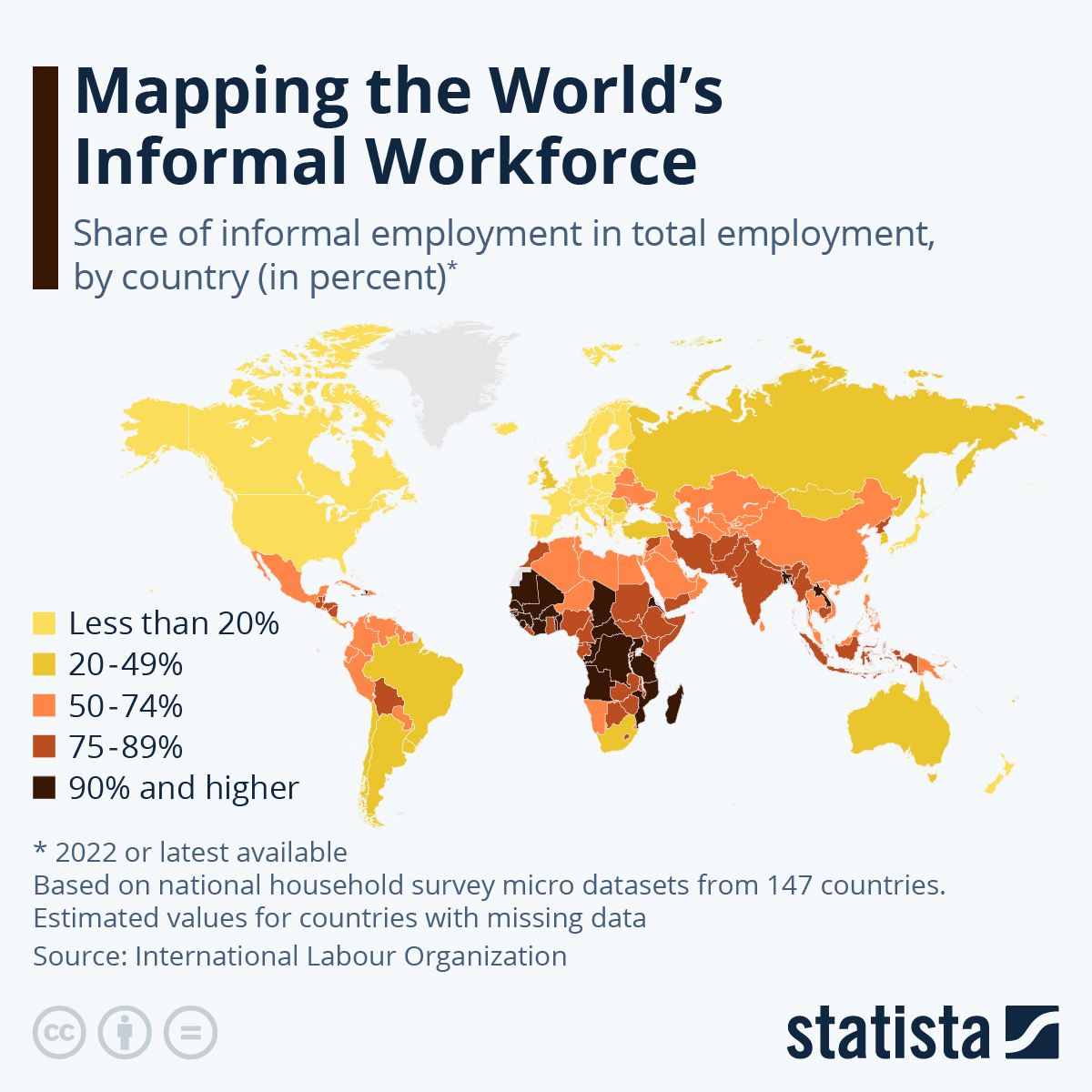
    India could not: Its ultra-hitech skills of a miniscule number found greener pastures abroad, while the low skilled had limited job opportunities in the public sector (which also shrank after a policy of deliberate divestment and privatisation by the present government.) The result has been a burgeoning informal sector, and impoverishment of the poor while the richest grow richer, as a recent ICE survey revealed:

    This depletion of a generation worth of human capital is unrecoverable and it means that India will not have a seat at the table in the emerging multipolar world order – witness its already diminishing clout in multilateral fora like SCO and BRICS+. Therefore, with the ideal of EQUALITY now firmly beyond our reach, the word SOCIALIST in the Preamble has become rather redundant.

    And what about Fraternity? Hasn’t that also remained unattainable in a society riven by caste and class and with a bloody history of riot after riot in its 75-year history? India has consistently failed to act in a secular way either by the standard definition of separating State and religion, or by its own version of secularism as the State acting neutrally between religions. Not when every political party in every election plays the ‘caste and community’ card right from the selection of candidates, to the design of campaigns and even the targeting of welfare schemes.  Which begs the question: what is secular about the Government’s calculus that we need that word in the Preamble?

    Globally, too, both these words are falling into disfavour: The collapse of the Soviet Union put paid to Socialism, and today, strident religiosity is rife everywhere – whether it is a Prime Minister justifying a genocide by referring to a 3000-year-old battle with the Amalek, or the Patriarch of Moscow, urging the Russian Army to take on Antichrist! 

    Yes, as someone who grew up in the heart of a compassionate society, I shall shed a silent tear when India does away with its socialist and secular aspirations; but so long as the other adjectives, SOVEREIGN and DEMOCRATIC, remain untouched, I shall be back here to celebrate the ONE Book which unites us all.

    Jai Hind!

    Related Links:

    The 3 Cs: Corruption, Clientelism and Capture

    Formalising the Informal

  • Independence Day 2023: On to true Freedom…

    As we celebrate another Independence Day in India, there will be a lot of chest thumping about the steadily growing GDP, reaching a record $3.75 trillion in 2023.

    However, the flip side is that the benefits of this economic growth are not reaching 75-85% of the common people, trapped as they are in India’s infernal informal sector.

    As a consequence:

    • The poverty rate in India has remained high, at 21.9% on the Multidimensional Poverty Index, and the number of people living in poverty is not declining
    • India’s Human Development Index has not improved significantly in recent years. In 2014, it was 0.629, and in 2022, it was 0.631 and the country ranks at 135/188 
    • Levels of Inequality are amongst the highest in the world. The richest 1% of Indians control more than 20% of the country’s wealth, while the poorest 50% of Indians control less than 10% of the wealth. The increasing inequality in India is not just of income and resources but also of opportunity, and as caste, class and birth continue to eclipse the opportunities available to an individual, the poor continue to remain poor as will their children and grandchildren. And continuing informalization will only deepen the divide between those who can and those who cannot

    The social effects of the growing informalisation of the economy are already visible:

    • Vast numbers of unemployed and underemployed youth are just waiting to be exploited by the rich and powerful to ignite an incident here, a rampage there, resulting in an increasingly unstable law and order situation
    • The decline in India’s manufacturing capabilities continues, where the trade deficit keeps inexorably rising, and domestic consumption is relegated to shoddy products manufactured in sweatshops in back alleys with no regard for quality assurance or labour welfare – leading to greater exploitation of the working class
    • The growing fatalism among the poor is very noticeable today, along with the total annihilation of protest movements, because the formal sector trade unions have been systematically eliminated following liberalisation
    • The increasing privatisation of primary, secondary and tertiary education and health care has eroded the very core of a welfare state that Nehruji evoked in his famous ‘Tryst with Destiny’ speech on 15 August 1947. This has not only nullified India’s demographic dividend, but will adversely affect the quality of its human resources for generations to come. 
    • The total politicisation of society, where even the most basic of human rights are bestowed as a ‘gift’ by the rulers and the subsequent subsidisation of basic needs, which creates the ‘dependency culture’ so noticeable in the declining years of all great powers. Moreover, workers in the informal sector are denied a feeling of self-worth and self-esteem and their only identity becomes an anonymous number in an indifferent identity system like Aadhar – which is at best a way to procure meagre benefits from an uncaring government, not a ticket to claim their rights as proud citizens of this country

    *               *              *

    The time has come this Fifteenth Day of August to revert to the original meaning of ‘Azadi’, which is not just independence but FREEDOM – a freedom from subservience, apathy, anomie, poverty, illiteracy, illness and the shackles of a burdensome past of grudge and grievance. 

    Happy Freedom Day to all!

    Related:

    Formalising the Informal

  • Republic Day: look back in awe… look forward in anguish

    I make it a point to post something on this blog every 26th of January, to commemorate the day “we, the people of India” gave to ourselves a brand new Constitution. 

    A Constitution that was to become the template for the healing of a bruised, battered and partitioned motherland, which promised a unified, caring and modern home to its children of every persuasion, weaving their diversities into the fabric of nationhood, embroidered with the silks of optimism, hope and learning.

    It had the gumption to include in its Fundamental Duties, Article 51A(h): “to develop the scientific temper, humanism and the spirit of inquiry and reform”. Towards this end, the most world renowned institutions of learning were born like TIFR, BARC, ICAR, ISRO, IISc, IITs, IIMs etc whose alumni adorn so many global corporates today. 

    Social research too was given its due and Indian research organisations soon acquired the reputation of providing the most reliable social and demographic data among the developing countries. Such data are a boost to coherent policy-making and scientific planning, resulting in the optimum utilisation of scarce resources. The lynchpin, of course, was to be the decadal Census of India, and its conduct became a Union subject under Article 246 of the Indian Constitution, and it is listed at serial number 69 of its Seventh Schedule.

    A census essentially reveals the demographic profile of the nation which is vital for many reasons like the conduct of health, education, and agriculture surveys, the design and implementation of policy, and for administrative decision-making. The data collected through the Census is also used for the management and evaluation of various programmes run or to be introduced by the Government, NGOs, academics, researchers, as well as commercial and private enterprises. 


    Census data is also used for the demarcation of constituencies and allocation of representation to the Parliament, State Legislative Assemblies and local bodies. And the Finance Commission gives grants to the States on the basis of population figures available from the Census data.

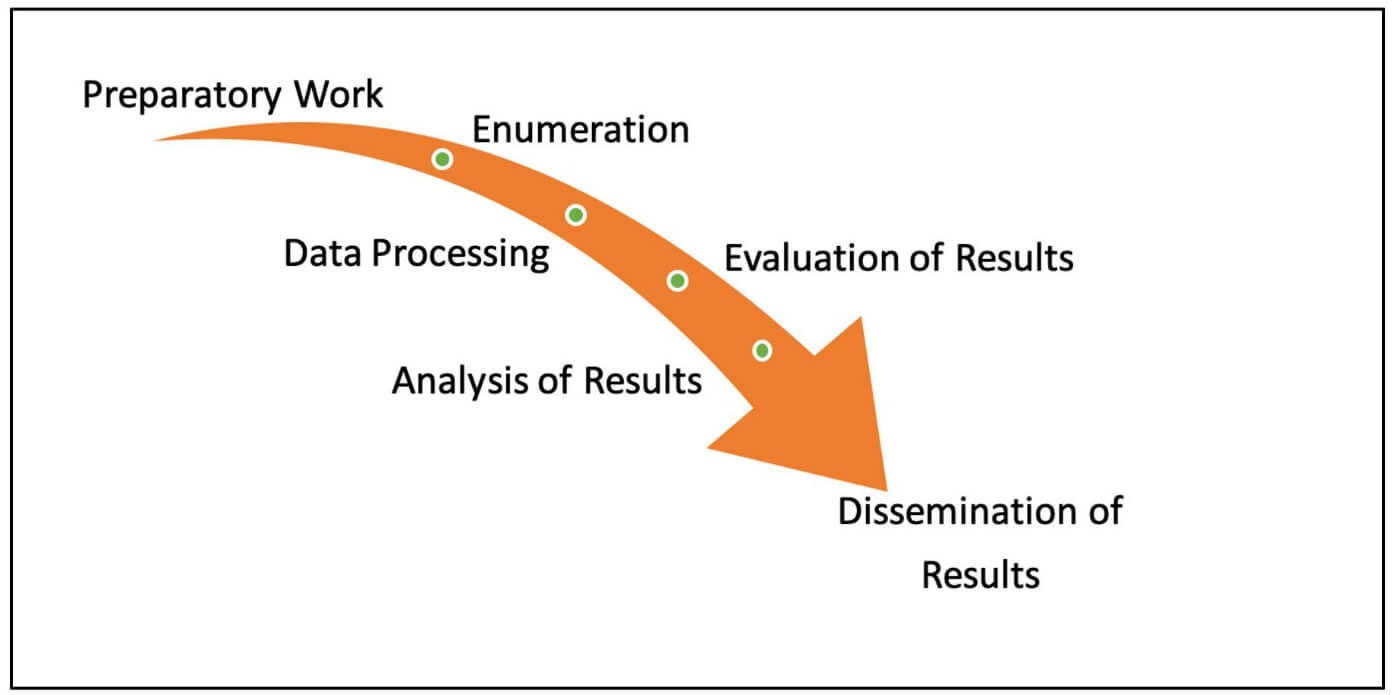
    Ever since the First Census of 1881, India kept its date with the Census – once a decade, hundreds of thousands of enumerators visited every household in one of the most populous countries on the planet, to gather information about individuals, families, livelihoods, economic conditions, migration status, societies and cultures. 

    Sadly it took a pandemic like Covid to disrupt this schedule. However, what would have been a short disruption of a few months has unfortunately become a deliberate postponement of indefinite length. Politics once more trumps development and governance – if there is no Census, it will be difficult to hold the incumbents accountable for the rising poverty, malnutrition, unemployment and declining labour ratios at the next General Election. Not to mention that political interference in the statistical institutions of the country calls into question the integrity of Indian data and does untold harm to India’s reputation globally.

    As expected, it’s always the poorest of the poor who pay the price. For instance, since the government still depends on population figures from the 2011 census to determine who is eligible for aid, more than 100 million people are estimated to be excluded from the subsidised food grain Public Distribution System, and millions of children are left with inadequate schooling and nutrition. What’s left to say…

    I sometimes wonder why every post which begins as a celebration of our nationhood on every Republic Day becomes a lamentation by the end.

    I am beginning to despair… 

    Jai Hind!

  • How British Rule changed our Cities and Towns forever

    Discussing the effects of colonial rule in countries like India, is a regular pastime on TV channels like the BBC, but these discussions are often hung up on single events or instances like the GDP then and now. I prefer to look at long term processes and the often irreversible effects they leave behind. Published in Times of India, Pune in November 2018, and reposted for a global audience.

    As one grows older, one realizes that life has no ‘undo’ button. Life happens – and our best intentions and greatest plans finally amount to little. The same is true with the life of nations. We can, at best, understand history – not change it. So even as we lament about the excesses of colonial rule, there is no escaping the fact that British rule had an irreversible and far-reaching impact on the way we live and work in our cities today.

    In the pre-colonial days, our cities grew organically from the soil and represented old pieties and practices – so we had temple towns, pilgrim centres, handicraft hubs, agricultural market towns, fortresses and royal capitals studding every corner of India. The British, however, were to greatly change this timeless landscape with the addition of 5 new types of urbanization: port cities, railway towns, cantonments, hill stations and mining centres.

    As the British consolidated their dominion over India, the growing railway network provided connectivity and allowed them to centralise their two essential functions of maintaining law and order, and collecting taxes. This required a centralised bureaucracy and the ‘steel frame’ is still with us today – rusty, creaking and neither trained nor qualified to tackle the immense challenges of unplanned urbanization and growing informalisation.

    The centralization of power and authority, coupled with a deep distrust of the ‘natives’ was formalized in the mother of all municipal laws – the Bombay Municipal Act of 1888. And its archaic provisions still govern our cities and towns, through the various Acts it has spawned on the sub-continent. Even today, despite modifying the Constitution through the 74th Amendment in 1992, little or no true power has percolated down to our municipal bodies – which are the third tier of government. Their powers to raise taxes have eroded through the years, with the GST regime dealing the final blow, and State and Central allocations to municipal bodies remain largely arbitrary and politically coloured.

    The third deep impact of British rule has been on our town planning and urban land use. With the British nostalgia for creating ‘a green and pleasant land’ in the distant tropics, the planning laws were too short-sighted for a country as densely populated as India where low-form urbanization would be entirely unsuitable. To now densify Indian cities by raising FSI just isn’t practical because there is a limit to how much the existing infrastructure can cope with (water supply, sewerage, power lines) and retrofitting infrastructure is extremely expensive – and chaotic. The result has been urban sprawl – and in the absence of efficient public transport, expensive and time-consuming commuting.

    With these planning norms, we also inherited strict development control rules which require such high standards of construction that the poor have no option but to go informal, simply because they build their houses incrementally, as and when they have the resources. Our town plans also do not provide for informal enterprise, hawking areas, or waste collection and processing within the city limits.

    We also continue to be bound by that other British gem – the Land Acquisition Act of 1894. Despite attempts to modify it in 2013 and remodify it two years later, its interpretation has been left largely to the discretion of State Governments and is consequently mired in controversies, scams, litigation and land mafias.

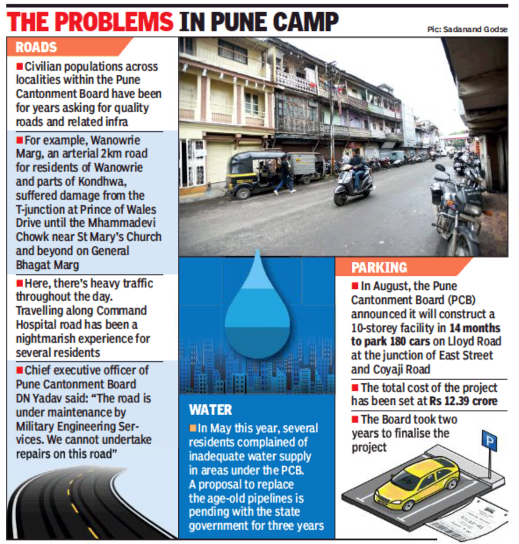
    Finally, the most ticklish and controversial legacy of the British – Cantonments. And who better to understand the problems this creates for urban governance than the people of the Pune Metropolitan Region, blessed as we are with 2 Municipal Corporations and 3 Cantonment Boards. How can any wizard conjure up a Development Plan for this city without stepping on a thousand toes?

    Pune is indeed proud to host so many techno-military establishments, but why can’t these establishments be part of a common urban landscape, availing the services and paying the taxes of a SINGLE municipal body, as other civilian and scientific establishments do? Isn’t it time to ‘trust the natives’ 70 years after Independence? Imagine the CBD that a Singapore planner could develop in that vast swathe of prime urban land from Sachapir Street to the Race Course and from Poona Club to St Mary’s – it is, after all, almost entirely under civilian use, so why can’t it have a civilian makeover? It is said that the cantonments are the lungs of Pune, but there are alternatives. Planned high rise development interspersed with vast open and green eco-friendly public spaces are the modern option in cities across the world, and would sit well with Pune’s hills and dales.

    To end, let us give the devil his due: The British formalized urban governance in India, and municipalities were endowed with powers of taxation as far back as 1850. The creation and development of port cities put India on the map for world trade, while industrial technologies and the railways speeded up our modernization. Finally, the legacy of modern education, scientific temper and the English language has put India at the forefront of a globalized world and on a trajectory to the future. All thanks to those firangis

    Related:

    Development and the Rural-Urban Continuum

    Development and the Informal Urban Economy

  • Independence Day 2022: 75 years of growth or dissolution?

    15 August is just a date, and 75 is just a number, but this year, as India celebrates the diamond jubilee of its freedom from oppressive colonial rule, these numbers focus our minds sharply on what has been gained… and lost.

    India’s first Prime Minister, Pandit Jawaharlal Nehru delivered his dreams and hopes in one of the most famous speeches of the English language (Tryst with Destiny) at midnight on 15 August 1947; and for the next 17 years, he endeavoured to strengthen India’s Independence in every sense of the word:

    The first priority was to provide self-sufficiency in food – hence the Green Revolution and the foundations of a vast network of irrigation and hydro-electric power stations in rural areas.

    Equally important was the consolidation of India’s natural resources through the creation of various Public Sector Undertakings (PSUs) in Mining, Energy, Infrastructure, Communication and Transport. Several Public Sector manufacturing units also came up, and were dubbed the temples of New India – industrial and urban India was on the cusp of a great revolution.

    Then came an ambitious programme to strengthen human resources through the creation of world class institutions of learning in everything from the Pure Sciences, to Technology, to Business Management and the Liberal Arts, to Medicine and Space Research, to Defence R&D to the Nuclear Sciences.

    Internationally, Nehruvian India stood proud and tall as the leader of the Non-Aligned Movement, and the country which everyone had expected to disintegrate within a decade of Independence, found its rightful place on the world stage as an arbiter of good common sense, an exemplar of unity in diversity, and a proponent of peace and goodwill among nations.

    There was a simultaneous effort to improve the quality of life of the country’s citizens through various poverty alleviation programmes, and the vast improvement in Human Development Indicators in the second half of the last century, are evidence of their success.

    However, the world caught up with India and after the oil shock and various wars of the 1970s, came the ‘lost decade’ of the 1980s, and inevitably, the dawn of an era of globalisation accompanied by liberalisation and privatisation.

    Ironically the great economic reforms which were ushered in by Pandit Nehru’s own party were to sound the death knell of the great Nehruvian dream of planned development, and pave the way for a right-wing government under A B Vajpayee, which merrily went on to sell some precious gems from India’s public sector, to private investors. Between 1999 and 2004, the BJP privatized the Bharat Aluminium Company (BALCO), Hindustan Zinc (both to Sterlite Industries), Indian Petrochemicals Corporation Limited (to Reliance Industries) and VSNL (to the Tata group) and various state government establishments as well. While the track record and future of these companies were considered good at the time of sale, they have all failed under the private establishments that they were sold to.

    Between 2014 and 2018 the present government divested a total of ₹1,94,646 crore – and as most of these PSUs were literally run into the ground to justify their sale, it led to a loss to the taxpayer of over ₹69,575.64 crores over the past decade.

    So much for Indian independence and self-sufficiency in key areas of manufacturing.

    Ditto with the human resources which have leached away to foreign shores with full support of the government, which has done little or nothing to staunch the brain drain and incentivize investment in India by its expatriates. Studies have found that 23,000 Indian millionaires have left India since 2014 and that nearly 7,000 millionaires left in 2019 alone, costing the country billions in tax revenue. Since 2015, nearly 9 lakh Indians have given up their citizenship.

    So much for Indian independence and self-sufficiency in key areas of learning and knowledge.

    And the final loss of independence stares us in the face in the arena of foreign relations, as India scuttles embarrassingly from this side to that – swinging from BRICS to QUAD, with no principled reasoning to support either side. And with a world on the verge of moving away from the unipolarity of the last 30 years to a distinctly multipolar order, we are very much in danger of being utterly marginalized in world affairs. Sad but true.

    The coming decades will be crucial and here’s hoping we can overcome the growing poverty, the immoral inequality, the increasing divisiveness, and our marginal global profile, so that we can celebrate the Centenary of our Independence as a truly great nation in 2047. Amen!

  • Ethical Consumption and Indian Industry 2.0

    First published on 8 February 2015

    I started this blog to counter the current Indian Government’s proclivity for mega pronouncements without thinking through the implications. The latest buzz phrase is ‘Make in India’. But make in India for whom? The domestic consumer or the European and American consumer, where India hopes to replace China as the key provider of the basic essentials of life?

    Update 1:

    Despite various bans and boycotts imposed by the Government of India on Chinese goods following a border clash, Indian imports from China in 2021 reached a whopping $97.5 Billion, a 30% rise from 2019. Moreover, these imports are largely ‘manufactured’ goods like electrical and mechanical machinery, auto components, pharmaceutical ingredients, and medical supplies like oxygen concentrators and PPEs.

    So much for ‘Make in India’…

    India is also not able to compete in export markets for manufactured goods because of its relatively poor infrastructure and tedious red tape, widespread petty corruption, an ill-educated workforce (by international standards) and the prevalence of child labour and forced labour somewhere in every corporate supply chain, which creates a very negative image of the country in the minds of the western consumer, who is tech-savvy, globally connected, well-informed and increasingly believes in conscious consumerism.

    Update 2:

    Need for Regulating Supply Chains

    In the early years of this century, the movements for ethical supply chain management gathered momentum, and every time there was a furore in the western media about environmental damage, animal experimentation, poor labour practices, or unsafe working conditions anywhere down a long and trailing multinational supply chain, the most high-profile retailer bore the brunt of boycotts and protests. This was unacceptable in economic terms and extremely expensive in transnational legal terms, and so a global standard had to be put in place to assure ethical supply chain management.

    The best known of these is the SA8000 initiated by Social Accountability International, a US-based non-profit. The SA8000 looks at human rights in the workplace, worker safety, child labour and forced labour and other issues, based upon ILO guidelines, the UN Declaration of Human Rights, and the UNICEF Convention on Rights of the Child.

    Its 9 principles for certifying a business as SA8000 compliant are:

    1. Child Labour: No child labour; remediation of any child found working
    2. Forced Labour: No forced labour; no lodging of deposits or identity papers at employers or outside recruiters; no trafficking
    3. Health and Safety: Safe and healthy work environment; system to detect and prevent threats to health and safety; regular health and safety worker training; access to clean toilet facilities and potable water
    4. Freedom of Association and Right to Collective Bargaining: All personnel have the right to form and join trades unions and bargain collectively; where these rights are restricted under law, the company shall allow workers to freely elect their own representatives
    5. Discrimination: No discrimination based on gender, race, caste, origin, religion, disability, sexual orientation, marital status, family responsibilities, trade union or political affiliation, or age; no sexual harassment
    6. Discipline: No corporal punishment, mental or physical coercion or verbal abuse
    7. Working Hours: Compliant with applicable law, but, in any event, no more than 48 hours per week with at least one day off following every six consecutive days or work; voluntary overtime paid at a premium rate and not to exceed 12 hours per week; overtime may be mandatory if part of a collective bargaining agreement
    8. Remuneration: Wages paid for a standard work week must meet legal and industry standards and be sufficient to meet the basic needs of workers and their families and to provide some discretionary income
    9. Management Systems: To earn and sustain certification, facilities must go beyond simple compliance to integrate the requirements into documented management systems and into their supply chain, including complaints response, workplace dialogue, and stakeholder engagement.

    Compliance with SA8000 includes compliance with ILO conventions, local and national law, openness to worker concerns, and a commitment to continuous improvement. Research I undertook in 2012 threw up the following interesting facts about the 614 SA8000 compliant businesses in India at that time:

    • The most common businesses opting for SA 8000 were small and medium enterprises, (the reasoning is that large, heavy manufacturing businesses already have the statutory framework in place in compliance with the existing labour legislation in India, and therefore do not require an SA 8000 type of certification for their international trade activity).
    • Most of the SA 8000 certified Indian businesses are essentially part of the supply chain of large multi-national retailers, who insist on such certification, while domestic retailers seldom do
    • Most of the SA 8000 certified Indian businesses manufacture consumer nondurables like apparel, textiles, footwear, processed foods, leather and sports goods
    • Most of the SA 8000 certified Indian businesses are likely to be located in the States with niche manufacturing small and medium sector enterprises, like Tamil Nadu, where the overwhelming number of SA8000 compliant companies were in Tirupur, a cotton apparel town, sometimes called the ‘ganji’ or capital of the world for its exclusive production of men’s vests and T-shirts.

    However, just 600-700 ‘ethical’ businesses in a country with hundreds of thousands of small and medium enterprises is indeed laughable, and this ‘tokenism’ in the name of ethical supply chains by the manufacturing sector is bound to take its toll in the international market, where the conscious consumer is now king.

    Whatever claims of equitable work conditions are made by corporate India, the sad fact is that India’s image abroad has steadily declined as it continues its downward slide in various international rankings like the World Hunger Index and the World Press Freedom Index; besides the negative press it gets abroad for its growing communalism, casteism, curtailment of dissent, and treatment of protesters.

    The aftermath of the COVID19 pandemic too has added to India’s woes as huge masses of rural children have dropped out of the education system into forced and child labour, and general poverty, unemployment, informalisation and inequality have reached frightening levels.

    ———————————————————————————————–

    Thus, before proclaiming grandiose schemes like ‘Make in India’, perhaps the Government should overcome its aversion to ‘leftist’ ideals of a rights-based approach to human development – especially, education, vocational training, and public health. This was the path so successfully followed by Japan, Singapore, South Korea and China. Let India not go down in history as the country which so carelessly threw away its priceless demographic dividend.

  • Republic Day 2022: Speaking of Inequality…

    The 26th of January is celebrated as Republic Day to mark the date on which Independent India’s Constitution came into effect.

    The Indian Constitution is a remarkable articulation of a post-colonial dream – to reshape the very matrix of socio-political interactions in a country enslaved by the inequities of caste and class stratification, religious strife, foreign occupation, and endemic poverty.

    Its awe-inspiring PREAMBLE leaves no one in doubt of these intentions:

    WE, THE PEOPLE OF INDIA, having solemnly resolved to constitute India into a SOVEREIGN SOCIALIST SECULAR DEMOCRATIC REPUBLIC and to secure to all its citizens:

    JUSTICE, social, economic and political;

    LIBERTY of thought, expression, belief, faith and worship;

    EQUALITY of status and of opportunity; and to promote among them all

    FRATERNITY assuring the dignity of the individual and the unity and integrity of the Nation …

    And to be fair, successive Indian governments have made numerous inclusive laws, implemented social justice schemes, and formulated multiple programmes and projects to ensure that Justice, Liberty, Equality and Fraternity prevail.

    However, in recent years, the emergence of right-wing governments across the globe with their concomitant Neocon free market economic policies, and the growth of individual innovators in technology has seen unprecedented growth in the wealth of a few at the cost of the many – and India is no exception.

    As the India Supplement 2022 of the Oxfam Report INEQUALITY KILLS reveals:

    • Despite it being the worst year yet for India during the pandemic, the number of Indian billionaires grew from 102 in 2020, to 142 in 2021. This was also the year when the share of the bottom 50% of the population in national wealth was a mere 6%.
    • The combined wealth of the richest hundred Indians on the Forbes list stands at more than half a trillion US$.
    • In 2020, India’s top 10% held close to 45% of the country’s total national wealth.
    • The richest 98 Indian billionaires had the same wealth (USD 657 billion) as the poorest 555,000,000 people in India, who also constitute the poorest 40%.
    • India is home to a quarter of all undernourished people worldwide. The 2021 FAO report on The State of Food Security and Nutrition in the World states that there are over 200 million undernourished people in India.
    • Daily wage workers topped the categories of people who died of suicide in 2020, followed by self-employed and unemployed individuals.

    These inequalities have been exacerbated by indifference, inaction and even deliberate pro-rich biases of the present regime:

    • The chronic neglect of the healthcare system in India is clear when one looks at the poor budgetary allocations to the sector made by successive governments. Other middle-income countries (MICs) like Brazil (9.51), China (5.35), Russia (5.32) and South Africa (8.25) have allocations much higher than India (3.54). This consistently poor spending on health has also created gross inequalities in the healthcare system: for example, the life expectancy of a Dalit woman is approximately 15 years less than that of an upper caste woman.
    • Despite a recognition of the value of spending on education, India’s governmental expenditure on education has stagnated, remaining around 3% of GDP between 2014-15 to 2018-19, against the historic target of 6% of GDP. Other MICs like Brazil (6.1), Russia (4.7), and South Africa (6.8) allocate far more in comparison. A bad situation was made infinitely worse by the COVID 19 Pandemic, when only 4% of rural SC/ST students were able to study online on a regular basis.
    • The pandemic also saw many children pushed out of school and into child labour. (A study by Aide et Action found that 50% of migrant children were engaged in work to help their parents, and 67% accompany their parents on worksites.)
    • Between June and October 2020, child marriages reportedly increased by more than 33%.
    • Awareness of PDS among respondents was at 66%, but one-third of the respondents with a ration card were unable to buy ration at a PDS outlet.
    • Only 8% had heard of Ayushman Bharat and just 1% had a health card.
    • Additionally, the awareness of labour codes was close to zero.

    Inadequate expenditure on health, education and social security go hand-in-hand with the rise in privatisation of the provision of essential goods and services, thus increasing inequality in the country. 

    The proportion of India’s children attending a government school has now declined to 45% – this number is 85%  in the USA, 90%  in England, and 95% in Japan. Sending a child to a private school is approximately NINE times the cost of a government school.

    The growing inequality in the country with the wealthiest 10% amassing 45% of the national wealth, while the poor struggle for access to health, education and social security, calls for specific policy responses to tackle the issue.

    The Oxfam Report makes the following suggestions to address this growing inequality:

    • Redistribute India’s wealth from the super-rich to generate resources for the majority: A 4% wealth tax on the 98 richest families in India can take care of the Ministry of Health and Family Welfare for more than 2 years, the Mid-Day-Meal programme of the country for 17 years OR the Samagra Siksha Abhiyan for 6 years. Similarly, estimates suggest that a 1% wealth tax on 98 richest billionaire families can finance the Ayushman Bharat scheme for more than SEVEN years OR the Department of School Education and Literacy of the Government of India for one year.
    • Generate revenue to invest in the education and health of future generations: A temporary 1% surcharge on the richest 10% population could help raise an additional INR 8.7 lakh crore, which could be utilised to increase the education and health budget.
    • Enact and Enforce Statutory Social Security Provisions for Informal Sector Workers: While the government is recognising gig economy workers, it also needs to focus on laying the legal groundwork of basic social sector protections for 93% percent of India’s workforce. It is time to reverse privatisation and commercialisation of public services, address jobless growth and bring back stronger social protection measures for India’s informal sector workers.

    Who can argue with that!

    Jai Hind!