Development and Governance

Author: NASRIN SIDDIQUI

  • Business as usual – and damn the environment!

    (With the three main stories in India being about land grab in metros, possibly compromised elections, and deteriorating air quality in the national capital, this post – originally written 10 years ago – bears reposting.)

    Two stimuli for this post: the first being John Grisham’s searing novel Gray Mountain, about the havoc wreaked by Big Coal on the environment and people of small town Appalachia, in the United States, aided and abetted by unscrupulous law firms and corrupt politicians; and Donald Trump’s smug assertion that he has been ‘buying up’ politicians for years as a ‘donor’ to campaign funds, in anticipation of seeking their help in his business in the future.

    This is termed clientelism and when the clients are big industrialists and businessmen, it soon leads to capture of the economy to favour the rich. This deadly combination is popularly termed as crony capitalism.

    Some form of clientelism exists in all democracies where election campaigns are funded by private donations, and is therefore considered ‘legitimate’. However, when the donors call in the favours, that’s when it begins to undermine the very institutions of governance. And that is why clientelism and capture as part of the political culture are more pernicious in the long term, than overt corruption and bribery.

    India for the first time in its democratic history has in power a party which makes no bones about its links with big business, and boy are they in a hurry to call in the favours! So first, we had the amendments to the land bill, which virtually gives government carte blanche to acquire any land anywhere to be handed over to private parties for ‘infrastructure’ development. However, for once a united opposition has partially stymied moves to do away with the consent clause and the socio-economic surveys, mandatory in the unamended Act. I say partially, because the Centre can now pass the buck to State Governments, and as its party or allies are in power in the most industrialised States in India, the amendments can still sneak in through the back door.

    Already, the State Government of Maharashtra is contemplating an IT Policy offering greater incentives to IT Parks, like a Floor Space Index, or FSI (built-up to open land ratio) of 3 as against the 1 for commercial premises, and 2 for IT Parks. The proposed policy has also diluted the concept of IT-enabled services (ITES) to such an extent that every business which uses computers (practically everyone these days!) can claim ITES status and buy premises in these IT Parks, and get the benefits of lower stamp duty, utility charges and taxes.

    The question is ‘cui bono?’ Who benefits? Those self-same industrialists who were granted vast swathes of urban land in industrial zones at throwaway prices a few decades ago, and have let their manufacturing units go under with the influx of cheap Chinese imports. Well they can now build swanky IT Parks on their industrial land, get extra FSI, get tax concessions and sell their offices to alleged ITES companies and make huge profits. Something similar is also in the works for the private Special Economic Zones in the country.

    At the rural and tribal level, the government is also taking a much tougher line in dealing with those fighting for the land rights of indigenous people, branding all dissent as a ‘law and order’ problem, and even terrorism. And infrastructure projects are being cleared with such alacrity that environmental concerns are being pushed aside in haste.

    The latest sleight of hand comes in the form of the Compensatory Afforestation Fund Bill, 2015, which was introduced in the Lower House of Parliament on May 8, 2015. It essentially allows use of land in a Reserved Forest or Protected Area for infrastructure projects, upon the payment of a levy, which goes into a Compensatory Afforestation Fund, allowing for the planting of trees in another location, to compensate for the area of forest lost. But as every schoolkid knows, trees alone do not a forest make. What about bio-diversity? Or the displaced forest dwellers? Or the wildlife? The environmentalists can shout themselves hoarse, but who cares, so long as the area has a new power plant, a new 6-lane highway, or whatever…

    The rest of the world has closely scrutinised and criticised China for such development policies, but as the major beneficiaries of India’s ‘development’ are likely to be western MNCs, the global environmental and human development community is suspiciously silent.

    In fact, in a recent infographic on the world’s 15 most polluted cities (based upon data from the World Economic Forum), Statista expressed surprise that these cities are not in China, as every westerner expected, but in India and Pakistan!
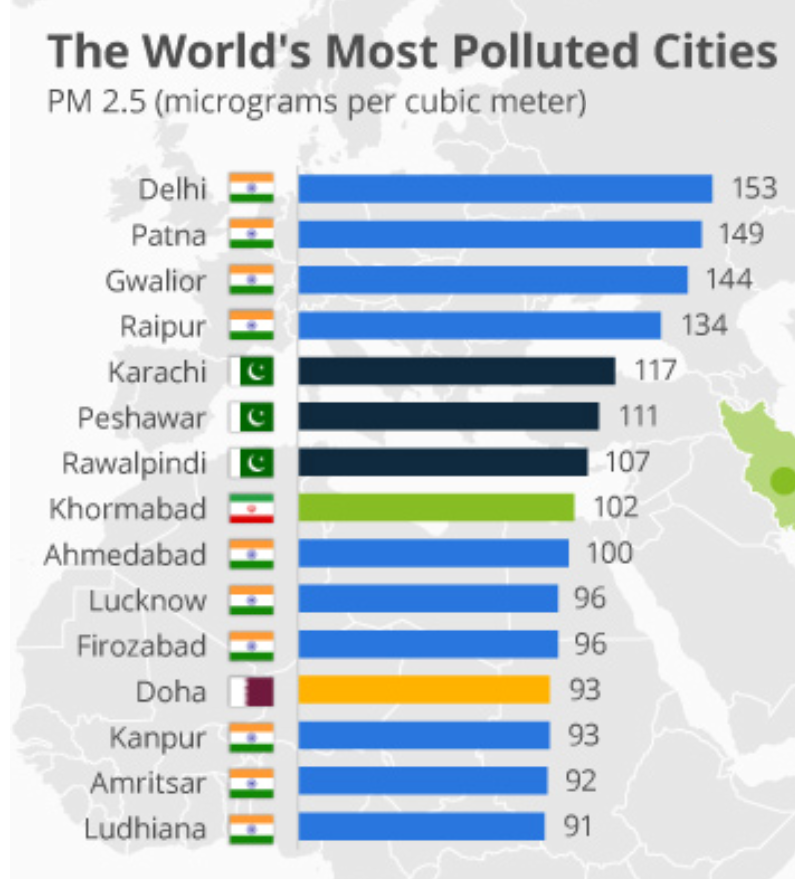
    Most Polluted Cities


    So tell me about it!

  • Social Security Nets as guarantors of Human Development

    Whenever one talks of sustainable livelihoods, we look not only at the 5 types of assets of a community or individual, but also at their coping strategies. Thus vocational diversity in a farming family will cushion it against a bad crop or a natural disaster, or the sudden death of the principal breadwinner. At the national level, the coping mechanism is provided by the state in the form of social security nets like unemployment benefits, health care, free education, pensions or child benefits.

    The second edition of The State of Social Nets which attempts to compile, analyze, and disseminate data and developments as part of the World Bank’s 2012–22 Social Protection and Labor Strategy, makes for interesting reading, and its key findings are summarized below:

    • The portfolio of social safety net programmes is large and diverse. A developing country runs about 20 different safety net programmes, on average.
    • Cash transfers and school feeding programmes are present in almost all countries. Cash transfers are becoming more popular and increasingly complex. Conditional cash transfer programmes are now present in 64 countries, a dramatic increase from 2 countries in 1997 and 27 countries in 2008.
    • Worldwide, 1.9 billion people are enrolled in social safety net programmes.
    • The world’s five largest social safety net programmes are all in middle-income countries and reach over 526 million people.

    It was also noted that the social security programmes and composition of social spending varied greatly across regions, as seen below:

    Social Security Nets

    However, the Report  found that despite remarkable progress over the past 5 years, most of the poor remain outside the social safety net system, especially in low- and lower-middle-income countries, which have the lowest coverage levels of poor people in their societies, and the least ability to direct resources to those most in need. The coverage gap is particularly acute in Sub-Saharan Africa and South Asia, where most of the global poor live. In these regions, only one-tenth and one-fifth of the poorest 20 percent have access to social safety nets, respectively. Urban areas have serious gaps in coverage, at all income levels. While 285 million poor people live in cities in developing countries, reaching them presents special challenges, including identifying, targeting, communicating with, and enrolling perspective beneficiaries.

    In this writer’s own experience, the National Social Assistance Programme (which consisted of a nominal pension to the poor above the age of 65) showed very good results in rural areas, but was absent from the big metros, chiefly because the pension was disbursed through money orders, and the urban poor being homeless, simply did not have a postal address! Such procedural lapses are the chief cause that the social security coverage of the poorest in developing countries remains inadequate. Take the latest case of cheap loans for farmers, which have been cleverly diverted to non-farming uses. Firstly, as these loans use land as collateral, the poorest landless tenant farmers are not covered; and as the scrutiny before granting loans is cursory at best, a lot of these loans end up in Fixed Deposits earning the borrower anything from 8-9% interest, while he pays no more that 4% on his loan.

    To plug such loopholes, many countries are increasingly looking to Unconditional Cash Transfers (UCT) and Conditional Cash Transfers (CCT). This strategy has several additional benefits, as the Report points out: “Newer studies confirm the positive and significant impacts of cash transfers on school enrollment and attendance; increased live births in safer facilities; improved prenatal and postnatal care; regular growth monitoring of children during critically important early ages; and enhanced food security.”

    The studies also delve deeper into the productive impacts of cash transfers, demonstrating how predictable cash transfers enhance households’ investment in activities to generate agricultural and nonagricultural income. In the urban context, a secure and predictable monthly income can mean the difference between shelter and homelessness, between education and illiteracy, between health and illness. Cash transfers also have major positive spillover effects on the local economy of target communities, especially in urban areas.


    Sadly, India is now ignoring all these benefits and the new government has ruthlessly slashed social expenditure in its last budget. What is frightening is that the eternal chase for higher growth rates (with a matching aversion to any form of subsidies and direct cash transfers, which are now being replaced by contributory insurance schemes), may rapidly undo all the gains in the areas of social security, social welfare and food security made by India as part of its commitment to the global social agenda, and the Millennium Development Goals.

  • Why our cities cannot be run as businesses

    Very simply, cities cannot be run as businesses because urban governance is more than just government. It is government + people. And while a business can clearly classify all its stakeholders (share-holders, management, workers, suppliers and distributors), how does a city draw the lines – between the property owners and the squatters? Between the tax-payers and the indigent? Between the empowered citizens and the illegal migrants? Between the rich and the poor? Between the natives and the newcomers? Between the producers and the consumers? Between the governed and the government? Between local demands and regional priorities? And so on…

    Thus while a business can be satisfied with mere efficiency, a city needs to look at effectiveness. There is little merit in computerized property tax bills, if the tax base has not been updated for the last twenty years, is there? Ditto with completing a pumping station on time, if the water delivery continues to be erratic and unreliable. City dwellers are more interested in the water in their taps than the technology which gets it there.

    Similarly, a business doesn’t really care about participation, equity or inclusion while an urban government must necessarily provide for it.

    Accountability in business is often merely a matter of financial accounting and compliance with various government norms – if they were accountable to society at large, we wouldn’t need a law of torts, or liability clauses in every business contract. A city on the other hand, is held to account in every election by its citizens, and there are a large number of mechanisms available today, for citizens to monitor and pull up their local governments.

    These thoughts have come to mind because the Indian media are rife with news of grand new urban initiatives being announced by the Central Government. The urban rejuvenation programme (AMRUT) is essentially a reworking of the erstwhile government’s Jawaharlal Nehru National Urban Renewal Mission (JNNURM) which this writer had an opportunity to closely observe from conception to execution to demise… and the summary judgment on JNNURM across the country has been – too many private sector consultants at every stage! Again the proclivity to run a city like a business…

    Brazil seems to have had a similar experience as the mayor of Sao Paulo admitted in an interview in 2013: “The previous economic model was very private-sector orientated, so the reaction of the local community was very negative. We need to rebalance the equation so development is not seen as a threat,” he said. “People consider politicians as bad people so it is important to get them involved personally. If they feel a sense of ownership then they don’t complain.”

    The fact that the JNNURM then, and AMRUT now, are deeply influenced by organizations like USAID and the Asian Development Bank explains this ‘cities as businesses’ approach, where a Business Development Plan got renamed as a City Development Plan, and almost all reforms made mandatory, had a financial angle – and somewhere along the line we forgot what a mish-mash the urban scene in India is, with thousands of small market towns, ancient pilgrim towns, bustling cities, and dysfunctional megacities with huge informal sectors, all getting the same treatment.

    The present Indian government is already receiving a lot of flak for massive cuts in social welfare programmes, discontinuing the consent and Social Impact Analysis from the Land Bill, and replacing unconditional transfers in the social security net with contributory (and therefore conditional) insurance schemes. It appears to put infrastructure and industry before people and the environment – and this attitude is again coming to the fore as India launches a very ambitious Smart Cities project. The many IT consultants are of course looking enviously at Songdo in South Korea or Masdar in the UAE, and hoping to create something similar in India. But do Indians really want this kind of super-efficient but impersonal urban experience? And what minute percentage could eventually afford to live in such a place? Well nobody’s asking these awkward questions.

    As the Prime Minister attends a BRICS meeting, he can perhaps pick up a few tips from Brazil about a more participatory and humane approach, seen in the Smart City Initiative to prepare Rio for the Olympics:

    Rio Smart City

    Only such a holistic approach; which balances the human development, infrastructure and environmental aspects; and formulated with the active participation of the residents of a city, can make it SMART in the long run.

  • Growing fragility of Indian Society

    No sentient human being on this planet can ignore the increasing fragility of the human condition across the world today – civil wars, burgeoning arms industries, natural calamities, epidemics, inter-communal and intra-communal violence, the destruction of viable nation-states in an unending battle for the control of natural resources, and so on and so on…

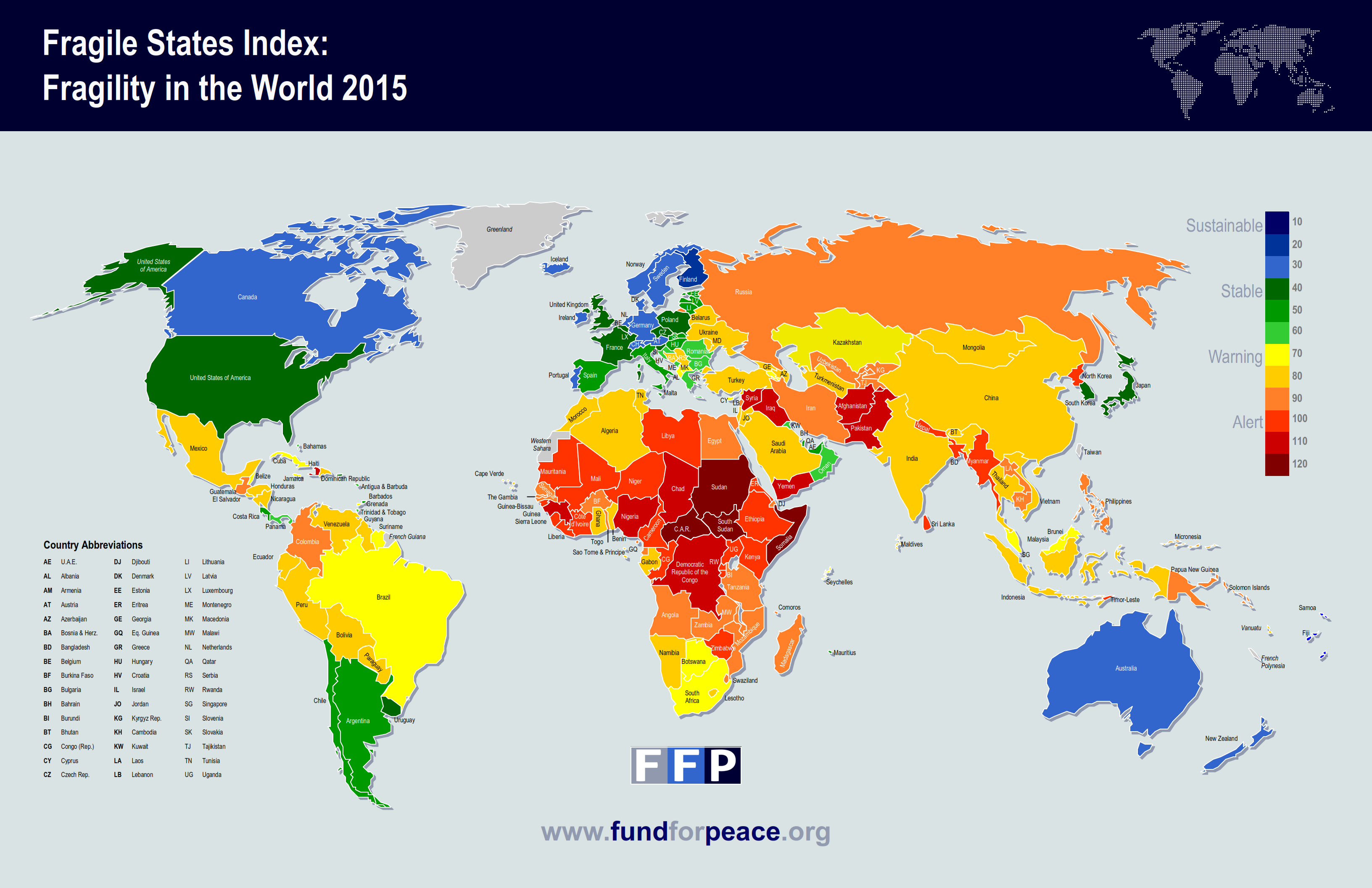
    And sure enough, we now have a Fragile States Index with facts and figures to give frightening substance to these events. Brought out annually by a Washington-based non-profit, the Fragile States Index has this to show in its latest report:

    Fragile State Index Map 2015

    And at 79.4, there sits India on the cusp of a High Warning Status.

    While the country is thankfully NOT in a state of war, the high score is all the more disturbing because it reflects the deepening fault lines in its social fabric, as measured in the socio-economic aspects of the Index – especially relevant to India being the Demographic Pressures, Uneven Economic Development, Group Grievance, and Poverty:

    World Fragility Index social factors

    Several recent events have thrown into sharp relief the growing disparities in every aspect of life in India. And the worst discrimination is that practised by the mainstream media in their overkill coverage of issues that impact the haves, the privileged and the entitled classes; while totally ignoring or cursorily dismissing those issues which affect the vast numbers of the permanently disadvantaged – the poor, the disempowered and the disenfranchised.

    Under pressure from industry which thrives on the cheap overheads of the urban informal sector, the government is proposing to amend the Child Labour Act of 1986, relaxing the ban on children working in family-owned occupations, which is sure to lead to much more exploitation and abuse than India is shamed with today. Instead of widespread discussion to ascertain the views of working children, what we get on the mainstream media is endless discussion on the possibility of excessive lead in noodles manufactured by a multinational, and consumed mainly by the urban haves and their children as a lifestyle choice, and not as a necessity for survival!

    Similarly, the fact that the present government has ruthlessly cut social welfare expenditure in its very first year has also gone unnoticed by the mainstream media. Instead, there is great publicity for 3 contributory schemes targeted at the poor, which totally miss the point that you have to first assure regular incomes, so that the potential beneficiaries can pay the premium on these insurance schemes, isn’t it? The only beneficiaries of these schemes are the fat cat insurance companies, who have already found a very lucrative market in the private medical insurance being offered in India. How hurtful it is that a noted hospital can offer different ‘packages’ for radiation therapy to cancer patients, with the top package available to the well-heeled and the well-insured. When asked what the difference was, one is told that there was more regular monitoring by CT scans for the higher packages, and also more care in mitigation of side-effects of radiation therapy. The sheer cold-bloodedness of such a commercial approach takes one’s breath away!

    Yet again, the ‘manufactured’ aspect of communal riots such as the recent one in Haryana are not commented upon, nor is the fact that at the heart of the trouble is a piece of disputed land. According to one writer, what is noticeable is the total absence of remorse among the perpetrators, and the deliberate targeting of the relatively wealthy members of the victim community, who had their homes and worldly possessions like washing machines and fans systematically destroyed! Very reminiscent of what goes on in the Palestinian Occupied Territories, isn’t it?

    And amid all the talk of building new smart cities, what happens to that terminally ill queen of Indian cities – Mumbai? The first spell of heavy monsoon rain, and the infrastructure and services come crashing down, as though no lessons were learnt from the calamitous floods of nine years ago…

    Meanwhile, the intermittent tit-for-tat violence continues in the Indian North-East, with NO attempt to address the festering grievances of that region.


    The deepening of these fault lines along caste, class, region, ethnicity and community have become so aggravated in recent months, that Indian society as a whole has become more fragile, more unpredictable, more liable to implosions and violence… and I dread to think where India will find itself in the Fragile States Index in 2016.

    This is the first and most frightening consequence of pursuing economic growth at all costs – human and environmental.

  • Part II: Why poor people remain poor

    As I have devoted a couple of posts already to the distress among farmers and rural communities in India, I think it is time to take a look at the growing urbanisation of poverty in the country.

    In developing countries like India, most urban workers are self-employed in precarious conditions or are employed on a casual basis without a contract and access to social security. The ILO terms such forms of employment as informal. In most cases, informal employment procures lower, more volatile pay and worse working conditions than employment in formal arrangements, and these informal sectors form the bulk of the urban poor in any country.

    The situation has greatly worsened with globalisation, which has deeply fragmented production processes, labour markets, political entities and societies, creating a plethora of interest groups and lobbies which have undermined the integrity of civil society and its rights and entitlements across the world. As a result, the number of permanent secure jobs (even in the formal sector) have given way to contractual/temporary employment, with downsizing, rightsizing and outsourcing becoming the new business mantras. This infographic from Statista puts it very plainly.


    JOBS Post

    Sadly, recent Indian governments seeking their place in a global market are so keen to attract foreign direct investment, that they have lost the national sovereignty to make decisions that benefit their own people, and surrendered control to highly mobile international finance capital. To placate these foreign investors we have begun the privatisation of precious natural resources and shredded whatever pro-labour legislation existed in India, and virtually annihilated Trade Unions in a way that would make Margaret Thatcher proud. But whereas Great Britain had a social security system already in place (in terms of unemployment benefits, old age pensions, compulsory education for the children and free health care), low and lower middle income countries have no such security net for those in distress.

    Ergo, once a household falls to the poverty line, it is very unlikely to rise much above it – and therefore the poor remain poor generation after generation.

    The vulnerability of the urban poor is exacerbated by the inadequate provision of basic public services, as well as by policy and regulatory frameworks that govern land and housing supply and property rights.

    Most of the urban poor do not have tenure security because their dwellings are built on public land or on private property belonging to someone else, or built on shared title land. Further, most dwellings of the poor are constructed without occupancy or construction permits from the municipal authority, or rented in slums without formal renting contracts.

    The situation is exacerbated by the inadequacy of planning tools like master planning, zoning and development regulations, in making land available to keep pace with rapid urbanisation, resulting in insufficient land supply and increases in land prices. Master plans in many developing countries like India are too centralised, take too long to prepare, are inherently anti-poor, and fail to address implementation issues or the linkages between spatial and financial planning.

    The Development Control Rules too are outdated and inappropriate, often opting for low form urbanisation, redolent of the colonial era. All recent attempts at densification have remained a pipe dream, because it is virtually impossible to upgrade the necessary infrastructure in thickly populated neighbourhoods. Unrealistically high standards for subdivision, project infrastructure, and construction make it impossible to build low-income housing legally, and the poor simply cannot afford to build to these specifications. Furthermore, the poor and low income groups have little or no access to credit, again because of the lack of a representational system to formalise their assets and holdings.

    Some of the ways in which the problem of housing for the urban poor has been tackled in different countries include:

    • Some form of transfer of ownership rights to the residents building upon public land
    • Greater flexibility in building specifications, construction materials and infrastructure norms
    • Decentralisation of urban planning
    • Simplification of building permissions and occupancy certification
    • Easier access to housing finance for the poor
    • And a simple transparent system of ownership title which will enable the poor to use their houses as collateral for loans to expand their income generation capability

    The lack of adequate and secure housing ultimately aggravates all other dimensions of urban poverty like education, health and income. If a family has no rights of tenure and may not even know where it will rest the night, how are the children going to register in schools and get an education? How will the parents earn a livelihood? How will the family draw the rations from the Public Distribution System to feed itself? And where will the sick find succour?

    As the National Commission on Urbanisation lamented in its 1988 report: “For the poor, there is simply nothing…”

  • Part I: Why poor countries remain poor

    In everybody’s life there comes a book which is a revelation; a book that explains simply and beautifully a complex process which one finds perplexing… and if (like me) you are a lucky wanderer in the vaults of human knowledge and wisdom, then you are sure to have experienced many such ‘a-ha’ moments.

    The book which prompted this post is ‘The Mystery of Capital’ by Hernando de Soto – respected Peruvian economist, political adviser, and reformer. Published in 2000 (a decade into the era of liberalisation, privatisation and globalisation), and based upon extensive field research in Asia, Africa and Latin America; the book poses a simple question – why does capitalism work only in the rich countries of Western Europe and North America?

    The reason, according to de Soto, is that the poorer countries simply fail to generate capital. He goes on to show that even in the poorest countries, the poor save – for instance, in Egypt the wealth that the poor had accumulated at the time of publication, was 55 times as much as the sum of all direct foreign investment ever recorded there, including the Suez Canal and Aswan Dam.

    However, these assets of the poor are not fungible assets – they cannot be turned into capital, cannot be traded, cannot be used as collateral for a loan, and cannot be used as a share against an investment.

    The heart of de Soto’s theory is that the poor countries remain poor because they lack a representational system which documents every parcel of land, every building, every piece of equipment, every store, every inventory, thus making it visible so that it can connect to a larger formal economy, thereby making the vast hidden assets of the poor and informal sectors fungible. But unfortunately, developing such representational systems takes time, resources and a much longer time-frame than a government on a 5-year run can afford.

    Take the case of land titles in India.

    In the prevalent system, a registered sale deed does not confer title ownership and is merely a record of the transaction. The current system of 7/12 extracts are no more than a caveat emptor or ‘buyer beware’ type of document, conferring only presumptive ownership, which is liable to be disputed.

    A proposed amendment to the Registration Act, 1908 would convert land registration into a ‘guaranteed title certification’ and would affect a paradigm shift in India’s land titling system, bringing it in line with other Commonwealth countries which follow the Torrens system of land titling. Under this system, a registered transaction would extinguish all previous rights and become sanctified as a formal title transfer to the purchaser, as prospective land buyers would only need to examine the land register, and purchase from the recorded owner.

    However,  such a system is only as good as the Land Register supporting it.

    The creation of a land-holdings register requires that land parcels be identified, with clearly demarcated boundaries, through maps of individual land parcels and their location within an area’s land grid. This has to then be correlated to undisputed, litigation-free ownership rights. Both these records then have to be publicly notified before they take effect. But the devil is in the details of course.

    As in most developing countries, the land record systems in India are archaic with no provision for regular systematic updates. In fact the terms used in land records (and the Act itself)  hark back to the British colonial era, or even further back to the Mughals! No register, which reliably confirms title, exists anywhere in India; and small experiments in some states to build such registers have not succeeded in achieving comprehensive coverage.

    How do you build up a land register in a country where rural land has moved from one power elite to another over thousands of years, and inherited land is often partitioned within the family, without any formal registration?

    The situation is much worse in urban areas where the chain of ownership is impossible to trace too far back, and most real estate developers take recourse to unregistered power of attorney transactions, when they build houses for the average middle-class buyer. Such a buyer is naturally kept totally in the dark about any title disputes or encumbrances attaching to the land where he dreams of owning a penthouse on the twentieth floor.

    The repeated fragmentation of lands generation after generation, with intractable boundary and ownership disputes can lead only one way – to the courts. It is not surprising, therefore that a vast majority of cases pending in Indian courts deal with land-related litigation, and most of the rural undertrials in Indian jails are there as a result of land disputes violently settled.


    So as it completes a year in office and is worried that the economy is not really taking off as expected, the Indian government would do well to listen to de Soto. After all, if 68% of the local economy of Mumbai – India’s commercial capital – is estimated to lie in the informal sector, just imagine what a boost the national economy would receive if the assets of the poor were looped into the formal system. Not to mention the assets back home in a city of migrants, which will come into play for procuring credit for housing and business. The entire country can be rejuvenated, city by city and town by town…

    But that will take more than five years, so who’s interested?

  • Land and growing social malaise

    The ongoing brouhaha in India about the amendments proposed to the Right to Fair Compensation and Transparency in Land Acquisition, Rehabilitation and Resettlement Act, 2013 has concentrated on its potential for depriving small and marginal farmers of their meagre land-holdings, pushing several of them to desperation and even suicide. But addressing just one of the several major issues in Indian agriculture and the resultant endemic rural poverty is at best a short-sighted attempt to gain political brownie points. Nothing more.

    Farmers’ suicides mainly occur in the more remote areas of States like Maharashtra, which are part of the great underdeveloped hinterland of India, and unlikely to attract large infrastructure projects in any case, so issues of land acquisition by government (whether under the unamended or amended Act) are moot. The major cause of farmers’ suicides continues to be great rural indebtedness. How many otherwise well informed urban Indians know that if a farmer wants to take a personal loan because of an illness or marriage in the family, the formal sector banks insist he put up his land as collateral? Otherwise he has no alternative but to approach the rapacious village money-lender, and either way, he is a hostage to the vagaries of weather and market forces, and a couple of failed crops seals his doom. (What ails Indian agriculture as a whole is a separate issue covered partly in my post ‘It’s all about the land…’, so I shall not dwell upon it here.)

    The failure of successive governments to tertiarize the rural economy, through the development of agro-industries in the myriad small market towns which dot the countryside, is the primary reason for widespread poverty in rural India. This situation has been made worse by engendering a deep sense of dependency among the rural poor, so that they have lost all appetite for enterprise, risk-taking and innovation. And again, it suits successive governments to have a pliant and dependent peasantry, ready to accept its state of perpetual misery as karma, never revolting, never protesting; but ever grateful for any largesse that comes its way (like loan waivers) in the  year immediately before a General Election. That way, they will not demand their basic rights – like universal education and health care and access to higher education.

    Suffice it to say that right now, the greater opposition to the Land Bill Amendments will come not from these crushed millions, but from relatively prosperous farmers, carrying out commercial rather than subsistence farming, closer to the big towns and definitely not prone to desperate measures like suicide! Theirs are the lands most likely to be acquired for industrial corridors, intercity expressways, new airports, ports and high speed transit systems. And this is also the group which has benefited the most from farm subsidies, and even cheap electricity, since the Green Revolution of the 1960s.

    Of course small and marginal farmers in these catchment areas are also at risk of losing their sole means of livelihood, and forfeiting not just their own future but also that of their children and grandchildren, because all such laws basically speak only of monetary compensation and there is no provision for alternative and sustainable livelihoods included in the compensation package.

    The real concern about the Amendments among grassroots NGOs and Community-based Organizations (CBOs) however, is the dilution of 2 provisions of the 2013 Act: The government has amended Section 10(A) of the Act to expand sectors where assessment and consent will NOT be required. These are: national security, defence, rural infrastructure (including electrification), industrial corridors and housing for the poor including PPP where ownership of land continues to be vested with the government. For these five sectors, the government or private individuals/companies will no longer need the mandatory 80% consent for land acquisition.

    The more disturbing aspect of this amendment is that by omitting the mandatory social impact assessment, the government will be required to compensate only the land owner, not all those who are dependent on the land and likely to permanently lose their livelihoods; and who also needed to be compensated. To add insult to injury, the fertility or infertility of the land will NOT be taken into consideration while acquiring it for these five specific sectors. Thus, even if the land is extremely fertile, it can be acquired if it fits the criterion of these five sectors, no questions asked.


    These Amendments have been opposed by several stakeholders, and their very legitimate concerns need to be addressed in totality, not piecemeal. Allowing these grievances to fester will not only stymie development through Public Interest Litigation (PIL), but will add further to the unrest and malaise seething just below the surface in Indian society, which manifests itself in increasing violence in day to day social transactions as much as in the sporadic skirmishes between extremists and law enforcement agencies in the ‘hot spots’.

    The political class needs to stop playing its power games, and listen…

  • Beyond the Millennium Development Goals

    In developing countries, 2015 is a year of particular interest because it is the deadline for achieving the various targets under the Millennium Development Goals. To recap, the United Nations Development Programme (UNDP) saw a new hope for global action in the dawn of a new millennium, and this took the shape of the 8 Millennium Development Goals, which have shaped the development policies of many a nation for the last decade and a half.

    The original Millennium Development Goals, and their targets, were:

    GOAL 1: ERADICATE EXTREME POVERTY AND HUNGER

    Halve, between 1990 and 2015, the proportion of people whose income is less than $1.25 a day

    Achieve full and productive employment and decent work for all, including women and young people

    Halve, between 1990 and 2015, the proportion of people who suffer from hunger

    GOAL 2: ACHIEVE UNIVERSAL PRIMARY EDUCATION

    Ensure that, by 2015, children everywhere, boys and girls alike, will be able to complete a full course of primary schooling

    GOAL 3: PROMOTE GENDER EQUALITY AND EMPOWER WOMEN

    Eliminate gender disparity in primary and secondary education, preferably by 2005, and in all levels of education no later than 2015

    GOAL 4: REDUCE CHILD MORTALITY

    Reduce by two thirds, between 1990 and 2015, the under-five mortality rate

    GOAL 5: IMPROVE MATERNAL HEALTH

    Reduce by three quarters, between 1990 and 2015, the maternal mortality ratio

    Achieve, by 2015, universal access to reproductive health

    GOAL 6: COMBAT HIV/AIDS, MALARIA AND OTHER DISEASES

    Have halted by 2015 and begun to reverse the spread of HIV/AIDS

    Achieve, by 2010, universal access to treatment for HIV/AIDS for all those who need it

    Have halted by 2015 and begun to reverse the incidence of malaria and other major diseases

    GOAL 7: ENSURE ENVIRONMENTAL SUSTAINABILITY

    Integrate the principles of sustainable development into country policies and programmes and reverse the loss of environmental resources

    Reduce biodiversity loss, achieving, by 2010, a significant reduction in the rate of loss

    Halve, by 2015, the proportion of the population without sustainable access to safe drinking water and basic sanitation

    Achieve, by 2020, a significant improvement in the lives of at least 100 million slum dwellers

    GOAL 8: DEVELOP A GLOBAL PARTNERSHIP FOR DEVELOPMENT

    Develop further an open, rule-based, predictable, non-discriminatory trading and financial system

    Address the special needs of least developed countries

    Address the special needs of landlocked developing countries and small island developing States

    Deal comprehensively with the debt problems of developing countries

    In cooperation with the private sector, make available benefits of new technologies, especially information and communications


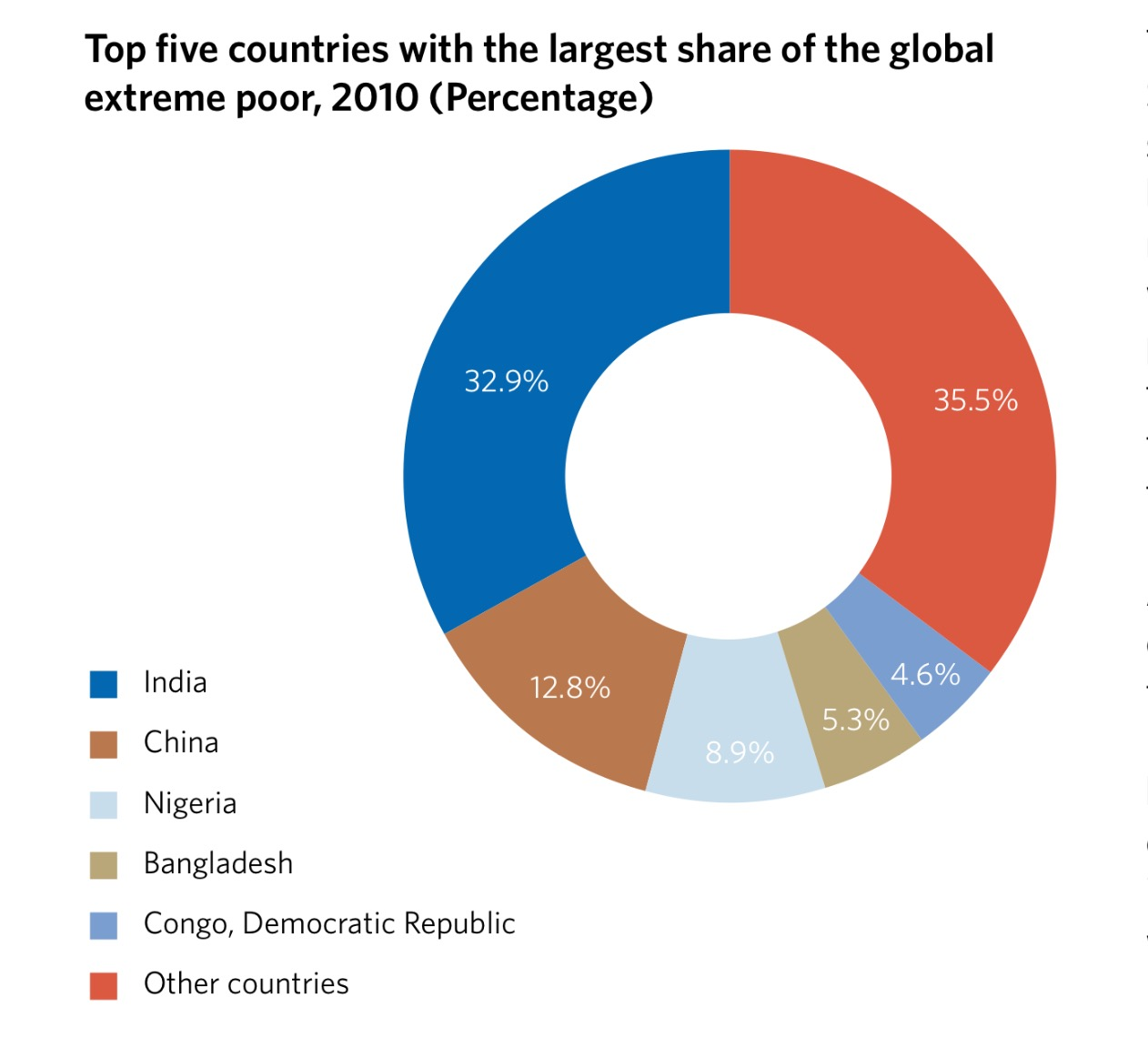
    As almost all the MDGs deal with different dimensions of poverty, the question to be asked here is how well (or badly) have the two demographic giants on the planet fared? Because the MDG targets basically dealt with halving this or that indicator, the expectation never was that poverty would indeed be eradicated in 15 years. It has been tackled with vigour in both India and China, and yet they have a long, long way to go:

    Poverty pie chart MDG post

    While China has largely secluded its poor in the countryside, India’s poor are everywhere – on street corners in the big metros; among the ill-educated and underemployed of the small towns, living lives of quiet desperation; amidst the small and marginal farmers with an anxious eye on the next monsoon which could spell the difference between choosing to live and choosing to die; and the poorest of the poor in the tribal districts of the country, with no private land to till, and all community resources lost to the greedy contractor.

    Many, like this blogger, have been trying to get the present government to look at the state of the nation’s poor, rather than posturing abroad to gain foreign direct investment – but to no avail. Well, if they don’t listen to us, they may perhaps listen to the 7.3 million people worldwide who are saying precisely the same thing. This was the number polled by UNDP in setting the goals for the next 15 years for all the countries in the world.

    Given the global concerns with issues like growing carbon footprints, climate change, and unsustainable development, the new goals targeted for 2030 are known as the Sustainable Development Goals, and are more than twice as many as the original MDGs. They are:

    1. End poverty in all its forms everywhere
    2. End hunger, achieve food security and improved nutrition, and promote sustainable agriculture
    3. Ensure healthy lives and promote well-being for all at all ages
    4. Ensure inclusive and equitable quality education and promote lifelong learning opportunities for all
    5. Achieve gender equality and empower all women and girls
    6. Ensure availability and sustainable management of water and sanitation for all
    7. Ensure access to affordable, reliable, sustainable and modern energy for all
    8. Promote sustained, inclusive and sustainable economic growth, full and productive employment, and decent work for all
    9. Build resilient infrastructure, promote inclusive and sustainable industrialization, and foster innovation
    10. Reduce inequality within and among countries
    11. Make cities and human settlements inclusive, safe, resilient and sustainable
    12. Ensure sustainable consumption and production patterns
    13. Take urgent action to combat climate change and its impacts
    14. Conserve and sustainably use the oceans, seas and marine resources for sustainable development
    15. Protect, restore and promote sustainable use of terrestrial ecosystems, sustainably manage forests, combat desertification and halt and reverse land degradation, and halt biodiversity loss
    16. Promote peaceful and inclusive societies for sustainable development, provide access to justice for all and build effective, accountable and inclusive institutions at all levels
    17. Strengthen the means of implementation and revitalise the global partnership for sustainable development

    Lest we forget…

    The Indian electorate does have a proclivity for throwing out governments which contemptuously ignore the poor – at the State level, and the Centre. Smart cities and busy expressways just don’t cut it with the village mother whose child has to trudge 10 kilometers to school – through rain and shine…

  • Social Progress and Directed Growth

    Blog Entree The recently published Social Progress Index Report made big news in India, because it put India lower than both Nepal and Bangladesh in its rankings. The ruling rightist Government (which worships at the altar of S&P, McKinsey and Moody’s) dismissed it as yet another leftist conspiracy – just as they dismiss all critics from Amartya Sen to Greenpeace – not realising that the report comes from the pens of globalization experts and management gurus like Michael E Porter.

    The Report defines Social Progress as “… the capacity of a society to meet the basic human needs of its citizens, establish the building blocks that allow citizens and communities to enhance and sustain the quality of their lives, and create the conditions for all individuals to reach their full potential.”

    Under these 3 broad categories, the Social Progress Index measured the following indicators for 132 countries:

    SPI COMPONENETS The Social Progress Report makes it a point to disassociate itself from prevalent economic indicators like GDP, pointing out that the top ranker on this Index (New Zealand) has a GDP practically half that of the world’s largest economy, the USA, yet outranks it by 15 places.

    The following graph is very interesting (especially to the BRICS Countries, where India again, sadly, brings up the rear…):

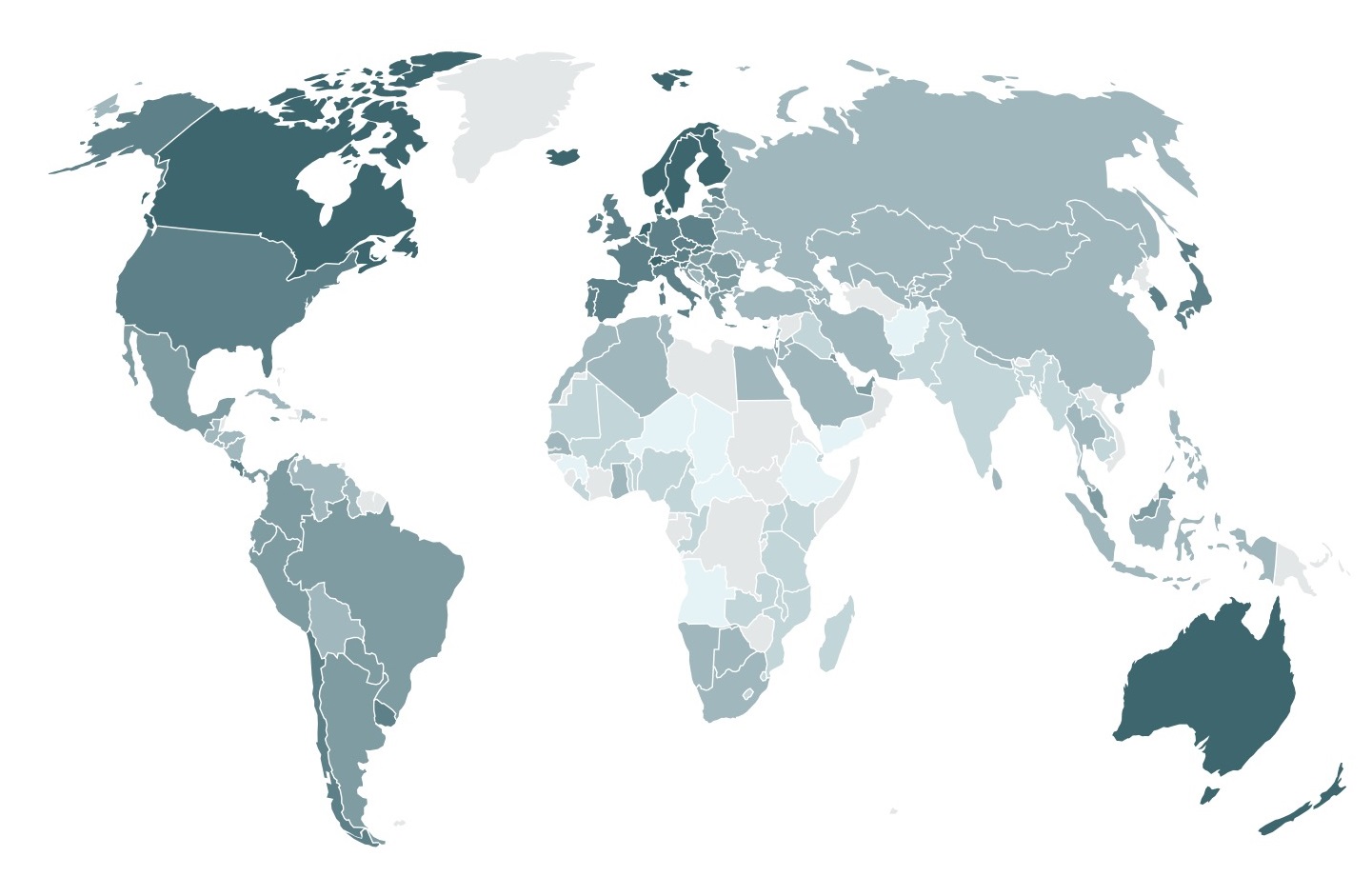
    SPI & GDP The overall findings of the Social Progress Report 2015 are best encapsulated in this map:

    SPI MAP The beauty of the Social Progress Index is that it is interactive, and you can immediately see the impact of any indicator by adding a component and watching the colours change. I tried it for each of the components, one by one, and read at a glance the signals for India, especially those where it faded from pale to paler jade, to almost white… and the real areas of concern were:

    • Availability of Water
    • Availability of affordable housing
    • Deterioration of the environment
    • Inequality in the attainment of education
    • Average years spent in school by the female half of the population
    • Years of tertiary education
    • Access to advanced education
    • Religious intolerance
    • Discrimination and violence against minorities – religious, ethnic, sexual preferences

    Of course it would not be fair to put the blame on (or give the credit to, for that matter) a government which has been in office for less than a year. However, if development is directed growth, and progress the distance covered in that direction, then it is the direction which may need to change – especially for a government which came to power on the promise of ‘development for all’…

    Or else, the next 4 years will see increasing discontent in civil society, more violence from the disgruntled, more Public Interest Litigation in the courts, more protests, and more raucousness in Parliament.

    Then how will the dream of smart cities and industrial corridors be achieved?

  • Latin America: Populations are also people

    As Mrs Indira Gandhi, late Prime Minister of India, once remarked, ‘the world media are interested in reporting on developing countries, only when there’s a coup or an earthquake.’ Of course, in the age of global connectivity and the internet, this tendency gets a hundred-fold exaggerated.

    I was struck by this ‘list’ I saw on a website, incongruously squeezed between something as banal and ridiculous as the world’s 10 richest cats, or the 20 worst gowns on the red carpet, or whatever. Except, this was a list of the 50 most violent cities in the world. And the writer of that particular post couldn’t be more off-hand:

    “Murder is more common in Latin America than any other part of the world… Thirty four of the fifty worst cities were located in the region, including repeat murder capital of the world – San Pedro Sula, Honduras – which saw 187 homicides per 100,000 inhabitants in 2013, and is getting steadily worse. Drug trafficking, gang wars, political instability, corruption, and poverty combine to cause the region’s elevated violence.”

    And in less than 70 words, do we dismiss the hopes, fears, dreams and reality of 588 million people – almost a tenth of humanity!

    This disregard for those who ‘do not really matter’ as much as one’s own social class, caste, compatriots, co-religionists, brotherhoods and sororities, is a universal trait. And as Foucault so beautifully explained, the modern State has lost its moral purpose and it suits those who govern to put a label on the governed, or ‘populations’ as he called them – forever diminished, devoiced, defanged, and disempowered.

    In fact, marketers and campaigners in the US have honed this to an art, when they talk of a product or candidate appealing to X, Y, Z ‘demographic’.

    If, like me, you found this list profoundly disturbing and dug a little deeper, what would you find? A region which has known the worst of colonial excesses, the decimation of indigenous populations, slavery, and the systematic plundering of its natural resources. South America, because of an accident of geography, became a battlefield for the superpowers during the Cold War in the late twentieth century, and in the 1960s and 1970s, the governments of Argentina, Brazil, Chile, and Uruguay were overthrown or displaced by US-aligned military dictatorships. These regimes detained tens of thousands of political prisoners, many of whom were tortured and/or killed. Economically, they began a transition to neo-liberal economic policies, in tune with the Washington Consensus, resulting in international indebtedness, widening gaps between the rich and poor, and one deep economic crisis after another.

    The legacy of these years was stark : rampant corruption, weakening of civil society, growing poverty and ever increasing economic disparity, where a few controlled the many. As any social scientist will tell you, corruption, poverty and disparity are the three major forces behind urban crime, and Latin American cities had well and truly begun their slide downhill, with violent crime receiving a boost from the easy availability of cheap handguns across the border, in the USA.

    Add to that the lack of opportunity in declining economies, where the only way out of a favela was football – no wonder then, that every Brazilian star from Pele to Neymar has a rags-to-riches story to tell. And where would the unsuccessful aspirants go but into the criminal underworld?

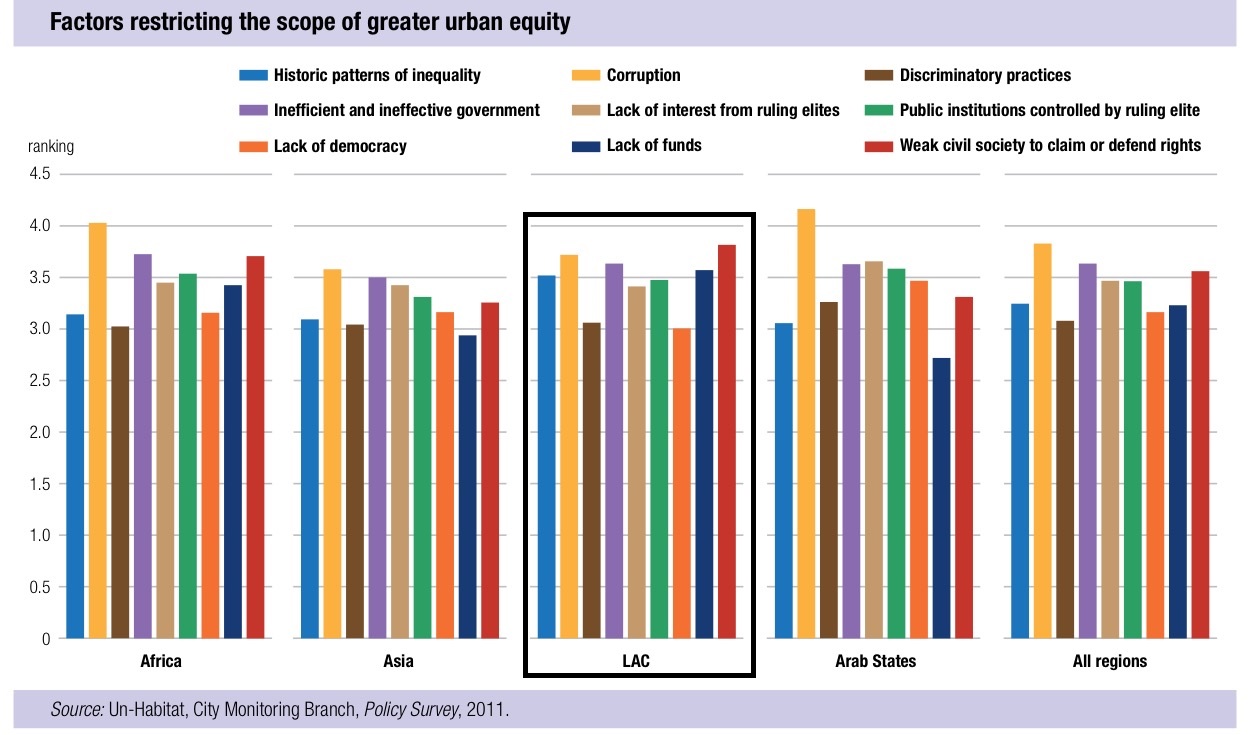
    The UN-Habitat’s ‘State of the World’s Cities 2012-13’ illustrates this point quite well, by quantifying the barriers to achieving greater social equity in a city:

    Social Equity LAC

    As expected, the chief barriers to greater equity in Latin American cities are: weak civil society, corruption, ineffective governments, historic patterns of inequality, public institutions controlled by ruling elite, and lack of interest from ruling elites.

    You see the pattern emerging?

    However, there is hope…

    Beginning with Hugo Chávez’s victory in the 1998 Presidential Election in Venezuela, South America has seen no less than 15 left-wing Presidents voted into office in Chile, Brazil, Ecuador, Argentina, Uruguay, Bolivia, Paraguay and Peru. And their pro-poor policies targeting the disempowered and marginalized – like systematic vocational training, direct aid transfers, and guaranteed food security – are beginning to make an impact.

    A 2013 UNDP Report by Lustig et al has heartening news: Inequality in Latin America has unambiguously declined in the 2000s, with the Gini Coefficient (a measure of disparity – the higher the Gini, the greater the inequality) decreasing significantly in 14 of the 17 Latin American countries studied, while steadily increasing in China, South Africa, India, and USA:

    Gini LAC

    So next time you are tempted to brand a people as lazy, or a country as corrupt, or an entire religion as terrorist; take pause and spare a few moments to find out their history and where they are coming from… Remember, someone somewhere is pigeonholing and labelling you in exactly the same way…