Published in Times of India, Pune, on 12 January, 2019. Lost and found. Reposted here for you.
It would be amusing, if it were not sad – but every time one reads citizens’ demands or looks at the pictures sent by citizen reporters, one sees a limited obsession with just four things: garbage, potholes, traffic congestion and overflowing drains. The typical reader of our English press seems to believe that the Municipal Corporation is simply a recalcitrant and lazy servant, who collects a salary (property tax) from us and does nothing in return. Moreover, that money is either lost to corruption or in subsidizing the parasitic poor because they are captive vote banks.
Nothing could be further from the truth.
We Indians seem to have ingrained in our minds the image of the municipality as cleaners, scavengers, firefighters, recorders of births and deaths, and providers of water for men and cattle going back to Kautilya’s Arthashastra. The image of municipal officer as regulator got further exaggerated by the ‘kotwal’ mentioned in the ‘Ain-e-Akbari’ and of course the British formalized this image of local government in the mother of all municipal laws – the Bombay Municipal Act of 1888.
This history has led to 3 major misconceptions among the formal sector or white-collar citizens of Indian cities:
Firstly, many believe that the Corporation merely performs a regulatory and conservancy role. This is not true. As seen from the box, the 74th Constitutional Amendment (1992) extended the role of urban local bodies to Development Planning, Poverty Alleviation and Social Sectors, under Schedule XII. But do we ever see our citizens mention the adequacy or inadequacy of a school or clinic in an area? Of course not. After all, the reader would never dream of sending her child to a municipal school, though her maid and driver will – because they have no choice! Never mind that the Pune Municipal Corporation (PMC) runs one of the poshest, entirely e-learning based schools in Sahakarnagar!
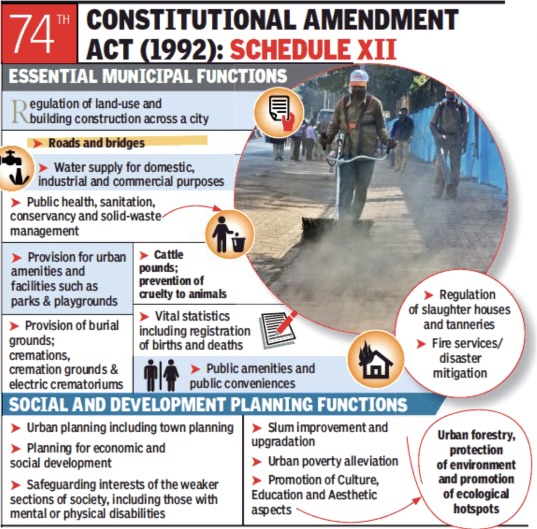
Secondly, we the payers of Property Tax think we are bank rolling the Corporation’s annual budget. Far from it – believe me, the poorest woman is paying tax on every grain of salt she buys at the kiranawala (grocery) and part of it goes to the Municipal Corporation, earlier as Octroi, and now as the Goods and Services Tax (GST). And surprisingly, in the larger cities this indirect tax component is anything from 10-20% higher than the Property Tax collection.
In the matter of subsidies, certain programmes for the poor are financed directly by Central Government or donor agencies, and others by State Government grants – not from local taxes. The most obvious local subsidy is on water supply (with the Pune Municipal Corporation spending Rs 11 and charging Rs 5 per 1,000 litres) but because of the indiscriminate pricing system, the biggest beneficiaries are not the hutment dwellers but people like us, with the luxury of huge storage tanks in our posh societies.
Thirdly, in the present dispensation, the local government is very limited in its activities and choices by various State Government departments and parastatals. For instance, it is the State Motor Vehicle Department which makes big money from an unbridled registration of new vehicles, but it falls to the Local Government to provide parking and roads. Similarly, while parastatals like MSRDC may construct flyovers, their subsequent upkeep is a burden on local government, even though they had no say in the quality of the original construction.
Even the supply of water released to a city is controlled by the State Irrigation Department, and Corporations are charged commercial rates for power installations by Electricity Boards, even when used for street lighting in public spaces. Moreover, even the most senior level local employees of a Corporation ultimately report to Officers from a Central Service, posted by a State Government for a period of three years or less, with no historical memory of the city’s past, nor long term interest in the city’s future. So much for Local Government autonomy.
Of course, we the citizens are not doing our bit to make the city liveable. With a middle class which considers individual mobility from the age of 16 a birth right, the congestion of private vehicles on our roads is inevitable – and when the pollution caused by these vehicles reaches Delhi levels, we will, of course, blame the municipal authorities. Ditto with garbage. How many housing societies start off with earnest vermicomposting, only to abandon it in a month, as all the composting worms have died because the wet garbage fed to them had bits of indigestible plastic?
And how long do we care about maintaining our rain harvesting systems? Nobody knows how effective the collection is every monsoon, but we do crib about the PMC not giving us the 5% tax incentive in every Society AGM. In fact, all it takes is a visit to the nearest Cooperative Court to see the huge number of cases resulting from squabbling among members of Cooperative Housing Societies. This is the ONE chance at self-government we were given – and look at the mess.
It is not this writer’s case that urban local bodies are the exemplars of every virtue. Only that instead of complaining about the shortcomings of the present system, we need to fight for systemic reforms – the Constitution of India provides us with the tools of transformation. All we need is to use our votes to push State Governments into taking our cities seriously and empowering our Local Governments and devolving the necessary resources and manpower to make them viable.
 Development and Governance
Leave a comment