Development and Governance

Month: January 2021

  • Republic Day 2021

    India marks 26 January as its Republic Day – the day WE THE PEOPLE gave unto ourselves a Constitution wherein we resolved that India was to be a SOVEREIGN, SOCIALIST, SECULAR, DEMOCRATIC REPUBLIC, which would secure to all its citizens:

    JUSTICE, social, economic and political; LIBERTY of thought, expression, belief, faith and worship; EQUALITY of status and of opportunity; and to promote among them all FRATERNITY assuring the dignity of the individual and the unity and integrity of the Nation.

    To bring about a just, free, egalitarian and fraternal society, the Constitution of India granted ALL its citizens, certain FUNDAMENTAL RIGHTS:

    The Right to Equality is one of the chief guarantees of the Constitution. It is embodied in Articles 14–16, which collectively encompass the general principles of equality before law and non-discrimination, and Articles 17–18 which collectively further the philosophy of social equality.

    Right to Freedom: Article 19 guarantees six freedoms in the nature of civil rights, which are available only to citizens of India. These include the freedom of speech and expression, freedom of assembly without arms, freedom of association, freedom of movement throughout the territory of India, freedom to reside and settle in any part of the country of India and the freedom to practise any profession.

    The Right against Exploitation, contained in Articles 23–24, lays down certain provisions to prevent exploitation of the weaker sections of the society by individuals or the State. Article 23 prohibits human trafficking, making it an offence punishable by law, and also prohibits forced labour, or any act of compelling a person to work without wages where he was legally entitled not to work or to receive remuneration for it.

    The Right to Freedom of Religion, covered in Articles 25–28, provides religious freedom to all citizens and ensures a secular state in India. According to the Constitution, there is no official State religion, and the State is required to treat all religions impartially and neutrally. Article 25 guarantees all persons the freedom of conscience and the right to preach, practice and propagate any religion of their choice.

    The Cultural and Educational Rights, given in Articles 29 and 30, are measures to protect the rights of cultural, linguistic and religious minorities, by enabling them to conserve their heritage and protecting them against discrimination.

    In a year burned into human memory by the Corona Pandemic, India has added several cuts and bruises of its own to its fragile social fabric, with scant regard for these fundamental rights, or even basic human rights.

    Yet one lives in hope of things stabilizing for the better in the new year.

    Happy Republic Day. Jai Hind!
  • Human Development Report 2020

    The first Human Development Report sent a ripple of excitement in the development community as it moved from tabulating mere incomes, to measuring the capacities and capabilities of human beings, as an indicator of the successes and failures of nation-states in providing a better quality of life to their citizens.

    The pioneering work of economists like Mahbub ul Haq and Amartya Sen left its impact on a whole generation of development economists, but as the years rolled by, some of the excitement of measuring every possible aspect of education, health and gender in a society, gave way to a certain predictability and tedium.

    The HDR 2019, the first under a refreshingly multi-disciplinary team, reignited this enthusiasm because it was much more grounded in current realities: growing inequalities, slower social mobility, democratic backsliding and rising authoritarianism around the world. As it clearly outlined, in an increasingly fragmented world, collective action on anything from pandemics to climate change to labour-friendly work cultures, becomes increasingly difficult.

    As the Human Development Report 2020 points out, in little more than a decade, the global financial crisis, the climate crisis, the inequality crisis and the COVID19 crisis have all shown that the resilience of the system itself is breaking down, buffering systems are maxing out, and once-supple connections are becoming brittle – leaving them more inclined to break than to bend, further destabilizing the Earth system.

    Lurching from managing one crisis to another, how is the global community going to find the resources and time for human development? That is the question the HDR 2020 tries to address.

    As an anthropologist, one was thrilled to note that the HDR 2020 is definitely anthropological in flavour. For three reasons:

    It proposes that we look at the planet as having exited the Holocene Geological era, which spanned some 12,000 years, and saw the blossoming of human civilization, and enter the Anthropocene — in which humans are a dominant force shaping the future of the planet.
    It proposes a holistic approach (so dear to anthropologists), wherein problems are not dumped in separate silos, but are perceived as “…multidimensional, interconnected and increasingly universal predicaments.”
    Finally, it looks for solutions in a matrix that combines capabilities, agency and values – one cannot enhance human development singularly by just enhancing people’s capabilities. Nor can we assume that by empowering more people, we will ensure that a stronger ‘agency’ will necessarily make the right choices. All individual and collective action must be underpinned by universally accepted values – but people cannot realize their values without having sufficient capabilities and agency.


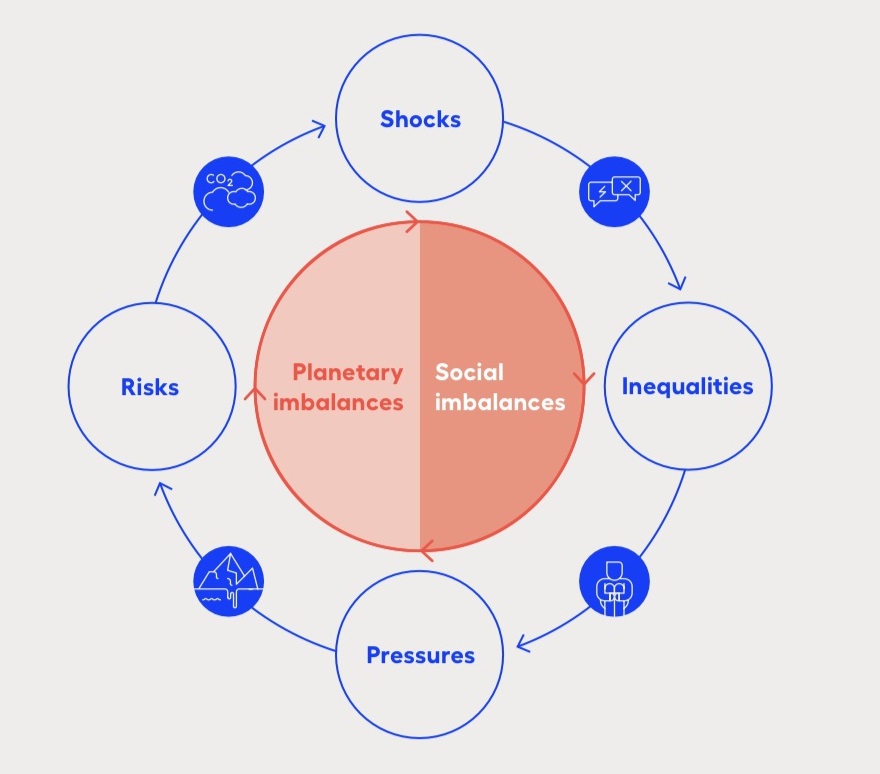
    The hinge for this report, is of course, provided by the COVID-19 Pandemic which ripped through every country in the year under report. It provides the authors with the perfect framework to posit their underlying theme that as social imbalance increases, so do the pressures on our planet – and the two feed on, and reinforce each other, in a way which directly impedes human development:

    The Report argues that “… to navigate the Anthropocene, humanity can develop the capabilities, agency and values to act by enhancing equity, fostering innovation and instilling a sense of stewardship of nature. If these have greater weight within the ever-widening choice sets that people create for themselves—if equity, innovation and stewardship become central to what it means to live a good life—then human flourishing can happen alongside easing planetary pressures.”

    Because, in the Anthropocene, it is essential to do away with stark distinctions between people and planet.

    This time, the way forward is not only about expanding people’s capabilities and choices, but also enhancing their agency and ability to participate in decision-making, within a framework of universal values that allow us to become true stewards of our only home – planet Earth.