Development and Governance

Month: January 2020

  • Republic Day 2020 : Time for stocktaking

    When I started this blog in November 2014, I wanted to make occasional assessments of how the incoming Government of India would deliver good governance – one of its major campaign promises.

    And what better occasion than today, when a Republic celebrates a Constitution that has been in effect for 70 glorious years, which has transformed a post-colonial basket case into a proud member of the comity of nations, which binds together more ethnicities and diversities than any other nation-state on the planet, and where a vast swathe of the population is suddenly feeling so vulnerable that the eyes of the world are watching every move of its elected government.

    So let’s begin with the UN Paradigm of good governance, and assess the Indian Government‘s performance objectively for each indicator, based upon reliable media reports and facts and data…

    Good Governance Indicators Performance of Indian Government (2014-19) from media headlines Assessing Government Performance Remarks
    Efficiency 355 Infrastructure projects with cost overrun of ₹3880 billion: Economic Times Nov 2019 FAIL INEFFICIENT
    Effectiveness Demonetisation drive that cost 1.5 m jobs, failed to uncover black money: The Guardian August 2018 FAIL INEFFECTIVE
    Participation Most schemes like SBA, Smart Cities, PMAY etc have not produced the desired results because their design, implementation and monitoring have been left entirely to bureaucrats and consultants with little or no public participation: Various Media Reports FAIL CENTRALIZED
    Accountability Umpteen examples of corruption cases against politicians being dropped once they switch allegiance to the ruling party. BJP campaigners proudly claim their party is a ‘washing machine’ : HW News, The Wire Oct 2019 FAIL UNACCOUNTABLE
    Responsiveness Not ONE senior minister deputed to discuss grievances with protesters, even after a month : All media reporting on Shaheen Bagh Protests, January 2020 FAIL UNRESPONSIVE
    Transparency Right to Information Act modified to curtail its independence : Economic Times Oct 2019 FAIL OPAQUE
    Inclusion Citizenship Amendment Act perceived as exclusionary and discriminatory : UN Human Rights Commission FAIL MAJORITARIAN
    Consensus Orientation Governance by brute majority, not consensus building : Parliamentary Proceedings FAIL MONOLITHIC
    Rule of Law Disregard for Rule of Law in crushing protest and dissent : Media Reports from UP, JMI, AMU, JNU : December 2019 FAIL AGGRESSIVE
    Equity Heightened disparity : Oxfam Report on growing disparity in India: ‘… economic inequality is being added to a society that is already fractured along the lines of caste, religion, region and gender.’ January 2020 FAIL DISCRIMINATORY

    Sadly, this means that we have ended up with a government that is monolithic, majoritarian, aggressive, and discriminatory in attitude, unaccountable, opaque and unresponsive in action, centralized in its decision making,  and incompetent and ineffective in its outcomes. Certainly not good governance…

    Happy Republic Day all the same.
  • Human Development Report 2019

    “The wave of demonstrations sweeping across countries is a clear sign that, for all our progress, something in our globalized society is not working. Different triggers are bringing people onto the streets: the cost of a train ticket, the price of petrol, political demands for independence.

    A connecting thread, though, is deep and rising frustration with inequalities.

    Too often, inequality is framed around economics, fed and measured by the notion that making money is the most important thing in life. But societies are creaking under the strain of this assumption, and while people may protest to keep pennies in their pockets, power is the protagonist of this story: the power of the few; the powerlessness of many; and collective power of the people to demand change”

    UNDP’s Human Development Report 2019 begins with these powerful words in the Foreword penned by Achim Steiner, Administrator UNDP.

    Here in India, we are at a pivotal moment in our history where the CAA-NPR-NRC triad threatens to embed inequality in the very concept of citizenship – and the nationwide demonstration of ‘collective power of the people’ resonates around the globe.


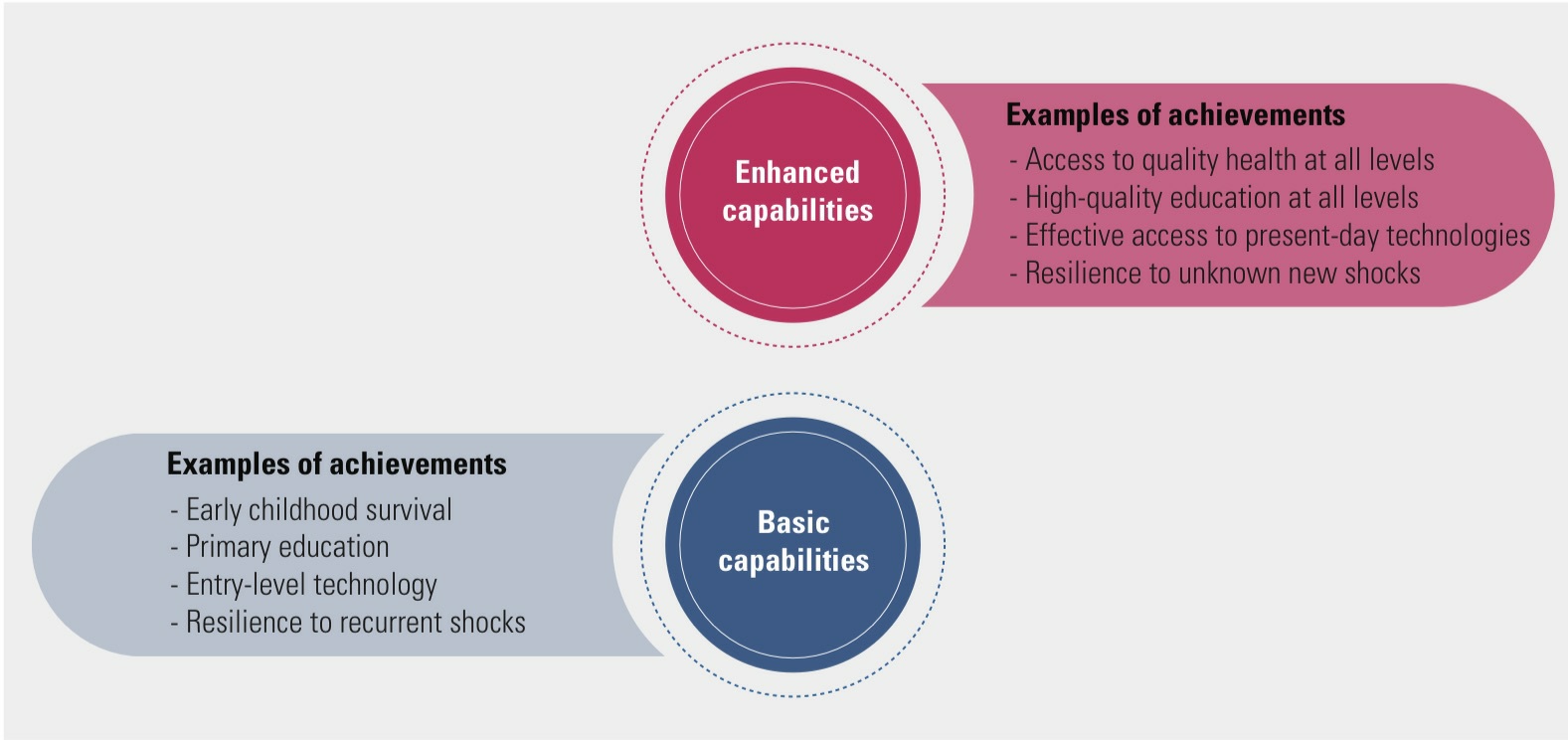
    The HDR 2019 makes a quantum leap from earlier Reports insofar as it looks at a different set of ‘enhanced’ capabilities, without which, large swathes of humanity will continue to fall further and further back, leading to greater disparities and consequent frustration and unrest around the world.

    The Report has 5 key messages to deliver:

    Key message 1: Disparities in human development remain widespread, despite achievements in reducing extreme deprivations. For example, while mobile telephones may have penetrated deep into villages and squatter settlements, how many users are capable of using the internet for banking? Or how many of those who stay the course through primary and secondary education have access to higher and vocational education which will help them earn a decent livelihood in a globalized economy?

    Key message 2: A new generation of inequalities is emerging, with divergence in enhanced capabilities, despite convergence in basic capabilities. Thus, while immunization against childhood disease may be universally available, tertiary care for more serious illnesses may not.

    Key message 3: Inequalities accumulate through life, often reflecting deep power imbalances. Malnutrition begins in the womb for the children of the poor, and becomes a lifelong liability affecting their mental development and capabilities to learn and participate fully in a modern knowledge society, making poverty endemic from generation to generation.

    Key message 4: Assessing and responding to inequalities in human development demands a revolution in metrics – new ways and means of measuring need to be introduced to correctly assess the new inequalities of modern society.

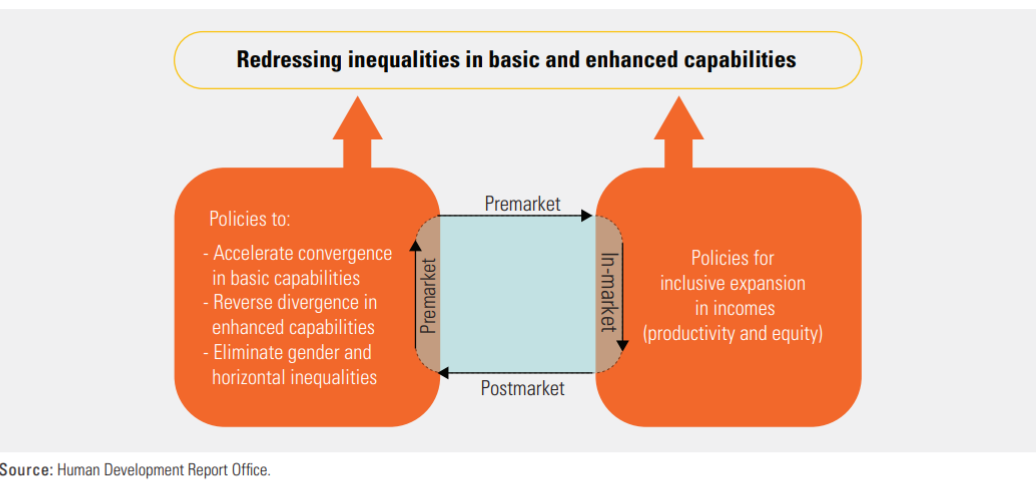
    Key message 5: We can redress inequalities if we act now, before imbalances in economic power are politically entrenched. The HDR 2019 proposes the following framework for designing policies to redress inequalities in Human Development:


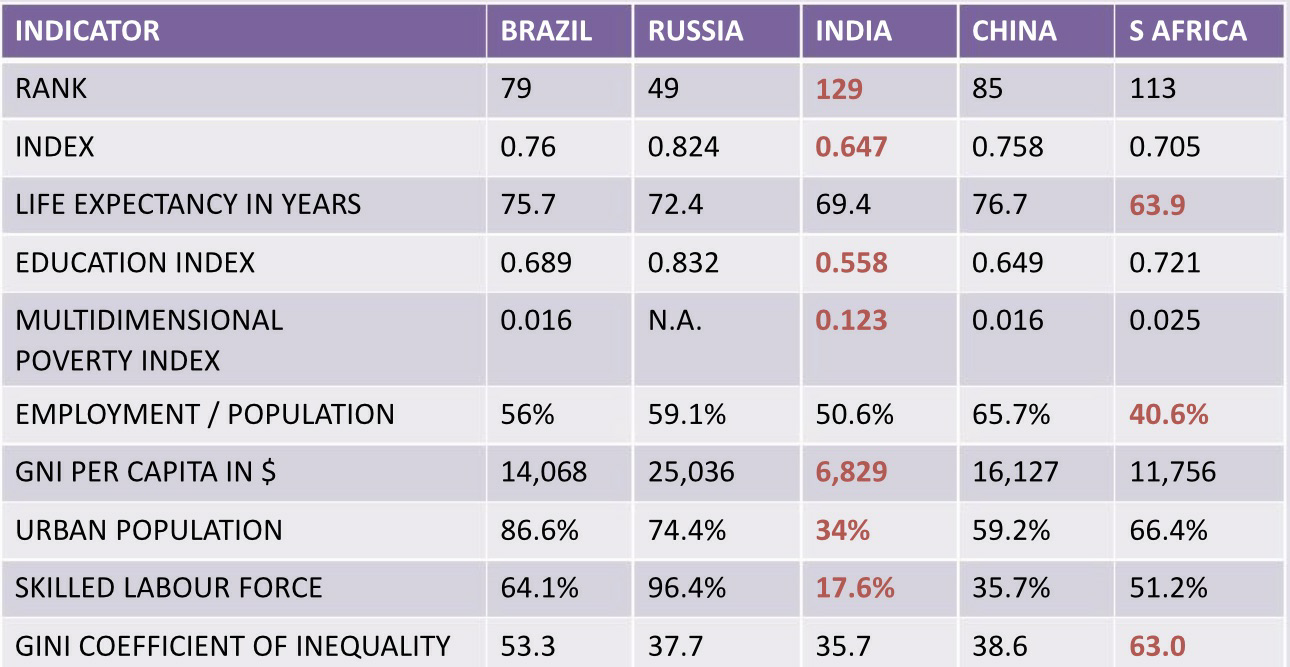
    In present-day India, every such report which doesn’t show the country in a very good light is either pooh-poohed as a leftist conspiracy, or everybody is consoled if India outperforms Pakistan. However, in my humble view, if our PM struts the stage at every meeting of the BRICS countries, why shouldn’t we compare our HDR parameters with these four instead?

    The results are indeed very illuminating, and I leave you to draw your own conclusions.