Development and Governance

Month: December 2018

  • Indian Urban Planning in limbo

    Clichés about Indian cities abound – the skyscrapers of the rich surrounded by the squalor of slums, the overcrowded public transport, the stray cows at the crossroads, the piles of garbage, the algae infested waterways, the polluted and unbreathable air… and successive governments have simply not had the time (because rural poverty required attention immediately after Independence) nor the inclination (because urban India has just 31% of the vote) to do anything about India’s dead and dying cities.

    To make matters worse, Indian urban planning has always been trapped in something of a time warp, still true to its British parentage, while countries like South Korea, Singapore and China have surged ahead and shown the world how millions of urban dwellers can live in cities that work, and are still people-friendly.

    Like all the laws governing Indian cities today, the planning laws too originated under British rule in the Bombay Town Planning Act of 1915, and it is quite understandable that the provisions of this law all hark back to ‘the green and pleasant land’ the law makers had left behind, and wished to recreate in India. Never mind that Britain had solved its population problems through forced and unforced emigrations to North America and the antipodes, while India’s population was still burgeoning!

    As a result, India was left tied to an outdated ‘low urban form’, strict zoning laws which militated against the poor, and development control rules (DCR) redolent of a past where the colonials lived in splendid bungalows, and the ‘natives’ lived in congested squalor. Remnants of this colonial past are still visible in the cantonment areas of cities like Pune, with crumbling bungalows (with empty stables!), huge tracts of vacant defence land, clubs (and even a racecourse!) occupying prime land in what could be the city’s Central Business District (CBD) if developed with an eye to the future instead of the past…

    Streamlining and modernizing land laws is crucial to any urban planning that Indian cities may indulge in, and integrated, culturally relevant, flexible and people-friendly urban planning allows for less costly provision of basic services such as water and sanitation, higher resilience, climate change mitigation and adaptation, poverty reduction and pro-poor policies.


    The cornerstone of current Indian urban planning is the Development Plan (DP), often described as the vision of the city, its physical configuration and growth in the foreseeable future, and the environmental considerations and technical solutions unique to the geography, history and social make-up of every city. It sets the agenda of what the city wants to do with itself in the next two to three decades. To make this vision a reality, the urban planner takes into account the various public requirements of the city and reserves lands, whether public or private, for those purposes. The plan also proposes conservation and preservation of areas that have natural, historical or architectural importance. The Development Plan also makes provisions for the city’s transportation and communication system such as roads, railways, airways and waterways, and parking facilities.

    The two instruments of a Development Plan are zoning, and reservation:

    • Zoning is the means whereby compatible land uses are grouped together, and incompatible uses segregated – such as manufacturing industry and residential areas.
    • Reservations for public purposes include schools, colleges and educational institutions, medical and public health facilities, markets, social welfare and cultural institutions, theatres and places of public entertainment, religious buildings, burial grounds and crematoria, government buildings, open spaces and playgrounds, natural reserves and sanctuaries, dairies, sites for public utilities such as water supply and sewerage, fire stations, other community sites, service industries and industrial estates.

    In order to successfully implement the Development Plan, the municipal body needs to be empowered and this is done through Development Control Rules (DCR). These rules deal with the manner in which building permission can be obtained, the general building requirements, and aspects of structural safety and services. Access, layouts, open spaces, area and height limitations, lifts, fire protection, exits and parking requirements are all stipulated in the DCR. Similarly, structural design, quality of material and workmanship, and inspections during construction are spelt out. The control of floor space use, tenement densities, and the Transfer of Development Rights (TDR) are some of the most crucial issues dealt with by these rules.

    Although Development Planning is the path to city development all across the world, the sad fact is that in most Indian cities, not even 10% of a DP gets actually implemented. In fact, while all the tedious processes of approval, amendment and land acquisition are going on, the citizens have built their houses and moved in, without waiting for the infrastructure promised in the DP. Once an area becomes inhabited, the best a municipal body can do is retrofitting the essentials like water supply and sewerage, at huge cost. In this way are our ‘planned’ cities unplanned.

    Urban Planning because of its control of that most precious commodity in an overcrowded country (land) is also susceptible to major subversion and scams. A well-documented case is that of the prime land tied up in Mumbai’s dead and dying textile mills, until the Supreme Court of India intervened to permit their brownfield redevelopment by the mill owners, with due reservations for public amenities and housing. The problem here arose from a little sleight of hand by vested interests. The Government of Maharashtra had introduced the Development Control Rules (DCR) in 1991, under which a mill owner was permitted to sell or redevelop his land, provided one-third was surrendered to the municipal corporation for public amenities and another third to the Maharashtra Housing and Area Development Authority (MHADA) for low-cost housing. The remaining third was the owner’s. Ten years later, it surreptitiously amended this clause to make it apply only to vacant land – as distinct from the entire footprint of the mill. As a result, the first mill which would have surrendered 5,641 sq m for open space and 4,616 sq m to MHADA, got away with forfeiting just 474 sq m and 388 sq m respectively. In the case of Modern Mills, the corresponding figures are 8,626 versus 1,163 sq m as open space, and 7,058 sq m versus nothing for housing. Even this open space is often subsumed within the redeveloped complexes (mill to mall) and is not public space, strictly speaking.

    This tendency to play fast and loose with planning laws and development control rules when it comes to big land owners in urban areas is deliberate, as it gives a lot of discretion to public officials and is the biggest source of corruption in local government. The ultimate losers, as always, are the unfortunate citizens of these cities, who keep getting pushed to the outer peripheries, as homes in the central areas have become simply unaffordable even for top earning professionals.

    Lastly, when the very raison d’être of great cities has been manufacturing, how can they survive de-industrialization? They don’t. While de-industrialization may hollow out a western city, in India, de-industrialization ‘leaves the world to darkness and to me…’ The stalwart of the informal sector, living a life of quiet misery and departing life unmourned and unlamented. How and when will India reinvent its Bombays and Madrases? Perhaps by renaming them yet again?


    According to UN Habitat, “…the city of the 21st century is one that transcends the form and functionality of previous models, balancing lower energy costs with a smaller ecological footprint, more compact form, and greater heterogeneity and functionality. This city safeguards against new risks and creates conditions for a higher provision of public goods, together with more creative spaces for imagination and social interaction.

    The city of the 21st century is one that:

    • Reduces disaster risks and vulnerabilities for all, including the poor, and builds resilience to any adverse forces of nature
    • Stimulates local job creation, promotes social diversity, maintains a sustainable environment and recognizes the importance of public spaces
    • Creates harmony between the five dimensions of prosperity and enhances the prospects for a better future
    • Comes with a change of pace, profile and urban functions and provides the social, political and economic conditions of prosperity…”
  • World Development Report 2019: The Changing Nature of Work

    It had to happen I suppose. After the World Development Report 2018 on Learning to Realize Education’s Promise, it was only to be expected that the World Development Report 2019 would look at the Changing Nature of Work.

    Last year, the President of the World Bank Group, Jim Yong Kim reminded us how education helped his country to rise from the ashes of war: “Today, not only has [South] Korea achieved universal literacy, but its students also perform at the highest levels in international learning assessments. It’s a high-income country and a model of successful economic development.” This year he reminds us that “investing in Human Capital is not just a concern of ministers of health and education; it should also be a top priority for heads of state and ministers of finance.” Simple economics indeed!

    The Report points out that the nature of work is changing in several ways:

    1. Digital technology is gradually replacing the traditional input-output production process, with the global platform marketplace which brings together producers, providers and customers in a multi-sided model
    2. The skill set required of workers today is shifting from manual skills to socio-behavioural, which require higher cognitive skills and greater adaptability
    3. There is a global shift from manufacturing to services, which again requires a differently skilled workforce and only those countries which have invested heavily in human capital (like Singapore and South Korea) have used this opportunity to move from developing to developed country status
    4. South Asia, on the other hand, has again missed the boat in this regard, and the result has been the unrelenting informalization of their economies, with a concomitant poor quality of life for their citizens

    The Report suggests areas in which governments need to act promptly, to ensure that they are not left behind by the rest of the world, often frittering away their demographic dividends:

    • Investment in human capital, particularly early childhood education, to develop high-order cognitive and socio-behavioral skills in addition to foundational skills.
    • Enhanced social protection. A solid guaranteed social minimum and strengthened social insurance, complemented by reforms in labor market rules in some emerging economies, would achieve this goal.
    • More fiscal space for public financing of human capital development and social protection.

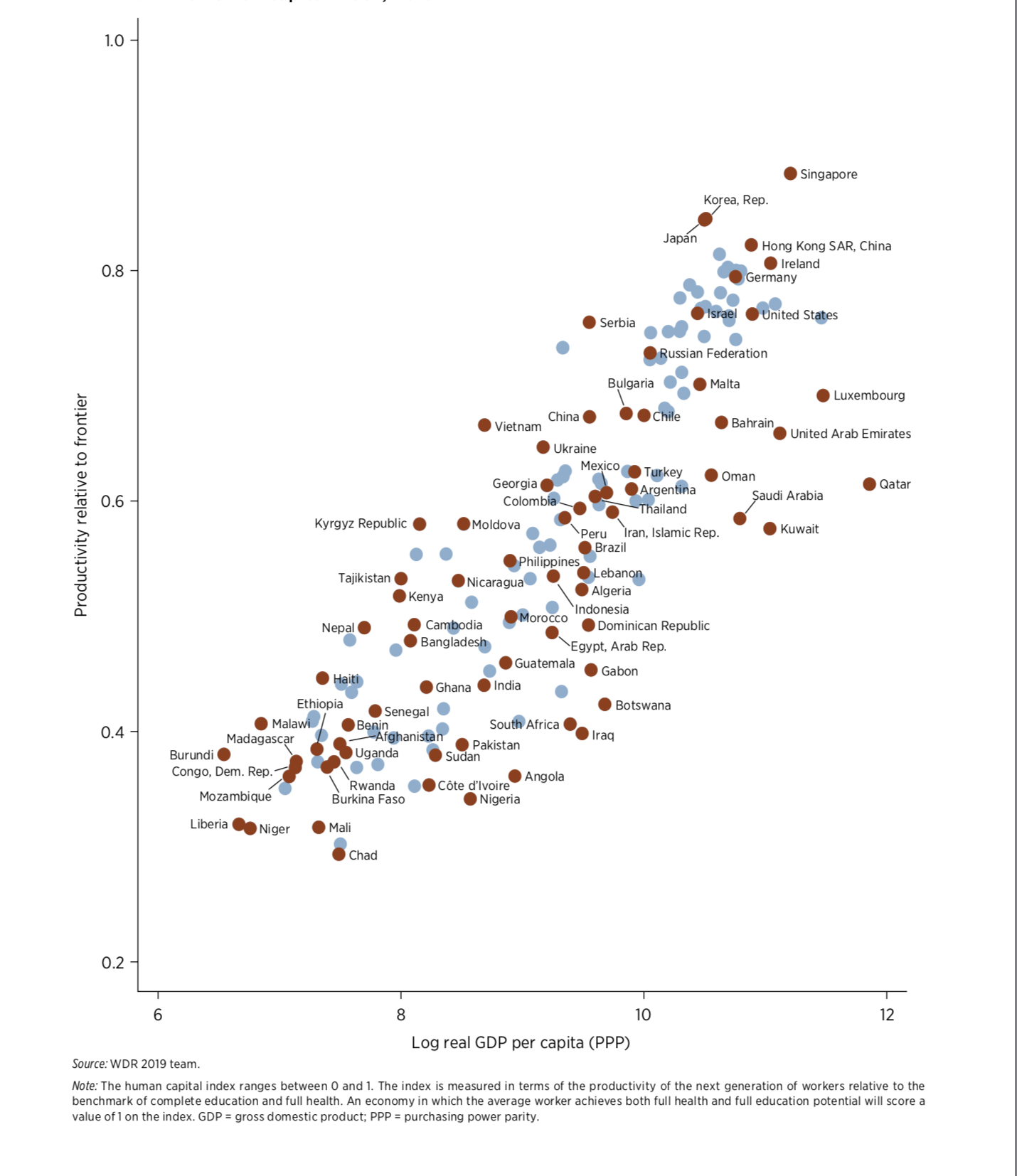
    To back up its argument, the Report presents its first Human Capital Index for ranking its member nations. The index follows the trajectory from birth to adulthood of a child born in a given year, and quantifies the milestones in this trajectory in terms of their consequences for the productivity of the next generation of workers.

    It has three components:

    1. a measure of whether children survive from birth to school age (age 5)
    2. a measure of expected years of quality-adjusted school which combines information on the quantity and quality of education
    3. two broad measures of health—stunting rates and adult survival rates.

    The HCI calculated for nations is graphically presented as below:

    The World Bank’s Human Capital Index has really set the cat among the pigeons, by calling to account governments like the present one in India, which only chase growth in GDP at the cost of long-term human development of future generations. The Indian Government has cried foul about the data used in this Index, but statistical hassles notwithstanding, it is very clear that the present government has grossly neglected the human, social and environmental aspects of development in favour of physical infrastructure alone. And as we know, sustainable livelihoods can be provided only when ALL five types of capital are amply provided and balanced – human, social, natural, physical and financial. 

    No wonder then, it may well be the issue of livelihoods in both urban and rural areas which may see drastic political changes across India in the coming days and months…


  • Looming Water Crisis in Indian Cities

     (Original posted December 2018)

    While the pollution of cities like New Delhi grabs world headlines, with the Supreme Court threatening to ban all private vehicles in the national capital, there is little public and media interest in another looming catastrophe for all Indian cities – the deteriorating water supply.

    India’s water consumption is projected to touch 843 billion cubic meters (bcm) by 2025 against the current availability of 695 bcm. By 2050, the country will need 1,180 bcm of water, and at the same time groundwater is being depleted at unsustainable rates. These are the conclusions of a new report by the Niti Aayog (formerly the Planning Commission), and its author, Avinash Mishra, goes on: “We’re in dire straits and we need to change our approach to tackle the crisis, otherwise the situation will become so grim that the shortages will knock down our GDP by 6 percentage points in over a decade.”

    The water situation has worsened gradually over the years and is rooted (as most of India’s problems are) in too much politics, and too little governance.

    The problems begin with sourcing of water for big cities like Chennai, Mumbai and Delhi. At the institutional level, urban local bodies do not have control of the source which is either with the Irrigation Department or parastatals, whose first priority is, naturally, agriculture.

    Secondly, the groundwater of a city remains largely in private hands and is tantamount to theft, as the aquifers supplying water to private wells are a common natural resource for everyone. The Groundwater Surveys and Development Agency (GSDA) of the State Government has identified 4,500 wells in a major city like Pune, but only 200 borewells are registered with the Pune Municipal Corporation (PMC). The result of this discrepancy has been the growth of a tanker mafia, with the average citizen at its mercy for his/her daily water supply. Again, only 150 water tanker suppliers are registered with the Corporation, while hundreds more operate below the radar – often tapping the PMC’s own supplies illegally, to sell at a premium to the hapless citizen.

    The ‘Dynamic Ground Water Resources of India’, a report published by the Central Ground Water Board, defines the stage of development of groundwater as the percentage of utilisation of groundwater with respect to recharge. The chart below shows the extreme overutilization of groundwater in major Indian cities:

    Groundwater in Major Indian CitiesMeanwhile, unchecked extraction by urban farmers and wealthy residents has caused groundwater levels to plunge to record lows, and the 21 major cities shown above, are expected to run out of groundwater by 2020, affecting 100 million people.

    To make matters worse, an estimated 70% of India’s water is contaminated with arsenic, fluoride, salinity, nitrates, industrial effluents, organic and inorganic solid waste. Further, only one-third of its wastewater is currently treated, meaning raw sewage flows into rivers, lakes and ponds – and eventually gets into the groundwater.

    A municipal corporation’s woes though, are only just beginning – having made this low-quality water drinkable at great cost in terms of treating agents and electric power for purification, it must further spend millions to distribute the treated water through an antiquated distribution network, losing further through illegal tapping and leakages in the system – often as high as 40%. The heavy physical losses, low pressure and intermittent supplies, lead to back siphoning and further contamination of water in the distribution network.

    Of course, the consumer at the other end is never happy with the result, curses the Corporation for not providing water 24×7, and will take to the street to protest even a paltry hike in his monthly bill. Water, it is argued, is a ‘gift of nature’ and should be free. In reality, the heavy subsidy on drinking water is the main reason for the impoverishment of municipal bodies the world over. The Pune Municipal Corporation, for instance, spends Rs 11 to provide 1000 litres of water, and recovers only Rs 5 – a subsidy of Rs 6 for every thousand litres, multiplied a thousand-fold, takes a heavy toll of its inadequate resources.

    The financial situation of municipal bodies was not helped by replacing buoyant local taxes and levies (like Octroi) with grants from the Central kitty, routed and delayed by the State Government. It is estimated that although the Centre will compensate cites like Mumbai on par with their last receipts when Octroi was replaced by a consolidated Goods and Services Tax (GST), the loss to the Municipal Corporation in terms of the buoyancy and immediacy built into Octroi, could mean anywhere between 10-15% loss of revenue.

    The problem arising from the complexity of the institutional arrangements, the machinations of the informal water sector, and the huge imbalance between revenue and expenditure, all make urban water supply a city manager’s worst nightmare.

    However, all is not lost – municipal bodies themselves can do a lot to improve operational efficiency in the sourcing and supply of water to their citizens. An effective, professional and dedicated workforce will go a long way in preventing the massive losses through illegal connections and leakages. Most municipal bodies have water supply departments which are grossly understaffed, and this increases their dependence upon private contractors whom it can neither monitor, control nor regulate. This adds greatly to the inefficiency of the city’s water supply as a whole.

    Municipal Corporations must also stem the leakage losses due to the corruption amid its own staff, whereby private contractors will fit a broad-gauge supply line to a particular building or locality, while it is shown at half that gauge in the municipal records.

    Demand side management of costing and pricing of water also needs to be modernized, learning from good practices across the world. Currently, most Indian cities have only a fraction of their connections metered, but the bulk of their non-commercial users pay a lump sum as part of their annual Property Tax – and this has no relation whatsoever, to the actual quantity of water used in a year by that property owner. As the poor are limited in the amount of water they can store, the greatest beneficiaries of the subsidy are the middle class, who may indiscriminately use the expensively provided water for drinking, bathing, flushing their toilets, or washing their cars. While a more discriminatory pricing system like the Increasing Block Tariff or IBT will ensure that the available subsidies go to the deserving, the conservation of water through rainwater harvesting and recycling schemes could also be incentivized through a system of rebates on tariff.


    Sadly, one thing is clear – just like climate change and air pollution, dwindling water supplies must be tackled by all countries on a war footing. There simply aren’t enough tomorrows left with the human race…

  • Quality of Life in a Global and Indian Context

    (Published in 2018, and still relevant.)

    Quality of Life is being increasingly discussed in India – the older generation laments its passing and TV Gurus propose that we use it to measure the Government’s performance before the next election. Then again, there are sporadic reports from foreign agencies ranking Indian cities globally at 116, or 126, or whatever. And we shake our heads in sorrow. But have you ever wondered how ‘quality’ of life can be measured with such accuracy in ‘quantities’? And who exactly is measuring it and why?

    The whole QOL craze is a product of our increasingly interconnected global economy. Multinationals needed an easy base number to calculate the salaries of expatriate workers and an index was needed to work out the costs of children’s education, medical care, and ‘hardship’ allowances for conveniences unavailable in a foreign posting.

    The best known of these indices is the Mercer Index for Quality of Life. It evaluates local living conditions in more than 450 cities according to 39 factors, grouped in 10 categories: political and social environment, economic environment, cultural environment, medical and health considerations, schools and education, public services and transportation, recreation, consumer goods availability, rental housing including household appliances, furniture and maintenance services, and lastly, natural environment/climate and record of natural disasters.

    QOL Determinants

    As expected, the prime cities of over-resourced and underpopulated Western Europe, Australia or Canada take the top spots. Interestingly, if we list the best 20 cities on the Mercer Index and compare them with the 20 most populous cities, we will find that not one city from the second list figures in the first. So, one can safely conclude that as a city grows in size, beyond its carrying capacity, the first casualty will always be the quality of life of its citizens.

    Does this mean that the world’s largest urban agglomerations are doomed to linger in the nether regions of such scales year after year – with their citizens forever deprived of a decent quality of life? I don’t think so.

    Instead of constantly validating our happiness by western criteria, why can’t Indian (and Asian) cities set their own standards for judging Quality of Life? These would be firmly anchored in each country’s social, cultural and political realities and would resonate well with the people, besides comparing one city with another on the true quality of life; not just the level of services available.


    To work out an Indian QOL Index, the following questions need to be asked. These can be answered using our own urban experience and data locally available with various government agencies, parastatals, professional bodies and NGOs. (Note: These can readily be adapted for other countries too, taking local socio-political factors into account.)

    Political and Social Environment

    • Do women feel safe living by themselves and traveling at all hours across the city?
    • What is the city’s performance in Centrally-sponsored programmes for the poor – in terms of livelihoods, self-help groups and subsidized housing?
    • What is the Police record in tackling crime and maintaining Law and Order in the city?
    • Are there mohalla (community) committees to defuse a potential conflict before violence breaks out?
    • How active is the voluntary sector in the city?
    • How successful are public awareness and sensitization campaigns on various social issues?

    Economic Environment

    • What is the city’s contribution to the Central and State exchequer in terms of various direct and indirect taxes?
    • What is the access and availability of banking and financial services in the city?
    • Are there Special Economic Zones, IT Parks and other facilities, earmarked for industries and services?
    • Does the city have a domestic/international airport, a railway junction/station?
    • How well is the city connected to national and international e-retail networks?
    • What are the rents per square foot for commercial premises in the city’s CBD?
    • How many businesses in the city are registered under the Shop and Establishments Act?
    • How efficient are the public utilities like power and broadband connectivity?
    • What is the standard of municipal services in the areas of public transport, water supply, sanitation, solid waste management, etc?

    Housing and related issues

    • What percentage of the city’s economy and housing are in the informal sector?
    • How many notified slums does the city have?
    • What is the average monthly rent for a 1000 sq ft apartment?
    • What are the average monthly maintenance charges in a cooperative society?
    • What percentage of the city’s housing is owner-occupied?

    Schools and Education

    • Is the number of schools adequate for 100% coverage of the school going population?
    • What is the average student to teacher ratio in the city schools?
    • Do municipal and ZP schools offer children the same learning opportunities as private schools?
    • What is the availability and affordability of institutions of higher learning? Are they equally accessible to locals as to outsiders?

    Health and Sanitation

    • How does the Public Health machinery respond to a crisis, epidemic or disaster?
    • Is Primary Health Care (PHC) available and accessible in every corner of the city?
    • What is the city’s doctor to patient ratio?
    • What is the city’s hospital bed to patient ratio?
    • How many specialist medical and diagnostic services are available in the city’s hospitals?
    • How many 24-hour pharmacies does the city have?
    • What is the city’s record in mass immunization campaigns?
    • What percentage of the city’s housing is connected to the main sewage line?
    • How many public toilets does the city have per 1000 users?

    Natural Environment

    • Is there a city policy on monitoring and limiting air, noise and water pollution?
    • What are the average annual pollution levels for the city as a whole?
    • Are the public spaces and green cover available in the city adequate for its population?
    • Is the water supply in the city adequate per WHO norms? How much is actually supplied per day per capita?

    Cultural Environment

    • Does the city government finance, subsidize and encourage cultural activities?
    • Does the city organize annual festivals of Literature, Art, Music, Drama?
    • How many Libraries, Art Galleries, Drama theatres, Cinema theatres and multiplexes does the city have?
    • Are there local handicrafts and artisan groups? Does the city provide them subsidized business support?

    And so on…

    Such an Index will not only be meaningful to Indians, but will also facilitate policy formulation at the city level, and allow cities to compete with one another to offer a better quality of life to all their citizens.