The maiden edition of UN Habitat’s World Cities Report (WCR 2016) reviews the changing face of urbanization in the last 20 years, covering the period when the global urban population hit the critical 50% mark, and our world was forever changed.
It identifies and discusses the following key issues or challenges before our cities, citizens and local and federal governments:
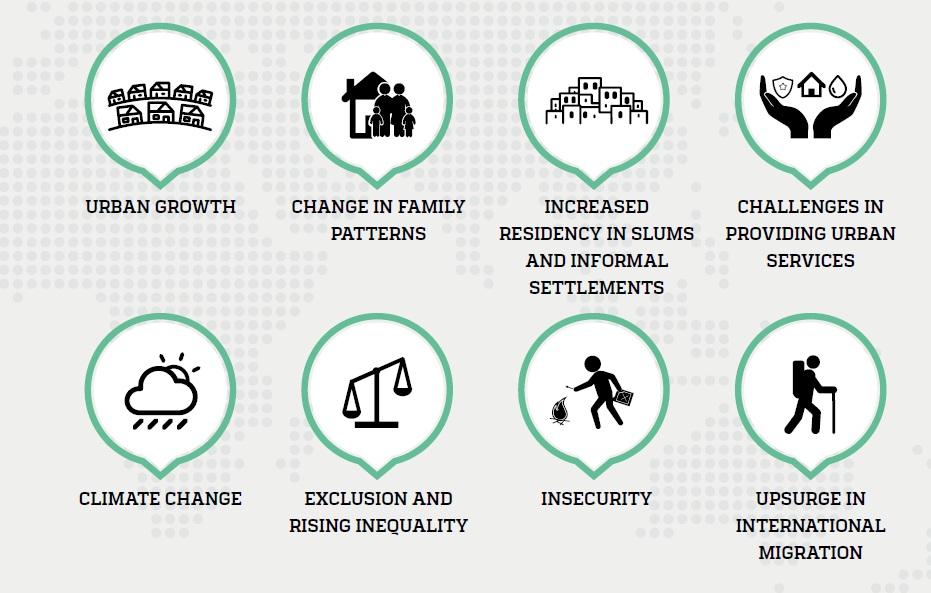
Of particular interest to countries like India is the section on Slums and Informal Settlements. UN-Habitat defines slums as “… a contiguous settlement that lacks one or more of the following five conditions: access to clean water, access to improved sanitation, sufficient living area that is not overcrowded, durable housing and secure tenure.” The WCR 2016 clearly avers that “…slums are the products of failed policies, poor governance, corruption, inappropriate regulation, dysfunctional land markets, unresponsive financial systems, and a lack of political will.”
And what is apparently true of the world, is true of India as well. In spades.
The WCR 2016 draws a dismal picture of government efforts to address the problem of informal settlements, across the world:
- Over the last 20 years, housing has not been central to national and international development agendas, and urban land management and administration have suffered as a result
- The housing policies put in place through the enabling approach have failed to promote adequate and affordable housing
- Inequality, focus on homeownership, speculation and neglect of rental housing have gone on unchecked
- Most involvement by governments has focused on helping the middle class to achieve home-ownership in a formal sector that only they can afford
- The dependence on the private sector to provide housing has steadily increased across the world
The Report suggests the following policy initiatives at all tiers of government, to address the issue of adequate and affordable housing:
- If the emerging future of cities is to be sustainable, a new approach that places housing at the centre of urban policies is required, to re-establish the important role of housing in achieving sustainable urbanization
- At the national level, the goal is to integrate housing into national urban policies
- At the local level, the importance of housing must be reinforced within appropriate regulatory frameworks, urban planning and finance, and as part of the development of cities and people.
Nobody in India is paying the least attention, as housing subsidies for the poor are rapidly replaced by ‘subsidized housing loans’ and initiatives like Smart Cities run into local resistance, because they are seen as a means of further enrichment of multinational IT firms, by raising local tariffs and taxes. RIP!
And as the Government of India jettisons all rights-based approaches in the social sector, the situation in the country’s slums will only get worse. Urban land transactions have bred land and construction mafias, which have totally penetrated and undermined local governments; engendered corruption on an unimaginable scale in State and Central Governments; and transferred huge tracts of public lands into private hands through the back door – in the name of the poor. Where else but in Mumbai can a rich man buy a 5 bedroom penthouse, signing 4 different contracts with the developer for 4 ‘lower income’ flats ‘merged’ into one while the government authorities conveniently looked the other way? And even the beleaguered and heavily indebted middle class must turn its hard earned ‘white’ money into ‘black’ to appease the property developer who demands part of the price of a house in this form, to avoid paying taxes. None of the successive governments of various ideological hues has done anything to address these woes, and none will, because the builders’ lobby is simply too strong and influential.
So it goes in various guises across the world, as the global housing shortage is expected to hit a billion by 2025…

 Development and Governance