(Written in February 2015, long before the Russian SMO in Ukraine, and reposted because these issues are still relevant and largely remain unaddressed by the Indian Government.)
An article I read on the ICH really shook me up, as it spoke about the real purpose behind the Ukraine coup and subsequent conflict – capturing the ‘granary’ of Europe, so that its lucrative agro-industries could be corporatized by western MNCs. And here we were naively assuming that wars were essentially fought over petrol and gas in the 21st Century!
This article resonated with me particularly, as India is currently in the throes of a great debate between corporate promoters of infrastructure development, and protectors of those who make a living from the land which will be needed to develop this infrastructure – the millions of small and marginal farmers across the country.
The occasion is the introduction in Parliament of the Bill amending the Right to Fair Compensation and Transparency in Land Acquisition, Rehabilitation and Resettlement Act, 2013 in such a way, that the social impact analysis and consent elements (which gave a voice to land owners) have been greatly undermined.
So it boils down to the age-old rural-urban conflict, and how to allocate scarce resources like land in an equitable and just manner for the overall development of the nation.
However, it is my personal view as a mere citizen that this is a false dichotomy. Greater efficiency in urban land use; and higher productivity on agricultural land are both achievable with a little forethought and planning, and can mitigate a lot of this false conflict.
Let us look at urban land use first: Despite only 31% urbanization, India has the second largest urban population after China, and the differences in the Indian and Chinese approaches to urbanization have been amply covered in my earlier posts. (China and India: Two roads diverged… and China and India: Our cities, their cities)
Essentially, I make a case for better land management, empowering of local urban government, and the densification of Indian cities to make them more efficient and citizen-friendly.
Now look at the rural/agricultural scenario in these two countries, and one key indicator i.e. cereal production in kg/hectare:
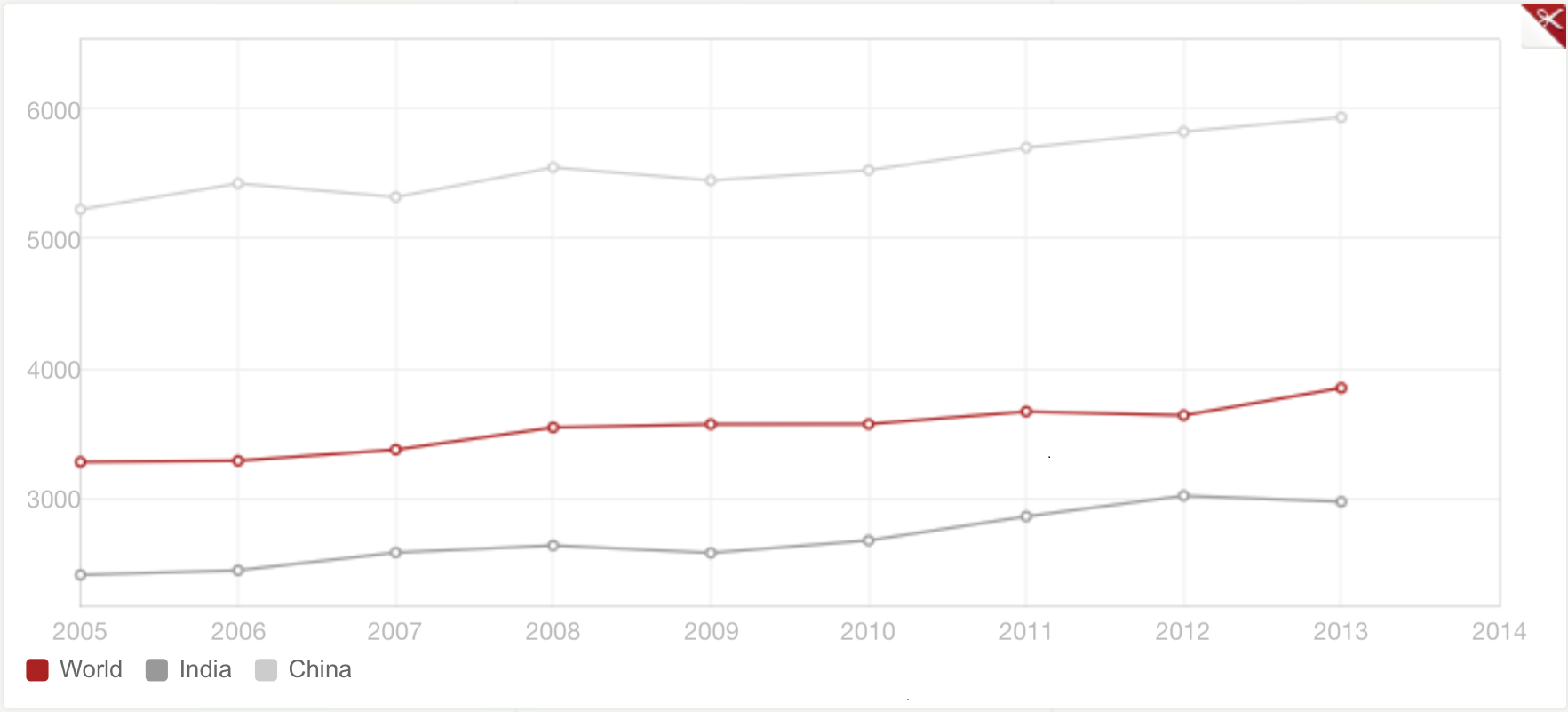
(Source: World Bank)
Again, while Indian cereal production has remained consistently below the world average, China manages almost twice that. No wonder that 2013 estimates of the Indian economy put industry at 25.8%, the services sector at 56.9%, and agriculture at merely 17.4% of GDP.
Slow agricultural growth (and not smart cities) should be the top priority of any Indian Government, as two thirds of India’s population depends on rural employment for a living. Ministers should be considering why current agricultural practices are neither economically nor environmentally sustainable, and why India’s yields for many agricultural commodities are consistently low.
There are several reasons cited for this:
- Firstly, acts of omission and commission by past governments (which a government promising ‘development’ and ‘good governance’ should be able to address, but won’t), like poorly maintained irrigation systems; absence of good extension services which facilitate the transfer of technology from the lab to the farm; poor roads; rudimentary market infrastructure; slow progress in implementing land reforms; inadequate or inefficient finance and marketing services for farm produce; and excessive regulation.
- Secondly, the endemic poverty, illiteracy, general socio-economic backwardness of the Indian countryside. But as the current government has little time for advocates of human development like Dr Amartya Sen, I don’t see much hope there either…
So constrained by its corporate backers, does this Government really have the will to do something for India’s farmers? They could start off by taking a leaf out of China’s book and pool agriculture land for economies of scale – maybe not as communes or collectives, but as cooperatives, which have proved so successful for sugarcane plantation in Maharashtra.
Then there are alternatives to capital-intensive and heavy fertilizer dependent agriculture, which has only left behind a sad trail of rural indebtedness, despair and farmer suicides. Holistic farming systems which utilise locally appropriate knowledge, native wisdom, and local labour can successfully tertiarize rural economies and create significantly higher employment opportunities in the rural sector, thereby halting and reversing migration from rural to urban areas.
Empowering farmers to ensure their own food and livelihood security through holistic farming systems, and through dispersed small industry based on agricultural produce, seems to be the only way forward.
Sadly, instead of supporting small and marginal farmers through adequate budgetary allocations, the Central and State Governments have been expropriating their land for industrial corridors, townships and SEZs with huge incentives to their promoters, which eventually come out of the taxpayers’ pockets.
It is rumoured that the proposed new capital for the state of Andhra Pradesh will be initially acquiring 30,000 acres of fertile, food-producing land – surely an extravagance India can ill afford.
And the shiny new buildings there will produce a lot of food for thought perhaps, but none for the belly…


 Development and Governance