Development and Governance

Month: June 2015

  • Growing fragility of Indian Society

    No sentient human being on this planet can ignore the increasing fragility of the human condition across the world today – civil wars, burgeoning arms industries, natural calamities, epidemics, inter-communal and intra-communal violence, the destruction of viable nation-states in an unending battle for the control of natural resources, and so on and so on…

    And sure enough, we now have a Fragile States Index with facts and figures to give frightening substance to these events. Brought out annually by a Washington-based non-profit, the Fragile States Index has this to show in its latest report:
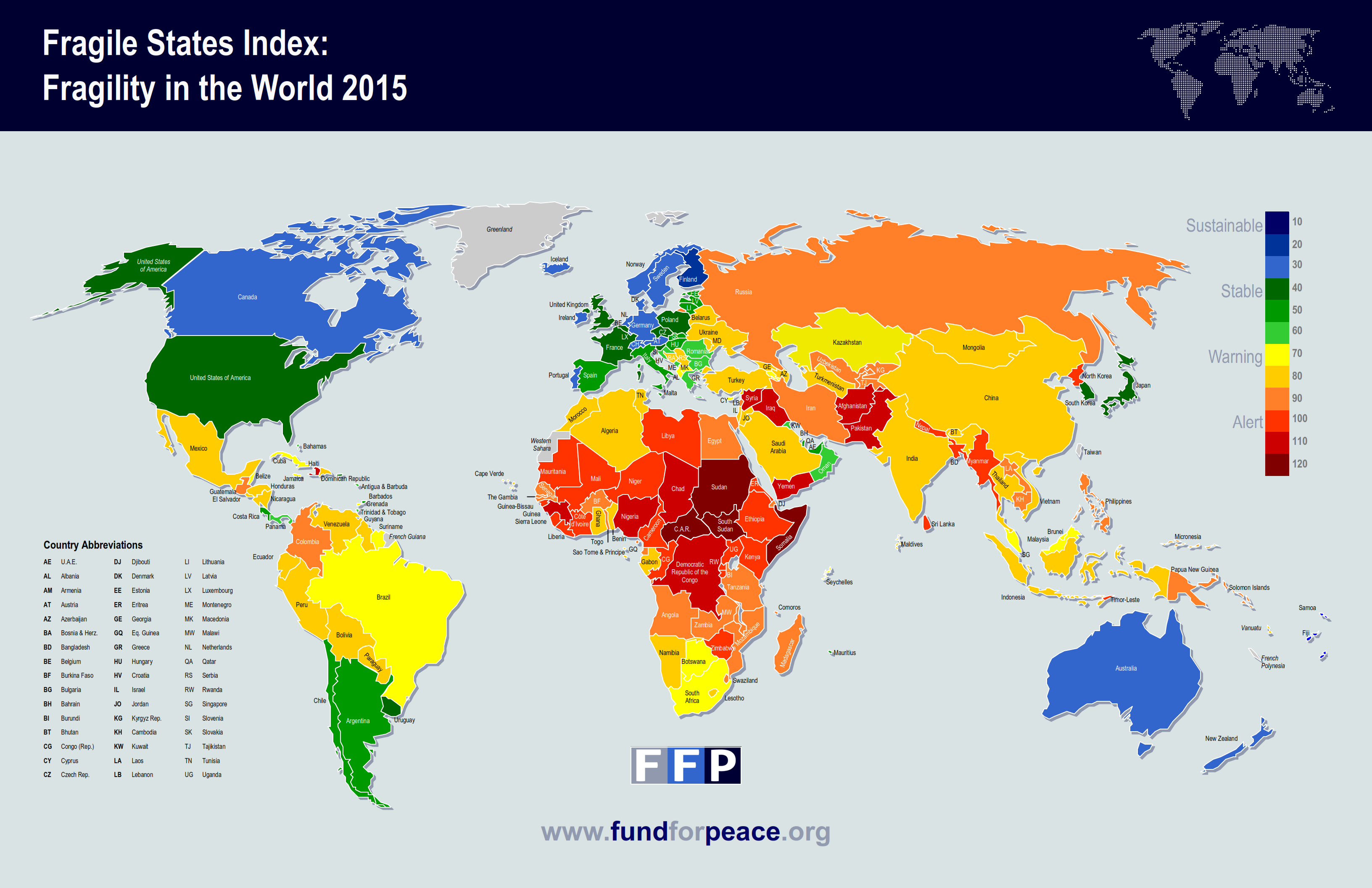
    Fragile State Index Map 2015

    And at 79.4, there sits India on the cusp of a High Warning Status.

    While the country is thankfully NOT in a state of war, the high score is all the more disturbing because it reflects the deepening fault lines in its social fabric, as measured in the socio-economic aspects of the Index – especially relevant to India being the Demographic Pressures, Uneven Economic Development, Group Grievance, and Poverty:

    World Fragility Index social factors

    Several recent events have thrown into sharp relief the growing disparities in every aspect of life in India. And the worst discrimination is that practised by the mainstream media in their overkill coverage of issues that impact the haves, the privileged and the entitled classes; while totally ignoring or cursorily dismissing those issues which affect the vast numbers of the permanently disadvantaged – the poor, the disempowered and the disenfranchised.

    Under pressure from industry which thrives on the cheap overheads of the urban informal sector, the government is proposing to amend the Child Labour Act of 1986, relaxing the ban on children working in family-owned occupations, which is sure to lead to much more exploitation and abuse than India is shamed with today. Instead of widespread discussion to ascertain the views of working children, what we get on the mainstream media is endless discussion on the possibility of excessive lead in noodles manufactured by a multinational, and consumed mainly by the urban haves and their children as a lifestyle choice, and not as a necessity for survival!

    Similarly, the fact that the present government has ruthlessly cut social welfare expenditure in its very first year has also gone unnoticed by the mainstream media. Instead, there is great publicity for 3 contributory schemes targeted at the poor, which totally miss the point that you have to first assure regular incomes, so that the potential beneficiaries can pay the premium on these insurance schemes, isn’t it? The only beneficiaries of these schemes are the fat cat insurance companies, who have already found a very lucrative market in the private medical insurance being offered in India. How hurtful it is that a noted hospital can offer different ‘packages’ for radiation therapy to cancer patients, with the top package available to the well-heeled and the well-insured. When asked what the difference was, one is told that there was more regular monitoring by CT scans for the higher packages, and also more care in mitigation of side-effects of radiation therapy. The sheer cold-bloodedness of such a commercial approach takes one’s breath away!

    Yet again, the ‘manufactured’ aspect of communal riots such as the recent one in Haryana are not commented upon, nor is the fact that at the heart of the trouble is a piece of disputed land. According to one writer, what is noticeable is the total absence of remorse among the perpetrators, and the deliberate targeting of the relatively wealthy members of the victim community, who had their homes and worldly possessions like washing machines and fans systematically destroyed! Very reminiscent of what goes on in the Palestinian Occupied Territories, isn’t it?

    And amid all the talk of building new smart cities, what happens to that terminally ill queen of Indian cities – Mumbai? The first spell of heavy monsoon rain, and the infrastructure and services come crashing down, as though no lessons were learnt from the calamitous floods of nine years ago…

    Meanwhile, the intermittent tit-for-tat violence continues in the Indian North-East, with NO attempt to address the festering grievances of that region.


    The deepening of these fault lines along caste, class, region, ethnicity and community have become so aggravated in recent months, that Indian society as a whole has become more fragile, more unpredictable, more liable to implosions and violence… and I dread to think where India will find itself in the Fragile States Index in 2016.

    This is the first and most frightening consequence of pursuing economic growth at all costs – human and environmental.

  • Part II: Why poor people remain poor

    Posted originality on 4 June 2015.

    As I have devoted a couple of posts already to the distress among farmers and rural communities in India, I think it is time to take a look at the growing urbanisation of poverty in the country.

    In developing countries like India, most urban workers are self-employed in precarious conditions or are employed on a casual basis without a contract and access to social security. The ILO terms such forms of employment as informal. In most cases, informal employment procures lower, more volatile pay and worse working conditions than employment in formal arrangements, and these informal sectors form the bulk of the urban poor in any country.

    The situation has greatly worsened with globalisation, which has deeply fragmented production processes, labour markets, political entities and societies, creating a plethora of interest groups and lobbies which have undermined the integrity of civil society and its rights and entitlements across the world. As a result, the number of permanent secure jobs (even in the formal sector) have given way to contractual/temporary employment, with downsizing, rightsizing and outsourcing becoming the new business mantras. This infographic from Statista puts it very plainly.


    JOBS Post

    Sadly, recent Indian governments seeking their place in a global market are so keen to attract foreign direct investment, that they have lost the national sovereignty to make decisions that benefit their own people, and surrendered control to highly mobile international finance capital. To placate these foreign investors we have begun the privatisation of precious natural resources and shredded whatever pro-labour legislation existed in India, and virtually annihilated Trade Unions in a way that would make Margaret Thatcher proud. But whereas Great Britain had a social security system already in place (in terms of unemployment benefits, old age pensions, compulsory education for the children and free health care), low and lower middle income countries have no such security net for those in distress.

    Ergo, once a household falls to the poverty line, it is very unlikely to rise much above it – and therefore the poor remain poor generation after generation.

    The vulnerability of the urban poor is exacerbated by the inadequate provision of basic public services, as well as by policy and regulatory frameworks that govern land and housing supply and property rights.

    Most of the urban poor do not have tenure security because their dwellings are built on public land or on private property belonging to someone else, or built on shared title land. Further, most dwellings of the poor are constructed without occupancy or construction permits from the municipal authority, or rented in slums without formal renting contracts.

    The situation is exacerbated by the inadequacy of planning tools like master planning, zoning and development regulations, in making land available to keep pace with rapid urbanisation, resulting in insufficient land supply and increases in land prices. Master plans in many developing countries like India are too centralised, take too long to prepare, are inherently anti-poor, and fail to address implementation issues or the linkages between spatial and financial planning.

    The Development Control Rules too are outdated and inappropriate, often opting for low form urbanisation, redolent of the colonial era. All recent attempts at densification have remained a pipe dream, because it is virtually impossible to upgrade the necessary infrastructure in thickly populated neighbourhoods. Unrealistically high standards for subdivision, project infrastructure, and construction make it impossible to build low-income housing legally, and the poor simply cannot afford to build to these specifications. Furthermore, the poor and low income groups have little or no access to credit, again because of the lack of a representational system to formalise their assets and holdings.

    Some of the ways in which the problem of housing for the urban poor has been tackled in different countries include:

    • Some form of transfer of ownership rights to the residents building upon public land
    • Greater flexibility in building specifications, construction materials and infrastructure norms
    • Decentralisation of urban planning
    • Simplification of building permissions and occupancy certification
    • Easier access to housing finance for the poor
    • And a simple transparent system of ownership title which will enable the poor to use their houses as collateral for loans to expand their income generation capability

    The lack of adequate and secure housing ultimately aggravates all other dimensions of urban poverty like education, health and income. If a family has no rights of tenure and may not even know where it will rest the night, how are the children going to register in schools and get an education? How will the parents earn a livelihood? How will the family draw the rations from the Public Distribution System to feed itself? And where will the sick find succour?

    As the National Commission on Urbanisation lamented in its 1988 report: “For the poor, there is simply nothing…”